
A robot in a warehouse can already move bins from one station to another. A robot arm in a laboratory can repeat a pipetting routine with remarkable consistency. Yet ask either machine to “put the damaged package aside, then bring me the unopened blue box,” and the task suddenly becomes much harder.
The difficulty is not just grasping. The robot must connect words such as damaged, aside, and blue to what its cameras see, decide what sequence makes sense, and turn that decision into safe motion. People perform this chain almost automatically because we combine perception, language, prior knowledge, and physical experience.
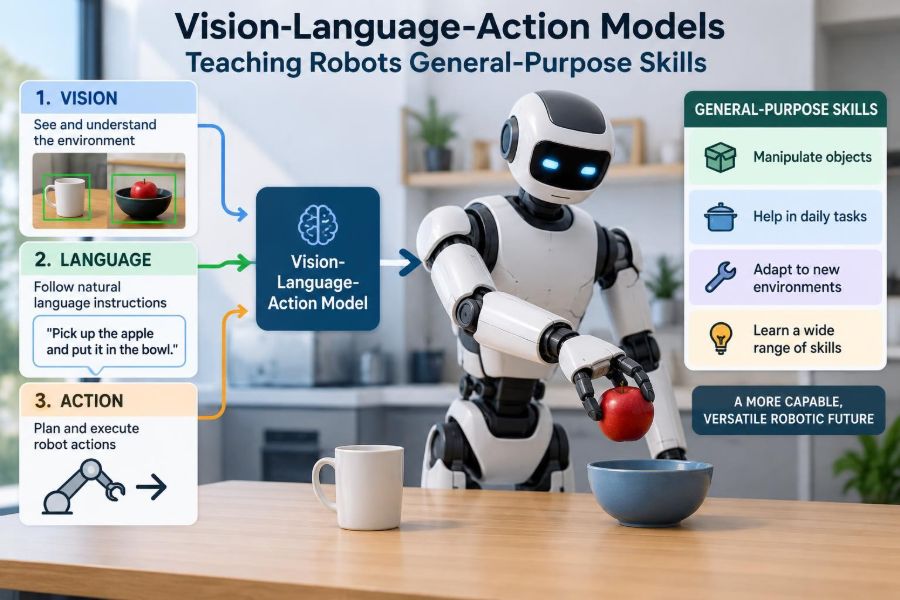
Vision-language-action models, usually shortened to VLA models, are an emerging approach to giving robots more of that integrated capability. Rather than building a separate rule or narrowly trained controller for every new instruction, researchers are exploring models that can interpret images and language together, then produce robot actions.
This does not mean robots have suddenly become universal household helpers. It does mean robotics is moving toward systems that can reuse knowledge across tasks more effectively—and that shift matters to students, engineers, technicians, and anyone designing human-robot workflows.
🧭 The gap between a capable machine and a useful assistant
Traditional robots excel when their environment, objects, and steps are tightly controlled. A factory cell may use fixed fixtures, known part positions, and a carefully programmed sequence. This is often exactly the right engineering choice.
Human environments are less cooperative. Boxes arrive in different orientations, tools are moved, instructions vary in wording, and unusual cases appear without warning. A general-purpose robot must cope with this variation rather than treating every deviation as a fault.
VLA models aim at that gap: enabling a robot to map a broad instruction and a current visual scene to an appropriate next action.
👁️ What “vision-language-action” means
The name describes three information streams joined in one decision-making system. Vision provides observations from cameras or other sensors. Language conveys goals, constraints, questions, or corrections. Action is the robot’s physical output, such as a gripper movement, mobile-base command, or arm trajectory.
A VLA model is not necessarily the only software in a robot. It commonly sits within a larger stack containing motion planning, collision checking, low-level motor control, safety monitoring, and sensor processing.
Its distinctive role is to make the high-level connection: given what I see and what I was asked, what should I do next?
🧩 Why this is different from a chatbot with a camera
A language model can produce a convincing written answer about how to stack dishes. A robot must contend with friction, occlusion, uncertain object poses, limited reach, and the consequences of a poor grasp. Describing action is not the same as executing it.
Likewise, an image-captioning system might identify “a mug near a plate,” but it does not automatically know how its particular robot arm should approach, grasp, lift, and place that mug without collision.
VLA systems bring semantic understanding closer to control, but reliable physical behavior still depends on robotics fundamentals. Geometry, calibration, feedback control, and safety constraints do not disappear.
🧠 The central idea: learn a shared representation
Many VLA approaches learn a shared representation—an internal numerical form that relates language, visual observations, and actions. During training, the model sees examples in which a scene, an instruction, and successful robot behavior appear together.
For example, demonstrations might pair camera frames of a workbench with requests such as “place the red block in the tray” and the corresponding sequence of arm commands. Over many examples, the system can begin associating words, object appearances, spatial relationships, and useful movement patterns.
The goal is not for the model to memorize one scene. It is to learn patterns that transfer, at least partially, to new arrangements or differently phrased requests.
📷 Vision gives the robot situational context
Cameras tell the robot what is presently in front of it. Depending on the system, observations may include RGB images, depth images, wrist-mounted camera views, multiple fixed viewpoints, or video from earlier moments.
Visual input supports tasks such as locating objects, recognizing approximate categories, estimating whether a drawer is open, and detecting change after an action. A robot placing an item cannot rely only on the original image; it needs feedback that the object actually moved.
Vision is imperfect. Reflective surfaces, shadows, clutter, motion blur, and hidden objects can all make interpretation uncertain. Good systems acknowledge this uncertainty instead of confidently acting on a fragile visual guess.
💬 Language expresses goals humans actually use
Language is valuable because people rarely think in joint angles or coordinate frames. They say “clear the table,” “hand me the smaller wrench,” or “put the clean containers on the upper shelf.”
These instructions are rich but often incomplete. Does “the smaller wrench” mean the shortest one, the narrower one, or the one compared with another nearby tool? Is “upper shelf” reachable and safe to access?
A capable system must treat language as a source of intent, not a magical specification. In ambiguous cases, asking a short question can be safer and faster than guessing.
🦾 Action turns understanding into movement
Robot action may be represented in several ways: target end-effector poses, incremental Cartesian movements, gripper open-close commands, base velocities, or discrete skill tokens. The representation affects what the model can learn and how smoothly it can control hardware.
Some models produce small movement increments at high frequency, continually using fresh camera input. Others select a higher-level skill, such as “pick,” “open drawer,” or “navigate to station,” and hand execution to specialized controllers.
This distinction matters. End-to-end action prediction can be flexible, while modular skill execution can make verification, tuning, and safety boundaries easier.
🔄 The perception-action loop is essential
Effective robotics is rarely a one-shot sequence: observe once, plan once, then blindly execute. Physical tasks require a loop of observing, acting, and observing again.
Consider picking up a soft pouch. The robot may approach correctly, but the pouch can deform, slip, or become partially blocked. A closed-loop system uses later visual or force feedback to adjust its behavior.
Open-loop behavior is fragile when the world changes. VLA models can contribute contextual decisions within a feedback loop, but they must be paired with sensing and controllers fast enough for the task.
📚 Where training data comes from
VLA models need examples that connect perception, instructions, and physical behavior. These examples can come from teleoperated robots, human demonstrations, scripted data collection, simulation, existing robotic datasets, and sometimes videos or image-language data used for pretraining.
Robot demonstrations are especially valuable because they capture what a specific embodiment can actually do. A mobile manipulator, a two-finger gripper, and a humanoid hand have different reach, contact behavior, and failure modes.
Collecting high-quality robot data is costly. Each example requires hardware time, maintenance, calibration, supervision, and often recovery from failed attempts.
🎮 Teleoperation captures practical demonstrations
In teleoperation, a person controls a robot through a joystick, motion-tracked device, haptic interface, keyboard, or specialized console. The operator supplies the dexterity and judgment while the system records sensor observations and control commands.
This approach can create demonstrations for contact-rich tasks that are difficult to script. It also records useful recovery behavior, such as repositioning a gripper after an imperfect first approach.
However, teleoperation data reflects the operator’s habits and the interface’s limitations. If demonstrations consistently avoid clutter or use one preferred object orientation, the model may inherit those blind spots.
🧪 Simulation expands coverage—but not reality
Simulation can generate many scene layouts, object positions, lighting conditions, and task variations without risking a real robot. It is useful for testing ideas, training basic behaviors, and finding obvious failure modes early.
The challenge is the sim-to-real gap: a simulated object may slide, bend, reflect light, or collide differently from its physical counterpart. Sensors and actuators also have noise, delay, and wear that a simple simulator may omit.
Domain randomization—varying textures, lighting, camera positions, and physics parameters—can help models become less tied to one virtual world. It does not eliminate the need for real-world evaluation.
🗂️ Why broad datasets can improve transfer
A narrow dataset teaches a narrow lesson. If every training example involves identical cups on the same table, the model may associate the instruction “pick up the cup” with a specific color, camera angle, and grasp pose.
Broad datasets include different objects, backgrounds, task wording, robot viewpoints, and manipulation strategies. This diversity gives the model more opportunities to separate the true task concept from incidental details.
More data alone is not enough. Poor labels, repetitive demonstrations, unrepresentative environments, and unsafe actions can produce a larger dataset without producing a more dependable robot.
🌍 Generalization is the real benchmark
In robotics, generalization means performing sensibly outside the exact situations seen during training. This may involve a new object color, an unfamiliar instruction phrasing, a different table arrangement, or a task composition not demonstrated as one complete sequence.
Generalization is not all-or-nothing. A model may handle new locations for familiar objects but fail on a new object material. It may understand paraphrased language while struggling with a changed camera angle.
Engineers should ask precisely what changed between training and testing. “General-purpose” is a direction of capability, not a guarantee that a robot can do every task in every setting.
🗣️ Language variation is more than a convenience
People naturally express the same goal in multiple ways: “put the can in recycling,” “sort that tin,” or “move the empty soda can to the recycle bin.” Training across varied phrasing can make interaction less brittle.
Language also allows corrective instructions. A person might say, “not that bottle—the one behind it,” after seeing the robot reach toward the wrong target. The model must combine that correction with the latest visual scene.
Still, vague natural language should not override explicit safety constraints. “Move it quickly” must remain subordinate to speed, force, and clearance limits defined for the workspace.
🧱 Compositional tasks reveal deeper capability
Many useful tasks are compositions of smaller behaviors. “Prepare the shipping box” may mean find a box, open its flaps, place an item inside, add packing material, and move the box to a conveyor.
A robot does not need one monolithic behavior for every full workflow. It can combine reusable primitives such as locate, grasp, open, place, inspect, and navigate.
VLA models may help select and sequence these behaviors based on instructions and context. Classical task planners can still provide structure, preconditions, and checks that reduce the chance of nonsensical action sequences.
🧭 Spatial reasoning remains a hard problem
Instructions often depend on relationships rather than object names: “put the label to the left of the monitor,” “pick the box behind the cart,” or “place it between the two dividers.”
Correctly grounding words like left, behind, and between requires a reference frame. Is “left” from the camera’s view, the robot’s view, or the worker’s view? In safety-critical workflows, this should be specified rather than assumed.
Depth sensing, calibrated cameras, object tracking, and geometric scene models can complement learned visual-language representations. The most robust solution is often hybrid.
✋ Contact, force, and touch cannot be ignored
A camera can show where an object is, but it may not reveal whether a gripper has a secure hold or whether a drawer is stuck. Manipulation requires interaction with the physical world.
Force-torque sensors, tactile sensors, motor-current signals, and compliant control provide evidence about contact. For delicate tasks, these signals may matter more than visual detail during the final millimeters of motion.
A VLA system that only sees images can still perform useful tasks, but its competence will be bounded. Multimodal robotics increasingly includes touch and proprioception—the robot’s sense of its own joint positions and motion.
⚙️ VLA models work best inside a layered stack
It is tempting to imagine one model directly solving every robotics problem. In practice, dependable systems often divide responsibility across layers.
| Layer | Typical responsibility | Why it matters |
|---|---|---|
| VLA policy | Interpret scene and instruction; propose next action or skill | Connects human intent to context-sensitive behavior |
| Motion planner | Find collision-aware paths | Accounts for geometry, reach, and obstacles |
| Low-level controller | Track positions, velocities, and forces | Keeps movement stable and responsive |
| Safety supervisor | Enforce limits and stop unsafe behavior | Provides an independent protective boundary |
Layering does not make integration trivial. Interfaces must communicate uncertainty, timing, coordinate frames, and failure status clearly. But it prevents a high-level learned model from becoming the sole authority on every physical decision.
🛡️ Safety needs independent guardrails
A model may select an action that appears reasonable in an image yet is unsafe because a person is just outside the camera view, the payload is unstable, or a joint is near its limit. Safety cannot depend entirely on the model “remembering” the correct rule.
Practical guardrails include workspace boundaries, speed and force limits, collision monitoring, emergency stops, human-presence detection, restricted operating modes, and approval steps before consequential actions.
For a robot near people, a useful principle is fail safely, not creatively. When confidence is low or a constraint is violated, slowing, stopping, or requesting help is often the correct behavior.
⚠️ Hallucination has a physical counterpart
In language systems, hallucination refers to generating plausible but incorrect information. In robotics, an analogous failure can occur when a system acts as though an object, location, or affordance exists when it does not.
For example, a robot might attempt to grasp a partly occluded tool based on an incorrect visual inference, or place an item into a container it mistakenly believes is empty. The result can be dropped objects, collisions, or contaminated processes.
Mitigations include confidence estimation, multiple viewpoints, object verification before grasping, explicit state checks, and policies that ask for clarification when the evidence is insufficient.
🔍 Evaluation must test failures, not just demos
A polished demonstration in a prepared environment is useful, but it does not establish broad reliability. Evaluation should include controlled variations that reflect the deployment setting.
- Changed object positions, colors, and orientations
- Alternative wording for the same request
- Clutter, partial occlusion, and distractor objects
- Interrupted grasps and recovery opportunities
- Lighting changes and sensor noise
- Ambiguous instructions that should trigger a question
Metrics should match the application. A sorting robot may be judged by correct placement and cycle time, while a collaborative robot also requires measures related to safe stops, contact behavior, and recovery quality.
🏭 Manufacturing will remain structured for good reasons
VLA models may make certain production tasks easier to reconfigure, especially when product variants or bin layouts change frequently. They could reduce some of the engineering effort needed to specify every visual condition and instruction.
But structured automation will remain valuable. If a process runs the same operation on precisely fixtured parts at high speed, a dedicated machine-vision and control solution may be simpler, faster, easier to validate, and more predictable.
The promising niche is not replacing every conventional robot cell. It is expanding automation into tasks where variation currently makes programming too expensive or operationally brittle.
🏠 Home robots face an unusually wide world
Homes contain clutter, narrow spaces, varied materials, pets, children, personal belongings, and constantly changing layouts. They also involve social expectations: a robot should not rummage through private items merely because an instruction was vague.
VLA models could make household interaction more natural by allowing people to use everyday language. Yet home deployment demands conservative behavior, clear permissions, privacy-aware sensing, and reliable recovery from uncertainty.
A realistic near-term role may be bounded assistance—tasks within a prepared area or involving a limited set of objects—rather than unrestricted autonomy throughout a home.
🏥 Sensitive domains require stronger validation
Healthcare, laboratories, food handling, and other sensitive settings can benefit from flexible robotic assistance. They also impose stricter requirements around hygiene, traceability, accuracy, access control, and safe escalation when a case falls outside normal operation.
A model that can interpret a spoken instruction is not automatically suitable for a regulated workflow. The entire system—including data handling, user interface, verification steps, and maintenance procedures—must meet the needs of that environment.
For high-consequence tasks, learned perception may support staff rather than independently authorize an irreversible action.
🔐 Privacy and data governance deserve early design attention
Cameras in workplaces and homes can capture faces, documents, screens, room layouts, and other sensitive details. Training logs may also record voice instructions and operator behavior.
Teams should establish what data is collected, who can access it, how long it is retained, and whether it can be used for training. Minimizing data collection and separating personally identifying information from technical logs can reduce exposure.
Privacy is not a feature added after deployment. It shapes sensor placement, storage architecture, incident response, and whether users will trust the system at all.
👷 How robotics roles are changing
VLA systems do not remove the need for robotics engineers; they broaden the set of skills that matter. Teams need people who understand mechanical design, controls, perception, machine learning, data pipelines, human factors, and deployment operations.
Working professionals may spend less time hand-coding every object-specific rule and more time designing task specifications, collecting demonstrations, defining safety envelopes, auditing failures, and integrating learned components with deterministic software.
Domain knowledge remains crucial. A model developer may understand training, but a warehouse supervisor understands bottlenecks, exceptions, and what counts as a costly mistake.
🧰 A practical development workflow
Teams considering VLA-based robotics should begin with a constrained operational problem, not a vague ambition to build a general robot. Define the task boundary, users, objects, environment variation, and unacceptable failures.
- Choose a task with a clear success condition and meaningful variability.
- Instrument the workspace with appropriate cameras, calibration, and safety hardware.
- Collect demonstrations that include normal cases and controlled recoveries.
- Build baseline solutions using conventional perception, planning, or fixed skills.
- Introduce VLA capability where language grounding or visual variation creates genuine value.
- Test on held-out conditions and monitor failures during limited deployment.
This workflow prevents a common error: using an advanced model before establishing whether a simpler, more transparent method already solves the problem.
🧯 Common implementation mistakes
One mistake is training only on successful, neat demonstrations. Real deployment includes failed grasps, misplaced objects, ambiguous requests, and sensor faults. A system needs safe responses to these conditions.
Another is treating natural-language instructions as unambiguous commands. Interfaces should support confirmation, constrained vocabulary where appropriate, and clarification when object identity or intent is uncertain.
Finally, teams sometimes evaluate capability without evaluating operations. Calibration drift, network delay, hardware wear, changing lighting, and staff turnover can degrade a system that performed well during initial testing.
📈 What progress should look like
Meaningful progress is not merely a robot completing a more impressive-looking demo. It is a robot completing a useful task across expected variation, detecting when it is outside its competence, and doing so within practical time, safety, and maintenance limits.
For some applications, a modest but dependable ability to sort a changing set of known products will matter more than an ambitious system that occasionally handles an exotic task but cannot be trusted on routine work.
Engineering maturity comes from measuring boundaries as carefully as capabilities.
🔭 Open research questions
Researchers are still working on how to improve long-horizon planning, data efficiency, memory of prior interactions, tactile integration, uncertainty estimation, and transfer between different robot bodies. Each problem is difficult because physical environments produce consequences that text-only systems do not face.
Another open question is how much reasoning should reside in a learned model versus explicit planning and control modules. The answer may differ by task: flexible interaction can benefit from learned representations, while precise constraints may favor explicit algorithms.
There is also no single definition of general-purpose robotics. A system general across tabletop manipulation may remain highly specialized relative to the full range of human physical work.
🎓 What students should learn now
Students interested in this area should build foundations before chasing model names. Linear algebra, probability, control theory, kinematics, computer vision, optimization, and software engineering all remain directly relevant.
Hands-on projects teach lessons that datasets cannot. Calibrate a camera, command a small arm, estimate object poses, implement a grasp pipeline, and observe what happens when lighting changes or an object slips. Those failures make abstract concepts concrete.
Also practice experimental discipline: define a test set before tuning, record failure categories, and distinguish a promising prototype from a robust result.
🤝 Designing for human collaboration
The best interaction is often not fully autonomous. A worker may set priorities, correct a mistaken target, approve a risky step, or handle exceptional items while the robot manages repetitive movement.
Clear feedback is essential. The robot should communicate what it believes the request is, what it plans to do, and why it stopped. A small display, projected cue, spoken confirmation, or status light can prevent confusion.
Trust grows when behavior is legible. People do not need to understand every model parameter, but they need predictable ways to supervise and intervene.
🌱 The core takeaway: grounded intelligence, bounded responsibility
Vision-language-action models are a significant step toward robots that can connect everyday instructions with changing visual environments. Their promise comes from reducing the gap between how people express goals and how robots choose behavior.
But a useful robot is not defined by language fluency alone. It needs physical grounding, feedback, task-specific validation, independent safety controls, and an honest understanding of what it cannot yet do.
The strongest systems will likely combine learned flexibility with engineered constraints: models for interpreting messy real-world context, and reliable robotics methods for ensuring that action remains safe, measurable, and accountable.
VLA models can make robots more adaptable, but dependable general-purpose skill emerges only when learning is joined to sound robotics engineering and careful human oversight. 🦾👁️⚙️