
A production manager sees an industrial robot quoted at one price, then receives a complete automation proposal that is several times higher. The first reaction is often simple: why is the robot so expensive? The more useful question is: what, exactly, is being bought?
A robot arm is only one part of a working robotic cell. It needs to reach the right places, handle a real part, operate safely around people and machines, and keep producing when shifts change or a sensor fails.
That distinction matters to students choosing a specialization and to professionals preparing a capital request. A low purchase price can become costly if the system cannot meet cycle time, while a higher initial price may reduce downtime, scrap, and manual handling.
Industrial robot pricing is therefore less like buying a laptop and more like specifying a small manufacturing system. The final cost reflects performance, risk, integration effort, and the support needed over years of operation.
🏷️ The Price Is Not One Number
When people say “the price of a robot,” they may mean the arm alone, a package with controller and teach pendant, or a fully installed cell. These are fundamentally different scopes.
A vendor’s robot-only price commonly covers the manipulator, controller, basic software, and standard cabling. It generally does not cover a gripper, guarding, fixture, application engineering, installation, or production acceptance.
Before comparing quotations, ask each supplier to define what is included. A cheaper quote is not necessarily a cheaper solution if it excludes the components required to make parts on day one.
🧩 The Difference Between a Robot and a Robot Cell
A robot cell combines the robot with everything that lets it perform a specific task. For machine tending, that may include a door interface, part trays, a gripper, a vision camera, safety fencing, and logic that responds to machine alarms.
For welding, it may include a power source, torch package, wire feeder, fume extraction, positioner, seam tracking, and weld-quality process setup. The arm may be visible, but it is not necessarily the dominant cost.
This is why early budget conversations should name the desired outcome: “load this machining center,” “palletize these cartons,” or “assemble this component,” rather than simply “buy a robot.”
📏 Payload Capacity Changes the Mechanical Design
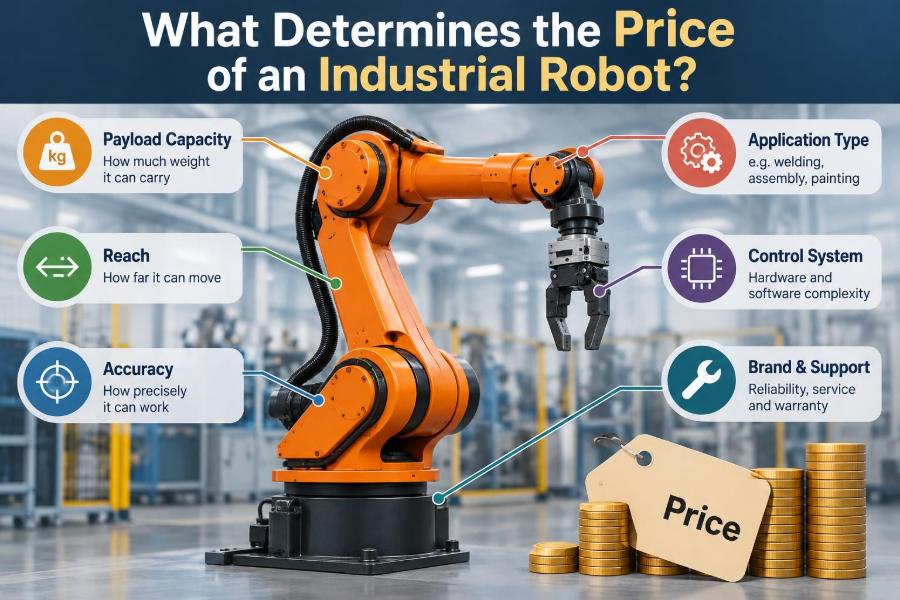
Payload is the maximum mass a robot can carry under specified conditions. A robot handling a lightweight plastic cap does not need the same motors, gearboxes, brakes, or structure as one lifting a heavy casting.
The relevant mass includes more than the workpiece. Engineers must add the gripper, tool changer, sensors, brackets, hoses, cables, and any product variation. A gripper that seems small can consume much of the available payload.
Payload also interacts with reach and speed. A robot may lift a given mass close to its base but be unable to accelerate it safely at maximum reach. Selecting the smallest suitable payload class can control cost, but leaving too little margin creates reliability and performance problems.
📐 Reach and Work Envelope Affect Size
Reach is how far the robot wrist can extend, while the work envelope describes the volume its axes can access. A longer arm needs a stiffer structure and must manage larger bending moments, especially when carrying a tool and part.
Two applications can have similar payloads yet require different robot sizes. A compact robot loading parts into a nearby press may be much smaller than one reaching across a conveyor, over a fixture, and into a deep machine enclosure.
Measure the real task in three dimensions. Include approach paths, clearance around obstacles, and the space needed to orient the wrist—not just the straight-line distance from the base to the target.
⚡ Speed and Cycle-Time Requirements Add Cost
Industrial robots are valued for repeatable motion, but cycle time determines how aggressively that motion must be performed. Faster acceleration requires motors, drives, gear trains, controls, and structural stiffness that can handle higher dynamic loads.
A cell that has ample idle time may use a less demanding robot. A high-throughput packaging line may require rapid short moves, coordinated conveyors, and optimized motion paths. In that case, simply choosing a larger arm does not guarantee a faster system.
Ask for a cycle-time demonstration or simulation using realistic payload, tool geometry, path points, and waits for external equipment. Catalog speed values alone rarely predict the actual production cycle.
🎯 Accuracy, Repeatability, and Calibration Are Different
Repeatability is a robot’s ability to return to the same commanded position. Accuracy is how closely that position matches the intended real-world location. A robot can be highly repeatable while still needing calibration to align precisely with a fixture or machine.
Many handling tasks only need repeatability because a fixture establishes the part position. Precision assembly, machining support, dispensing, and measurement can demand tighter accuracy, compliance sensing, or external calibration systems.
Those requirements increase cost through better mechanics, metrology, software, and engineering time. Do not pay for extreme precision if the process cannot use it—but do not assume a standard arm will solve a metrology problem without additional controls.
🔄 Number of Axes and Robot Architecture
A six-axis articulated robot offers broad freedom to position and orient a tool. It is versatile, but that versatility comes with more mechanical joints, servo drives, and programming considerations than a simpler design.
| Architecture | Typical strength | Cost driver to consider |
|---|---|---|
| Articulated six-axis | Complex orientation and reach-around motion | Versatility and wrist capability |
| SCARA | Fast assembly in a horizontal plane | High-speed precision setup |
| Cartesian/gantry | Large rectangular workspaces | Rails, structure, and installation length |
| Delta | Very fast light-item picking | Vision and conveyor synchronization |
| Collaborative arm | Lower-force shared spaces in suitable tasks | Safety validation and lower speed limits |
The right architecture is the one that performs the required motion with the least unnecessary complexity.
🦾 Wrist Design and Tool Orientation
The wrist is where the robot creates useful tool orientation. Hollow wrists can route cables internally, reducing snag risk. More capable wrists may offer improved range, torque, or protection for difficult tool paths.
Wrist limits are especially relevant in arc welding, painting, sealing, and machine tending. If the torch or gripper cannot approach at the required angle, the cell may need a reoriented fixture, a positioner, or a different robot model.
These choices influence price because they change both equipment and engineering effort. A simple pick-and-place task rarely needs the same wrist performance as a robot tracing a complex three-dimensional seam.
🌡️ The Operating Environment Shapes the Specification
Factory conditions are not uniform. Dust, coolant mist, heat, washdown chemicals, metal chips, static electricity, and explosive atmospheres can all require special protection.
Sealed joints, corrosion-resistant finishes, cleanroom-compatible materials, food-grade designs, or hazardous-area configurations can raise the equipment cost. They may also affect maintenance procedures and spare-part selection.
Specify the environment honestly. Buying a standard robot for a harsh location may appear economical until contamination, corrosion, or repeated cable failures interrupt production. Conversely, over-specifying environmental protection adds cost without improving a clean indoor application.
🛡️ Safety Equipment Is a Core System Cost
An industrial robot can move quickly and with substantial force. A safe cell usually needs risk assessment, safeguarding, safety-rated controls, emergency stops, and validation that the installed system reduces risk appropriately.
Physical fencing and interlocked doors are common solutions. Other applications use scanners, light curtains, safety mats, speed-and-separation monitoring, or reduced-speed modes. The suitable approach depends on hazards, layout, access needs, and task behavior.
Safety is not a decorative add-on. It affects floor space, electrical design, operating procedures, and commissioning time. Local regulations, workplace rules, and the final risk assessment determine the exact requirements.
🤝 Collaborative Robots Change Some Costs, Not All
Collaborative robots are designed with features that support operation in shared spaces under appropriate conditions. They can simplify certain low-force, lower-speed tasks and may reduce the need for full perimeter guarding.
They are not automatically safe in every use. A sharp tool, heavy payload, pinch point, or fast moving product can make a collaborative application hazardous even when the arm itself has force-limiting features.
Collaborative deployments still require risk assessment, suitable end-effectors, and safety validation. Their purchase price may be attractive for flexible workstations, while their speed or payload limits can make conventional automation more economical for high-volume lines.
✋ End-Effectors Often Decide Whether Automation Works
The end-effector is the robot’s hand: a vacuum cup array, mechanical gripper, welding torch, screwdriver, dispensing valve, or custom tool. It must reliably interact with real parts, including normal variation in shape, surface, temperature, and orientation.
A simple vacuum tool may be economical for sealed cartons. Porous, oily, flexible, or irregular products can require sensors, multiple gripping methods, compliant fingers, or custom mechanisms. That engineering can cost more than expected.
Include changeover needs in the specification. A tool that handles one product perfectly may be a poor choice if production frequently changes sizes or if operators need to replace wear parts quickly.
👁️ Vision Systems Add Capability and Complexity
Machine vision helps robots find randomly oriented parts, inspect features, read codes, or verify placement. It can remove the need for highly precise part presentation, but it introduces cameras, lenses, lighting, calibration, software, and error-handling logic.
Lighting is often the quiet challenge. Reflective metal, transparent packaging, shadows, and changing ambient light can make an apparently easy vision task unreliable unless the scene is controlled.
Vision should solve a clearly defined problem. It is powerful when it replaces impractical fixturing or enables inspection, but it should not be added merely because a process has not been measured carefully.
🔌 The Controller, Software, and Licenses Matter
The controller contains motion control hardware, safety functions, communications, and the runtime that executes the robot program. Base software may be included, while specialized features can be licensed separately.
Possible extras include vision interfaces, conveyor tracking, force control, advanced safety, offline programming, fieldbus communication, process packages, and data collection. License models vary, so a quote should identify recurring and one-time costs.
Also consider who can edit the program. A system that only an external specialist can troubleshoot may be appropriate for a complex process, but it creates a different long-term support cost than an accessible, well-documented cell.
🔗 Integration With Existing Equipment Takes Engineering
A robot cell must exchange signals with upstream and downstream equipment. It may need to know whether a machine is ready, whether a part is present, whether a conveyor is moving, and what to do after a fault.
Integration commonly involves programmable logic controllers, industrial networks, electrical panels, pneumatics, sensors, and mechanical interfaces. The difficult work is often defining every normal and abnormal state, not merely connecting wires.
A vague interface is a pricing risk. If the existing machine has undocumented behavior or limited access to control signals, integration can require extra hardware, investigations, and schedule contingency.
🏭 Fixtures and Part Presentation Are Hidden Cost Drivers
Robots repeat what they are taught. If parts arrive in unpredictable positions, the cell needs fixtures, sensors, vision, compliant tooling, or a different process to cope with that variation.
Good fixturing can make a modest robot highly reliable. Poor fixturing can force expensive sensing and complex recovery logic. The most economical automation sometimes improves the incoming process before adding intelligence to the robot.
Consider part tolerances, tray design, bin fill level, surface condition, and how operators load the station. These details determine whether the robot sees a controlled task or a stream of exceptions.
🧠 Application Engineering Is Not Optional Labor
Application engineering turns a concept into a cycle that can run in production. It includes reach studies, payload checks, layout design, tool selection, sequence development, safety planning, and tests of failure recovery.
A palletizing cell, for example, must account for box stability, pallet patterns, height limits, slip sheets, infeed variation, and what happens when a carton is missing. The arm motion is only one part of the solution.
Quotes with significant engineering content are not necessarily inflated. They may reflect work needed to reduce commissioning surprises. The useful question is whether the proposed engineering tasks address the application’s real uncertainties.
🧪 Prototyping and Proof of Feasibility Reduce Risk
Some applications are straightforward enough to configure from established designs. Others involve fragile materials, difficult gripping, uncertain cycle time, or demanding quality outcomes. In those cases, tests with representative parts can be valuable.
A proof of feasibility does not guarantee every production condition, but it can expose problems early: vacuum leaks, glare in an image, product deformation, insufficient reach, or a path that cannot meet the desired cycle.
Prototype work has a cost, yet skipping it may transfer risk to installation. For novel tasks, define measurable acceptance criteria before testing rather than relying on a subjective impression that the robot “looks good.”
🚚 Installation, Shipping, and Site Preparation
Large robots and cells may need specialized transport, rigging, anchors, utility connections, and floor-space changes. A facility may need compressed air, electrical capacity, network access, extraction, or changes to material flow.
Site conditions can affect installation more than expected. Restricted doors, uneven floors, overhead obstructions, and limited shutdown windows add planning effort. A robot that fits in a CAD layout may still be difficult to move into the building.
Request a site-readiness checklist early. It should identify responsibilities for foundations, utilities, permits where applicable, lifting access, network configuration, and removal of existing equipment.
✅ Commissioning and Acceptance Define “Done”
Commissioning is the process of installing, tuning, testing, and proving the system. Acceptance criteria should state what will be produced, at what cycle time, with what quality conditions, and over what test period.
Without clear criteria, a project can stall over reasonable but conflicting expectations. Is occasional operator intervention acceptable? Are test parts representative? Does the target include downtime from an upstream machine?
A factory acceptance test may verify the cell before shipment, while a site acceptance test confirms performance after installation. The exact division depends on the project, but both reduce ambiguity when specified in advance.
🧰 Training, Documentation, and Maintainability
A robot cell performs better over its life when operators understand recovery procedures and maintenance staff can diagnose common faults. Training is not only programming instruction; it should cover safe operation, alarms, changeovers, inspection, and escalation paths.
Documentation should include electrical drawings, pneumatic diagrams, spare-part lists, backup procedures, safety information, and a description of the cell sequence. These materials are especially valuable when the original integrator is no longer immediately available.
Maintainability has design consequences. Provide access to filters, gripper wear parts, cables, and sensors. A component that is inexpensive but difficult to replace can create long production interruptions.
🔧 Service, Spares, and Lifecycle Costs
The purchase order is the beginning of the cost story. Lifecycle spending may include preventive maintenance, replacement cables, gripper consumables, software support, batteries, training for new staff, and occasional retooling.
Robot reliability depends on application severity, maintenance quality, environmental conditions, and duty cycle. It is unwise to assume identical service needs for a lightly used demonstration cell and a round-the-clock abrasive process.
Critical operations may justify on-site spare sensors, a replacement gripper module, or a service agreement with defined response terms. For low-volume work, holding extensive inventory may be unnecessary. Match the support plan to the cost of downtime.
📈 Production Volume and Return on Investment
Higher volume can justify more dedicated automation because fixed engineering costs are spread over more units. Lower volume often favors flexible tooling, quick changeover, and reusable equipment, even if the per-cycle rate is less aggressive.
Return on investment should include more than direct labor. Depending on the application, relevant effects may include throughput, ergonomics, consistency, scrap, rework, quality checks, uptime, and the ability to operate during staffing constraints.
These benefits should be modeled conservatively. A spreadsheet should distinguish measured current losses from assumptions about future performance, and it should include expected maintenance and integration costs.
🌍 Geography, Supply Chains, and Commercial Terms
Equipment price can vary with currency movements, transport distance, import duties, lead times, local labor rates, and the availability of regional service. These factors are commercial realities rather than measures of robot quality.
Payment milestones, warranty scope, shipping responsibility, and training location also affect the apparent price. A proposal with a lower headline value may transfer more logistics or commissioning risk to the buyer.
Compare commercial terms alongside technical scope. Procurement and engineering teams should review them together, because a technically sound cell can still be a difficult project if responsibilities are unclear.
📊 Comparing Quotes on an Equal Basis
A structured comparison prevents a common mistake: selecting the lowest number without recognizing omitted work. Build a scope matrix that lists each required function and indicates who supplies, installs, programs, and validates it.
- Robot, controller, cables, and software options
- Tooling, fixtures, sensors, vision, and process equipment
- Guarding, safety design, and risk-assessment responsibilities
- Electrical and pneumatic installation, interfaces, and site work
- Cycle-time assumptions, test parts, and acceptance criteria
- Training, documentation, warranty, service, and spare parts
Also record exclusions and assumptions. A transparent higher quote can be safer than a low quote that leaves essential requirements to be solved later.
⚠️ Common Budgeting Mistakes
One mistake is specifying the robot before defining the process. Another is budgeting only for the arm and discovering late that guarding, tooling, and integration are substantial portions of the project.
Teams also underestimate exceptions: a double-fed part, an empty tray, a bad barcode, a jammed conveyor, or a tool that loses grip. Production systems need a safe response and a practical recovery path for these normal disruptions.
A final mistake is optimizing for the fastest quoted cycle without considering changeovers, maintenance access, and operator usability. A slightly slower cell that recovers predictably can deliver more useful output over time.
🧭 A Practical Way to Set an Early Budget
Start with a short application definition: product range, part mass, required orientations, production rate, shift pattern, quality needs, available floor space, and the equipment to be connected. Photos, drawings, and real sample parts make supplier discussions more accurate.
Then separate costs into three levels: the robot platform, the application equipment, and the integration/installation work. This prevents an early robot catalog price from being mistaken for a project budget.
Finally, identify the largest unknowns and assign a plan to reduce them. A reach study, grip test, site survey, or interface review is often more valuable than requesting a precise number before the technical scope exists.
🎓 What Students and New Engineers Should Learn From Pricing
Robot cost is a systems-engineering lesson. Mechanical design affects payload and tooling; controls affect interfaces and fault handling; safety affects layout; manufacturing engineering affects fixtures and cycle time.
Students can practice by taking an everyday automation task—sorting packages, loading a machine, applying adhesive—and listing every component needed for reliable operation. The exercise reveals why a robot arm is not a complete solution.
Working professionals can use the same mindset during design reviews. The best questions are often practical: What happens when the part is wrong? Who clears the fault? How is the tool changed? Can maintenance reach the component?
💡 The Core Principle: Buy Capability, Not Just Hardware
Industrial robot price is determined by the capability required to perform a defined task safely, repeatedly, and economically. Payload, reach, speed, precision, environment, software, tooling, safety, integration, and support all contribute.
The arm is often a meaningful cost, but it is rarely the whole investment. A well-scoped cell makes its costs visible and connects each one to a production requirement or a risk being managed.
The strongest purchasing decision is not the one with the lowest catalog figure. It is the one that balances current needs, credible operating assumptions, maintainability, and enough flexibility for the changes the factory can reasonably expect.
An industrial robot is priced not merely by what it is, but by what the complete system must reliably accomplish in the real world. 🦾🏭📊