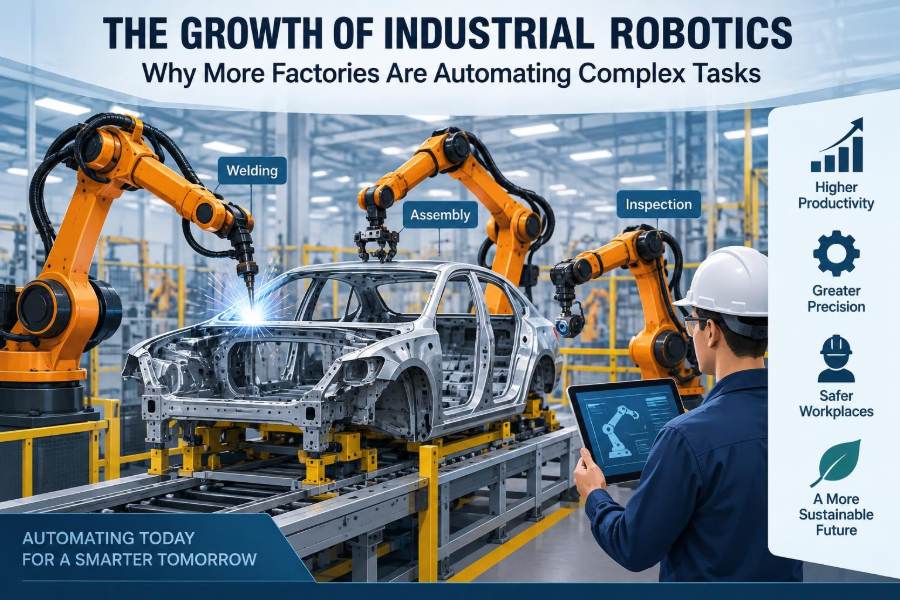

A package arrives the day after it was ordered. A car model changes without an entire factory being rebuilt. A medical device is assembled in a clean environment with a traceable record of each critical step. Behind many of these ordinary outcomes is a manufacturing system that has become far more adaptable than the fixed, fenced-off robot cells people often imagine.
Factories still use people for judgment, troubleshooting, craft, and work that changes too often for a machine to justify. But a growing range of tasks now sits in the middle: difficult, repetitive, variable, safety-sensitive, or physically demanding work that robotics can support when it is designed carefully.
This shift matters to engineers, technicians, managers, and students because industrial automation is no longer only about moving parts faster. It is increasingly about sensing, planning, verifying, documenting, and responding to variation.
The growth of industrial robotics is therefore best understood not as factories replacing humans with machines, but as factories redesigning how work is divided between people, software, and electromechanical systems.
🏭 Industrial Robotics Has Moved Beyond Simple Repetition
Traditional industrial robots excel at highly repeatable motion. If a part arrives in the same fixture at the same location every cycle, a robot can weld, paint, or place it with remarkable consistency.
Complex tasks introduce uncertainty. Parts may be mixed in a bin, surfaces may vary, demand may change, or the robot may need to confirm that an operation was completed correctly. Modern systems address those problems with better sensors, software, end effectors, and integration methods.
The key change is not that robots suddenly “understand” factories like people do. It is that engineers can now build systems that measure enough of the real situation to make controlled decisions.
📈 Why Factories Are Reconsidering Automation
Manufacturers automate when a process creates a persistent operational problem, not merely because a robot is impressive. Common drivers include difficulty hiring for repetitive shifts, pressure to improve quality, ergonomic injuries, short production runs, and volatile order patterns.
Automation can also protect capacity. When trained workers are scarce, assigning a robot to repetitive handling may allow experienced staff to focus on setup, diagnostics, inspections, and process improvement.
For many plants, the question is no longer “Can a robot do this?” It is “Can a complete robot system perform this task reliably enough, safely enough, and flexibly enough to justify its lifecycle cost?”
🧩 What Makes a Manufacturing Task Complex
Complexity does not necessarily mean that a task is intellectually difficult. In a factory, it often means the task has too many variables for a simple fixed-motion program.
- Parts arrive in changing positions or orientations.
- Materials bend, reflect light, or vary slightly in shape.
- The required force depends on the fit of each individual part.
- Many product variants share the same production line.
- Errors must be detected immediately and recorded.
Consider inserting a flexible cable into a housing. The action looks simple, but success may depend on cable routing, connector alignment, insertion force, and visual confirmation. That combination requires more than a robot arm; it requires a designed process.
🦾 The Robot Arm Is Only One Part of the System
An industrial robot is usually a programmable mechanical arm with joints driven by motors. Its controller calculates joint movement so that the tool at the wrist follows a desired path.
Yet the arm alone does not make an application work. The surrounding system often includes fixtures, conveyors, safety equipment, sensors, tool changers, part-feeding equipment, software interfaces, and inspection devices.
This is why robot projects succeed or fail at the systems level. A capable arm cannot compensate for a poor presentation of parts, an unreliable gripper, or a measurement method that cannot distinguish good products from bad ones.
✋ End Effectors Turn Motion Into Useful Work
An end effector is the device mounted at the robot wrist. It may be a gripper, welding torch, screwdriver, suction cup array, dispensing nozzle, cutter, or inspection camera.
Tool design has become a major enabler of more complex automation. A well-designed gripper can tolerate modest variation, sense whether it has grasped a part, and release fragile items without damage. A poorly chosen one can turn a feasible automation project into a source of stoppages.
Engineers select end effectors by considering the part’s geometry, mass, surface condition, temperature, allowable contact points, orientation, and consequences of a dropped or misplaced part.
👁️ Machine Vision Gives Robots Situational Awareness
Machine vision uses cameras, lighting, lenses, and image-processing software to extract useful information from an image. In robotics, vision may locate a part, read a code, inspect a surface, or check an assembly.
Lighting is often more important than the camera specification. A shiny metal component can create glare; a dark plastic part can disappear against a dark conveyor. Good vision engineering controls the scene so the required feature is consistently visible.
Vision does have limits. Dust, reflections, changing ambient light, part occlusion, and unexpected product variation can reduce reliability. A production vision system should be tested across realistic conditions, not only with ideal sample parts.
📐 3D Sensing Helps With Unstructured Parts
Two-dimensional vision is effective when parts lie on a known surface. When parts are piled in a container or have significant depth variation, a system may use 3D sensing to estimate shape and position.
This supports applications such as bin picking, where a robot identifies a reachable part from a mixed pile. The software must determine not only where the part is, but whether the robot can approach it without colliding with the bin or neighboring parts.
Bin picking is powerful but not universal. Highly tangled, deformable, glossy, or randomly stacked parts may require changes upstream, such as separators, better containers, or a simpler loading method.
🧭 Force Control Handles Contact and Fit
Position control tells a robot to move to a location. Force control adds the ability to regulate or react to contact forces, which is valuable when a fixed position cannot guarantee success.
During polishing, deburring, insertion, sanding, or seal installation, small differences between parts can matter. A force-torque sensor or compliant mechanism can help the robot press with a controlled force rather than rigidly following a path.
Force sensing is not a magic solution for bad tolerances. It works best when the part design, fixture, tooling, and motion strategy all provide a reasonable path to successful assembly.
🧠 Software Connects Perception, Motion, and Decisions
Modern robot programs increasingly combine several layers: sequence logic, sensor handling, motion planning, quality checks, alarms, and communication with factory equipment. The robot controller may coordinate some of this work, while industrial PCs, programmable logic controllers, or manufacturing software handle other layers.
A useful program does not merely command motion. It defines what happens when a sensor disagrees, a component is missing, an inspection fails, or a downstream machine is unavailable.
Recoverability is a hallmark of mature automation. A system that detects a fault, moves to a safe state, gives a clear reason, and permits controlled recovery is far more useful than one that simply stops.
🔄 Flexible Automation Supports More Product Variants
Fixed automation is built around a narrow, stable product. Flexible automation uses programmable motion, configurable fixtures, tool changes, recipes, and sensing to handle more variation.
For example, one palletizing cell may stack several carton sizes by selecting a recipe that changes grip points, stacking pattern, and allowable load. Another cell may assemble related products by identifying each variant through a barcode or database record.
Flexibility has a cost. Each additional product variant adds programming, validation, spare-part, and operator-training needs. The goal is not maximum flexibility; it is enough flexibility for the expected product mix.
🔧 Collaborative Robots Expand Where Automation Fits
Collaborative robots, often called cobots, are designed with features that can support operation near people under an appropriate risk assessment. Depending on the application, these features may include force limiting, speed monitoring, and safety-rated stop functions.
A cobot is not automatically safe simply because it is smaller or marketed as collaborative. A sharp tool, a heavy payload, a pinch point, or a fast-moving workpiece can still create serious hazards.
Cobots are often useful for moderate-payload tasks, frequent changeovers, and workstations where people and robots share a process. Conventional industrial robots remain a strong choice for high speed, high payload, or tightly enclosed operations.
🛡️ Safety Engineering Is Designed In, Not Added Later
Robot safety begins with a structured risk assessment. The team identifies hazards, estimates exposure and severity, and chooses risk-reduction measures such as guarding, interlocked doors, safety scanners, light curtains, safe speeds, and emergency stops.
Safe design considers normal production, setup, teaching, maintenance, clearing jams, and foreseeable misuse. Many incidents occur during non-routine work, when guards are open and personnel are close to equipment.
Safety requirements vary by region and application, so projects should involve qualified safety professionals and follow the standards and regulations applicable to the facility. No article can substitute for a site-specific assessment.
🏗️ Cell Layout Often Determines Reliability
A robot cell layout governs reach, cycle time, accessibility, safety, cable routing, and maintenance. An arm may technically reach every target but still create awkward joint angles, slow paths, or poor access for an operator.
Part flow should be simple and visible. Materials should enter predictably, completed items should leave without interfering with robot motion, and rejected parts should be clearly contained and traceable.
Digital simulation can help identify reach and collision issues before installation. Still, physical commissioning matters because real cables, part tolerances, reflections, vibration, and human work habits reveal details that models may not capture.
⏱️ Cycle Time Is More Than Robot Speed
Cycle time is the time required to produce one unit or complete one repeated sequence. Teams sometimes focus on the arm’s maximum speed, but overall output is commonly constrained by loading, inspection, fastening, curing, material delivery, or downstream equipment.
A faster motion can also reduce reliability if it causes vibration, missed grasps, unstable loads, or wear. The best cycle is the fastest one that can be sustained while meeting quality and safety requirements.
When evaluating a cell, measure waiting time and small delays as well as robot travel. Removing a few seconds of unnecessary fixture movement may matter more than accelerating an already short robot path.
✅ Quality Inspection Can Move Closer to the Process
Robots make it easier to place cameras, probes, or sensors in repeatable positions. This enables inspection during production rather than relying only on a final check after many value-adding steps.
Early detection limits the number of affected units when a tool wears, a feeder drifts, or a supplied component changes. It can also provide data for diagnosis, such as which station processed a part and what result the inspection produced.
Inspection automation must be validated carefully. A system needs to avoid both false accepts, where defects pass through, and false rejects, where good products are unnecessarily discarded or reworked.
📦 Warehousing and Intralogistics Are Major Growth Areas
Industrial robotics includes more than production-line arms. Factories increasingly automate movement of materials between receiving, storage, machining, assembly, inspection, and shipping.
Autonomous mobile robots can transport racks, totes, or carts through defined areas, while robotic palletizers and depalletizers handle repetitive loading and unloading. These systems can reduce manual travel, but they depend on disciplined traffic rules and dependable handoffs.
The operational value often comes from connecting material movement to production status. Delivering the right component at the right time is more useful than merely moving a cart quickly.
🔥 Hazardous and Ergonomic Work Is a Strong Use Case
Robots are especially compelling when work exposes people to heat, fumes, sharp edges, heavy loads, awkward postures, repetitive force, or hazardous substances. Examples include welding, foundry tending, grinding, chemical dispensing, and high-temperature handling.
Automation does not eliminate responsibility for workplace safety. Maintenance staff may still need to service equipment near these hazards, and the process itself requires ventilation, guarding, lockout procedures, and monitoring.
Where a robot removes repeated lifting or uncomfortable reaching, the benefit is not only labor saving. It can make a job more sustainable for the people who remain responsible for supervising and improving the process.
🧪 Process Automation Differs From Part Handling
Picking and placing an object is one category of robotics. Controlling a process such as welding, adhesive dispensing, painting, machining, or polishing adds another layer of complexity because the tool changes the part.
In dispensing, for instance, the result depends on fluid condition, nozzle geometry, pressure, path speed, temperature, and substrate surface. A robot can repeat a path precisely, but process quality still requires monitoring and calibration.
This distinction helps teams scope projects honestly. Motion repeatability is necessary, but it does not by itself guarantee a good weld bead, seal, finish, or bonded joint.
🧰 Tool Changing Makes a Cell More Capable
Automatic tool changers allow one robot to use multiple end effectors in a sequence. A robot might pick a component with a gripper, switch to a screwdriver, then change to an inspection tool.
Tool changing can save floor space and reduce equipment duplication. It also introduces interfaces that must be maintained: mechanical locking, electrical connections, pneumatic lines, and tool identification.
It is worthwhile when the added capability outweighs the change time and maintenance burden. For a very fast, stable task, dedicated tools or multiple simpler stations may remain more practical.
📊 Data Turns a Robot Cell Into a Managed Process
Robot cells generate operational signals such as cycle completion, fault codes, motor load, inspection results, and downtime events. When collected with context, this information helps teams find recurring losses instead of relying on anecdotes.
Useful data answers concrete questions: Which fault is most frequent? Does a reject rate rise after a tool change? Which product variant takes longest? Is the cell waiting for material or for an operator?
Data collection should serve decisions, not create dashboards no one uses. Clear definitions, reliable timestamps, and attention to cybersecurity are essential when equipment is connected to plant networks.
🔌 Integration Is Usually Harder Than Programming Motion
A robot must exchange signals and materials with the rest of the factory. It may need to wait for a machine-ready signal, receive a product recipe, report a quality result, or stop safely when a conveyor faults.
These handoffs require clear ownership and testing. Ambiguous states such as “ready,” “busy,” or “complete” can cause deadlocks, duplicated work, or parts stranded between stations.
Good integration uses defined interfaces, clear fault behavior, and documented recovery sequences. The goal is not only to make equipment communicate, but to make the overall line behave predictably when something goes wrong.
🧑🏭 Jobs Change When Automation Arrives
Automation can reduce the amount of direct manual work in a specific task, but its wider workforce effect depends on the factory’s products, demand, staffing, and investment choices. It can also create or expand roles in maintenance, controls, quality, production planning, and process engineering.
Workers who understand the real process are valuable during automation design. They know where parts stick, which variations are normal, what defects look like, and which shortcuts signal an underlying problem.
The strongest implementations include training before launch. Operators need to understand normal operation and escalation; technicians need safe troubleshooting methods; engineers need access to understandable documentation and backups.
🎓 Skills That Matter in Industrial Robotics
Industrial robotics is interdisciplinary. Students and professionals benefit from combining mechanical reasoning with electrical safety, programming, control systems, manufacturing processes, and communication.
- Read drawings, tolerances, pneumatic diagrams, and electrical schematics.
- Understand coordinate frames, payloads, reach, and basic robot motion.
- Work with sensors, actuators, PLC logic, and industrial communications.
- Apply risk assessment principles and disciplined troubleshooting.
- Document changes so a system remains maintainable after handover.
Specialization is still valuable, but practical collaboration matters just as much. A gripper issue may look like a programming problem until a technician discovers an air-pressure drop or a worn fixture.
💰 Return on Investment Requires a Full Lifecycle View
The cost of a robotics project includes more than the robot purchase. Budgeting should account for end effectors, guarding, fixtures, sensors, integration, installation, validation, training, maintenance, spare parts, and production disruption during commissioning.
Benefits may include increased capacity, less scrap, reduced ergonomic exposure, more stable quality, and improved traceability. Some benefits are difficult to convert into a single universal number, so teams should state their assumptions openly.
A sound business case also asks what happens if demand changes. A reusable robot and modular cell may retain more value than dedicated machinery, while a simple dedicated solution may win for a stable high-volume product.
🚧 Common Automation Mistakes to Avoid
One frequent mistake is automating a broken process. If incoming parts are inconsistent, work instructions are unclear, or defects have unknown causes, a robot will often make the instability more visible rather than solve it.
Another mistake is treating the demonstration as proof of production readiness. A cell must run through variation, shift changes, material replenishment, recoverable faults, and maintenance conditions.
- Choosing a robot before defining the actual process requirements.
- Underestimating fixturing, lighting, and material presentation.
- Leaving maintenance and spare-part planning until after startup.
- Ignoring operator input until the installation is nearly complete.
- Measuring only average cycle time instead of reliability and recovery.
🛠️ Start With Process Stabilization
Before automating, map the work as it is truly performed. Identify part variation, decision points, rework loops, quality criteria, handling hazards, and reasons for downtime.
Then improve the process where possible. Standardized containers, better locating features, clearer work instructions, controlled lighting, or redesigned parts can make automation much simpler and more reliable.
A useful rule is to automate the stable core first. Once the core operation works consistently, sensing or manual exceptions can handle the smaller set of unusual cases while the team gathers evidence for further automation.
🧱 Pilot Cells Reduce Technical and Organizational Risk
A pilot cell is a limited deployment that tests a defined task under realistic conditions. It should have measurable objectives, such as safe operation, acceptable quality, a sustainable cycle time, and a clear recovery method.
Pilots are most valuable when they challenge assumptions. They should include representative part variation, realistic operators, and normal disruptions rather than a carefully staged demonstration.
Successful pilots create reusable knowledge: fixture principles, programming patterns, safety templates, spare-parts lists, training materials, and data conventions. That learning can make later deployments faster and less risky.
🌐 Connected Robotics Brings Cybersecurity Responsibilities
Connecting robot cells to production databases, remote support tools, or analytics platforms can improve visibility and support. It can also expand the number of pathways through which a system might be accessed or disrupted.
Factories need practical controls such as network segmentation, managed user access, software update procedures, backups, and an incident-response plan. The exact approach depends on the equipment and organization, but cybersecurity cannot be treated as solely an office-network concern.
Availability matters in manufacturing. A poorly managed software or network change can stop a cell just as effectively as a mechanical failure.
🌱 Automation Can Support More Efficient Manufacturing
Robotics can reduce waste when it improves placement accuracy, dispensing consistency, material yield, and early defect detection. It can also enable processes that use less material or allow remanufacturing and sorting operations to be performed more consistently.
However, a robot is not inherently sustainable. It consumes energy, requires materials to manufacture, and may encourage unnecessary complexity if applied carelessly.
The useful question is lifecycle-based: does the automated process reduce scrap, rework, transport, exposure, or energy use enough to justify the equipment and its operation? Measurement is better than assumption.
🔮 What Growth Is Likely to Look Like
Industrial robotics will likely continue spreading through applications that were previously too variable, too small-batch, or too difficult to engineer economically. Better sensing, easier programming tools, modular equipment, and stronger integration practices all lower barriers in some settings.
Progress will not be uniform. Highly structured tasks with repeatable parts will remain easier to automate than work involving soft materials, unpredictable environments, or nuanced human judgment.
The most practical future is often hybrid: machines perform repeatable physical work and generate useful data, while people handle exceptions, improve the process, make decisions, and take responsibility for safe operation.
🎯 The Core Principle: Automate the System, Not Just the Motion
More factories are automating complex tasks because robotics has become better at dealing with variation through sensing, adaptable tooling, software, and data. But the robot’s movement is only the visible portion of the solution.
Reliable automation starts with a stable process, suitable part presentation, thoughtful safety design, maintainable interfaces, and people who are trained to run and improve the cell. When those foundations are missing, even sophisticated technology struggles.
For aspiring robotics professionals, this is the central lesson: successful industrial automation combines mechanical design, controls, manufacturing knowledge, safety practice, and respect for the people who work with the system.
Industrial robotics grows when it makes manufacturing safer, more consistent, and more adaptable—not when it merely makes an impressive machine move. That is why the most valuable robot projects are designed as complete, human-supported production systems. 🦾🏭📈