
A robotics engineer may spend the morning tracing a fault that stops a packaging line, then spend the afternoon tuning a vision model so a robot can recognize a part arriving in a different orientation. Both tasks involve robots. They do not necessarily create the same business value, require the same judgment, or lead to the same compensation.
That distinction matters when you are choosing a degree concentration, deciding what to learn after work, or preparing to ask for a raise. Job titles in robotics are broad, while pay often follows the particular technical problems an employer needs solved.
A robot that can move is useful. A robot that moves safely, sees variation, communicates with factory systems, and keeps producing when conditions change is far more valuable. Engineers who can build and support those capabilities tend to have stronger leverage.
Salary is never determined by skills alone. Location, industry, experience, business conditions, scope, and negotiation all matter. Still, a practical skill strategy can help you pursue roles where your work is closer to reliability, throughput, safety, and product capability.
🧭 Salary Begins With the Problem You Solve
Robotics compensation is best understood as a reflection of scarcity plus business impact. A skill tends to command more when few people can apply it reliably and when applying it reduces costly downtime, enables a product feature, improves quality, or unlocks automation that was previously impractical.
For example, basic robot operation is valuable, but an engineer who can diagnose intermittent servo faults, modify a safety-rated cell, and restore production has a different level of responsibility. Likewise, a developer who can turn an unreliable prototype perception pipeline into a monitored production system solves a harder problem.
🏷️ Why “Robotics Engineer” Is Not One Salary Category
The title can describe mechanical designers, embedded developers, controls engineers, autonomy specialists, field engineers, and systems integrators. Their daily tools and accountability differ substantially.
Before comparing roles, read the job description for its actual work: commissioning, motion planning, PLC programming, embedded software, machine learning, simulation, customer support, or technical leadership. This is more informative than the title alone.
| Role emphasis | Typical value created | Common technical center |
|---|---|---|
| Industrial automation | Reliable production and throughput | PLCs, safety, industrial networks |
| Robot software | New behavior and product capability | C++, Python, ROS 2, algorithms |
| Perception and AI | Recognition and decisions under variation | Vision, data pipelines, model deployment |
| Embedded and controls | Stable, accurate physical behavior | Real-time software, sensors, control theory |
| Systems integration | Working machines across vendor boundaries | Interfaces, commissioning, troubleshooting |
🏭 Industry Changes What Employers Reward
A high-volume factory, a medical-device company, a warehouse automation provider, and a mobile-robot startup can all hire robotics engineers for very different reasons. In mature industrial environments, safe uptime and fast recovery may be central. In product companies, architecture, software quality, and intellectual property may carry more weight.
Regulated or safety-critical work can reward disciplined verification and documentation. Travel-heavy integration roles may compensate for on-site demands, while product-development roles may put more emphasis on reusable software and long-term ownership.
📍 Location, Labor Markets, and Total Compensation
Pay ranges move with local labor markets, cost of living, employer concentration, and competition for specialized talent. A salary figure from one city or country should not be treated as a universal benchmark.
Evaluate the full offer: base pay, variable pay, equity where applicable, retirement contributions, health benefits, travel expectations, overtime policies, training budget, relocation support, and on-call requirements. A role with a lower base can still be the stronger career move if it provides deep technical ownership and credible advancement.
📈 Experience Means Evidence, Not Just Years
Years of experience matter because they often correlate with judgment, but employers look for evidence that you can handle ambiguity. Have you shipped a cell, led a commissioning, resolved a recurring failure, reviewed a safety concept, or improved an interface used by other engineers?
A junior engineer may be paid for potential and supervised execution. A more senior engineer is often paid for reducing uncertainty: estimating risk, making trade-offs, communicating with multiple teams, and preventing expensive mistakes before hardware is built.
🧠 AI Skills That Matter Beyond Model Training
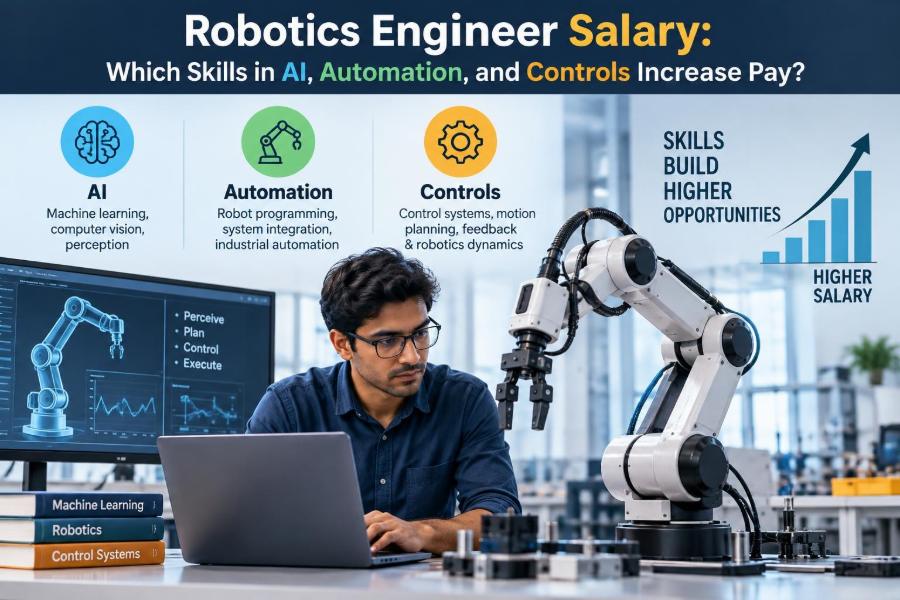
AI can increase pay when it is tied to a real robotic capability, not merely a course certificate. Useful applications include visual inspection, bin picking, anomaly detection, grasp selection, predictive maintenance, and sensor fusion.
The difficult part is usually the complete system. An engineer needs to understand camera placement, data quality, labeling, latency, confidence thresholds, failure handling, and how a model’s output becomes a safe action. A highly accurate offline model is not automatically useful on a production floor.
👁️ Computer Vision Turns Variation Into an Engineering Task
Machine vision is often valuable because physical environments are messy. Parts can be rotated, reflective, partly occluded, or presented against changing backgrounds. Conventional sensors may not distinguish those cases.
Strong vision engineers combine optics, calibration, lighting, image processing, and software integration. They know that better illumination or a fixture change can outperform a more complex neural network. That practical judgment is especially useful in manufacturing and logistics.
🗂️ Data Engineering Is an Underestimated Robotics Skill
Robots generate logs, images, timestamps, diagnostics, maps, and sensor streams. Without organized data, teams struggle to reproduce failures, improve algorithms, or prove whether a change helped.
Skills in data schemas, time synchronization, storage, labeling workflows, and experiment tracking make AI and autonomy work more dependable. They also help operations teams distinguish a genuine fault from normal variation.
🚀 Deploying AI Is More Valuable Than Demonstrating It
Deployment connects research to an operating machine. It may involve optimizing inference for available hardware, managing model versions, checking inputs, monitoring performance drift, and defining a fallback mode when confidence is low.
Suppose a vision system cannot identify a part. A sensible production design might slow the cycle, request another image, divert the item, or ask for human review. Letting uncertain output directly control motion can create quality and safety risks.
⚙️ PLC Programming Remains a High-Value Foundation
Programmable logic controllers, or PLCs, are rugged industrial computers that coordinate machines, sensors, actuators, alarms, and sequences. In automation roles, the ability to read, modify, test, and document PLC logic is highly marketable.
Employers value engineers who can turn a process into understandable state logic: what starts a cycle, what must be true before motion occurs, what triggers a fault, and how the machine recovers. Clear code matters because someone will troubleshoot it later, often under time pressure.
🔌 Industrial Networks Multiply Your Impact
A robot rarely operates alone. It exchanges signals with PLCs, drives, cameras, conveyors, safety devices, manufacturing systems, and operator interfaces. Industrial networking knowledge helps engineers resolve failures that appear mechanical but are actually communication or timing problems.
Learn the concepts behind deterministic communication, addressing, I/O mapping, managed switches, diagnostics, and segmentation. Specific protocols differ by employer, but the ability to inspect a system boundary and isolate a fault transfers well.
🛡️ Functional Safety Carries Serious Responsibility
Functional safety concerns the control functions that reduce risk when a fault or hazardous condition occurs. It is not simply adding an emergency-stop button. It involves risk assessment, safety functions, validation, documentation, and controlled changes.
Safety competence can differentiate an automation engineer because errors have real consequences. It should be developed with formal training, applicable standards, site procedures, and appropriate review. Never treat online tutorials as sufficient authority to approve a safety design.
🎛️ Controls Engineering Makes Robots Behave Predictably
Controls engineering uses feedback from sensors to make a physical system follow a desired behavior. A simple thermostat is a familiar feedback controller; robotics applies the same idea at higher speed and complexity to position, force, velocity, temperature, or balance.
Engineers who understand stability, noise, delays, saturation, and tuning can improve accuracy without making a machine oscillate or behave unpredictably. These are durable skills because every robot ultimately interacts with physical hardware.
📐 Learn the Math Behind the Tuning Knobs
It is useful to tune a proportional-integral-derivative controller, commonly called PID, by procedure. It is more valuable to understand why proportional action responds to current error, integral action addresses accumulated error, and derivative action reacts to the rate of change.
That understanding helps when a fix in one operating condition creates a problem in another. It also supports more advanced work in state estimation, trajectory tracking, force control, and model-based control.
🧭 Motion Planning and Kinematics Expand Robot Capability
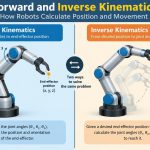
Kinematics describes the relationship between robot joints and the position or orientation of an end effector. Motion planning determines a feasible path while accounting for joint limits, obstacles, speed, and sometimes process constraints.
These skills are particularly useful in manipulators, autonomous mobile robots, surgical systems, and custom equipment. A path that looks correct in simulation may still fail near singular configurations, cable limits, or poorly modeled fixtures, so real-world validation remains essential.
⏱️ Real-Time and Embedded Skills Close the Hardware Gap
Robotics depends on software that interacts with sensors and actuators at predictable intervals. Real-time systems prioritize timing guarantees; embedded systems run near the hardware, often with constrained memory, power, and compute.
C, C++, microcontrollers, device drivers, debugging tools, and communication buses can raise your usefulness when a project cannot be solved entirely in high-level application code. These roles reward careful work: a rare timing bug can be far harder to find than an ordinary software defect.
💻 C++ and Python Serve Different Career Purposes
Python is excellent for prototyping, analysis, testing, data tools, and many AI workflows. C++ is common where performance, memory control, and integration with established robotics libraries matter. Neither language is a complete robotics skill by itself.
A strong portfolio explains why a language was selected. For instance, Python may orchestrate dataset evaluation while C++ runs a latency-sensitive perception component. The design decision communicates more maturity than listing many languages.
🤖 ROS 2 Is Useful When You Understand the Architecture
ROS 2 provides communication patterns and tools used in many robotics software projects. It can accelerate development by organizing nodes, messages, services, parameters, logging, and visualization.
Its career value comes from knowing how to build a maintainable system: define clean interfaces, manage dependencies, record data, diagnose communication, and handle lifecycle states. Simply launching a demonstration package does not show that you can support a deployed robot.
🧪 Simulation Lets You Learn Faster, Not Skip Reality
Simulation helps test control logic, motion plans, and software before hardware is ready or safe to use. It can reduce iteration cost and make edge cases easier to reproduce.
But every simulation rests on assumptions. Friction, sensor noise, lighting, delays, flexible components, and human behavior can differ from the model. Employers value engineers who use simulation to form testable hypotheses, then verify critical behavior on representative hardware.
🔧 Commissioning Skills Create Immediate Operational Value
Commissioning is the transition from installed equipment to reliable operation. It often includes verifying I/O, calibrating sensors, testing sequences, checking interlocks, training operators, and documenting recovery procedures.
It is demanding work because the engineer must combine electrical, mechanical, controls, software, and communication skills. Someone who can stay methodical during a start-up—rather than changing many variables at once—can become indispensable to an integration team.
🕵️ Structured Troubleshooting Is a Premium Capability
Complex systems invite guesswork. Strong troubleshooters instead define the failure, collect evidence, isolate variables, test a hypothesis, and record the root cause and corrective action.
For a robot that occasionally misses picks, investigate timing, gripper pressure, part presentation, camera confidence, coordinate calibration, network latency, and mechanical wear. Replacing components without evidence may hide the problem temporarily while increasing cost and downtime.
📊 Reliability and Maintenance Knowledge Connects Engineering to Money
Every unplanned stop can affect labor, production schedules, quality, and customer commitments. Engineers who design for diagnostics, graceful recovery, maintainable access, and clear alarms help reduce the operational burden of automation.
Useful habits include logging actionable fault context, tracking recurring failure modes, selecting sensors with maintainable calibration procedures, and including recovery states in control designs. Reliability work may feel less glamorous than a new feature, but it is often directly visible to customers and plant leaders.
🔗 Systems Integration Is Where Specialties Meet
Integration means making components from different disciplines work as one coherent machine. A mechanically sound gripper still fails if coordinate frames are wrong; a capable AI model still fails if its result arrives too late for the motion sequence.
Engineers who can translate across specialties are valuable because they reduce handoff friction. This does not require mastery of every field. It requires enough depth to ask precise questions, expose assumptions, and negotiate practical interface requirements.
🗣️ Communication Raises the Value of Technical Work
Communication is not separate from engineering. A concise fault report can save days of duplicated effort; a clear design review can reveal an unsafe assumption before fabrication; a well-run customer discussion can turn a vague complaint into measurable requirements.
Practice explaining the same issue at two levels: the technical cause for the engineering team and the operational consequence for a manager or operator. Engineers who do this well are more likely to be trusted with larger scope.
📋 Documentation Is a Career Asset, Not Administrative Waste
Robotics systems outlive individual project members. Wiring diagrams, interface definitions, version histories, calibration steps, test records, and recovery instructions enable another person to operate and modify the system safely.
Good documentation is specific enough to use during a stressful fault. It records what was changed, why it changed, how it was tested, and what remains uncertain. That discipline supports senior roles because it makes engineering work repeatable.
🧩 Choose a T-Shaped Skill Profile
A practical path is to build broad literacy across mechanics, electronics, software, and safety while developing deep capability in one or two areas. This is often called a T-shaped profile: the horizontal bar is collaboration breadth, and the vertical bar is specialist depth.
A controls-focused engineer might add vision basics and industrial networking. A perception engineer might add calibration, motion constraints, and deployment skills. The goal is not to collect buzzwords; it is to become the person who can connect a specialty to a working robot.
🎓 Credentials Help Most When They Validate Practice
Degrees, vendor training, and certifications can help employers identify candidates, especially early in a career or in environments with formal requirements. Their value depends on the role and on whether you can demonstrate applied competence.
Pair credentials with evidence: a documented project, a test plan, a code sample you can explain, a commissioning checklist, or a design trade-off. Be candid about the limits of personal projects, particularly where safety or production-scale claims are concerned.
🧰 Build a Portfolio Around Measurable Engineering Decisions
A compelling portfolio need not contain expensive hardware. It should show your reasoning from requirements through testing. A small mobile robot, simulated manipulator, vision inspection rig, or PLC-style sequencing project can demonstrate useful habits.
- State the operating problem and constraints.
- Show the system architecture and important interfaces.
- Explain one trade-off, such as accuracy versus cycle time.
- Describe how you tested normal and failure cases.
- List what you would change before real deployment.
A video alone shows that something moved. A concise engineering record shows that you understand why it moved and how it can fail.
💼 Turn Projects Into Stronger Salary Conversations
When discussing compensation, connect your work to outcomes rather than reciting tools. “I use PLCs” is broad. “I redesigned fault handling so operators could isolate a sensor issue without resetting the whole cell” is concrete.
Keep a private record of projects, responsibilities, reliability improvements, handoffs you led, training you completed, and difficult issues you resolved. Avoid claiming sole credit for team outcomes. Accurate, specific evidence is more credible and easier for a manager to advocate for.
⚠️ Avoid Chasing Trends Without a Work Context
Learning machine learning may not raise your value in a role where the recurring challenge is electrical commissioning. Conversely, memorizing one PLC vendor’s interface may have limited reach if you want to build autonomous robot software.
Start with target job descriptions and identify repeated problems, then choose learning that closes a meaningful gap. Trend awareness is useful; problem relevance is more valuable than a fashionable label.
🧱 Do Not Neglect Fundamentals for Frameworks
Frameworks change, vendors change, and libraries evolve. Fundamentals transfer: coordinate transformations, state machines, sensor uncertainty, control feedback, electrical safety, network diagnosis, and software design.
A framework can make an early project move quickly. Fundamentals help you understand what to do when the framework’s default behavior fails in a real machine. Build both, but let durable concepts guide your learning time.
🪜 A Practical Skill-Building Sequence
For many aspiring engineers, the most effective order is to establish a core, build a visible system, then specialize. Begin with programming, basic circuits, mechanics, and a clear understanding of sensors and actuators. Next, complete a project that integrates several of them.
- Choose a target path: automation, embedded controls, robot software, or perception.
- Learn the core tools used in that path through a bounded project.
- Add one adjacent skill that solves an interface problem.
- Test, document, and explain the result.
- Use feedback from job descriptions and interviews to choose the next gap.
This approach creates a connected body of evidence rather than a disconnected collection of courses.
🤝 Leadership Expands Compensation Potential
Technical leadership does not necessarily mean leaving engineering. It can mean setting interfaces, mentoring a colleague, leading a design review, planning validation, managing a supplier relationship, or owning a subsystem through launch.
As scope increases, employers may reward the ability to align people and decisions around a reliable result. Preserve technical credibility by remaining close enough to the work to understand the risks you are coordinating.
🧭 The Core Principle: Become Useful at the Boundaries
The strongest pay growth often comes from working at valuable boundaries: AI output meeting physical motion, PLC logic meeting a production process, embedded code meeting noisy sensors, or a robot design meeting safety and service reality.
Those boundaries are difficult because no single tool solves them. They reward engineers who combine depth, systems thinking, disciplined testing, and clear communication. You do not need to master every domain, but you should build a specialty that makes another part of the system work better.
Choose skills that help robots deliver dependable outcomes in the environments where they actually operate, and your career value will grow more sustainably than it would by chasing titles alone. 🦾⚙️📈