
A glowing hot casting leaves a die-casting machine. For a human worker, collecting it can mean heat, sharp edges, repetitive motion, fumes, and an exact timing requirement that repeats all shift long. For a machine, it is a sequence: wait, grip, lift, rotate, place, repeat.
That kind of task helped launch industrial robotics. The first widely recognized industrial robot did not arrive as a human-shaped mechanical worker that could do everything. It was a large programmable arm built to move material reliably in a harsh production environment.
Its debut changed more than one job on one factory floor. It gave manufacturers a practical way to separate a process from the human hands that had to stand beside it, and it showed engineers that a machine could be reprogrammed for a family of motions rather than built for only one fixed movement.
The story of that first factory robot explains why industrial robots still look, operate, and create debate the way they do. It is a lesson in engineering trade-offs: capability, safety, economics, maintenance, and the people who make automated systems work.
🏭 The Robot That Entered the Factory First
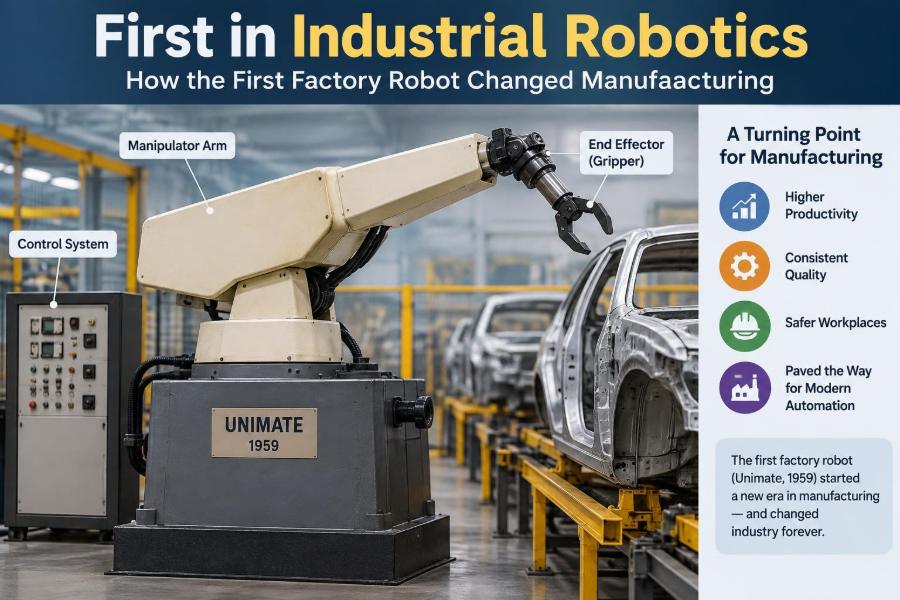
The machine most often identified as the first industrial robot was Unimate. Developed from inventor George Devol’s concept and commercialized with entrepreneur and engineer Joseph Engelberger, it was installed at a General Motors plant in Trenton, New Jersey, in 1961.
Its job was not assembling an entire automobile. It handled hot die-cast parts and performed related material-transfer tasks. That narrower role is precisely why it succeeded: the task was hazardous, repetitive, physically demanding, and structured enough to automate.
Calling Unimate “the first robot” needs context. Earlier automatic machines, mechanical manipulators, and remote-handling devices existed. Unimate’s historical importance lies in being an early commercially deployed, programmable industrial robot used in production.
🧭 Why the Definition of “Robot” Matters
A machine is not automatically a robot simply because it moves. A dedicated cam-driven mechanism can repeat one motion for decades, but changing its task may require redesigning hardware.
An industrial robot is generally a reprogrammable, automatically controlled manipulator designed to move materials, parts, tools, or specialized devices through variable programmed motions. The crucial idea is reprogrammability.
Unimate could store a sequence of positions and actions, allowing its motion pattern to be changed without rebuilding the entire mechanism. Its capability was modest by modern standards, but this distinction separated robotics from conventional fixed automation.
💡 George Devol’s Foundational Idea
George Devol developed the core idea during the 1950s. He filed a patent application in 1954 for a programmable material-transfer device, later granted as a patent in 1961. The concept described a general-purpose programmable manipulator rather than a single-purpose production machine.
That was a meaningful engineering shift. A factory could potentially use one machine architecture for several handling operations by changing instructions, end tooling, or both.
Devol’s idea solved only part of the problem. A patent concept must still become a durable product: one that can survive industrial conditions, be controlled predictably, be sold to manufacturers, and earn back its cost. That required a business and engineering partnership.
🤝 Joseph Engelberger and Commercialization
Joseph Engelberger recognized the manufacturing potential of Devol’s invention and worked with him to form Unimation in 1956. Engelberger is often called the “father of robotics” because of his central role in turning the concept into an industrial product and market.
Commercialization demanded more than enthusiasm for a futuristic device. The team had to identify a task where the robot offered a clear advantage, build a robust arm and controller, persuade a major manufacturer to take operational risk, and support the equipment after installation.
This is a recurring pattern in robotics history: invention creates possibility, but deployment creates impact. A robot becomes consequential only when it can keep working in the messy reality of production.
🔥 Why Die Casting Was the Right First Application
Die casting injects molten metal into a reusable mold under pressure. When a part is released, it may be extremely hot and must be removed with repeatable timing before the next machine cycle begins.
This environment suited an early robot because the workpiece locations were controlled, the motion could be defined in advance, and human exposure to heat and repetitive handling could be reduced. The robot was not asked to identify random objects on a cluttered table or make judgment calls about quality.
Early automation often succeeds where the world is made predictable first. Fixtures, guards, conveyors, and consistent part presentation can simplify the robot’s job as much as the robot itself does.
🦾 What the First Unimate Actually Did
The first Unimate at General Motors handled die-cast components and moved them through a production sequence. Accounts commonly describe it extracting hot parts, then placing them into cooling or processing operations such as trimming.
The robot’s value came from repeatability and endurance. It could perform the same movement at a consistent cadence without placing a worker directly beside the heat-intensive machine during each cycle.
It is tempting to picture a versatile digital assistant with a metal arm. Unimate was closer to a powerful, programmable production machine: specialized, deliberate, and designed around a particular cell. Its success came from matching capability to a well-bounded task.
⚙️ How a Programmable Arm Changes Automation
Fixed automation is like a music box: its physical mechanism determines the tune. A programmable robot is more like a player piano: within its mechanical limits, a new sequence can be entered without rebuilding every moving component.
For a manufacturer, this mattered when products, part sizes, or process layouts changed. A robot could potentially be taught new points, given a new gripper, and integrated into a revised cell.
Reprogramming did not make change free or instantaneous. Engineers still needed to validate reach, payload, collision clearance, cycle time, safety, tooling, and process quality. But it introduced useful flexibility into an environment long dominated by dedicated machinery.
🧠 The Early Control System
Unimate used control technology very different from the compact digital robot controllers familiar today. Early systems relied substantially on hydraulic power and stored motion information using magnetic-drum memory.
Hydraulics supplied large forces, which made sense for heavy industrial handling. The trade-off was a system with pumps, valves, fluid management, noise, and maintenance demands. A controller had to coordinate movements reliably enough for the arm to repeat its taught sequence.
Modern readers should avoid judging the system by today’s interfaces. The accomplishment was not a touch screen or artificial intelligence. It was dependable automated motion in a demanding production setting using the technologies available at the time.
📐 Degrees of Freedom and Useful Motion
A robot arm’s degrees of freedom are independent motions it can control. They may include rotation at joints and linear extension. More degrees of freedom can help an arm reach around obstacles or orient a tool, but they also increase control complexity.
Unimate’s articulated motion gave it a practical working envelope for transferring parts. It did not need human-like dexterity to be valuable. It needed enough controlled motion to reach into a machine, withdraw a part, and place it accurately at the next station.
This remains a good design principle. Choose the least complex robot that can safely and reliably achieve the required motion, rather than treating maximum flexibility as an automatic advantage.
🧲 End Effectors Turn Motion into Work
The arm itself moves; the end effector performs the task. An end effector may be a mechanical gripper, vacuum cup, magnetic tool, welding gun, screwdriver, dispenser, or custom fixture.
For foundry and die-casting work, gripping had to tolerate heat, part variation, and the forces created by acceleration. A poorly designed gripper can drop a component, deform a part, or make an otherwise capable robot unusable.
Students sometimes focus on robot arms because they are visually striking. In many real projects, end-of-arm tooling determines success. It connects the abstract capability of motion to the physical reality of material, geometry, and process conditions.
🔁 Repeatability Before Intelligence
Early industrial robotics was built on repeatability, not perception. If every part arrived in the same position, the robot could use the same coordinate sequence every time. That was enough for many high-value tasks.
Repeatability means returning to a commanded position consistently. It is not identical to absolute accuracy, which describes how closely a machine reaches a specified real-world location. Both matter, but repeatability is often especially important in a stable production cell.
Modern vision systems can locate varied parts and compensate for some change. Yet reliable fixturing still reduces uncertainty, speeds commissioning, and makes faults easier to diagnose. Intelligent sensing extends good process design; it does not eliminate the need for it.
⏱️ Cycle Time and Production Rhythm
A manufacturing line operates to a rhythm. Cycle time is the time allowed to complete one sequence or produce one unit. If a robot takes too long, it becomes the bottleneck; if it moves faster than downstream equipment can accept, its extra speed produces no benefit.
Unimate was valuable because it could synchronize material handling with a process machine. Its movement was part of the cell’s total cycle, not an isolated demonstration of mechanical speed.
When evaluating a robot cell, engineers measure more than arm travel time. They include gripper operation, machine handshakes, part settling, inspection, conveyor transfer, safety delays, and recovery after an interruption. Productive automation is coordinated automation.
🛡️ Safety Became a System Design Problem
A powerful industrial robot can move quickly and unexpectedly from a nearby worker’s perspective, especially during automatic operation. The first generations of industrial robots helped make clear that safety could not be an afterthought.
Safeguarding evolved through physical barriers, interlocked gates, emergency-stop circuits, operating modes, safe work procedures, and later safety-rated control functions. Exact requirements depend on jurisdiction, application, and applicable standards, so installations must be assessed by qualified professionals.
The central lesson is durable: a robot is safe only as part of a complete work cell. Risk comes from the arm, tooling, payload, surrounding machines, stored energy, pinch points, and the tasks people perform during setup and maintenance.
🚧 Why Demonstrations Are Easier Than Deployments
A robot can perform beautifully in a controlled demonstration and fail in production because real factories introduce variation. Parts may arrive slightly skewed, a gripper may wear, cooling conditions may change, or an operator may need access for a jam.
Deployment therefore requires engineering around exceptions. Sensors confirm that a part is present. Interlocks confirm safe conditions. Fault messages guide recovery. Preventive maintenance addresses wear before a missed cycle becomes a long outage.
Unimate’s lasting contribution was not simply proving an arm could move. It proved that a programmable arm could be incorporated into an industrial process seriously enough for manufacturers to invest in the surrounding system.
📈 The Economic Case Was More Than Labor Cost
Industrial robots are sometimes described as tools for replacing labor. That description is incomplete. In hazardous work, a manufacturer may automate to reduce exposure. In high-volume work, the value may come from consistent throughput, less scrap, steadier quality, or the ability to run a process that is difficult to staff.
Costs also matter: capital equipment, tooling, integration, floor space, energy, spares, programming, training, and downtime all affect the decision. A robot that is technically feasible may still be a poor investment for a low-volume, frequently changing process.
The strongest business case is specific. It identifies the constraint being relieved and measures whether the full system, not merely the robot, improves it.
👷 Jobs Changed Rather Than Simply Vanished
The arrival of factory robots changed work. Some direct manual handling tasks were reduced or removed, especially where they were repetitive or unsafe. At the same time, robotized production created needs for technicians, maintenance workers, tool designers, programmers, controls engineers, and production staff who could supervise automated cells.
That does not mean every transition was easy or fair. Automation can disrupt roles, alter skill requirements, and shift bargaining power. Workers and communities may feel the consequences before retraining opportunities become accessible.
A responsible engineering view recognizes both realities: robots can reduce harmful exposure and improve process consistency, while implementation decisions should include training, communication, and meaningful pathways into the new work.
🏗️ From One Robot to a Production Cell
Unimate was a key machine, but it worked within a system. The die-casting machine, part-handling equipment, downstream process, controls, guards, and operators all influenced its performance.
This is why industrial robotics is fundamentally a systems discipline. A robot may have sufficient reach and payload on a specification sheet, yet fail because a conveyor presents parts inconsistently or a maintenance technician cannot safely access a component.
Think of the robot as a skilled member of a tightly organized team. Its effectiveness depends on clear handoffs, usable interfaces, well-defined responsibilities, and recovery procedures when something goes wrong.
🔧 Reliability Depends on Maintenance
Every production asset wears. Joints, hoses, seals, cables, grippers, sensors, connectors, and fixtures need inspection and replacement at appropriate intervals. In hydraulic systems, fluid condition and leak prevention are additional concerns.
Maintenance is not merely repair after failure. Preventive maintenance uses scheduled checks, lubrication where required, calibration verification, cleaning, and spare-parts planning to reduce unplanned downtime.
For modern teams, fault history is valuable engineering data. If a robot repeatedly misses a pickup, the root cause may be a worn gripper pad, drifting fixture, unreliable sensor, or changed part—not necessarily a “robot problem.” Diagnose the entire cell before changing code.
🌍 The Spread Beyond Automotive Plants
Automotive manufacturing provided an early home for industrial robots because production volumes were high and many processes were physically demanding. Over time, robot applications spread to welding, painting, machine tending, palletizing, electronics assembly, packaging, food handling, and laboratory work.
Different industries demanded different strengths. Automotive welding emphasized reach, repeatability, and coordinated cells. Electronics required delicate handling and cleanliness. Logistics increased demand for picking, sorting, and pallet movement.
The common thread is not one robot shape. It is the ability to combine controlled motion, suitable tooling, sensing where needed, and a process designed for automation.
🎨 Welding Made the Robot Visible
Industrial robots became strongly associated with automotive welding, where coordinated arms could repeatedly position welding tools along defined paths. The visual impact of sparks and moving arms made this application a familiar symbol of factory automation.
Welding also illustrates why robotics requires process expertise. A robot can follow a path precisely, but weld quality depends on joint preparation, tool condition, power settings, shielding, part fit-up, and inspection. Motion alone does not guarantee a sound weld.
This distinction applies broadly. Robots improve consistency when the underlying process is capable and controlled. They can repeat a bad setup with extraordinary consistency too.
🖥️ From Magnetic Drums to Digital Controllers
Robot controllers became smaller, faster, and more capable as electronics and computing advanced. Digital control enabled more sophisticated motion planning, easier program storage, diagnostics, communication with other equipment, and integration with sensors.
Later generations added offline programming, simulation, networked manufacturing data, force sensing, machine vision, and safety functions. These tools widened the range of feasible applications, particularly where position variation or product mix made simple taught motion insufficient.
Still, a modern controller does not erase physical constraints. Payload affects acceleration, reach affects stiffness, cable routing affects reliability, and tooling still determines how parts are grasped. Better software expands options; sound mechanics remains essential.
👁️ Vision and Sensing Address Variation
A fixed robot program assumes a predictable world. Sensors provide information when that assumption breaks down. Photoelectric sensors can confirm presence, force sensors can detect contact, and cameras can estimate the position or orientation of a part.
For example, a hypothetical bin-picking cell may use a camera to locate randomly arranged components before the robot chooses a safe grasp. That is fundamentally harder than taking a casting from a fixed die because the scene changes every cycle.
Sensing improves flexibility, but it brings its own engineering work: lighting, calibration, communication latency, confidence thresholds, error handling, and validation of edge cases. The best sensor strategy is often the simplest one that resolves the real uncertainty.
🤖 Collaborative Robots Are Not Unimate’s Replacement
Collaborative robots, often called cobots, are designed with features that can support operation nearer to people in suitable applications. They are useful for some assembly, inspection, packaging, and machine-tending tasks, especially where flexibility and relatively quick changeovers matter.
They are not inherently safe in every setup, and they are not always the best choice. Tool shape, payload, speed, workpiece hazards, and the overall cell determine risk. A cobot carrying a sharp or hot tool may require substantial safeguarding.
Traditional industrial robots frequently remain better for high-speed, heavy-payload, or high-throughput work. The lineage from Unimate is not a march toward one perfect robot; it is an expanding set of designs for different constraints.
📊 Fixed Automation, Robots, and Cobots Compared
| Approach | Best fit | Primary strength | Key limitation |
|---|---|---|---|
| Fixed automation | Stable, very high-volume task | Speed and repeatability | Costly to change over |
| Traditional industrial robot | Demanding handling or process work | Reach, payload, speed, flexibility | Requires careful integration and safeguarding |
| Collaborative robot | Flexible, lower-force tasks near people | Deployment flexibility in suitable cells | May have lower speed or payload; still needs risk assessment |
These categories overlap in practice. The correct choice follows from process requirements, not from which machine appears most advanced.
🧪 What Students Can Learn from Unimate
Unimate is an unusually useful case study because it connects mechanics, controls, manufacturing, business, and human factors. It was not a breakthrough caused by one discipline working alone.
When studying a robotic application, ask practical questions:
- What exactly is the material, tool, or process being handled?
- What variation exists, and how will the system detect or constrain it?
- What cycle time, payload, reach, and accuracy are actually required?
- How will people load, inspect, maintain, and recover the cell safely?
- What outcome justifies the investment: safety, quality, capacity, consistency, or flexibility?
Those questions turn fascination with robots into engineering judgment.
🧰 A Practical Method for Choosing an Automation Task
Good first robot projects are rarely the most complicated tasks in a facility. Look for a repeatable operation with a defined start and end state, measurable pain points, stable parts, and a clear recovery strategy.
- Map the current process, including exceptions and operator actions.
- Measure variation in part position, orientation, timing, and condition.
- Define the required output, quality checks, and safe operating modes.
- Select robot, tooling, sensors, and safeguarding as one system.
- Test normal cycles and foreseeable fault conditions before release.
This approach echoes the logic behind Unimate’s early success: begin with a constrained, valuable problem instead of asking a robot to solve everything at once.
⚠️ Common Mistakes in Robot History Lessons
One mistake is treating the first industrial robot as a sudden replacement for all factory labor. In reality, adoption was gradual, application-specific, and dependent on capital, integration skill, and manufacturing conditions.
Another is treating technology as inevitable. Unimate needed inventors, a company, a customer willing to deploy it, and a task whose risks and economics made automation sensible. Different choices could have delayed or redirected adoption.
A third mistake is celebrating autonomy while ignoring the designed environment. Much industrial reliability comes from fixtures, process control, disciplined maintenance, and trained people. The robot is powerful because the system around it is engineered to make success repeatable.
🧩 The Core Principle Unimate Established
Unimate changed manufacturing because it demonstrated a practical formula: use a programmable manipulator to remove a person from a hazardous, repetitive transfer task while keeping production synchronized and controllable.
That formula remains recognizable in modern cells, even when the hardware includes servo motors, machine vision, collaborative operation, cloud-connected data, or advanced simulation. The technologies changed; the engineering question did not: where can controlled motion produce a safer, more reliable, and economically sensible process?
The first factory robot mattered not because it resembled a person, but because it made programmable physical work useful on the factory floor.
From hot castings in one General Motors plant to today’s diverse automated cells, industrial robotics has advanced through the same discipline: understand the task, design the whole system, and use automation where it genuinely improves the work. 🦾🏭⚙️