
A robot arm may look impressive as it swings across a factory cell, stacks cartons, or places components with millimeter-level repeatability. But an arm without a tool at its wrist cannot pick, cut, inspect, dispense, fasten, or assemble anything useful.
That final tool is the end effector. In many applications, it is the part that actually meets the product, the workpiece, or the environment. Its design often decides whether an automation project is reliable or constantly interrupted by dropped parts, jams, and manual recovery.
Consider a robot asked to move fragile glass vials in one shift and sealed shipping cartons in another. The arm may have enough reach and payload for both jobs, yet the same gripper will rarely handle both objects well. The contact method, force control, finger shape, sensing, and tool material all matter.
Understanding end effectors helps students connect robot kinematics to real production work. It also gives working engineers a practical way to frame a key question: not merely “Can the robot reach the part?” but “Can it securely and safely do something useful with it?”
🦾 What an End Effector Is
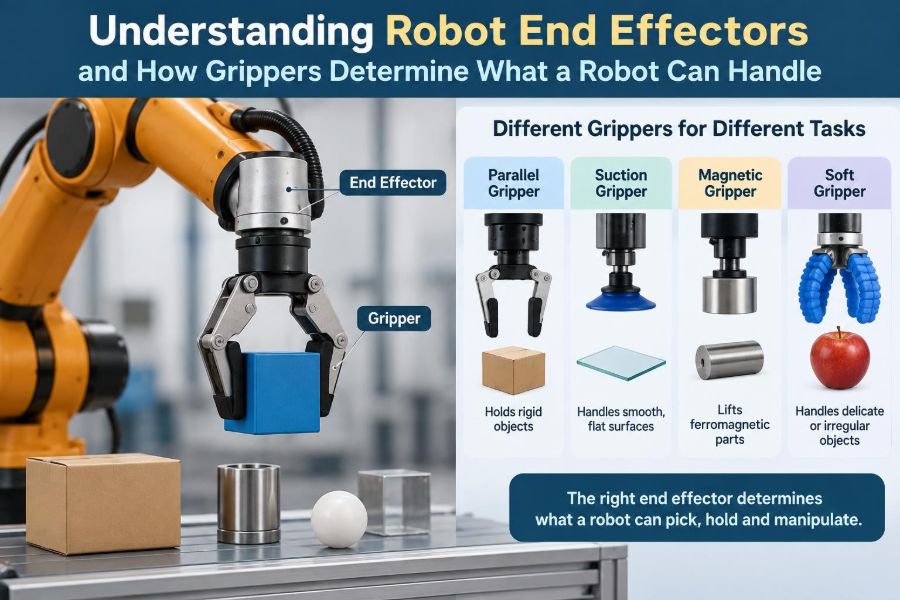
An end effector is the device attached to the end of a robot manipulator, usually at the wrist flange. It converts the arm’s motion into an interaction with the outside world: gripping a component, turning a screw, applying adhesive, scanning a barcode, or welding a joint.
A gripper is therefore one type of end effector, but the terms are not interchangeable. A vacuum cup, welding torch, screwdriver, camera, and paint spray gun are all end effectors even though they do not grip an object in the usual sense.
🎯 Why the Wrist Tool Defines the Job
Robot arms are general motion platforms. Their axes provide position and orientation, but the end effector determines the physical action available at the point of contact.
A six-axis arm fitted with a parallel gripper can pick a gear. Fit the same arm with a dispensing valve and it can lay down a controlled bead of sealant. The arm has not changed; the manufacturing capability has.
This is why end-effector selection belongs near the beginning of cell design, not as an accessory chosen after the robot model.
🧩 The Main Parts of an End-Effector System
The visible fingers or suction cups are only part of the system. A working tool often includes mechanical, electrical, pneumatic, and software elements that must operate together.
- Mounting interface: connects the tool to the robot wrist.
- Actuator: creates motion or gripping force using air, electricity, hydraulics, or springs.
- Contact elements: fingers, pads, cups, blades, nozzles, or other working surfaces.
- Sensors: detect part presence, jaw position, force, vacuum level, or tool condition.
- Utilities: cables, air lines, vacuum hoses, coolant, or process material feeds.
Ignoring any one of these can create a tool that works in a demonstration but fails in continuous operation.
🤏 Grippers: The Most Common Handling Tool
A gripper holds or constrains an object so a robot can move it without unintended slip, rotation, or loss. It must do this while respecting the part’s allowable contact locations, surface condition, weight, and fragility.
Good gripping is not always about squeezing harder. Excess force can dent thin sheet metal, crack molded plastic, mar a cosmetic surface, or distort a precision part. The goal is stable control with an appropriate safety margin.
↔️ Parallel-Jaw Grippers
Parallel grippers move two jaws toward or away from each other along straight, opposing paths. They are common because their motion is intuitive and their fingers can be customized for many part shapes.
They can grip a part externally by closing around it, or internally by expanding inside a hole or cavity. Parallel jaws work particularly well when a component has repeatable flat, cylindrical, or machined gripping features.
The limitation is alignment. If a loosely presented part is offset or rotated, rigid fingers may collide with it rather than guide it into position.
🦀 Angular Grippers and Their Useful Clearance
Angular grippers use jaws that pivot open and closed. Their fingers sweep through an arc, often creating more clearance around a part when open than a comparable parallel gripper.
That can be valuable when reaching into a fixture, unloading a machine, or avoiding adjacent geometry. However, the arc changes the finger position as the jaws close, so designers must check for collisions throughout the entire motion—not only at the final grasp.
☁️ Vacuum Grippers and Suction Cups
Vacuum end effectors hold an object by creating lower pressure inside a suction cup or gripper chamber. Atmospheric pressure then presses the object against the cup. They are widely used for cartons, sheet material, sealed packages, and flat or gently curved surfaces.
Vacuum can be fast and mechanically simple, but it depends on surface conditions. Porous cardboard, dusty panels, uneven films, perforated materials, and leaky packaging can reduce holding performance.
A vacuum sensor helps confirm that a part has been picked. It does not eliminate the need to account for acceleration, cup wear, and the possibility that a surface seal changes over time.
🧲 Magnetic Grippers for Ferrous Parts
Magnetic grippers handle ferromagnetic materials such as many steels without squeezing the workpiece. Permanent magnets can hold without continuous power, while electromagnets can be switched electrically.
They are useful for sheet metal, stamped blanks, and steel components, especially where a mechanical gripper has little edge access. But they do not work on aluminum, copper, most stainless steels, or nonmetallic objects.
Residual magnetism, oily surfaces, stacked-sheet separation, and the risk of carrying more than one thin part are practical concerns that need testing.
🖐️ Soft Grippers for Delicate and Irregular Objects
Soft grippers use compliant materials, flexible fingers, inflatable structures, or adaptive mechanisms to conform around an object. Their value is not simply softness; it is the ability to distribute contact over a larger area and tolerate shape variation.
They are often considered for produce, baked goods, fragile consumer products, and irregularly shaped items. Their compliance can reduce damage, but it may also reduce positional precision and make exact grasp behavior harder to predict.
Soft tooling still needs cleaning, durability assessment, and a clear understanding of how it behaves after repeated cycles.
🧰 Specialized End Effectors Beyond Gripping
Some robot tasks require a tool that changes the part or gathers information rather than transports it. These end effectors are selected around process performance as much as handling performance.
- Welding torches control arc position and orientation.
- Screwdriving tools manage bit engagement, torque, and screw feeding.
- Dispensers meter adhesives, sealants, lubricants, or coatings.
- Deburring tools remove material while managing contact force.
- Cameras and scanners inspect features, read codes, or guide picking.
A process tool may still need a small gripper, clamp, or locating device elsewhere in the cell to stabilize the workpiece.
📦 Start With the Part, Not the Catalog
End-effector selection begins with a structured description of the object and task. A supplier catalog can suggest options, but it cannot know whether a part arrives wet, nested, hot, misoriented, or slightly different from batch to batch.
Document the part’s mass, dimensions, center of gravity, material, surface finish, permitted contact zones, temperature, and variation. Then describe what the robot must do: pick, orient, insert, inspect, carry, press, or release.
The most useful question is: what features can the tool reliably use without harming the product?
⚖️ Payload Is More Than Object Weight
Robot payload ratings generally include everything carried at the wrist: the end effector, adapter plates, hoses, cables, sensors, and the workpiece. A heavy gripper reduces the remaining capacity available for the part.
Mass distribution matters too. A long tool places its center of mass farther from the wrist, increasing the moment or turning effect on the robot joints. This can reduce achievable speed, affect accuracy, or trigger protective limits even when the mass seems acceptable.
Use the robot manufacturer’s payload and inertia guidance for the intended pose range. A static weight check alone is not sufficient.
🏃 Acceleration Creates the Real Holding Challenge
A gripper does not merely support a stationary object. It must resist forces caused by starts, stops, turns, and changes in orientation. A lightweight part moving quickly can impose substantial dynamic loads.
If a robot accelerates horizontally, friction-based fingers must prevent the part from sliding. If it rotates a part rapidly, the grip must resist a torque that tries to twist the object free. Vertical motion also changes the forces during acceleration and braking.
For this reason, a successful slow bench test is not proof that a tool will work at production speed.
📐 Center of Gravity and Moment Arms
The center of gravity is the effective point through which an object’s weight acts. When it is offset from the grip location, gravity creates a moment that tries to rotate the part.
Imagine holding a hammer by the end of its handle. Its weight is modest, but the heavy head is far from your hand and makes control harder. Robot grippers face the same principle.
Gripping closer to the center of gravity, adding a locating feature, or using multiple contact points can improve stability. In some cases, changing the pick orientation is easier than redesigning the gripper.
🧱 Friction, Form Closure, and Force Closure
Grippers secure parts in different ways. Friction closure relies on normal force pressing pads against a surface; the resulting friction resists motion. It is simple but sensitive to oil, dust, moisture, and surface variation.
Form closure uses geometry to physically block movement, such as fingers that capture a shoulder, groove, or flange. It can be more robust because the part is not held solely by friction.
Force closure uses multiple controlled contact forces so that the part can resist motion in several directions. The terminology is useful because it directs attention to what motions remain possible after the grasp.
🧪 Surface Condition Can Defeat a Good Design
The same part can behave differently after machining, washing, painting, or handling by people. Oil can lower friction, dust can prevent a vacuum seal, and burrs can catch on fingers or fixtures.
Design reviews should include the realistic condition of incoming parts, not only clean samples from a lab. If conditions vary, choose contact materials and grasp geometry that remain acceptable across that variation.
Where contamination is unavoidable, inspection and maintenance plans become part of end-effector reliability.
🪶 Choosing Contact Materials
Finger pads, suction cup lips, and protective coatings influence grip, wear, marking, and cleanability. Rubber-like materials can increase friction and protect finishes, but they can wear, absorb contaminants, or leave residue in some environments.
Metal contact surfaces tolerate heat and repeated impacts but can scratch softer products. Engineering plastics may offer low friction, low mass, and chemical resistance, though their stiffness and temperature limits vary.
Select material around the actual environment: washdown, food handling, electronics assembly, high temperature, cleanroom use, or abrasive dust each create different requirements.
🔍 Sensors Turn a Tool Into a Feedback Device
A basic gripper may only open and close. A smarter end effector can report whether jaws reached a position, whether a part is present, whether vacuum is adequate, or whether contact force exceeded a limit.
This feedback helps a controller distinguish between a successful pick and an empty grasp. It can also trigger recovery routines before a robot carries a missing or misplaced part into the next station.
Sensors improve diagnosability, but they must be installed and interpreted carefully. A jaw-position sensor, for example, may indicate that the gripper closed; it does not always prove that the correct part was grasped.
👁️ Vision and Grasping Work Together
Machine vision can locate parts whose position or orientation varies, identify a usable grasp region, and verify conditions before picking. It is especially helpful for bin picking, mixed-item handling, and trays with imperfect presentation.
Vision does not replace gripper design. A camera can estimate where an item is, but the end effector still needs enough clearance, compliance, and holding capability to execute the grasp.
The strongest systems treat perception and tooling as a joint problem: vision identifies what is feasible, while the gripper provides a tolerance to small positioning errors.
🔄 Tool Changers Expand a Robot’s Range
An automatic tool changer allows a robot to pick up and release different end effectors during an operating sequence. One arm might use a gripper to load a machine, a probe to inspect a feature, and a vacuum tool to pack the finished product.
The flexibility has costs. Tool changers add mass, length, interfaces, calibration requirements, and possible failure points. They are most justified when several tasks share the robot effectively, rather than when a dedicated second robot would simplify the process.
🧭 Coordinate Frames and TCP Accuracy
The tool center point, or TCP, is the reference point the robot controller uses to command the end effector. For a welding torch it may be the wire tip; for a gripper it may be the center of the grasp; for a camera it may be an optical reference point.
If the TCP is calibrated incorrectly, the robot may consistently miss the target even though its programmed coordinates look correct. Tool orientation also matters because long fingers can collide with fixtures during wrist rotations.
Whenever a tool changes, its TCP, mass properties, and collision envelope should be treated as engineering data—not informal assumptions.
🧷 Compliance Helps With Imperfect Alignment
Compliance means controlled flexibility or motion that allows a tool to accommodate small misalignments. It may come from soft pads, spring-loaded fingers, a remote center compliance device, or force-controlled robot motion.
This is particularly useful for insertion tasks, such as placing a peg into a hole or seating a connector. A completely rigid tool can jam when the robot and fixture have small positional errors.
Too much compliance can make placement imprecise. The design challenge is to allow motion in the directions that need forgiveness while remaining stiff in the directions that require control.
🛡️ Safety Is Part of Tool Design
End effectors introduce hazards: pinch points between fingers, sharp process tools, hot surfaces, stored pneumatic energy, unexpected releases, and falling parts. A safe robot cell considers these hazards in normal operation, maintenance, faults, and manual recovery.
Grippers should not rely on uncontrolled loss of air or power for safety-critical holding unless the risk assessment specifically supports that behavior. Some applications use mechanical retention, monitored vacuum, or designed fail-safe states, but the suitable approach depends on the task.
Safety requirements vary by jurisdiction and application. Use the relevant machine-safety process and qualified personnel when designing or modifying a system.
🧼 Hygiene, Cleanliness, and Contamination Control
Food, pharmaceutical, laboratory, and electronics environments can impose requirements beyond basic gripping performance. Crevices may trap residues, shed particles may contaminate a product, and lubricants may be unacceptable near a process.
A hygienic end effector often favors smooth surfaces, accessible cleaning areas, compatible materials, and routing that avoids liquid traps. In electronics work, electrostatic discharge considerations may influence materials and grounding.
These constraints can rule out an otherwise capable gripper, which is why environment belongs in the original requirements list.
🛠️ Maintenance Determines Long-Term Repeatability
Wear appears at suction cup lips, finger pads, bearings, seals, cable bends, and pneumatic fittings. Small changes can gradually reduce grip quality long before a complete failure occurs.
Maintenance should include visual checks, cleaning, verification of sensors, inspection for leaks, and replacement of consumable contact parts. Tracking recurring faults can reveal whether the root cause is tool wear, part variation, programming, or upstream handling.
A design that makes pads and cups quick to replace often saves more downtime than a theoretically superior tool that is difficult to service.
🚫 Common End-Effector Selection Mistakes
Many failures come from reasonable assumptions that were never tested under real conditions. Avoiding them early is less expensive than correcting them after installation.
- Choosing based only on part weight, while ignoring acceleration and center of gravity.
- Testing with ideal sample parts instead of real surface contamination and tolerance variation.
- Using excessive gripping force to compensate for poor geometry.
- Forgetting cables and hoses when checking collisions and robot payload.
- Assuming a part-present signal proves correct orientation or complete seating.
- Designing a tool without considering access for cleaning, adjustment, and repair.
📝 A Practical Selection Workflow
Start by observing the current handling process. Note where people naturally hold the part, where they avoid touching it, and what causes jams or drops. Human handling often reveals useful grasp features, but a robot may need a more repeatable presentation method.
- Define the part, its variation, and prohibited contact areas.
- Define the task path, cycle expectations, and process environment.
- Estimate payload, center of gravity, dynamic loads, and collision space.
- Choose candidate grip principles: mechanical, vacuum, magnetic, soft, or specialized.
- Prototype with representative parts and realistic speeds.
- Add sensing, recovery logic, and maintainability before finalizing the design.
Testing should include edge cases: low and high tolerance parts, awkward orientations, worn cups or pads, and the expected range of surface conditions.
🏭 Example: Picking a Carton Versus a Machined Gear
A sealed carton may be best handled from above with multiple vacuum cups. The design priorities are cup layout, package stiffness, vacuum confirmation, and safe response to a leaking seal or damaged box.
A machined gear may instead need a parallel gripper with shaped fingers that locate on a bore, hub, or tooth-free feature. Here, oil resistance, repeatable orientation, fixture clearance, and protection against dropping into machinery may dominate.
Both are “pick-and-place” tasks, but their contact physics and failure modes are fundamentally different. That is why a generic gripper is rarely a universal answer.
📈 Designing for Throughput Without Sacrificing Reliability
Faster cycles can increase dynamic force, vibration, and the consequences of small timing errors. A gripper that is reliable at moderate speed may need different pads, stronger geometric retention, or a revised robot path at higher speed.
Sometimes the best throughput improvement is not stronger grip force. It may be reducing travel distance, presenting parts more consistently, using a lighter tool, or avoiding a wrist rotation that destabilizes the object.
Reliable throughput comes from the combined behavior of robot, end effector, fixture, part supply, and control logic.
🧠 The Core Principle: Match Contact to the Task
The central rule of end-effector design is simple: choose the contact method around the part’s geometry, condition, motion, and allowable risk. A robot can only handle what its tool can repeatedly locate, secure, move, and release.
Mechanical fingers excel when shape provides a reliable feature. Vacuum is compelling for suitable surfaces and broad-area pickup. Magnetic tools suit compatible metals. Soft and compliant tools help where product variation or fragility matters. Process end effectors demand their own accuracy and safety criteria.
No tool is universally best. The right answer is the one that remains dependable when real parts, realistic motion, environmental variation, maintenance needs, and fault recovery are all considered together.
A robot arm provides motion, but its end effector determines what that motion can accomplish in the real world. Design the grasp as carefully as the robot path, and the entire system becomes more capable, predictable, and safe. 🦾⚙️📦