
A robot arm lifts a shiny automotive panel from a bin, rotates it, and places it onto a fixture. The motion looks routine—until the next panel arrives slightly tilted, partly covered by protective film, and a few millimeters away from its expected position.
A conventional machine can repeat a taught path with remarkable consistency. But repetition alone does not solve a changing workspace. To handle variation safely and accurately, the system must first perceive what is there, decide what it means, and then move with controlled force and position.
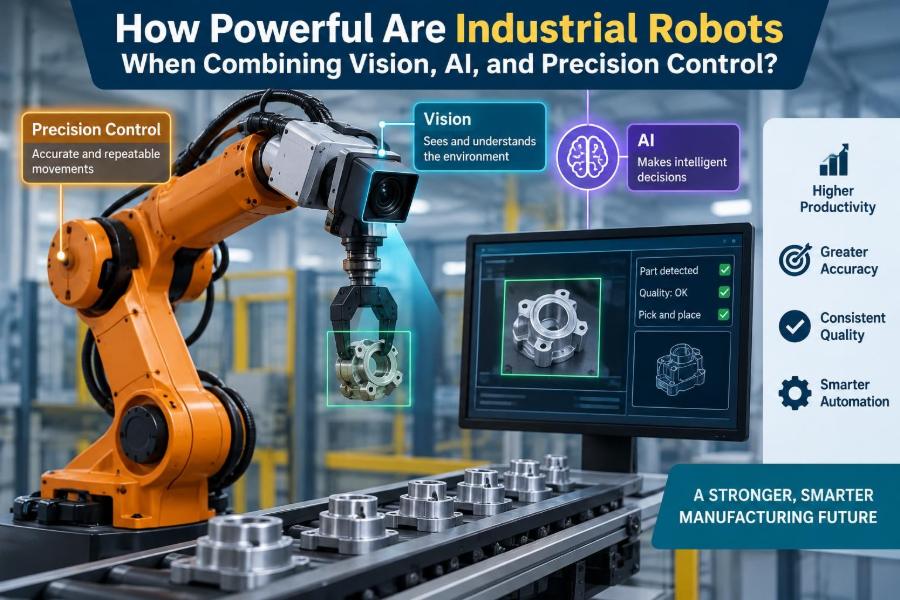
That is where machine vision, artificial intelligence, and precision motion control meet. Combined well, they turn an industrial robot from a powerful programmable arm into a system that can react to real production conditions.
The combination is influential in factories, warehouses, laboratories, food lines, and electronics assembly. Yet its capabilities are often misunderstood: it does not make robots magically human-like, and it introduces new engineering limits that matter just as much as the gains.
🏭 The Meaning of “Powerful” in Industrial Robotics
Robot power is not simply motor size or payload rating. In practical automation, power means the ability to produce a useful result despite variation: locating a part, selecting a suitable grasp, placing it accurately, verifying the outcome, and recovering when conditions are not ideal.
A robot may be physically strong enough to handle a heavy casting but unable to identify its orientation. Another may identify a tiny connector but lack the stiffness, tooling, or force control needed to insert it. The most capable systems align perception, decision-making, motion, and process feedback.
🧩 The Three-Layer Capability Stack
Vision answers, “What is present, and where is it?” AI can help answer, “What object, condition, or action is most likely?” Precision control answers, “How can the robot execute the motion safely and accurately?”
These functions are connected but not interchangeable. A reliable cell also needs fixtures, end-of-arm tooling, safety hardware, networking, lighting, calibration, and clear acceptance criteria. The robot arm is only one part of the automated system.
👁️ What Machine Vision Adds
Machine vision uses cameras and image-processing methods to extract usable information from images. A basic system may find edges, read a code, measure a gap, or determine whether a component is present.
For robotic guidance, vision often estimates an object’s position and orientation. A two-dimensional camera can locate parts on a flat plane. A 3D camera, stereo system, laser profiler, or depth sensor can estimate height and surface geometry when the task requires it.
📷 From Pixels to Robot Coordinates
A camera does not naturally report a point in the robot’s coordinate frame. It reports pixels, depth values, or a pose relative to its own viewpoint. Calibration establishes the geometric relationship between camera, robot, tool, fixture, and work surface.
Hand-eye calibration is especially important when a camera is mounted on the robot wrist or observes the robot from a fixed position. Small errors in this relationship can become large placement errors, particularly when the robot reaches far from its reference position.
🧠 Where AI Fits—and Where It Does Not
AI in industrial vision commonly refers to machine-learning models that classify, detect, segment, or inspect objects in images. A model can be useful when objects vary in appearance, when defects are visually complex, or when hand-written image rules become difficult to maintain.
AI is not a replacement for geometry, calibration, or engineering judgment. A model may recognize a part reliably while still providing a pose that is not accurate enough for insertion. In many cells, conventional vision supplies the precise measurements while AI handles recognition or anomaly screening.
🔎 Rule-Based Vision Versus Learned Vision
Traditional vision tools use defined operations such as thresholding, template matching, blob analysis, edge detection, and geometric measurement. They are often transparent, fast, and effective when lighting, part shape, and background are controlled.
Learned vision can handle more visual variation, but it requires representative data, validation, version control, and monitoring for new conditions. The right choice depends on the task, not on which approach sounds more advanced.
| Approach | Often well suited to | Key engineering concern |
|---|---|---|
| Rule-based vision | Stable geometry, codes, precise edges | Sensitivity to lighting and presentation changes |
| Learned vision | Variable appearance, classification, complex defects | Training coverage and behavior outside the data |
| Hybrid system | Recognition plus accurate localization | Clear division of responsibility between methods |
🎯 Precision Is More Than Repeatability
Robot specifications often distinguish repeatability from accuracy. Repeatability describes how consistently a robot returns to the same taught point. Accuracy describes how close it comes to the intended real-world location.
A robot can be repeatable but offset from its nominal target because of calibration error, thermal effects, load deflection, or imperfect setup. Vision-guided correction can reduce some positioning error, but it cannot eliminate mechanical compliance or a poorly designed process.
📐 Understanding Pose: Position and Orientation
For many tasks, finding the center of a part is not enough. The robot needs a full pose: location plus orientation. A rectangular tray, for example, may need translation in three directions and rotation around multiple axes.
The more degrees of freedom the task requires, the more demanding sensing and calibration become. A flat label application may need only planar location and angle, while picking an irregular object from a bin may need a robust 3D pose estimate.
🦾 Motion Control Turns Intent into Movement
The robot controller converts a commanded path into joint motion through servo control. Encoders measure joint position, and feedback loops continually correct motor commands to follow the requested trajectory.
Path planning must account for speed, acceleration, singularities, joint limits, payload, and collision risk. A vision system can identify a target, but the controller still needs a feasible, safe route to reach it.
⚙️ Force Control Makes Contact Tasks Smarter
Position control is appropriate when the target and fixture are highly repeatable. Contact tasks are different. Pressing a seal, polishing a surface, seating a connector, or inserting a shaft can fail if the robot insists on following one rigid positional command.
Force or torque sensing lets the robot react to contact loads. Compliance control, sometimes implemented through impedance or admittance behavior, allows controlled “give” while maintaining a desired force. This can reduce damage, but it must be tuned around the mechanics of the tool and part.
🤏 Grasping Is a Perception-and-Mechanics Problem
A successful pick depends on more than seeing an object. The system must identify a reachable grasp point, avoid collisions, account for the object’s center of mass, and select a gripper that can tolerate expected variation.
Vacuum cups may be excellent for flat, sealed surfaces but struggle with porous, dusty, or highly irregular parts. Parallel grippers provide mechanical retention but need suitable surfaces and clearance. Vision guides the approach; tooling determines whether the grasp survives the move.
📦 Bin Picking Shows the Full Challenge
Bin picking is a useful example because it combines perception, planning, grasping, and recovery. Parts may overlap, reflect light, occlude one another, or present only a small graspable area.
A capable system typically detects candidate objects, estimates one or more poses, filters them by confidence and reachability, chooses a grasp, plans a collision-aware path, and checks whether the pick succeeded. If it fails, the system needs a controlled retry strategy rather than blind repetition.
🔄 Closed-Loop Control Beats One-Time Guessing
In an open-loop process, the robot acts on an assumption: the part is where it should be and the action worked. In a closed-loop process, sensors verify a condition and provide feedback for correction.
Examples include checking a vacuum-pressure signal after a pick, using a camera to verify a label location, or measuring insertion force during assembly. Closed-loop feedback improves robustness because it detects deviation before that deviation becomes scrap or a downstream jam.
🏗️ Fixture Design Still Matters
Vision does not make fixtures obsolete. A well-designed fixture constrains a part in predictable ways, improves repeatability, simplifies inspection, and reduces the burden on software.
The strongest automation design often uses the minimum necessary complexity. If a low-cost nest presents a part consistently, a simpler camera and faster cycle may outperform an elaborate vision solution trying to solve avoidable variability.
💡 Lighting Is Part of the Measurement System
Many apparent “AI failures” are actually imaging failures. Glare, shadows, changing daylight, flicker, dirty lenses, and background clutter can alter the information reaching the camera.
Lighting should be selected for the feature being measured. Backlighting can reveal a clean silhouette, diffuse lighting can reduce reflections, and angled illumination can emphasize texture or scratches. Stable lighting often delivers more value than adding model complexity.
🌡️ Real Factories Are Not Laboratory Benches
Production environments introduce vibration, heat, dust, oil mist, electrical noise, changing material lots, and human intervention. These conditions can shift camera mounts, contaminate optics, alter contrast, or change how a part behaves in a gripper.
Robust deployment means designing for inspection, cleaning, maintenance access, protective enclosures where appropriate, and detection of degraded sensor performance. A pilot that works for an hour is not automatically ready for continuous operation.
⏱️ Cycle Time Creates Hard Trade-Offs
Every vision-guided task has a timing budget: image capture, image transfer, processing, robot communication, motion, verification, and any recovery. More inspection views or deeper analysis can improve confidence while increasing cycle time.
Engineers should identify what must happen serially and what can happen in parallel. For example, a fixed camera may inspect the next part while the robot completes a placement, provided the cell layout and safety logic permit it.
🧪 Confidence Scores Need Sensible Policies
AI and vision tools may return a confidence score, but that number is not a universal guarantee of correctness. Its interpretation depends on the model, data, operating conditions, and how the score was calibrated.
Instead of treating every result as accept or reject, a cell can define operational bands: proceed, inspect again, send to a review lane, or stop for intervention. The thresholds should be tested against the cost of a missed defect, a false reject, and an unnecessary stoppage.
🧷 Safety Remains Separate From Intelligence
A smarter robot is not automatically a safer robot. Industrial robot safety requires risk assessment and appropriately designed protective measures, such as guards, interlocks, safety-rated sensing, emergency stops, safe-speed functions, and validated operating procedures.
Vision used for production guidance should not be assumed to provide safety protection unless the complete system is specifically designed, rated, and validated for that purpose. This distinction is critical when people share space with moving equipment.
👥 Human-Robot Collaboration Has Boundaries
Collaborative robots can make certain shared-workspace applications easier to implement, but collaboration is a system property, not a marketing label. Tool shape, payload, speed, pinch points, workpiece edges, and layout all affect risk.
Vision can help a robot adapt to work presented by an operator, such as locating a tray or recognizing a product variant. It does not remove the need for predictable behavior, clear handoff rules, and a safety strategy for abnormal conditions.
🧰 The Data Pipeline Behind Reliable AI
Industrial AI depends on data that represents the actual job: acceptable variation, difficult lighting, orientation changes, expected defects, and confusing near-matches. Data captured only under ideal setup conditions can create a brittle model.
Useful data practices include retaining examples of failures, documenting labels and camera settings, separating training and evaluation data, and controlling model versions. A model update should be tested like any other production change, not quietly deployed during a shift.
🛠️ Commissioning Requires More Than a Demo
A convincing demonstration usually proves that a concept can work. Commissioning proves that the cell meets defined requirements repeatedly in its intended environment.
Test plans should include normal operation, boundary conditions, missing parts, wrong parts, sensor faults, communication interruptions, poor images, and recovery after a stop. Acceptance criteria must be measurable: not simply “works well,” but what counts as a valid pick, placement, inspection, or safe halt.
🚨 Common Failure Modes to Design Around
Failures frequently occur at the interfaces between subsystems. The camera may identify a part correctly while a coordinate transform is wrong; the robot may reach the target while a flexible part bends; the gripper may close while confirming neither retention nor orientation.
- Assuming a vision result is correct without verification.
- Ignoring tool wear, camera contamination, or mechanical drift.
- Training an AI model on narrow, idealized examples.
- Using confidence thresholds without evaluating false decisions.
- Adding vision to compensate for a fundamentally unstable process.
- Designing recovery behavior only after failures appear on the line.
🔧 A Practical Integration Sequence
Start with the process, not the camera. Define the part variation, takt time, accuracy requirement, quality risk, available space, environmental conditions, and consequences of a bad action.
- Stabilize presentation and choose suitable tooling.
- Decide what must be sensed and at what precision.
- Select optics, lighting, and sensing geometry.
- Calibrate coordinate frames and verify them with physical tests.
- Build robot motion and interlocks before optimizing speed.
- Add inspection, recovery logic, data logging, and maintenance checks.
This sequence prevents a common mistake: selecting impressive hardware before understanding the actual source of variation.
📊 Measuring the Right Performance
System performance should be measured across the full workflow. Pick success alone is incomplete if placement accuracy, inspection reliability, recovery time, or false-reject behavior is poor.
Useful measures may include successful-cycle rate, placement error, defect escape rate, false-rejection frequency, cycle-time distribution, unplanned stops, and mean recovery time. The appropriate metrics depend on the process and should be interpreted alongside product quality and safety outcomes.
🏥 Applications Beyond Traditional Assembly
In electronics, vision-guided robots align small components and inspect fine features. In logistics, they identify packages and select grasp strategies for mixed items. In food handling, they can sort products by shape or surface appearance while using tools designed for washdown and gentle handling.
Laboratories use vision and precision motion for repetitive liquid-handling or sample-transfer workflows, where traceability matters. Each application changes the dominant challenge: cleanliness, speed, fragility, traceability, visual variation, or precision.
🧑🏫 Skills Engineers Need to Build These Systems
Successful teams span disciplines. Mechanical design determines stiffness, tolerances, and tooling behavior. Controls engineering handles motion, signals, and state logic. Vision engineering addresses optics and calibration, while software and data skills support integration and learned models.
Students entering this field benefit from learning coordinate transformations, basic control theory, image formation, robot programming, industrial communication, and structured troubleshooting. Just as valuable is the habit of testing assumptions with measurements.
💰 When Added Intelligence Is Worth It
Vision and AI are most compelling when they solve costly variation: many product variants, uncertain part position, manual inspection bottlenecks, frequent changeovers, or quality checks that are difficult to perform consistently by eye.
They may be unnecessary when part presentation is fixed, a simple sensor answers the question, or the process can be improved mechanically at lower risk. The best investment is not the system with the most features; it is the one that reduces the relevant constraint without creating a maintenance burden larger than the benefit.
🔮 The Direction of More Adaptive Automation
Robots are becoming easier to connect with cameras, depth sensors, force sensors, and higher-level software. Better interfaces can shorten integration work, while simulation and digital models can help test layouts and reachability before equipment is installed.
Even so, adaptability will remain bounded by sensing quality, physical uncertainty, safety requirements, and the need to validate behavior. The future is not a factory full of unconstrained robots; it is more capable automation designed with clearer feedback and better engineering discipline.
✅ The Core Principle: Perceive, Decide, Act, Verify
The strongest vision-guided robotic cells follow a simple cycle. They perceive the real situation, decide on an action within defined limits, execute with controlled motion, and verify the result before moving on.
That cycle explains both the promise and the limits of combined vision, AI, and precision control. Vision provides evidence, AI can interpret complex evidence, and precision control converts a valid decision into physical work. None of them can compensate indefinitely for poor mechanics, weak data, unsafe design, or an unstable process.
Industrial robots become genuinely powerful when intelligent perception and careful control are engineered as one verifiable system, rather than treated as separate add-ons. That is how automation earns trust on the factory floor—one observed, controlled, and confirmed action at a time. 🦾👁️⚙️