
A warehouse robot pauses beside a pallet. Its camera sees a box edge, its lidar sees a vertical surface, its ultrasonic sensor reports a nearby obstacle, and its wheel encoders say it is still moving. Which signal should it trust?
Adding another sensor can sound like an obvious upgrade. More cameras, more range finders, more microphones, more data—surely that must make a robot smarter. In practice, an extra sensor can just as easily add noise, delay, power draw, software complexity, and a new way to fail.
This matters whether you are choosing parts for a student rover or designing equipment for a factory floor. Sensors shape what a robot can observe, but observation is not the same as understanding, and neither is the same as reliable action.
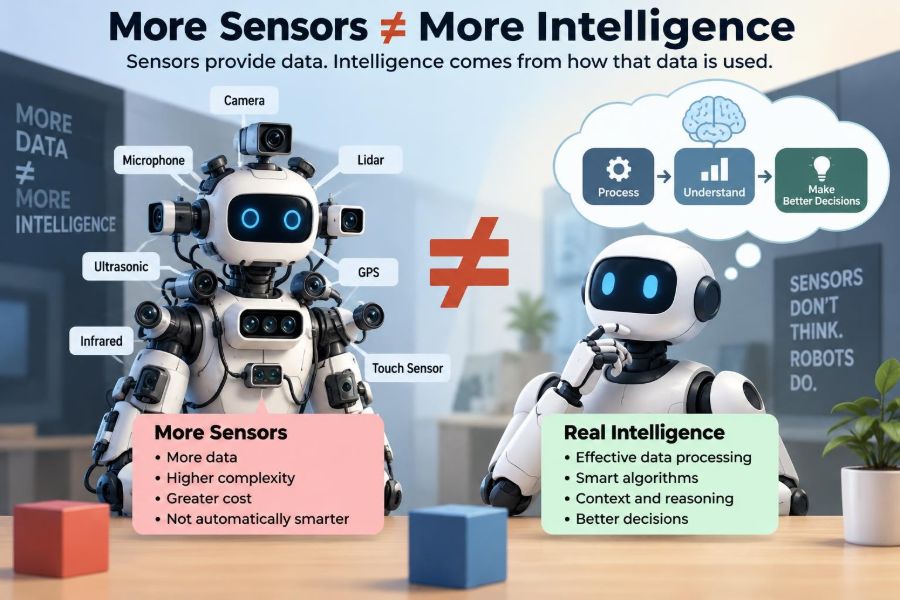
The better question is not “How many sensors does this robot have?” It is: what uncertainty does each sensor reduce, and can the system use that information well enough to make a better decision?
🧠 Sensors Are Not Intelligence
A sensor converts some physical quantity into a signal. A thermistor measures temperature-related resistance, an encoder measures rotation, and a camera records light. None of these devices, on their own, decides what a robot should do.
Robot intelligence is better understood as a system capability: perceiving relevant conditions, estimating what is happening, selecting an action, and adapting when conditions change. Sensors support the first two steps, but algorithms, models, control logic, and mechanical design determine whether the information becomes useful behavior.
👁️ What a Robot Can Actually Observe
Every sensor sees only a slice of the world. A 2D lidar may measure distance in one plane while missing an overhanging shelf. A camera may recognize a label yet struggle under glare or in dim light. An inertial measurement unit, or IMU, senses acceleration and rotation but cannot directly report its absolute location.
This is called partial observability: the full state of the environment cannot be measured directly from the robot’s available signals. More sensors may widen that view, but only if they observe a missing and decision-relevant part of the situation.
🎯 Start With the Decision, Not the Parts Catalog
Sensor selection should begin with the action a robot must perform. A line-following robot needs to distinguish line from floor at the required speed. A robotic arm placing fragile parts needs reliable contact or force information near the moment of placement.
Writing down the decision exposes the actual information need. “Avoid people within a safe stopping distance” is more useful than “add a depth camera.” The first statement allows engineers to compare sensing methods, compute required range and response time, and identify failure cases.
🧩 More Data Can Mean More Ambiguity
Two sensors may disagree for legitimate reasons. A camera can show a shiny floor reflection that resembles an obstacle, while lidar may return weak or inconsistent measurements from that same surface. The conflict is not automatically a software bug; it may reveal the limits of both sensing modalities.
If the robot has no policy for resolving disagreement, more data can increase ambiguity rather than reduce it. A system that blindly averages incompatible readings may produce an answer that describes neither reality nor a safe action.
📏 Accuracy Is Only One Part of Measurement Quality
Specifications often emphasize accuracy, but several properties determine whether a measurement helps. Resolution is the smallest change a sensor can distinguish. Precision describes repeatability. Bias is a consistent offset from the true value. Range, update rate, latency, and field of view also matter.
A highly accurate sensor that updates too slowly may be unsuitable for fast collision avoidance. A lower-cost sensor with predictable bias may be easier to calibrate and more useful for closed-loop control.
| Property | Practical question | Why it affects behavior |
|---|---|---|
| Latency | How old is this reading when control uses it? | Old obstacle data can cause late braking. |
| Update rate | How often does new data arrive? | Fast motion requires timely feedback. |
| Bias | Is the measurement consistently shifted? | Uncorrected drift can distort position estimates. |
| Coverage | What directions and conditions are visible? | Blind zones create unobserved hazards. |
⏱️ Timing Errors Can Defeat Good Hardware
Sensor fusion assumes measurements correspond to the right moment. If a robot moves while a camera frame is processed, the image may describe where an object was, not where it is when the controller reacts.
Clock synchronization, timestamps, buffering, and known processing delay are therefore engineering requirements, not housekeeping details. Combining a fresh encoder value with a delayed camera estimate without accounting for time can create a convincing but incorrect state estimate.
🔄 Calibration Is a Continuing Obligation
Calibration connects a sensor’s raw output to physical reality. For a camera, this may include lens parameters and its position relative to the robot body. For an IMU, it can include offsets and scale factors. For an arm-mounted tool, it includes the relationship between joints, tool tip, and workspace.
Mounts loosen, temperatures change, lenses get dirty, and mechanical impacts shift alignment. Adding sensors adds calibration relationships, which adds maintenance work and opportunities for subtle errors.
🧭 Coordinate Frames Multiply Quickly
A mobile manipulator may have a map frame, robot base frame, wheel frame, camera frame, lidar frame, arm frames, and gripper frame. A useful observation must be transformed correctly between them.
A small error in orientation or mounting position can place a detected object in the wrong location. More sensing hardware can therefore increase the mathematical and software burden of managing coordinate transforms.
🔀 Sensor Fusion Is an Estimation Problem
Sensor fusion combines observations to estimate something not measured perfectly by any one device: position, velocity, object identity, surface shape, or contact state. It is not simply stacking data streams together.
For example, wheel odometry is smooth over short distances but accumulates error when wheels slip. An IMU captures rapid motion but drifts when integrated over time. A camera or landmark detector can provide occasional correction. Fusion works when the system models these complementary strengths and limitations.
📉 A Wrong Confidence Estimate Is Dangerous
Every measurement has uncertainty, even when a device reports only one number. Good estimation systems represent, explicitly or implicitly, how much confidence to place in each observation under current conditions.
If a robot treats a degraded camera image as highly reliable, it can override better information. If it treats all data as unreliable, it may become overly cautious or unable to act. The challenge is not merely detecting objects; it is recognizing when the detector may be wrong.
🌧️ Real Environments Change Sensor Behavior
Lighting, rain, dust, vibration, electromagnetic interference, temperature, and reflective materials can all affect sensing. A sensor that performs well in a controlled demonstration may behave differently outdoors or after months of operation.
Consider a hypothetical delivery robot with several cameras. At sunset, direct glare can reduce contrast in one view; after rain, water droplets can obscure another. The design should not assume that a larger camera count eliminates shared environmental weaknesses.
🪞 Sensors Share Failure Modes
Redundancy is valuable only when failures are sufficiently independent. Two identical cameras mounted beside each other may both fail under the same glare, darkness, lens contamination, power fault, or software defect.
A camera and lidar can offer more diverse evidence because they rely on different physical principles. Even then, both may be affected by a poor mounting location, a common compute pipeline, or an incorrect coordinate transform.
🛑 Safety Requires More Than Extra Perception
For safety-relevant robots, perception is one layer in a broader system. Braking capability, speed limits, physical guards, emergency stop circuits, fault detection, operating procedures, and fail-safe behavior all affect risk.
Adding a sensor does not automatically make a robot safe. A sensor may detect a hazard, but safety still depends on detection range, reaction time, controller behavior, stopping distance, and what happens when the signal is unavailable or implausible.
⚡ Compute Budgets Are Physical Constraints
High-resolution cameras and dense 3D sensors can generate large data streams. Processing them consumes compute capacity, memory bandwidth, electrical power, and often cooling. When hardware cannot keep up, queues grow and perception becomes stale.
That trade-off is especially visible on battery-powered mobile robots. A simpler sensor arrangement with predictable latency can outperform a richer setup whose algorithms intermittently miss deadlines.
🔋 Every Sensor Has a System Cost
The purchase price is only one cost. Each added device can require brackets, wiring, connectors, protection, calibration tools, drivers, logging storage, test cases, replacement stock, and monitoring.
These costs matter in prototypes, but they matter even more in fleets. A sensor that is excellent technically but difficult to clean, replace, or validate may reduce real-world availability.
🧱 Complexity Creates New Failure Paths
More components create more interfaces. An additional sensor can introduce a driver conflict, a bandwidth bottleneck, a loose connector, a power transient, a version mismatch, or a dependency that prevents startup.
This does not mean engineers should avoid complexity at all costs. It means complexity needs a clear payoff. A sensor earns its place when its contribution is larger than the reliability and maintenance burden it introduces.
🧪 Test the Entire Perception-to-Action Chain
A sensor can pass a bench test while the robot still behaves poorly. End-to-end testing asks whether the robot detects, estimates, decides, and acts correctly under realistic timing and motion.
Useful test scenarios include partial occlusion, low battery, wheel slip, changing illumination, dropped network packets, unexpected reflections, and a sensor that freezes on its last valid value. The goal is to reveal how the system responds when evidence becomes imperfect—not just when every input is ideal.
📦 Example: The Warehouse Navigation Trap
Imagine a warehouse robot equipped with two lidars, several ultrasonic sensors, and cameras. It still clips a low pallet fork. The issue may not be a shortage of data: the fork could lie outside lidar planes, blend into a camera scene, or appear too late for the robot’s stopping distance.
A better solution could be a revised sensor height, a wider safety envelope, lower speed in pallet zones, map rules that restrict travel near loading areas, or a dedicated near-field detection method. The appropriate fix follows the failure mechanism, not the instinct to add another generic sensor.
🤝 Example: Force Sensing Can Beat Vision at Contact
A vision system may estimate where an object is, but it cannot always determine whether a gripper has seated a connector fully or whether an assembly has encountered unexpected resistance. At contact, a force-torque sensor, motor-current estimate, or compliant mechanism may provide more relevant feedback.
This illustrates a central design idea: use the modality that measures the variable controlling the task. More distant visual information is not necessarily better than one well-chosen local contact signal.
🧰 Mechanical Design Can Reduce Sensing Demands
Robust robotics is not achieved through software alone. Guides, funnels, chamfers, compliant grippers, fixtures, guards, and constrained workspaces can make a task easier to perceive and control.
A connector insertion task that requires millimeter-perfect vision can sometimes become forgiving with a tapered guide. This is not “cheating.” It is sound systems engineering: change the physical problem so the robot needs less uncertain information.
🗺️ Maps and Prior Knowledge Are Also Information
A robot often does not have to rediscover everything on every cycle. A map can identify fixed walls. A workcell model can define allowed zones. A barcode, fiducial marker, or known docking geometry can simplify localization when used appropriately.
Prior knowledge must be maintained. A stale map can be worse than no map if it causes the robot to dismiss a changed environment. The useful balance is to exploit stable structure while retaining ways to notice deviations.
🧑💻 Software Architecture Determines Usability
Raw sensor output should be traceable through the system. Engineers need to know when data arrived, which calibration was active, what transformations were applied, and why a planner chose a particular action.
Logging, health checks, unit conventions, clear interfaces, and replayable test data make multi-sensor systems debuggable. Without them, an added sensor can make failures harder to reproduce because the source of a bad decision remains hidden in a complex pipeline.
📊 Measure Task Success, Not Sensor Count
A useful evaluation asks task-level questions: Does the robot complete the pick without damage? Does it stop with enough margin? Does it localize accurately enough for the route? How often does it need human recovery under defined operating conditions?
Counting sensors is a poor proxy. A robot with fewer, well-characterized sensors may show more consistent task performance than a more heavily instrumented robot whose inputs are poorly integrated.
🔍 Build a Sensor Requirement Matrix
Before purchasing hardware, translate requirements into a small decision matrix. This makes assumptions visible and helps prevent feature-driven design.
- Define the task, operating environment, and worst credible conditions.
- Identify the state or event the robot must estimate or detect.
- Specify required range, accuracy, coverage, latency, and update rate.
- List likely failure modes and the safe response to each.
- Compare candidate sensors by information value, integration effort, and lifecycle cost.
- Plan an acceptance test that demonstrates the requirement in context.
The matrix does not eliminate judgment, but it forces a direct link between hardware choices and robot behavior.
🧱 Add Sensors Incrementally
In a prototype, establish a baseline with the minimum sensing needed for a safe, observable task. Measure where the baseline fails. Then add a sensor only when it targets a documented uncertainty or failure mode.
This approach makes causality clearer. If behavior improves, the team can identify why; if it degrades, the integration surface is smaller and easier to inspect. It also prevents a common trap: accumulating hardware before anyone has defined how each signal will influence action.
🩺 Monitor Sensor Health at Runtime
Robots should not assume a sensor remains trustworthy merely because it is connected. Basic health monitoring can check update timing, plausible value ranges, internal status signals, and disagreement with expected motion or other observations.
Health monitoring must be designed carefully. A disagreement does not always identify which sensor failed. In uncertain cases, the appropriate response may be slower operation, a controlled stop, or requesting human assistance rather than confidently choosing one source.
🧯 Design Graceful Degradation
A resilient robot has planned behavior for reduced perception. If one camera is unavailable, it may reduce speed and use a restricted route. If localization confidence drops, it may stop before entering a crowded area. If a noncritical sensor fails, it may continue with documented limits.
Graceful degradation is different from pretending the failure did not happen. It makes the remaining capability explicit and keeps the robot within conditions where its sensing and control are still adequate.
🧑🏫 A Better Mental Model for Students
When evaluating a robot, think in a chain: physical world, sensor measurement, state estimate, decision, actuator response, and resulting motion. At every link, ask what can be wrong, delayed, missing, or misunderstood.
This model applies to a classroom line follower, a drone, a surgical-assistance device, and an industrial manipulator. The scale changes, but the principle does not: behavior emerges from the whole loop, not from a component list.
🛠️ Questions Working Engineers Should Ask
Before approving an additional sensor, ask a few demanding questions:
- Which specific decision becomes better, and by how will we evaluate it?
- What uncertainty does this sensor reduce that existing inputs cannot?
- What environmental conditions degrade it?
- How will it be calibrated, synchronized, cleaned, and diagnosed?
- What happens when it disagrees with other sensors or stops updating?
- Could a mechanical, workflow, or control change solve the underlying problem more simply?
If these questions have no concrete answers, the sensor may be a feature in search of a requirement.
⚖️ When More Sensors Really Are the Right Choice
The myth has an opposite error: assuming minimal sensing is always elegant. Extra sensors are justified when they provide complementary coverage, reduce a meaningful uncertainty, support fault detection, or enable a task that one modality cannot perform reliably.
For instance, combining motion sensing with visual localization can improve navigation across different time scales. A near-field detector can cover a blind area left by a long-range sensor. The point is not restraint for its own sake; it is purposeful redundancy and integration.
🏁 The Core Principle: Information Must Improve Action
Robots do not become more intelligent simply by collecting more signals. They become more capable when their sensing, estimation, control, mechanics, and safety behavior work together to reduce the uncertainties that matter for a defined task.
The best sensor suite is therefore not the largest one. It is the one that provides timely, trustworthy, maintainable information—and a robot architecture able to act on it appropriately.
More sensors make a robot better only when they produce better decisions under real operating conditions. Design for useful information, not impressive hardware counts. 🦾🔍⚙️