
A packaging line is running late. One employee is moving cartons, another is checking labels, and a third is waiting for the next batch of parts. The team can see a repetitive task that ought to be automated—but the work area changes often, people need to enter it, and there is no spare floor space for a large fenced cell.
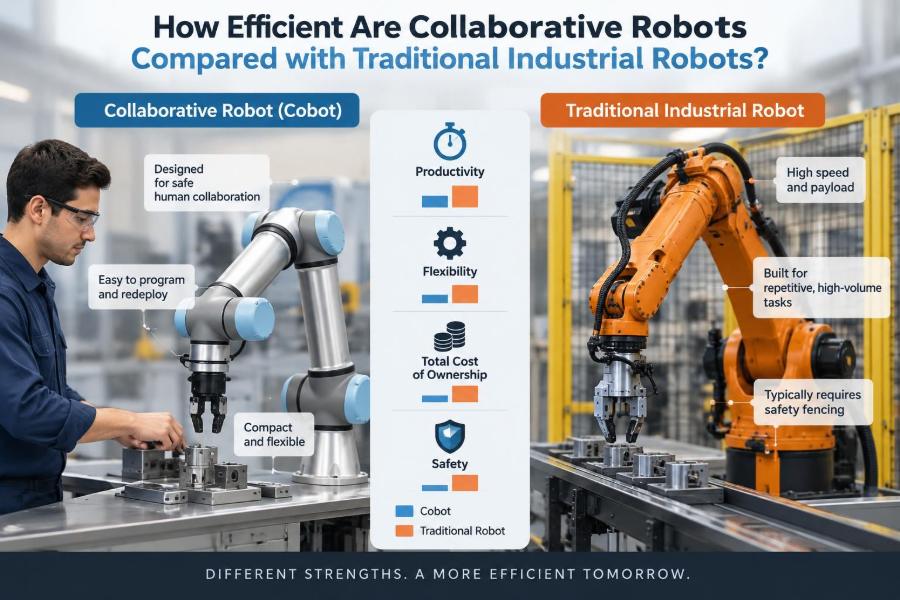
This is the situation that makes collaborative robots, or cobots, appealing. They are designed for applications where people and robots may share a workspace under a properly designed safety system. Yet a nearby plant may use a traditional industrial robot that moves faster, carries more, and repeats the same motion all day with remarkable consistency.
So which one is more efficient? The honest answer is not “cobots” or “industrial robots.” Efficiency depends on what is being measured: pieces per hour, operator time, changeover speed, floor-space use, energy consumption, quality, or the ability to keep production running when demand changes.
Understanding those trade-offs helps engineers avoid an expensive mistake: choosing a robot based on its label rather than the job it must do.
🤖 Start With Two Different Robot Categories
A traditional industrial robot is usually built for speed, payload, reach, and endurance in a dedicated automated cell. Common forms include articulated six-axis robots, SCARA robots, delta robots, and Cartesian systems. They are often separated from people by fences, gates, interlocks, light curtains, or other safeguarding.
A collaborative robot is a robot intended for collaborative applications, but that label does not mean it is automatically safe to touch or safe in every setting. The full installation—tool, workpiece, motion, fixtures, and controls—must be assessed.
Most cobots are lightweight articulated arms with force or torque sensing, controlled motion, and simpler hand-guiding or programming interfaces. Their design priorities often favor flexibility and interaction over maximum raw output.
📏 Define Efficiency Before Comparing Machines
“Efficient” can conceal several different questions. A robot that is slower at the pick-and-place motion may still create a more efficient operation if it is installed quickly, needs less guarding, and frees an operator from a physically demanding task.
For a high-volume, stable process, however, the fastest reliable cycle frequently dominates the calculation. A traditional robot can be more efficient because its higher acceleration, speed, payload, and continuous-duty capability produce more good units per shift.
Before comparing models, state the decision metric. Useful measures include:
- Throughput: accepted parts, packs, or assemblies produced per hour.
- Labor productivity: valuable work completed per operator or labor hour.
- Overall equipment effectiveness: availability, performance, and quality considered together.
- Changeover burden: time and skill needed to switch products or tasks.
- Total cost of ownership: acquisition, integration, operation, maintenance, and downtime.
⏱️ Cycle Time Usually Favors Traditional Robots
In a guarded, repetitive cell, traditional industrial robots generally have the advantage in cycle time. Their motors, gearboxes, structure, and control systems are commonly sized for aggressive acceleration and high repeatable motion rates.
Cobots frequently operate with lower permitted speeds, particularly when people can enter the shared area. Safety-related limits, payload-dependent dynamics, and conservative trajectory settings can make the difference substantial for tasks involving many short moves.
Consider a hypothetical machine-tending cell. If a CNC machine is the bottleneck and takes several minutes to cut a part, a cobot’s slower load/unload motion may have little effect on output. If the task is sorting small items at a rapid conveyor pace, that same cobot may be the bottleneck from the start.
🏋️ Payload and Reach Change the Equation
Payload is not just the mass of the product. It includes the gripper, tool changer, cables carried by the arm, and sometimes the load’s center-of-gravity effects. A robot that can lift the part but cannot accelerate it safely or reach every required position is not a suitable match.
Traditional robots span a very broad range, including models designed for heavy components, long reaches, and demanding handling tasks. Cobots have expanded their payload range, but large payloads can reduce the practical benefits associated with lightweight, close-proximity collaboration.
A heavier tool also raises collision energy and can complicate safety validation. For palletizing, casting handling, or large automotive components, a traditional robot or a dedicated palletizer is often the more productive architecture.
🛡️ Collaboration Is a System Feature, Not a Marketing Shortcut
Collaborative operation is defined by risk reduction in a specific application. A cobot arm alone does not establish that the system is safe. A sharp deburring tool, a hot workpiece, a powerful gripper, or a moving conveyor can introduce hazards that the robot’s force sensing cannot eliminate.
Common collaborative operating approaches include safety-rated monitored stop, hand guiding, speed and separation monitoring, and power-and-force limiting. Each approach has different requirements and may allow different levels of simultaneous human and robot activity.
Risk assessment should consider foreseeable actions: loading a fixture, clearing a jam, reaching around the robot, adjusting a sensor, and performing maintenance. A well-designed guarded industrial robot may be safer and more efficient than an inadequately assessed cobot cell.
🚧 Guarding Can Reduce Cobot Advantages
Cobots are often associated with “no cage” automation, but guarding may still be necessary. If the application requires high speed, has pinch points, uses a hazardous end effector, or moves heavy objects, the installation may need protective measures similar to a conventional cell.
Once fencing, interlocked doors, safety scanners, and reduced-access procedures are required, a cobot may lose part of its space and flexibility advantage. That does not make it a bad choice; it simply means the decision must return to payload, cycle time, programming needs, and cost.
The practical question is not “Can we avoid guarding?” It is “What safeguarding achieves an acceptable level of risk while preserving the needed production rate?”
👷 Labor Efficiency Is More Than Headcount
A cobot is often valuable because it redistributes work rather than replaces a person entirely. An operator may load varied parts while the robot applies adhesive, tightens fasteners, or tends a test station. The human handles judgment and exceptions; the robot handles repetition.
This arrangement can reduce fatigue and improve consistency, especially in awkward, monotonous, or ergonomically stressful tasks. It can also let a skilled technician supervise several semi-automated stations rather than manually perform every machine load.
But collaboration can introduce waiting. If the operator repeatedly pauses for the robot or must work around a slow trajectory, labor efficiency falls. Observing the actual handoffs is essential; a neat process diagram does not reveal every hesitation.
🏭 Dedicated Cells Reward Stable, High-Volume Work
Traditional industrial robots excel when the product, layout, and process remain stable long enough to justify a specialized cell. A fixed automotive welding operation, high-speed food packaging line, or repetitive welding fixture can exploit their speed and repeatability over many cycles.
In these settings, separating people from the active robot zone is usually a workable trade-off. Workers replenish materials, inspect output, and service equipment at planned times rather than sharing the motion envelope continuously.
The higher initial integration effort can be justified when it delivers dependable output for years. A faster robot is especially valuable when upstream and downstream equipment can keep pace.
🔄 High-Mix Production Rewards Flexibility
Cobots can be effective in high-mix, lower-volume operations where product variants change frequently. Their compact footprints, hand-guiding features, and approachable programming workflows can lower the friction of redeploying a station.
For example, a manufacturer producing several enclosure sizes may use one cobot for screwdriving on different fixtures. The robot does not need to be the fastest possible system if it can be reconfigured between batches without a major mechanical rebuild.
Flexibility still has limits. New grippers, revised safety boundaries, changed part presentation, and altered quality requirements may all require engineering review. “Easy to program” should never be interpreted as “no validation required.”
🧩 End Effectors Often Determine Real Performance
Many robot projects focus too heavily on the arm. In practice, the end effector—the gripper, vacuum cup, screwdriver, welding torch, dispenser, or inspection camera—often determines reliability and cycle time.
A poorly chosen gripper can cause dropped parts, slow alignment, multiple grasp attempts, or product damage. A simple, repeatable fixture and robust gripper may improve output more than upgrading to a faster robot.
Tool choice also affects collaborative feasibility. Rounded, compliant gripping surfaces and low stored energy may support a safer shared workspace, while blades, needles, high clamping forces, or hot tools demand additional controls.
🎯 Repeatability Is Not the Same as Accuracy
Repeatability describes how consistently a robot returns to a taught position. Accuracy describes how close that position is to the intended location in the real world. Both matter, but not in the same way.
Traditional robots often provide excellent repeatability, and many cobots are also highly repeatable for common assembly tasks. However, part variation, fixture tolerances, thermal effects, camera calibration, and compliance can dominate placement error.
If a process needs precise insertion, a robot may need force feedback, compliant tooling, machine vision, calibration, or a lead-in feature on the part. Choosing a robot based on a catalogue repeatability figure alone can lead to disappointing results.
👁️ Vision Adds Adaptability but Also Complexity
Vision can help either robot type locate parts, inspect labels, correct orientation, or respond to changing presentation. It is particularly useful when rigid fixtures would be costly or when operators place components with normal variation.
However, camera systems introduce lighting, calibration, image-processing, and exception-handling work. A vision-guided cell can be highly capable, but it should be evaluated as a complete automation system rather than a plug-in productivity feature.
For a stable part in a simple fixture, a low-cost sensor and a carefully designed mechanical stop may be more efficient than vision. The best solution is often the least complicated one that reliably handles real variation.
📦 Material Presentation Sets the Robot’s Pace
Robots cannot compensate indefinitely for chaotic inputs. Parts arriving tangled in a bin, cartons with inconsistent dimensions, or components placed unpredictably create delays whether the arm is collaborative or traditional.
Good material presentation might include trays, pallets, bowl feeders, indexed conveyors, locating nests, or clear operator work instructions. These additions can feel less glamorous than a robot arm, but they frequently determine whether automation achieves its planned output.
When a cobot waits for an operator to orient every part, calculate the full combined cycle. When a traditional robot relies on a feeder that jams, calculate the lost availability—not just its maximum speed.
🔌 Integration Time Can Favor Cobots
Cobots are often faster to deploy for straightforward tasks because their interfaces can simplify teaching, force-limited motion, and basic input/output connections. Their smaller size may also reduce facility changes in a cramped work area.
That advantage is strongest when the process is already well understood: part locations are defined, the tooling is mature, and success criteria are clear. A simple pick, place, or machine-tending task can move from concept to useful prototype quickly.
Complex applications erase this gap. Integrating conveyors, vision, traceability, machine controls, safety devices, quality checks, and multiple product variants requires conventional engineering discipline regardless of robot type.
💰 Purchase Price Is Only One Cost
A robot arm is only one line item. Budgeting should include tooling, fixtures, safety equipment, controls, electrical work, pneumatic supply, programming, testing, operator training, spare parts, documentation, and future support.
A cobot may have a lower barrier to entry for a modest cell, especially where its built-in capabilities fit the task. A traditional robot may cost more to install but generate better returns when its speed replaces multiple parallel manual operations or supports large production volumes.
Compare alternatives by cost per acceptable unit over the expected operating life, while being transparent about assumptions. Forecasts should include downtime, scrap risk, staffing, and likely product changes—not only optimistic cycle-time estimates.
⚡ Energy Use Depends on the Entire Cell
Cobots are often compact and may consume less power in light-duty motion, but energy efficiency cannot be judged from the arm alone. Compressors for vacuum grippers, heaters, welders, conveyors, machine tools, and safety hardware may consume more than the robot.
A faster industrial robot can use more peak power yet complete a task sooner. Conversely, oversizing any robot for a light task can waste energy and capital. The meaningful measure is energy per useful output under realistic operating conditions.
Reducing unnecessary travel, using efficient grippers, minimizing air leaks, and allowing sensible idle modes can improve either type of installation.
🧰 Maintenance Means Mechanical and Process Maintenance
Traditional industrial robots have a long record in harsh and continuous manufacturing environments. Depending on the model and duty cycle, they may require planned inspection, lubrication, battery replacement, cable checks, and component servicing.
Cobots also need maintenance. Joint wear, cable routing, gripper contamination, loose fasteners, calibration drift, and damaged protective surfaces can affect safety and performance. Their apparent simplicity should not lead teams to neglect preventive care.
Process maintenance matters equally. Clean sensors, stable fixtures, documented robot programs, backed-up settings, and available spare gripper components usually prevent more lost production than reacting after a failure.
📈 Availability Matters More Than Demonstration Speed
A robot’s brochure speed is rarely the production speed. Real output includes tool changes, inspection, replenishment, operator breaks, jams, communication delays, and recovery after faults.
Availability measures whether the system is ready to run when needed. A slightly slower cobot that operators can recover confidently may outperform a faster but fragile cell in a variable small-batch operation. In high-volume production, a highly engineered industrial cell can achieve strong availability because it was built around reliable material flow and recovery procedures.
Ask integrators to demonstrate common faults: missing parts, misaligned items, a failed vacuum pick, a paused machine, and a stopped safety device. Recovery behavior is part of the design.
🔧 Programming Speed Is Not Programming Quality
Many cobots offer intuitive interfaces, hand-guiding, and reusable command blocks. This helps technicians prototype motions and can reduce dependence on specialist programming for simple jobs.
Traditional robot programming may demand deeper knowledge of coordinate systems, motion types, interlocks, and vendor-specific languages, although modern industrial platforms can also be accessible. The right programming environment depends on the task and the people who will support it.
Fast teaching becomes inefficient if it creates undocumented positions, unclear recovery states, or unsafe edits. Production programs should use meaningful names, controlled versions, tested limits, and clear instructions for authorized changes.
🧠 Process Knowledge Cannot Be Purchased in an Arm
Automation exposes inconsistency. If operators use personal techniques to align a part, compensate for warped material, or recognize subtle defects, those decisions must be designed into fixtures, sensing, logic, or inspection criteria.
Teams sometimes buy a cobot expecting it to “learn” a messy manual process through demonstration. Teaching a path can be useful, but it does not automatically solve variation, quality rules, or ambiguous decisions.
Map the manual task before automating it. Record its inputs, variations, required forces, quality checks, cycle-time elements, and failure modes. This process work benefits both cobot and industrial robot projects.
🦺 Ergonomics Can Be a Legitimate Efficiency Gain
Not every automation project should be justified solely by output. Repeated reaching, lifting, twisting, and forceful tool use can fatigue workers and make a process harder to staff consistently.
A cobot can take over a tiring portion while the operator performs setup, inspection, or skilled assembly. Traditional robots can achieve the same result, especially when the task is fully enclosed or physically demanding.
The key is to redesign the workstation around the person as well as the robot. A collaborative cell that makes an operator stretch around a moving arm is not an ergonomic success.
🏗️ Floor Space Has Operational Value
Compact cobots can fit beside machines, benches, and inspection stations where a large fenced cell would be difficult to place. This can make automation feasible in existing facilities with limited open area.
But a small robot footprint is not the same as a small system footprint. Include operator access, part racks, maintenance clearance, electrical cabinets, conveyors, safety zones, and paths for carts or forklifts.
Traditional cells can consume more area, yet their enclosure may create a clear, repeatable flow. Layout efficiency should be evaluated using the entire movement of people and materials, not arm dimensions alone.
🧪 Pilot Projects Should Test the Hard Cases
A proof of concept should not only demonstrate perfect parts under ideal lighting. Include ordinary variation: slightly shifted parts, worn packaging, full and nearly empty bins, normal operator loading styles, and realistic production takt times.
Define pass criteria before the pilot begins. For example, a team might assess successful picks, placement quality, operator interaction, recovery time, and whether the robot can complete a representative run without constant engineering attention.
Use pilot results to refine the cell design, not to force a predetermined purchase. Sometimes the outcome is a cobot, sometimes a traditional robot, and sometimes a simpler fixture or semi-automatic tool.
⚖️ A Practical Comparison at a Glance
| Decision factor | Collaborative robot tendency | Traditional industrial robot tendency |
|---|---|---|
| Peak speed | Often lower, especially in shared-space operation | Often higher in dedicated safeguarded cells |
| Payload and reach | Suitable for many light-to-medium tasks | Broad range, including heavy-duty applications |
| Deployment flexibility | Often strong for changing tasks and compact work areas | Strong when engineered for a defined process |
| Human interaction | Designed to support collaborative applications after risk assessment | Usually separated from people during automatic motion |
| Best economic fit | High-mix, lower-volume, labor-supporting tasks | High-volume, fast, stable, repeatable processes |
| Integration need | Can be modest or substantial, depending on the cell | Usually substantial, particularly for full production cells |
These are tendencies, not rules. A guarded cobot can perform a dedicated task, and an industrial robot can be used in a flexible cell. Application details decide the result.
❌ Common Mistake: Comparing Only Robot Specifications
Comparing payload, reach, and repeatability is necessary, but it is not enough. Two arms with similar specifications can deliver very different production outcomes because of tooling, controls, support, safety design, and integration quality.
Another frequent mistake is timing only the robot motion. Time the entire cycle from the moment a part becomes available to the moment a verified good part leaves the station. Include human interactions and recovery actions.
Finally, do not assume that a cobot is the inexpensive choice or that an industrial robot is the complex choice. Either can become costly when applied to the wrong process.
🗺️ A Better Selection Workflow
- Describe the process objective in measurable terms: output, quality, ergonomics, and flexibility.
- Collect representative part, tool, and variation data rather than relying on nominal dimensions.
- Map the full material and operator flow around the proposed station.
- Identify hazards and perform a documented risk assessment for the complete application.
- Evaluate tooling, fixturing, sensing, and recovery logic alongside the robot.
- Test the most difficult representative cases and calculate realistic lifecycle costs.
- Plan training, maintenance ownership, program control, and safe change procedures before launch.
This workflow makes the robot a component of a production system, which is exactly what it is.
🔮 Hybrid Automation Is Often the Strongest Design
The choice does not have to be purely collaborative or purely conventional. A factory may use a fast industrial robot for bulk handling, with a cobot at a nearby bench for low-volume finishing or variable assembly.
Within one cell, a cobot may work in a safeguarded mode during unattended production and in a slower collaborative mode when an operator performs setup. Such designs require careful controls and safety validation, but they can use each machine’s strengths.
Engineers should think in terms of the right automation architecture, not allegiance to a robot category.
✅ The Core Principle: Match the Robot to the Constraint
Collaborative robots are efficient when flexibility, compact deployment, operator support, and manageable changeovers matter more than maximum motion speed. They can turn a manual, repetitive station into a more consistent and ergonomic process without demanding a large dedicated cell.
Traditional industrial robots are efficient when throughput, payload, rapid movement, and long-term repeatability in a stable process are the governing constraints. Their safeguarding and integration effort are often justified by sustained production output.
The most efficient robot is the one whose speed, safety design, tooling, and operating model match the real bottleneck—not the one with the most appealing label.
Choose from evidence gathered on the actual task, including its variation and failures. When the whole cell is designed around that reality, both cobots and traditional robots can deliver useful, dependable automation. 🦾🏭📊