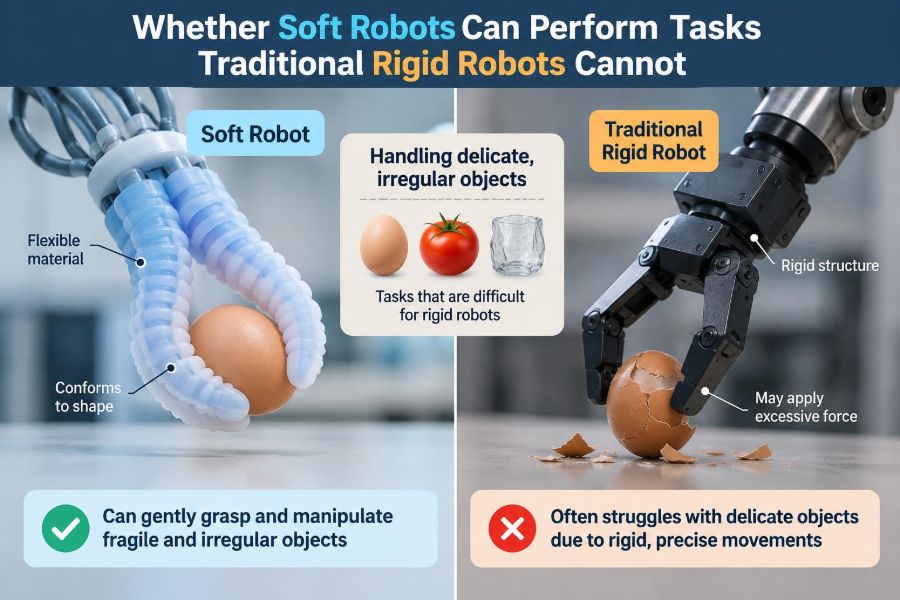

A robot reaches into a bin of ripe strawberries. A conventional metal gripper can move quickly and repeat the same motion all day, but a few millimeters of positioning error may bruise the fruit. A human hand succeeds because its fingers yield, conform to the berry, and sense when the contact is becoming unsafe.
Now picture a search robot moving through a collapsed building, a medical device navigating a winding pathway inside the body, or a machine sorting a mixed pile of delicate products. In each case, the hard part is not simply generating motion. It is making useful contact with an environment that is uncertain, cramped, fragile, or alive.
This is where soft robotics attracts attention. Rather than building every link, joint, and contact surface from stiff materials, engineers intentionally use elastomers, textiles, flexible structures, fluids, and other compliant components. The result can bend, stretch, squeeze, or deform in ways that rigid mechanisms cannot.
But flexibility alone does not make a robot more capable. The useful question is whether a soft robot can perform tasks that are physically impractical, unsafe, or overly complex for a traditional rigid robot—and where rigidity still remains the better engineering choice.
🤖 What Makes a Robot “Soft”?
A soft robot has a body, actuator, or end effector whose shape changes substantially during operation. “Soft” does not necessarily mean entirely squishy: many practical machines are hybrid systems with a rigid base, motors, valves, cameras, and electronics connected to a compliant arm or gripper.
The key property is compliance, meaning the ability to yield under force. A compliant robot can adapt its shape when it encounters an object or obstacle instead of demanding exact alignment before contact.
🧱 What Traditional Rigid Robots Are Built to Do
Rigid robots use stiff links connected by joints such as revolute joints, prismatic slides, and geared wrists. Their geometry is deliberately predictable, which makes it easier to calculate position, carry loads, and repeat a programmed path with high precision.
Industrial robot arms excel when parts are known, fixtures hold them in place, and the task rewards speed, stiffness, and repeatability. Welding, machining, palletizing, and many assembly operations benefit from a structure that does not flex appreciably under load.
⚖️ The Real Difference Is Not Hard Versus Better
Soft and rigid robots solve different versions of the contact problem. A rigid robot often tries to control its pose precisely before touching anything. A soft robot can tolerate more uncertainty by letting its body absorb small errors and distribute contact forces over a larger area.
That trade-off changes the design objective. Instead of asking only, “Can the robot reach this point?” engineers also ask, “Can it reach while safely adapting to whatever is there?”
🧭 Why Unstructured Environments Change Everything
Factory automation works best when the world is organized around the machine. Parts are presented in repeatable orientations, lighting is controlled, and workpieces have stable dimensions.
Homes, farms, hospitals, sewers, and disaster sites are different. Objects vary, surfaces move, visibility can be poor, and the robot may encounter unknown geometry. In these settings, a rigid mechanism can work, but it usually needs more sensing, more careful planning, specialized fixtures, or conservative motion.
🤲 Gentle Contact Is a Genuine Soft-Robot Advantage
A compliant finger can wrap around an object and spread force across a broad contact patch. This helps when handling items such as fruit, baked goods, soft packaging, biological samples, or irregular consumer products.
A rigid gripper can also handle delicate parts when it has good force control and suitable fingertips. The difference is that a soft gripper may achieve safe contact with less precise object localization. Its material behavior supplies some of the adaptation that otherwise must come from sensing and control.
🍓 Picking Fragile and Variable Produce
Harvesting illustrates both the promise and the limits. Fruits differ in size, ripeness, stem orientation, and accessibility behind leaves. A soft gripper can conform to a tomato or berry and reduce concentrated pressure compared with a narrow hard jaw.
Yet harvesting is not solved by softness alone. The machine must still detect the target, avoid damaging nearby produce, separate or cut a stem when needed, and operate reliably in dirt, moisture, and changing weather. A soft end effector helps with the grasp; it does not replace the rest of the robotic system.
🫁 Moving Safely Near People
When a robot shares space with people, accidental contact is a central safety concern. Soft coverings, compliant joints, and deformable actuators can lower peak contact forces and make impacts less abrupt.
This can be valuable for assistive devices, rehabilitation equipment, wearable robots, and service machines. However, compliance is not a substitute for safety engineering. A soft robot can still cause harm if it moves too fast, pinches a person, carries a heavy load, or is controlled poorly.
🩺 Following Curved Pathways in Medicine
Some medical robots use flexible, continuum-like structures that bend smoothly along their length rather than rotating at a few distinct joints. This behavior can be useful for reaching around anatomy or operating through constrained access paths.
Medical use has unusually high requirements for biocompatibility, sterilization, reliability, clinician control, and validation. A flexible device may improve access, but whether it is appropriate depends on the specific procedure and regulatory context. Softness is an enabling design feature, not a blanket clinical advantage.
🐙 Continuum Motion Reaches Around Obstacles
A conventional arm resembles a chain of rigid segments. A continuum robot behaves more like an elephant trunk or an octopus arm, producing curvature along much of its body. It can bend around an obstacle while its tip continues toward a target.
That shape change can make access possible in tight, winding spaces where a rigid link would collide. In return, the robot’s shape is harder to predict and control because each bend can affect the rest of the structure.
🕳️ Entering Confined and Irregular Spaces
Flexible inspection robots can be useful in pipes, aircraft cavities, machinery interiors, and other spaces with narrow entries or changing cross-sections. A body that bends or compresses can pass through a route that a rigid chassis cannot follow.
Access alone is not enough. The robot must carry or communicate with cameras, lights, sensors, power, and possibly tools. Tethers can provide power and control but may snag; onboard systems reduce tether dependence but add mass and packaging constraints.
🌊 Underwater Contact Benefits From Compliance
Marine organisms, corals, cables, and submerged structures are difficult to interact with because water currents disturb the robot and visibility may be limited. A compliant gripper can accommodate motion between the robot and the target without applying a sudden hard squeeze.
Soft systems can therefore be attractive for sampling delicate organisms or grasping irregular underwater objects. Pressure tolerance, sealing, buoyancy, and long-term material durability remain substantial engineering challenges.
🧗 Locomotion Where Wheels Cannot Roll
Some soft robots crawl, inch, undulate, or use repeated body deformation to move across uneven surfaces. Their bodies can maintain contact over rocks, gaps, or clutter rather than relying on a small number of wheel or foot contact points.
These locomotion modes can be useful in specialized terrain, but they are usually slower and less energy-efficient than wheels on flat ground. The meaningful comparison is not “soft crawling versus all transport,” but whether the terrain prevents a simpler vehicle from operating.
🧤 Grasping Unknown Shapes With Underactuation
Many soft grippers are underactuated: they have fewer independently controlled actuators than degrees of freedom. One pneumatic chamber or tendon may curl several portions of a finger at once.
This sounds like a limitation, but it can be useful. When the finger meets an object, the unblocked sections keep curling around it. The object itself helps determine the final grasp shape, reducing the need to command every joint angle.
💨 How Pneumatic Soft Actuators Work
Pneumatic actuators use pressurized air to deform an elastic chamber. Reinforcing fibers, fabric layers, or geometry constrain some directions of expansion, so inflation produces a desired bend, twist, extension, or contraction.
They can be lightweight and inherently compliant, but air is compressible. That makes their behavior less direct than a rigid motor-and-gear transmission, especially when hose length, pressure changes, and external loads vary.
🧵 Other Ways to Create Soft Motion
Soft robotic motion does not depend on air alone. Designers may use tendons pulled by motors, hydraulic fluid, shape-memory materials, dielectric elastomers, flexible beams, or variable-stiffness structures.
- Tendon-driven systems can place motors away from the flexible body, though cables introduce friction and routing challenges.
- Hydraulic systems can produce high forces, but fluid handling and leaks require careful design.
- Variable-stiffness mechanisms aim to switch between a soft, adaptable state and a firmer, load-bearing state.
The best actuator depends on force, speed, workspace, environment, power source, and maintenance requirements.
🧠 Embodied Intelligence Reduces Control Burden
Embodied intelligence describes useful behavior that arises partly from a robot’s physical form and material properties rather than from software alone. A soft finger naturally conforms to an object; a rigid finger must often be positioned and controlled more precisely to create similar contact.
This does not mean soft robots need no algorithms. Instead, mechanics and control share the work. Good design can make the desired behavior easier to achieve, while poor design can create a difficult-to-control deformable mechanism.
📡 Sensing a Shape That Keeps Changing
Rigid robot arms can often infer their configuration from joint encoders. A soft arm may have no obvious joints, and its body can deform differently under different loads. Knowing where its tip is becomes a sensing problem as well as a modeling problem.
Engineers may combine cameras, pressure sensors, stretch sensors, magnetic tracking, fiber-optic sensing, or estimation algorithms. Every approach has trade-offs in cost, calibration, durability, and sensitivity to environmental interference.
🗺️ Modeling Soft Bodies Is Harder Than Modeling Links
A rigid arm is commonly represented as a set of links and angles. Soft materials can stretch, shear, buckle, and exhibit hysteresis, meaning their response depends partly on recent loading history. Contact with the environment changes the shape again.
High-fidelity physical models can be computationally expensive, while simpler models may lose accuracy. Many successful systems therefore use a practical combination of approximate models, sensor feedback, and task-specific calibration instead of seeking a perfect universal model.
🎯 Precision Is the Most Common Trade-Off
A rigid machine’s stiffness helps it resist disturbances and hold a tool at a precise location. Soft robots deform under their own weight and external forces, so achieving fine positioning or applying a tightly controlled tool force can be difficult.
This matters for tasks such as drilling, metrology, high-speed insertion, and machining. Softness is most compelling when adaptation at the contact interface matters more than millimeter-level pose accuracy throughout the workspace.
🏋️ Payload and Power Set Practical Limits
Soft structures are not automatically weak, but their flexibility creates challenges when carrying heavy loads. The actuator must overcome the payload while also controlling deformation of the robot itself.
Compressors, pumps, valves, batteries, or tether systems can dominate the mass and volume of a soft-robot setup. A demonstration with a small gripper may be impressive, yet scaling it into an independent field machine requires an honest accounting of the complete power and control system.
⏱️ Speed, Cycle Time, and Recovery
Industrial automation is often judged by cycle time: how many reliable operations occur in a shift. Soft actuators may be slower because chambers must inflate and deflate, materials rebound gradually, or sensing and feedback are needed to settle motion.
That does not eliminate their value. If a soft gripper reduces damage, changeover time, or the need for custom tooling, it may improve the overall process. Engineers should compare total system performance, not only the speed of one actuator.
🧪 Materials Age, Tear, and Drift
Elastomers can fatigue, tear, creep, swell, or change stiffness with temperature and repeated use. Seams, bonded interfaces, and connections to rigid fittings are frequent areas of concern because stress can concentrate there.
For a laboratory prototype, occasional recalibration may be acceptable. For deployment, designers need inspection procedures, replaceable wear parts, compatible cleaning methods, and failure modes that are safe and detectable.
🔧 Hybrid Robots Often Provide the Best Answer
Many strong applications combine rigid and soft components. A rigid arm provides reach, repeatable gross positioning, and payload support; a soft wrist or gripper manages uncertain final contact.
This division is practical because the task is rarely soft everywhere. A packaging robot, for example, may need rigid structure to move boxes rapidly but compliant fingers to pick irregular food items. Hybridization targets softness where its benefits are largest.
📊 Choosing the Right Architecture
| Task condition | Often favors a soft or compliant design | Often favors a rigid design |
|---|---|---|
| Object variation | Unknown shapes, delicate surfaces, variable sizes | Precisely fixtured, consistent parts |
| Workspace | Curved, cramped, obstacle-filled routes | Open space with clear approach paths |
| Contact requirement | Broad, gentle, adaptive contact | High tool force or sharply defined contact |
| Performance priority | Safe adaptation and tolerance of uncertainty | Speed, repeatability, payload, and precision |
The table is a starting point, not a rulebook. A task can contain conditions from both columns, which is exactly why hybrid machines are common.
🧰 A Practical Evaluation Process
Before selecting a soft actuator or gripper, define the task in measurable terms. Identify object properties, required force, acceptable damage, location uncertainty, cycle time, cleaning needs, and what happens when the robot misses or collides.
- Map where uncertainty occurs: perception, approach, contact, or release.
- Determine whether mechanical compliance can safely absorb that uncertainty.
- Compare complete systems, including sensors, power, tooling, and maintenance.
- Test representative edge cases, not just ideal objects.
- Choose the simplest architecture that meets performance and safety requirements.
This process prevents a common mistake: adding a soft gripper because it looks adaptable without confirming that it addresses the actual bottleneck.
🚫 Mistakes When Comparing Soft and Rigid Robots
One mistake is treating rigid robots as incapable of delicate work. Force-controlled arms, compliant wrists, vision systems, and carefully designed tooling can handle many fragile tasks extremely well.
The opposite mistake is assuming a soft robot is automatically safer or easier to deploy. Its materials, hoses, sensor calibration, cleaning requirements, and unpredictable deformation may add operational complexity. Capability comes from the whole system, not from a material label.
🔍 What Counts as a Task a Rigid Robot Cannot Do?
“Cannot” needs careful interpretation. A rigid robot can sometimes complete an apparent soft-robot task with enough custom fixtures, perception, redundant joints, and sophisticated control. The question is whether it can do so within realistic limits of access, complexity, cost, safety, or acceptable damage.
Soft robots are closest to uniquely capable when their body must passively conform through a restricted route, safely envelop an unknown fragile object, or distribute contact in a way that a stiff geometry cannot reproduce without a much more complicated mechanism.
🌱 Where Soft Robotics Is Most Likely to Grow
Near-term progress is likely to come from focused applications rather than one general-purpose soft robot. Promising directions include adaptable end effectors, wearable assistance, flexible inspection devices, agricultural handling, and compliant interfaces for people and sensitive materials.
Better durable materials, compact valves and pumps, integrated sensing, and reliable manufacturing methods could expand those applications. Just as importantly, designers are learning where not to use softness—an equally valuable form of engineering knowledge.
✅ The Core Takeaway: Match the Body to the Task
Soft robots can perform certain tasks that traditional rigid robots struggle to perform directly: navigating constrained curved spaces, conforming around uncertain shapes, and making gentle distributed contact with fragile or moving targets. Their advantage comes from physical adaptability, not magic.
Rigid robots remain superior when a job demands high payload, fast repeatable cycles, precise tool positioning, or a stable structure. The most effective question is not which category will win, but where stiffness, compliance, sensing, and control should be placed in the same machine.
Soft robotics expands what machines can do when the world cannot be made rigid, predictable, and perfectly positioned. The best designs use flexibility deliberately, then support it with sound mechanics, sensing, control, and realistic testing. 🦾🤲🔬