
A robot on a car-production line may repeat the same weld thousands of times with remarkable consistency. A service robot in a hospital, by contrast, has to share corridors with people, carts, doors, uneven floors, and changing priorities.
Both are robots, but they are designed around very different assumptions. One succeeds by operating in a controlled cell; the other must sense uncertainty and respond safely when the environment does not cooperate.
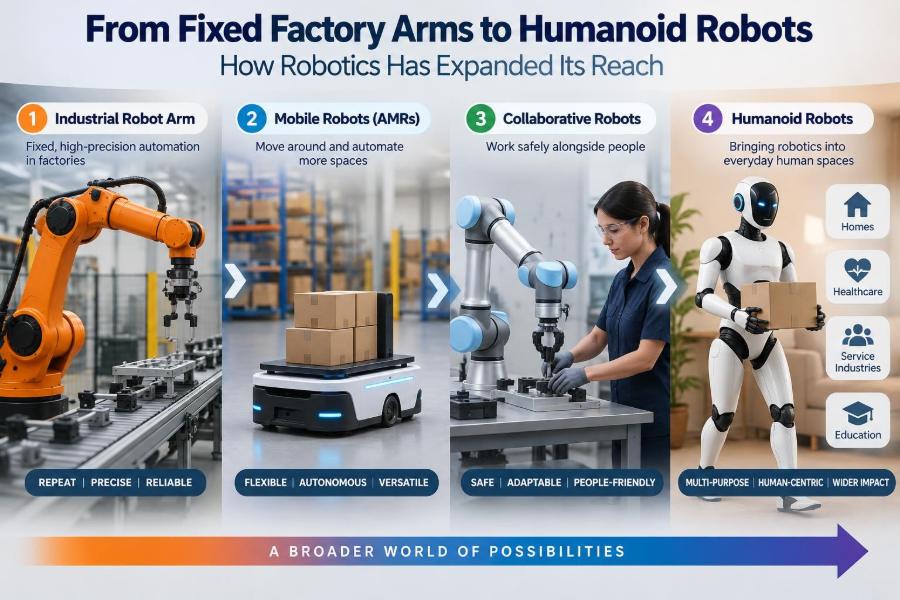
This shift helps explain why robotics now appears in warehouses, farms, laboratories, homes, disaster zones, and public spaces. The field has expanded not because every task needs a human-shaped machine, but because better sensing, computing, actuation, and software make more tasks technically feasible.
For students and working professionals, the useful question is not whether humanoids will replace every other robot. It is how engineers choose the right body, intelligence, safety strategy, and level of autonomy for a real job.
🏭 The Age of the Fixed Industrial Arm
Industrial robots became widely associated with manufacturing because factories offered an unusually favorable setting: repeated tasks, known workpieces, carefully arranged tooling, and restricted access for people. A fixed-base arm could be programmed to move through a repeatable sequence with high speed and precision.
Typical applications include welding, painting, machine tending, palletizing, and assembly. In these settings, the robot’s value often comes from consistency, throughput, and its ability to perform difficult or unpleasant work over long shifts.
📍 Why Structure Made Early Automation Practical
Early robot automation did not require a machine to “understand” the world in a broad sense. Engineers could place parts in fixtures, use jigs to constrain position, and define a work envelope where the robot was allowed to move.
This is a central engineering lesson: changing the environment can be easier than making the robot smarter. If a component always arrives in the same orientation, the perception problem becomes far smaller.
🔩 What a Traditional Robot Arm Actually Does
A robot arm is a chain of rigid links connected by joints. Motors, gearboxes, sensors, and a controller work together to place an end effector—the device at the arm’s tip—at a desired position and orientation.
The end effector may be a welding torch, gripper, suction cup, screwdriver, paint gun, or specialized tool. The arm itself is only part of the system; fixtures, conveyors, safety equipment, and process tools often determine whether the cell succeeds.
🧭 Degrees of Freedom and Reach
A degree of freedom is an independent motion variable, such as a joint rotating. Many industrial arms have enough joints to position and orient a tool flexibly, but their reachable workspace is still limited by link lengths, joint limits, collision constraints, and cable routing.
More degrees of freedom can help a robot avoid obstacles or reach awkward angles. They also make planning and control more complex, because multiple joint configurations may produce similar tool positions.
🛡️ Safety Cages Were Part of the Design
Fast, powerful industrial robots can create serious hazards. Historically, many operated behind fencing, interlocked gates, light curtains, or other safeguarding systems that stop or restrict motion when a person enters a protected area.
This separation was not a failure of robot design; it was an appropriate response to the task. A high-speed welding arm and an unprotected human worker should not occupy the same space without carefully engineered safeguards.
🤝 Collaborative Robots Changed the Workspace
Collaborative robots, often called cobots, are designed for closer interaction with people under specified conditions. They may use force limiting, speed monitoring, rounded forms, and safety-rated sensing to reduce risk.
“Collaborative” does not mean automatically safe in every configuration. A sharp tool, a heavy payload, a pinch point, or an unstable workpiece can still make a cobot application hazardous. Risk assessment remains essential.
👁️ Vision Opened the Door to Variation
Machine vision lets a robot use cameras and algorithms to locate objects, inspect surfaces, read markers, or estimate orientation. This reduces dependence on perfectly precise part placement.
Vision is valuable, but it is not magic. Lighting changes, reflections, occlusion, motion blur, transparent materials, and cluttered backgrounds can degrade performance. Robust systems treat perception as an engineering subsystem with calibration, validation, and fallback behavior.
🧠 From Playback to Decision-Making
A basic robot program can replay taught positions. Modern systems increasingly combine motion planning, sensor feedback, task logic, and optimization to choose actions as conditions change.
For example, a warehouse robot may select a route around temporary congestion rather than follow one fixed path. That is a meaningful increase in autonomy, though it remains much narrower than general human reasoning.
🛞 Mobile Robots Broke the Fixed-Base Assumption
Once a robot can move through a facility, it can serve multiple workstations instead of waiting at one location. Automated guided vehicles often follow defined routes, while autonomous mobile robots use onboard sensing and maps to navigate more flexibly.
Mobility introduces new problems: localization, battery management, traffic coordination, floor conditions, elevator interfaces, and safe behavior near pedestrians. A moving robot is a system-level challenge, not simply an arm placed on wheels.
🗺️ Mapping, Localization, and Navigation
A mobile robot needs some estimate of where it is and where it can travel. It may combine wheel encoders, inertial sensors, cameras, laser scanners, and maps; no single sensor is perfect in every environment.
Localization means estimating the robot’s position. Navigation means selecting and following a safe route. In a changing workplace, the robot must also distinguish permanent structure from temporary obstacles such as people, carts, or open doors.
📦 Warehouses Became a Major Testbed
Warehouses contain repeated transport and handling tasks, but they are more variable than a traditional robot cell. Inventory changes, aisles become blocked, and individual items differ in shape, packaging, and fragility.
Robots can move shelves, carry totes, scan inventory, or assist with picking. Fully automating grasping from mixed bins remains harder than transporting standardized containers because reliable manipulation depends heavily on object perception and contact control.
🌾 Robotics Moved Into Fields and Farms
Agricultural robotics faces a different kind of uncertainty: soil, weather, plants, lighting, and terrain vary continuously. A machine that works well in a laboratory may struggle with mud, dust, shadows, or leaves hiding the target fruit.
Useful farm robots include machines for guidance, monitoring, targeted treatment, weeding, and harvesting in selected crops. Their success depends on matching automation to a crop, cultivation method, and economic workflow rather than promising universal field intelligence.
🏥 Healthcare Requires a Different Standard of Care
Robotic systems in healthcare can support rehabilitation, surgery, logistics, imaging, and laboratory work. Their roles vary widely: a precise instrument-positioning system is not equivalent to a mobile delivery robot or a therapeutic exoskeleton.
Because patients are vulnerable and clinical workflows are complex, engineers must consider reliability, usability, hygiene, cybersecurity, training, and oversight. A technically capable device can still fail in practice if it interrupts care teams or creates confusing alarms.
🧪 Laboratories Benefit From Repeatability
Laboratory automation can dispense liquids, move samples, operate instruments, and record process data. These tasks benefit from repeatable motion and from reducing manual handling during long, routine workflows.
However, biological and chemical processes are not purely mechanical. Sample integrity, contamination control, traceability, and exception handling matter as much as robot motion. An automated pipetting system is valuable only if the complete process remains trustworthy.
🌊 Robots Go Where Conditions Are Hostile
Robots are useful when work exposes people to radiation, extreme heat, toxic materials, unstable structures, deep water, or hazardous heights. Remotely operated vehicles and inspection robots can extend human reach while keeping operators at a safer distance.
Remote operation is not the same as autonomy. In many hazardous tasks, human judgment remains central while the machine supplies mobility, sensing, and physical capability.
🦿 Legged Robots Address Terrain, Not Every Task
Wheels are efficient on smooth floors, but steps, rubble, gaps, and irregular ground can defeat them. Legged robots can place feet selectively and adjust posture, which may help in spaces designed around human mobility.
The trade-off is substantial. Walking requires continuous balance, perception, contact estimation, and energy management. A wheeled platform is usually simpler and more efficient when the environment allows it.
🧍 Why Humanoid Form Is Appealing
Human-built environments contain stairs, handrails, doors, shelves, tools, and work surfaces sized for human bodies. A humanoid robot—with a torso, two arms, and legs—may eventually use some of this infrastructure without requiring every building to be redesigned.
Its form can also support two-handed manipulation and a familiar communication posture. But resemblance to a person is a design hypothesis, not proof of suitability for a particular application.
⚖️ Humanoids and Purpose-Built Machines
A purpose-built robot can be shorter, more stable, cheaper to maintain, and better optimized for one task. A floor-cleaning robot does not need hands; a pallet mover does not need knees; a fixed arm may outperform a humanoid at repetitive bench work.
| Design approach | Best fit | Typical compromise |
|---|---|---|
| Fixed industrial arm | Fast, repeatable work in a defined cell | Limited reach beyond its installed workspace |
| Mobile manipulator | Moving objects between changing stations | Navigation and stability add complexity |
| Wheeled service robot | Indoor transport on accessible floors | Struggles with stairs and severe terrain |
| Humanoid robot | Tasks using human-oriented spaces and tools | Balance, energy use, and mechanical complexity |
The best morphology is the one that delivers the needed capability with acceptable risk, cost, maintenance, and operational complexity.
🧲 Grasping Is Harder Than It Looks
People pick up a mug without calculating every contact force consciously. A robot must deal with object shape, surface friction, center of mass, deformability, occlusion, and uncertainty in sensor estimates.
Simple grippers work extremely well when objects are standardized. General-purpose manipulation is harder because the robot needs to adapt its grip and react when the object slips, bends, or is not where the camera expected.
✋ Tactile Sensing Brings Robots Closer to Skilled Handling
Cameras show where an object may be; tactile sensors help reveal what is happening at contact. Force and torque sensing can tell a robot whether it is pressing too hard, encountering resistance, or making a stable grasp.
This feedback matters for inserting a connector, handling delicate produce, folding material, or working alongside people. Contact-rich tasks require compliant behavior: the robot should yield or adjust rather than rigidly forcing motion.
⚙️ Actuators Determine Physical Capability
Actuators convert energy into movement. Electric motors are common because they are controllable and practical in many settings, while hydraulic or pneumatic systems can be useful where high force, compliance, or particular environmental properties are needed.
Actuator choice shapes speed, strength, noise, efficiency, backdrivability, and maintenance. Backdrivability describes how readily an external force can move a joint, an important consideration for safe physical interaction.
🔋 Energy Is a Constraint, Not a Footnote
A stationary robot can draw power from the facility. Mobile robots must carry energy or frequently recharge, and legged robots spend energy not only moving but also balancing and supporting their own bodies.
Battery capacity is only one issue. Engineers must plan charging locations, downtime, thermal behavior, battery aging, emergency procedures, and the effect of payload on runtime. An impressive demo can hide an impractical duty cycle.
🧩 Software Connects Perception to Action
Robotics software connects sensing, state estimation, planning, control, user interfaces, and diagnostics. A camera detection has little value unless the system can convert it into a safe, achievable action.
A useful mental model is a loop: sense the environment, estimate the current state, choose an action, execute it, and measure the result. Real robots repeat this loop continuously because the world changes during motion.
📚 Learning Methods Help With Complex Variation
Machine learning can help robots recognize objects, estimate grasp candidates, detect anomalies, or improve policies from data. It is especially useful where hand-written rules become brittle across many visual or physical variations.
Learning does not remove the need for engineering discipline. Training data may omit rare conditions, simulated behavior may not transfer perfectly to hardware, and learned models can be difficult to interpret. Validation should reflect the actual operating environment.
🧱 The Sim-to-Real Gap Remains Real
Simulation is invaluable for testing algorithms, generating scenarios, and reducing early development risk. Yet a simulated contact, camera image, motor response, or floor surface never captures every detail of a physical system.
The difference between simulated and real performance is called the sim-to-real gap. Engineers reduce it with careful calibration, randomized simulation conditions, staged hardware testing, and conservative limits during early deployment.
🚦 Autonomy Should Be Chosen Task by Task
Autonomy is not an all-or-nothing label. A robot may navigate independently but ask for help when an aisle is blocked; it may perform routine picks automatically but hand unusual items to a worker.
Good system design defines operational boundaries: what the robot can do, when it must slow down, when it stops, and how a human can recover the task. Clear escalation is often more valuable than pretending exceptions will never occur.
🧑🏭 Work Changes Before It Simply Disappears
Robotics can reduce repetitive lifting, hazardous exposure, or tedious transport. It can also create work in deployment, maintenance, programming, supervision, quality assurance, and process redesign.
The outcome for workers depends on implementation. Organizations that involve operators early are more likely to identify practical problems, preserve tacit knowledge, and design training around real workflows rather than abstract job descriptions.
🔐 Security and Privacy Are Physical Concerns Too
A connected robot is both a machine and a networked computer. Unauthorized access, poor credential management, unpatched software, or insecure remote interfaces can create operational and safety risks.
Robots using cameras or microphones may also collect sensitive information. Data minimization, access controls, retention policies, and transparent use rules should be designed alongside mechanical and control systems.
🧯 Common Deployment Mistakes
Many robotics projects fail for ordinary systems-engineering reasons rather than because the robot was insufficiently advanced. The most common error is automating a poorly understood process without measuring its variation and failure modes.
- Choosing a robot before defining the task: begin with payload, cycle time, environment, variability, and safety needs.
- Ignoring integration: grippers, fixtures, charging, networks, material flow, and operator interfaces must work together.
- Testing only ideal cases: include damaged items, bad lighting, interruptions, and human recovery procedures.
- Underestimating maintenance: calibration, wear, spare parts, cleaning, and software updates require ownership.
🧰 A Practical Framework for Selecting a Robot
Start with the work, not the machine. Map the current process and identify which parts are repetitive, hazardous, physically demanding, highly variable, or dependent on judgment.
- Define the task outcome and acceptable error conditions.
- Measure objects, forces, cycle times, layouts, and environmental variation.
- Decide whether redesigning the workspace can simplify automation.
- Compare fixed, mobile, collaborative, and human-operated options.
- Pilot a bounded use case and record failures as carefully as successes.
- Plan support, training, safety review, and scaling before broad rollout.
🎓 Skills That Matter for Robotics Engineers
Robotics is inherently interdisciplinary. Mechanical design, electronics, control theory, embedded software, perception, data handling, human factors, and safety all matter, though few individuals master every area equally deeply.
Students benefit from building systems that leave the screen: calibrate a sensor, tune a controller, debug noisy data, and observe how a mechanism behaves under load. Working professionals benefit from process knowledge and the ability to translate operational needs into testable requirements.
🌍 The Core Principle: Expand Capability, Match the Context
Robotics has expanded from fixed factory arms because more tasks can now be sensed, planned, and controlled outside tightly constrained cells. That expansion includes mobile platforms, collaborative systems, specialized field machines, and increasingly capable humanoid designs.
Yet the direction of progress is not a march toward one universal robot. The most effective robot is the one whose physical form, intelligence, safeguards, and workflow fit the problem it is meant to solve. Fixed arms will remain excellent where repetition and precision dominate, while mobile and humanoid systems may earn their place where movement through human-designed spaces truly adds value.
Robotics advances when engineers pair ambitious capability with clear task boundaries, thoughtful safety, and honest evaluation of real-world conditions. That is how machines become useful partners rather than impressive but isolated demonstrations. 🦾🤖🌍