
A robot welding a vehicle frame can look almost ordinary: an arm moves with steady precision, sensors confirm position, and the next part arrives on schedule. Yet that scene rests on a surprisingly long chain of ideas.
Long before factories used programmable arms, inventors built clocks that rang bells, figures that wrote messages, and mechanical birds that flapped their wings. These devices did not think, but they raised a powerful question: could a machine perform a human-like action reliably?
For students, this history makes modern robotics less mysterious. For working engineers, it explains why familiar concerns—motion, repeatability, control, safety, and maintenance—have shaped the field from the beginning.
The industrial robot was not a single sudden invention. It emerged when mechanical ingenuity met electrical control, digital programming, and a real manufacturing need.
🧭 What Counts as a Robot?
The word robot is used broadly, from a vacuum cleaner to a humanoid research platform. In engineering, a useful definition is a machine that can sense aspects of its environment, process information or commands, and perform physical actions with some degree of programmability.
Not every early automated machine meets that definition. A clockwork figure may execute an impressive sequence without sensing, choosing, or being easily reprogrammed. Still, it belongs to the robot’s ancestry because it solved an essential problem: converting stored energy and mechanical design into coordinated motion.
🏺 Ancient Ideas of Artificial Motion
Stories of artificial servants and self-moving statues appear in ancient myths, but myths should not be mistaken for technical evidence. More concrete early devices included water-powered mechanisms and automatic temple effects described in the Hellenistic world.
Engineers such as Hero of Alexandria documented devices driven by air pressure, steam, falling water, and weights. Their practical purpose was often theatrical or ceremonial, yet their mechanisms introduced enduring concepts: valves, feedback-like regulation, timed sequences, and controlled release of energy.
💧 Water, Air, and the First Control Mechanisms
Before electric motors, builders needed another way to make devices move. Flowing water, compressed air, and falling weights supplied energy, while pipes, chambers, floats, and valves directed it.
A float valve is especially instructive. As liquid level rises, a float can close a valve and reduce incoming flow. This is a simple form of feedback control: the system’s current condition influences its next action. Modern robots use electronic sensors and software, but the control principle is recognizably related.
🕰️ Clockwork Made Sequences Repeatable
Medieval and Renaissance clockmakers refined gears, escapements, cams, springs, and linkages. A clock’s purpose was timekeeping, but its regular motion made it an ideal platform for automation.
A cam is a shaped rotating component that pushes a follower through a prescribed path. With several cams on one shaft, a designer can coordinate actions: lift an arm, turn a head, strike a bell, then return to the starting position. The machine repeats the sequence each cycle.
🎭 Automata Were Engineering Demonstrations
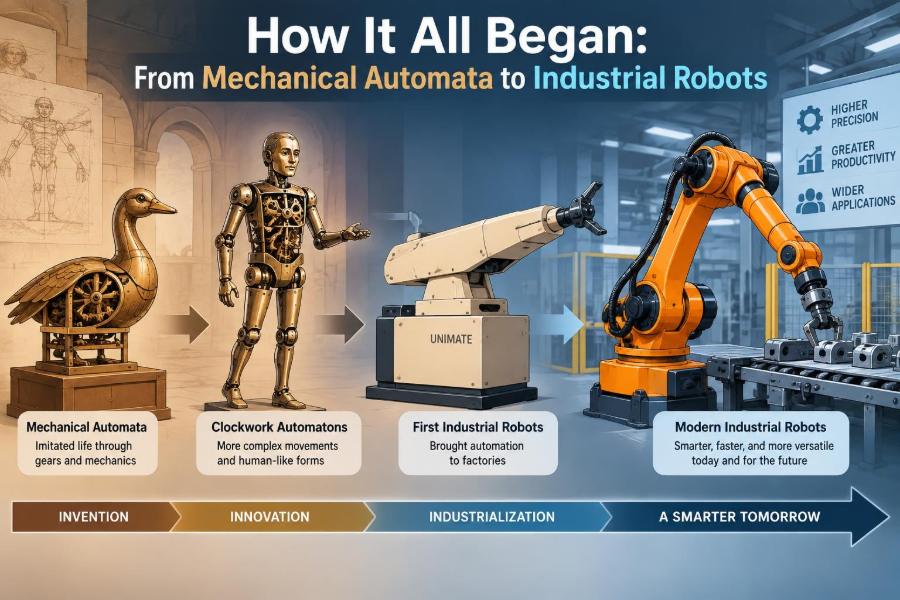
An automaton is a self-operating mechanical device, often designed to imitate a living action. Famous historical examples include elaborate musical figures, writing machines, and moving animals displayed in courts, workshops, and public exhibitions.
Many automata were entertainment, but dismissing them as toys misses their technical value. They demanded careful work in mechanisms, power transmission, timing, friction reduction, and fabrication. A figure that appears to write smoothly is coordinating many small motions, much like a modern machine executing a trajectory.
✍️ The Jacquet-Droz Automata and Motion Programming
In the eighteenth century, the Swiss clockmakers Pierre Jaquet-Droz and his collaborators created celebrated automata, including figures that could write, draw, and play music. Their mechanisms used cams and interchangeable components to produce complex action sequences.
The writing automaton is often described as an early example of programming because changing its mechanical arrangement could alter what it wrote. That is not programming in the modern software sense, but it illustrates a crucial separation: the machine’s physical structure can remain largely the same while its behavior is configured differently.
🧵 Textile Mills Introduced Encoded Instructions
The leap from beautiful mechanical motion to industrial automation accelerated in textile production. Weaving required repeated, highly structured choices about which threads should be lifted on each pass of the shuttle.
Joseph Marie Jacquard’s early nineteenth-century loom used punched cards to control this pattern. Holes and non-holes represented instructions that selected hooks and threads. The loom did not understand cloth design, but it could execute a stored pattern accurately and at scale.
💳 Why Punched Cards Matter to Robotics
Punched cards showed that instructions could be stored outside the machine’s moving parts. Instead of machining a new cam for every new pattern, an operator could prepare a different set of cards.
This distinction is foundational. A modern robot program is usually digital rather than physical, but the engineering benefit is the same: reconfigurable behavior. The capital equipment can serve multiple products when its instructions are changed safely and correctly.
⚙️ The Industrial Revolution Changed the Goal
Automata often existed to amaze an audience. Industrial automation had a different objective: make production more consistent, faster, and less dependent on continuous manual repetition.
Factories adopted specialized machinery where a task was stable enough to justify it. A stamping press, bottling line, or textile machine could outperform manual labor on a narrow operation. The trade-off was inflexibility; changing the product could require costly mechanical redesign.
🔩 Transfer Machines Solved Repetition, Not Flexibility
Early mass-production systems commonly moved parts through a fixed series of stations. Each station performed one operation, and the product advanced to the next. These transfer machines were highly productive when volume was high and variation was low.
They also reveal why industrial robots became attractive. A fixed machine is efficient for one geometry, but a programmable manipulator can potentially handle related parts, paths, or tools without rebuilding every station. “Potentially” matters: flexibility still requires suitable tooling, programming, and validation.
⚡ Electricity Freed Machines from Central Shafts
Early factories often distributed power from a central steam engine through belts and line shafts. This arrangement constrained layout and made individual machine control difficult.
Electric motors allowed power to be placed near each machine. Engineers could start, stop, and regulate individual processes more directly. This did not create robots by itself, but it made automated machinery more modular and helped establish the motor-and-controller architecture used in later systems.
🎛️ Relays Brought Logical Control
Electrical relays are switches operated by electromagnets. Wiring relays into circuits allowed machines to respond to conditions: if a guard closes, permit a cycle; if a limit switch is reached, stop an axis; if a part is present, begin the next step.
Relay logic was bulky and difficult to modify, but it made industrial sequences more sophisticated. It also established a discipline still central to robot cells: an action must occur only when its prerequisites are satisfied.
📏 Numerical Control Made Motion a Data Problem
After the Second World War, numerical control, or NC, transformed machine tools. Instead of relying only on manual handwheels or fixed mechanical templates, an NC system followed coded instructions to position cutting tools.
This mattered because it treated movement as coordinates and commands. A machining process could be expressed as a sequence of positions, speeds, and tool operations. Robotics would build on the same idea, extending programmed motion from cutting tools to general-purpose manipulators.
🧮 From NC to Computer Numerical Control
NC systems initially used media such as punched tape and specialized electronics. As computers became more practical in industry, computer numerical control (CNC) made programs easier to edit, store, verify, and reuse.
CNC and industrial robots are not identical. A CNC mill usually guides a tool along constrained machine axes, while a robot manipulates tools or objects in a larger workspace. Both, however, depend on accurate coordinate systems, motion planning, drives, and repeatable control.
🧠 Cybernetics Framed Control and Communication
Mid-twentieth-century work in cybernetics popularized the study of communication and control in animals and machines. The field emphasized feedback: measure a result, compare it with a desired state, and correct the difference.
This framework helped engineers describe robots as more than moving mechanisms. A useful robot needs a controller, actuators that generate motion, and often sensors that report position, force, or external conditions. The physical arm is only one part of the system.
🦾 George Devol’s Programmable Manipulator
A decisive milestone came when American inventor George Devol developed the concept of a programmable material-handling device and received a patent in the mid-1950s. His idea centered on recording and replaying sequences of motions.
That approach addressed a factory reality: many tasks do not require human-like intelligence, but they do require a machine to repeat a defined handling operation accurately. Devol’s concept connected programmability with an articulated mechanical device built for industrial work.
🏭 Unimate Entered the Factory
Devol partnered with entrepreneur Joseph Engelberger, and their company developed the Unimate, widely recognized as the first industrial robot installed in production. An early Unimate was deployed at a General Motors plant in the early 1960s for handling hot die-cast parts.
The task was a strong fit for automation. It involved repetitive motions, heavy and hot workpieces, and an environment where removing people from immediate exposure could improve working conditions. The robot’s value was practical rather than theatrical.
🔥 Why Die Casting Was an Ideal First Application
Die casting produces metal parts by forcing molten metal into a mold. The surrounding work can involve heat, sharp edges, heavy components, and strict cycle timing. These conditions made consistent mechanical handling attractive.
Early robots were not broadly capable helpers. They succeeded when a task was structured: the part arrived in a known place, the path was repeatable, and the required actions were limited. This remains a useful lesson when evaluating automation projects.
🛢️ Hydraulic Power Shaped Early Robot Arms
Many early industrial robots used hydraulic actuators, which generate force through pressurized fluid. Hydraulics offered substantial power for their size and suited heavy-duty handling.
They also brought limitations. Fluid leaks, heat, maintenance demands, and control complexity can be significant. Modern electric servomotors are common in many robot arms because they support clean, precise, and efficient motion, though hydraulics still have roles where very high force is needed.
🎯 Degrees of Freedom Define What an Arm Can Reach
A robot’s degrees of freedom are independently controllable motions. A simple linear slide has one; an articulated arm may have several rotating joints, allowing it to position and orient an end effector.
More axes can improve access to awkward angles, but they also complicate programming, collision avoidance, calibration, and cost. The right robot is not automatically the one with the most joints. It is the one whose reach, payload, precision, and speed fit the task.
🗺️ Coordinate Systems Turn Motion into Instructions
To move a robot reliably, engineers define reference frames: a base frame for the robot, a tool frame at the end effector, and often a workpiece frame. A command such as “move 50 millimeters upward” only has meaning relative to a chosen coordinate system.
Poor frame definition causes familiar commissioning problems. A path that looked correct during teaching may miss its target after a fixture shifts or a tool is replaced. Accurate calibration and deliberate naming of frames reduce confusion later.
🔁 Repeatability Is Not the Same as Accuracy
Repeatability is a robot’s ability to return to the same position repeatedly. Accuracy is how close that position is to the intended real-world location. A robot can be highly repeatable yet consistently offset from the desired point.
| Term | Practical meaning | Example consequence |
|---|---|---|
| Repeatability | Returns to nearly the same pose | Can repeat a taught weld path consistently |
| Accuracy | Reaches the intended absolute pose | Can place a part correctly in a precisely located fixture |
| Resolution | Smallest controllable position change | Affects fine incremental movement |
Understanding the distinction prevents a common selection mistake. If a job depends on absolute placement across changing fixtures, it may need calibration, vision guidance, or external measurement—not merely a robot with impressive repeatability.
👁️ Sensors Expanded What Robots Could Handle
Early industrial robots often operated in tightly controlled cells, relying on fixed fixtures and taught points. Sensors expanded their capabilities by reporting conditions that could not be assumed.
Examples include encoders for joint position, proximity sensors for part presence, force-torque sensors for contact, and cameras for visual inspection or location. Sensors do not automatically make a system intelligent; they produce data that must be interpreted reliably and quickly enough for the task.
🧰 End Effectors Made Arms Useful
A robot arm is a positioning platform. Its practical function usually comes from its end effector, the device attached at the wrist. A gripper picks parts, a welding torch joins metal, and a dispensing nozzle lays down adhesive or sealant.
End-effector design is often underestimated. A capable arm cannot compensate for a gripper that cannot tolerate part variation, a vacuum cup that loses seal on oily surfaces, or a tool that is difficult to maintain. In real cells, the “hand” can determine success more than the arm.
🔒 Safety Became a Core Design Requirement
Industrial robots can move quickly, carry loads, and create pinch, crush, impact, and tool-specific hazards. Their reliability does not remove risk; predictable motion can still be dangerous when a person enters the wrong space at the wrong time.
Safe systems use a combination of guarding, interlocked access points, emergency stops, safe speed or monitored-stop functions where appropriate, clear procedures, and risk assessment. Requirements vary by region and application, so engineers should use applicable standards and qualified safety expertise rather than copying a generic cell layout.
🤖 The Rise of Robot Programming Languages
Teaching a robot by physically guiding it or using a pendant remains valuable for many jobs. As applications grew more complex, manufacturers also developed robot programming languages and offline programming tools.
Programming made it easier to express logic around motion: wait for a machine signal, check a sensor, select a product recipe, recover from a fault, or communicate with a production controller. The robot became part of a larger automated system rather than an isolated moving arm.
🏗️ Automotive Manufacturing Drove Adoption
Automotive plants became major users of industrial robots because they combine high production volumes with repetitive processes such as spot welding, painting, sealing, and material handling. A well-designed cell can apply the same motion cycle after cycle.
That history can create a misleading impression that robots only suit giant factories. Automotive environments helped mature the technology, but later improvements in controls, tooling, and deployment methods broadened its use across many industries.
📦 Robots Moved Beyond the Assembly Line
Industrial robots now appear in food and beverage packaging, electronics assembly, medical-device manufacturing, warehouses, laboratories, metalworking, and many other settings. Their forms vary: articulated arms, delta robots, Cartesian gantries, autonomous mobile robots, and collaborative systems.
The underlying question remains unchanged from the early factory era: is the work sufficiently repeatable, measurable, and valuable to automate? A robot is not always the best answer, especially when product variation is extreme or process knowledge is incomplete.
🤝 Collaborative Robots Changed Deployment Choices
Collaborative robots, often called cobots, are designed with features intended to support operation near people under defined conditions. Depending on the application, these may include force limiting, speed monitoring, and safety-rated sensing.
A common mistake is assuming “collaborative” means inherently safe in every setup. The tool, payload, sharp edges, workpiece, speed, and surrounding equipment all affect risk. A cobot carrying a hazardous tool may still require guarding or other protective measures.
📉 Common Myths About Industrial Robot History
- Myth: Robots began as human-shaped machines. Reality: Industrial value came first from controlled handling and process automation, not human appearance.
- Myth: Automation always replaces an entire job. Reality: It often changes task allocation, creating needs in setup, maintenance, quality, and process engineering.
- Myth: A robot solves a bad process. Reality: Automation often exposes unstable tolerances, inconsistent incoming parts, and weak material flow.
History favors a less dramatic view: successful robotics is usually careful systems engineering applied to a specific operational problem.
🧪 Lessons for Students Building Their First Robot
Small projects can recreate the field’s historical progression. Start with a mechanism that moves predictably, then add sensing, control logic, and a clearly defined task. A line-following vehicle, sorting mechanism, or two-axis pick-and-place rig teaches more than an unfocused attempt at a human-like machine.
- Define the task before choosing motors or microcontrollers.
- Measure actual motion rather than trusting a theoretical model.
- Build safety limits into hardware and software from the start.
- Document coordinate frames, wiring, assumptions, and failure modes.
These habits connect clockwork-era discipline with modern robotics practice.
🛠️ Lessons for Engineers Automating a Process
Before selecting a robot, observe the existing process closely. Record part variation, cycle time, fixture condition, upstream reliability, changeover needs, maintenance access, and the real reason the task is difficult for people.
A productive feasibility review asks whether the process can be made more deterministic. Often the best early investment is not a larger robot but better part presentation, a robust fixture, clearer quality criteria, or an end effector designed for variation.
🌱 The Through-Line: Controlled Action in the Physical World
From water clocks and mechanical birds to Unimate and modern robot cells, the recurring challenge is controlled action. Engineers must provide energy, transform it into motion, specify the desired behavior, measure what matters, and manage error and risk.
The technologies have changed dramatically. Cams became code, punched cards became digital programs, and mechanical regulators became sensor-driven control loops. But the core engineering questions remain remarkably stable: What should move? How will it know where it is? What happens when reality differs from the plan?
🚀 The Lasting Principle of Robot Development
Industrial robots did not emerge because machines suddenly became human-like. They emerged because manufacturers needed adaptable, repeatable ways to move materials and tools through defined processes.
The most useful historical lesson is that a robot is never just an arm. It is a coordinated system of mechanics, power, control, sensing, tooling, software, safety measures, and human decisions. Treating all of those elements as one engineered whole is what turns motion into reliable automation.
From the first automata to the industrial robot, progress has come from making physical action more controllable, repeatable, and useful—not from making machines merely look human. 🦾⚙️🏭