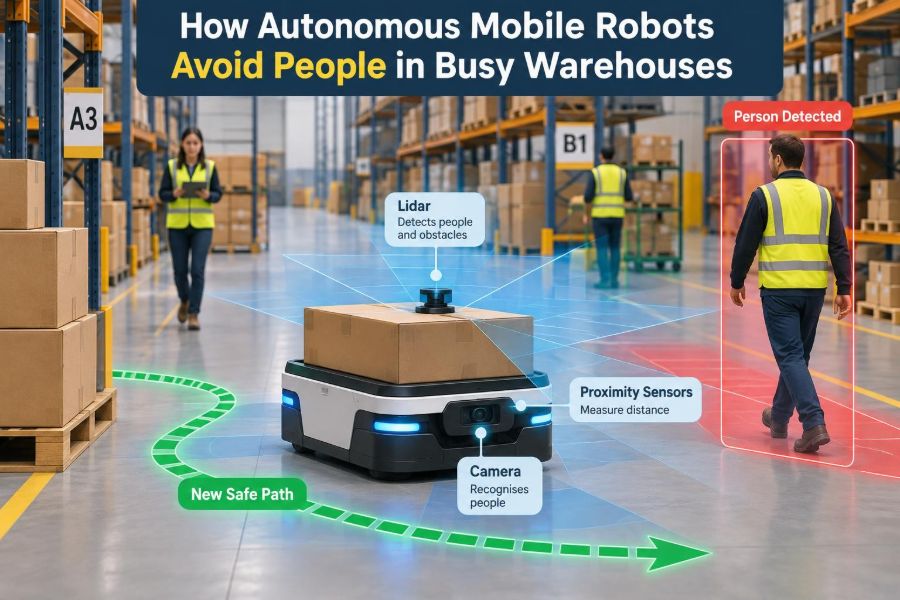

A picker rounds the end of an aisle with a loaded cart. At the same moment, an autonomous mobile robot, or AMR, approaches the same intersection carrying a tote of parts. Neither one needs to stop work for the warehouse to stay productive—but the robot must recognize the situation, predict what could happen next, and choose a safe response.
This is the everyday challenge of people-aware mobile robotics. Warehouses are not sealed robot laboratories. They contain pedestrians, forklifts, pallets, reflective wrapping, open dock doors, changing layouts, and periods of intense activity.
Modern AMRs do not avoid people through one sensor or one simple “stop if something appears” rule. Safe movement comes from layers of perception, mapping, prediction, planning, motion control, and operational discipline working together.
Understanding those layers helps engineering students design better systems and helps operations professionals ask the right questions before deploying robots alongside people. 🏭
🧭 1. The Real Job Is Shared-Space Navigation
An AMR must travel from a pickup point to a drop-off point while sharing space with people and equipment. Its mission is not merely to follow a route; it is to complete the route without creating unreasonable risk or disrupting the flow of work.
People are especially challenging because their motion is variable. A worker may pause, reverse direction, step around a pallet, carry a bulky object, or emerge from behind a rack with little warning.
The robot therefore needs both a long-term plan and rapid local reactions. Its global route says where to go, while its local navigation behavior decides how to move safely right now.
👥 2. Why Humans Are Different From Other Obstacles
A fixed rack stays where the map says it is. A pallet may be temporary, but it normally remains still long enough to be treated as an object to route around. A person has intention, attention, and unpredictable acceleration.
Humans also interpret a robot’s behavior socially. A robot that cuts too close, approaches quickly from behind, or hesitates in a doorway can feel unsafe even when it technically avoids contact.
- People can change direction abruptly.
- Body shape and visibility vary with clothing, carts, and carried loads.
- Pedestrians expect understandable, courteous motion.
- Workers may not always notice the robot’s lights or sounds.
Good people avoidance therefore considers both physical clearance and how the robot’s actions are perceived.
🗺️ 3. Start With a Usable Map
Many AMRs operate from a digital map of the facility. The map can include walls, racks, workstations, charging areas, travel lanes, and areas where the robot is not allowed to go.
This is often called localization: estimating the robot’s position and orientation within a known environment. A robot may compare live sensor readings with map features, combine wheel odometry with inertial data, or use other localization methods appropriate to the site.
A map is not a promise that the floor will remain unchanged. It is a useful baseline. Everything not matching that baseline—including people, parked carts, and misplaced pallets—must be handled as a live obstacle.
📡 4. LiDAR Provides a Fast Geometric View
Many indoor AMRs use LiDAR, a sensor that measures distance by scanning laser light across a plane or volume. Its readings create point measurements of nearby surfaces.
LiDAR is valuable because it can detect the outline of legs, carts, rack uprights, and other objects without relying on visible light alone. A two-dimensional safety scanner near the robot’s base is especially useful for detecting obstacles in the travel plane.
However, LiDAR does not automatically understand what it sees. It may know that an object is present at a location, but additional software is needed to classify it as a person, a pallet, or a permanent structure.
📷 5. Cameras Add Visual Meaning
Cameras can provide information that range sensors cannot easily capture, such as colors, signs, hand gestures, floor markings, and the visual appearance of people. Computer vision models can identify likely pedestrian shapes and estimate their position in an image.
Depth cameras can combine image data with distance estimates. Stereo cameras infer depth from two viewpoints, while other depth-sensing approaches measure or estimate distance using different optical methods.
Vision has limits. Glare, low light, dust, motion blur, occlusion, and unusual clothing can make recognition harder. That is why a robot should not rely on a single camera model as its only protection against collision.
🧩 6. Sensor Fusion Reduces Blind Spots
Sensor fusion combines evidence from multiple sensors into a more reliable estimate of the environment. For example, LiDAR may supply precise range to an obstacle while a camera suggests that the obstacle is a person.
Different sensors fail in different ways. A camera may struggle in shadow, while a range sensor may have difficulty with certain materials or geometry. Combining them can improve robustness, provided the system handles disagreement carefully.
| Sensor type | Useful contribution | Important limitation |
|---|---|---|
| LiDAR | Fast distance and obstacle shape | Limited semantic understanding by itself |
| Camera | Visual classification and scene context | Sensitive to lighting and occlusion |
| Wheel encoders | Short-term motion estimate | Errors accumulate with wheel slip |
| Inertial sensor | Acceleration and turning information | Can drift over time |
Fusion is not simply averaging readings. It requires timing, calibration, uncertainty estimates, and rules for what to do when confidence falls.
🧍 7. Detecting a Person Is Only the First Step
Once the robot observes an object, its software often turns raw measurements into tracks. A track represents the estimated position, velocity, and identity continuity of something seen over multiple sensor updates.
If a cluster of points moves like a pedestrian, the system can maintain a person track even when the exact sensor shape changes from moment to moment. If the person briefly passes behind a rack post, the track may persist with increasing uncertainty.
Detection answers “what is here?” Tracking begins to answer “where is it going?” That distinction is central to smooth avoidance.
🔮 8. Prediction Estimates Possible Future Motion
A robot cannot wait until a person is directly in front of its bumper to make every decision. It predicts possible future positions over a short horizon using current speed, direction, nearby pathways, and uncertainty.
Predictions should be treated as possibilities, not certainties. Someone walking straight down an aisle may keep walking, turn into a bay, stop to scan an item, or step aside for another worker.
As uncertainty grows, a cautious robot expands the space it reserves around the person or reduces its speed. This is one reason robots may slow down before an intersection even when the path appears clear.
📏 9. Safety Zones Change With Speed
AMRs commonly use protective fields or zones around the vehicle. The nearest zone may command an immediate protective stop, while a larger outer zone can request slowing or a planned stop.
The required stopping distance generally grows with speed because the robot needs time to detect a hazard, process the condition, command braking, and physically decelerate. Floor traction, payload, slope, and brake behavior also matter.
A useful conceptual model is:
stopping distance = reaction distance + braking distance + safety marginThe exact implementation depends on the robot and safety design, but the engineering principle is simple: faster travel requires more clear space.
🛑 10. Safety Stopping Is Separate From Normal Navigation
Navigation software tries to make progress efficiently. A safety function has a different priority: placing the machine into, or maintaining, a safe state when a hazardous condition is detected.
For example, a navigation planner may decide to steer around a person. If the person enters a close protective field, a safety-rated mechanism may instead require the robot to stop, independent of the planner’s preferred path.
This separation is important because advanced autonomy can fail in unexpected ways. The safety layer should not depend entirely on a complex perception model successfully making a high-level decision.
🔄 11. Global Planning Chooses the Route
The global planner selects a broad route through the mapped facility. It may prefer designated travel lanes, avoid restricted areas, account for one-way aisles, or choose a route with less traffic.
A global plan is usually expressed as waypoints or a path through a map. It is deliberately strategic rather than highly reactive. It does not need to predict every worker movement several minutes in advance.
When congestion persists, the fleet system or robot may create a new global route. Replanning can prevent repeated delays, but it must still honor operating rules and any reserved areas.
🏃 12. Local Planning Handles What Is Happening Now
The local planner uses current sensor data to select a safe velocity and short-term path. It may slow down behind a person, pass with extra clearance where permitted, wait at an aisle entrance, or stop completely.
Local planning repeatedly evaluates candidate movements. A candidate that collides with a predicted obstacle location, violates a clearance requirement, or exceeds the robot’s turning limits should be rejected.
The chosen motion must be feasible for the actual vehicle. A differential-drive robot, a car-like platform, and an omnidirectional base cannot all follow the same curves or stop in the same way.
↔️ 13. Clearance Is More Than “No Collision”
A path can be mathematically collision-free and still be poor behavior. Passing within a very small distance of a worker, particularly at speed, creates surprise and leaves little tolerance for sensor error or human movement.
Designers use inflation or safety buffers around obstacles. In a planning map, the detected person is represented as a larger excluded region rather than a single point or exact body outline.
The buffer can vary with speed, direction, visibility, and local context. A person near a blind corner or standing beside a moving forklift may deserve a larger margin than someone visible across an open area.
🚦 14. Speed Management Is a Major Safety Tool
In busy facilities, slowing down is often safer and more practical than trying to execute clever last-second avoidance maneuvers. Lower speed reduces stopping distance and gives the robot more time to update its understanding of the scene.
AMRs can apply speed limits by zone. Common candidates include intersections, pedestrian crossings, doorways, charging areas, narrow aisles, and spaces near manual workstations.
Speed also affects human trust. A robot moving at a predictable, moderate pace is easier to judge than one that repeatedly accelerates and brakes. Smooth control is a safety feature as well as a comfort feature. 🛞
👀 15. Occlusion Requires Conservative Behavior
An occlusion occurs when a person or hazard is hidden from a sensor’s view. Tall inventory, rack ends, stacked cartons, and parked equipment can all create occluded regions.
A robot should not assume an unseen space is empty simply because no obstacle has been detected there. Near a blind corner, it may reduce speed so it can stop within the visible free distance.
Some facilities also improve sight lines through layout choices, markings, mirrors, or protected crossing designs. Robotics safety is not solved exclusively in software; the environment can make perception easier.
🧱 16. Temporary Objects Must Be Treated as Normal
Warehouse floors change continuously. A pallet can be left partly in an aisle, shrink wrap can hang from a load, and a cart may appear where the digital map shows open space.
An AMR should regard unplanned objects as expected operating conditions, not exceptional errors. Its local obstacle layer must update quickly enough to prevent the robot from following stale map assumptions into a blockage.
If a route is blocked, sensible options include waiting, attempting a safe local detour, requesting help, or asking the fleet manager for a different assignment. The correct option depends on the geometry and the site’s operating policies.
🤝 17. Predictable Robot Behavior Helps People Cooperate
People develop expectations quickly. If a robot consistently yields at crossings, slows before passing, and does not weave around feet, workers can understand how to share space with it.
Predictability does not mean the robot must always stop. It means its choices should be legible. A gradual deceleration is easier for a pedestrian to interpret than a sudden change from full speed to an abrupt halt.
Signals such as lights, displays, or sound can communicate status, but they should supplement safe physical behavior rather than replace it. A person who never saw a signal must still be protected.
📣 18. Human-Robot Communication Has Limits
Audible alerts can help announce a robot approaching a crossing, while visual indicators can show motion direction, stopping status, or a request for assistance. These interfaces can reduce confusion during normal operations.
But busy warehouses are noisy, workers may wear hearing protection, and visual signals can be blocked by cargo. Communication cannot be the only control that prevents a collision.
- Use signals to improve awareness.
- Design motion to remain safe without acknowledgment.
- Avoid alerts that are so frequent they become background noise.
- Make fault or help-request indications clear to trained staff.
The strongest message is still a robot that visibly gives people room.
🧠 19. Machine Learning Can Help, but It Is Not Magic
Machine learning can improve visual person detection, semantic classification, scene interpretation, and prediction of movement patterns. It can be especially helpful when the robot must distinguish among people, forklifts, carts, and storage structures.
These models must be evaluated across realistic conditions: varied lighting, reflective materials, different clothing, unusual poses, partial occlusion, and busy traffic. A model that performs well on tidy training images may be unreliable on a real shift.
For safety-critical actions, engineers commonly combine learned perception with deterministic checks, conservative margins, and independent safety mechanisms. Confidence scores should influence behavior, not be mistaken for certainty.
⚙️ 20. Control Turns Plans Into Physical Motion
After planning chooses a desired path and speed, the robot’s control system commands motors and steering. The controller must account for mass, payload changes, wheel slip, actuator delay, and the vehicle’s turning geometry.
A plan is only safe if the robot can execute it. Requesting a sharp turn around a pedestrian is not useful if the vehicle needs more space than the planner assumed or if a heavy payload increases braking distance.
Feedback from encoders and other sensors lets the controller compare intended motion with actual motion. If tracking error becomes significant, the robot may need to slow, stop, or replan.
🔋 21. Payload and Floor Conditions Change the Answer
A robot carrying a light tote does not behave exactly like the same robot carrying a dense load. Payload affects inertia, center of mass, traction, and sometimes sensor visibility around the chassis.
Floor conditions matter too. Dust, water, uneven joints, ramps, and damaged surfaces can affect wheel traction and stopping behavior. These conditions should be considered in vehicle limits and operational rules.
Battery state can also influence performance in some systems, although a well-designed robot monitors its own condition rather than assuming identical behavior throughout every shift. Safe autonomy includes awareness of the machine’s physical state.
🏭 22. Facility Design Supports Safer Autonomy
A well-designed deployment separates or organizes traffic where practical. Clear lanes, marked crossings, sensible staging locations, and uncluttered intersections reduce the number of ambiguous encounters an AMR must solve.
Complete separation is not always possible or desirable. The goal is to reduce unnecessary conflict points while preserving efficient work. For example, placing replenishment staging away from a main pedestrian crossing can simplify both human and robot travel.
Facility changes should be reflected in robot maps, zone rules, and training. A robot deployment is a sociotechnical system: the building, workflow, equipment, and people all influence safety.
🧑🏫 23. Training Makes the System More Robust
Workers should understand what the robots do, where they travel, how they signal normal states, and what to do if a robot stops or behaves unexpectedly. Training should make clear that people should not rely on the robot seeing them in every circumstance.
At the same time, workers should not be expected to compensate for weak robot design. Procedures should discourage unsafe actions such as riding on robots, obstructing sensors, or entering restricted maintenance areas, while the system itself provides suitable protection.
Feedback from operators is valuable. The people walking the floor often identify confusing intersections, recurring obstructions, and workflow patterns that were not obvious during initial mapping.
🧪 24. Testing Must Include Messy Reality
Testing an AMR only in empty aisles proves little about people-aware navigation. Validation needs representative scenarios with trained test personnel, varied obstacle positions, changes in lighting, congestion, and realistic payload conditions.
Useful scenario categories
- A pedestrian enters from behind a rack end.
- A person and cart move slowly in the same direction as the robot.
- Two people cross paths near an intersection.
- A pallet narrows the available corridor.
- A sensor view is partially blocked by a carried load.
- The robot must stop on a surface with reduced traction.
Testing should also examine recovery behavior. A safe robot must handle uncertainty, blocked paths, localization loss, and component faults in a controlled way.
🛠️ 25. Monitoring Continues After Deployment
Deployment is not the end of engineering. Fleet logs, near-miss reports, stop events, route delays, sensor health indicators, and worker feedback can reveal whether the system is behaving as intended.
A high number of protective stops does not automatically mean the robot is unsafe; it may be responding appropriately to a crowded route. But patterns deserve investigation. Repeated stops at one corner may indicate an occlusion problem, poor layout, or an overly aggressive route.
Updates to maps, software, sensors, or workflows should be managed carefully. Changes can alter behavior in ways that need review and retesting rather than being treated as routine configuration edits.
⚠️ 26. Common Design Mistakes to Avoid
Several weak assumptions appear repeatedly in mobile robotics projects. Recognizing them early can prevent unsafe or frustrating behavior on the warehouse floor.
- Assuming the map is always correct: live sensing must override stale environmental assumptions.
- Using one sensor as the whole solution: robust systems use complementary sensing and safety layers.
- Optimizing only for travel time: speed and throughput must be balanced with clearance and predictability.
- Ignoring occlusion: unseen areas require reduced speed or improved facility design.
- Treating workers as obstacles only: human comfort, understanding, and workflow matter.
- Testing ideal conditions only: real warehouses are crowded, changing, and imperfect.
The best designs make conservative choices when information is incomplete.
🧷 27. The Core Principle: Layered Safety Enables Useful Autonomy
Autonomous mobile robots avoid people effectively when no single component carries the entire burden. Maps provide context, sensors observe the present, tracking and prediction estimate motion, planners choose safe options, controllers execute them, and protective functions intervene when necessary.
Just as important, the warehouse supports the robot through thoughtful layout, traffic policies, training, maintenance, and continuous review. A robot cannot be called people-aware solely because it has a camera or can detect an obstacle.
The core principle is to combine conservative perception, physically achievable motion, independent safety protections, and predictable human-centered behavior. When those layers reinforce one another, AMRs can move product efficiently while respecting the people who make the warehouse work. 🤖🦺🛞