
A warehouse robot pauses in front of a pallet. To a person, the next step is obvious: the box is slightly crooked, the aisle is clear, and the gripper should approach from the side. For the robot, that apparently simple decision involves turning light into measurements, separating the box from its background, choosing a safe motion, and confirming that its motors actually did what the software asked.
The same pattern appears in a robot vacuum avoiding a pet bowl, a surgical assistant holding a tool steady, and a drone maintaining position in gusty air. Robots do not experience the world as people do. They work through sensors, models, algorithms, actuators, and carefully managed uncertainty.
That is why a capable robot is never just a clever mechanical arm or an impressive AI demo. It is a complete engineering system in which perception, decision-making, motion, power, communication, and safety must cooperate in real time.
Understanding that cooperation makes robotics less mysterious—and more useful. Whether you are building a small mobile robot, selecting automation equipment, or entering the field professionally, the central challenge is learning how to make a machine observe, decide, and act reliably in the physical world.
🤖 A Robot Is a Closed-Loop System
A robot is a machine that senses conditions, computes an action, acts on its environment, and senses the result. This repeating cycle is called a closed loop. It is the core pattern behind machines that can adapt when reality differs from expectation.
Consider a wheeled robot told to travel one metre. Open-loop control might spin each wheel for a fixed time and hope the robot arrives correctly. Closed-loop control measures wheel motion and position, compares the measured state with the target, and adjusts motor commands when one wheel slips.
Seeing, thinking, and moving are therefore not separate product features. They are connected stages of a feedback process.
👁️ Seeing Means Measuring, Not Simply Using a Camera
Human vision combines recognition, context, depth cues, and years of experience. A camera gives a robot an array of pixel values. Before those pixels become useful, the robot needs calibration, processing, and a definition of what it is trying to detect.
A system may need to answer very different questions: Is a person present? Where is the edge of a table? Which bin contains the requested part? Is the robot drifting away from a painted line? Each task requires measurements that are accurate enough for the decision that follows.
Perception is the process of converting sensor readings into estimates about the world. Those estimates always contain some uncertainty.
📷 Cameras Provide Rich but Ambiguous Information
RGB cameras are popular because they capture texture, colour, markings, and shape. They can support barcode reading, object classification, visual inspection, and lane following. Their main limitation is that a two-dimensional image does not directly reveal distance.
Lighting changes can be equally disruptive. Glare can hide a glossy object, shadows can resemble obstacles, and automatic exposure can change the appearance of a scene from one frame to the next.
A vision system is most dependable when its environment is engineered too: stable illumination, controlled backgrounds, useful labels, and a camera position chosen for the actual task.
📏 Depth Sensors Add Geometry
Robots often need distance as well as appearance. Depth cameras estimate the distance of image points, while lidar measures ranges by timing reflected laser light. Ultrasonic sensors use sound and are common for short-range obstacle detection.
No sensor is universally best. A depth camera may struggle with reflective, transparent, or dark surfaces. Lidar can offer excellent geometric information but may not identify what an object is. Ultrasonic sensors have broad beams, so they can detect that something is nearby without describing its exact shape.
| Sensor type | Useful strength | Typical limitation |
|---|---|---|
| RGB camera | Appearance, text, colour, texture | Distance and lighting ambiguity |
| Depth camera | Dense near-field geometry | Surface-dependent depth errors |
| Lidar | Accurate range and mapping geometry | Limited semantic detail |
| Ultrasonic sensor | Low-cost proximity sensing | Wide, low-resolution measurements |
🧭 Proprioception Tells the Robot About Itself
External sensors describe the surrounding world. Proprioceptive sensors describe the robot’s own body. Encoders measure joint or wheel rotation; inertial measurement units, or IMUs, estimate angular rate and acceleration; current sensors can indicate motor load.
A robotic arm cannot place a tool accurately if it does not know its joint angles. A mobile robot cannot interpret its camera motion well if it has no estimate of its own turning and speed.
These measurements are not flawless. Encoder counts can miss motion caused by wheel slip, and IMU estimates drift over time. Robust systems combine several sources rather than assuming one sensor tells the whole truth.
🧩 Sensor Fusion Builds a Better Estimate
Sensor fusion combines measurements from multiple sensors into a more useful estimate. For example, wheel encoders can provide frequent short-term motion estimates, an IMU can sense rapid turns, and lidar can correct accumulated position error by recognizing surrounding geometry.
This is not merely averaging values. The software must account for when each reading was taken, how noisy it is, and whether the sensors agree. A measurement that arrives late or is interpreted in the wrong coordinate frame can make a robot behave worse, not better.
Fusion is valuable because sensors fail differently. A camera may lose a feature in dim light while wheel encoders continue reporting motion; on a slippery floor, the encoders may become misleading while a map-based sensor provides correction.
🗺️ Coordinate Frames Keep Measurements Meaningful
Every position needs a reference frame. A camera may report an object relative to its lens, an arm controller needs that object relative to the arm base, and a navigation system may represent goals in a building map.
Transforming correctly between these frames is a foundational robotics skill. It requires knowing the position and orientation of one frame relative to another. This relationship is often represented with translations and rotations.
A small calibration error can matter greatly. If a gripper believes a camera is mounted a few millimetres or degrees away from its true pose, repeated picking errors can appear even when object detection looks accurate.
🎯 Calibration Is Where Accuracy Begins
Calibration establishes the relationship between a sensor’s readings and physical reality. Camera calibration estimates properties such as focal length and lens distortion. Robot calibration identifies joint offsets, link dimensions, and the tool position at the end of an arm.
Engineers sometimes treat calibration as a one-time setup task. In practice, vibration, replacement parts, temperature changes, wear, and a bumped sensor mount can all alter a system enough to require checking.
A good debugging question is: Is the algorithm wrong, or is it receiving a physically incorrect measurement? Calibration problems can imitate software bugs remarkably well.
🧠 Perception Turns Data into Objects and Events
Raw sensor data must be interpreted. A robot might detect edges and shapes, segment a scene into regions, estimate the pose of an object, or classify an image region as a person, carton, or floor.
Object pose means both location and orientation. Knowing that a mug exists is not enough for grasping; the robot also needs to estimate where the handle is, how the mug is rotated, and whether it is reachable without collision.
Machine-learning models can help recognize variable objects, but they are only one part of perception. Geometry, filtering, tracking, lighting, and task-specific checks remain essential.
🧮 Thinking Is State Estimation Before It Is Intelligence
Before planning an action, a robot needs an estimate of its current state: position, velocity, joint angles, battery condition, detected obstacles, and sometimes the status of a task.
The true state is partly hidden. A robot cannot directly measure every relevant property, such as whether a wheel has just begun slipping or whether a partly occluded object is stable. It infers those conditions from imperfect evidence.
This is why robotic “thinking” is often less like a single brilliant decision and more like continuously maintaining a practical, updated belief about the world.
🧭 Localization Answers “Where Am I?”
Localization is the process of estimating a robot’s position and orientation. Indoor mobile robots may use lidar maps, visual landmarks, wheel motion, or floor markers. Outdoor systems may combine satellite navigation with inertial sensing and local perception.
A map only helps if the robot can match its observations to it. In a busy warehouse, moved pallets and repeated-looking aisles can make that difficult. In a home, furniture may be rearranged.
Localization should report confidence, not just a single pose. When confidence drops, a careful robot can slow down, seek a known landmark, or request assistance instead of proceeding as though its position were certain.
🗺️ Mapping Lets Robots Work Beyond Fixed Paths
Mapping records useful features of an environment: walls, shelves, open space, hazards, or semantic locations such as a charging dock. Simultaneous localization and mapping, commonly called SLAM, estimates a map while estimating the robot’s own location within it.
SLAM is powerful, but not magic. A featureless corridor, a room full of moving people, or a scene with repeated patterns can reduce reliability. Map maintenance also matters when the environment changes.
For a tightly controlled task, a simple fixed route or marker system may be safer and cheaper than a sophisticated map. The right approach depends on how much variation the robot must handle.
🧠 Planning Breaks a Goal into Decisions
Planning answers questions such as: Which route reaches the destination? Which arm posture avoids the fixture? In what order should items be collected? It converts a desired outcome into a sequence of feasible actions.
Planning operates at several levels. A task planner may decide to pick an item, inspect it, and place it in a bin. A motion planner then seeks a collision-free path for the arm, while a low-level controller commands motor effort along that path.
Separating these layers makes systems easier to test. A task can be logically correct while the selected arm motion is physically impossible.
🛣️ Navigation Balances Distance, Safety, and Progress
For a mobile robot, the shortest route is not automatically the best route. The planner must consider turning space, narrow passages, stopping distance, dynamic obstacles, and areas where sensing is unreliable.
Many systems use a global planner to choose a broad route through a map and a local planner to react to nearby conditions. The local layer can steer around a person or a cart without rebuilding the entire route.
A navigation system also needs a definition of acceptable behaviour. Moving slowly around people, preserving clearance from shelves, and avoiding abrupt turns can matter more than achieving the absolute minimum travel time.
🦾 Kinematics Connect Joints to Tool Position
Kinematics describes geometry and motion without considering forces. Forward kinematics calculates where an arm’s end effector is when joint angles are known. Inverse kinematics finds joint configurations that place the end effector at a desired pose.
Inverse kinematics can have multiple answers—or none. An arm may reach a point in several elbow configurations, but nearby equipment might make some unsafe. A target could also be outside the arm’s reachable workspace.
For mobile robots, kinematics describes how wheel speeds create forward motion and turns. A controller that ignores the vehicle’s turning constraints may request a path it cannot follow.
💪 Dynamics Explain Forces, Loads, and Momentum
Dynamics adds mass, inertia, friction, gravity, and force. A motion that looks valid geometrically can overload a motor, cause a payload to swing, or make a tall mobile robot unstable during a turn.
Acceleration is often the hidden constraint. An arm carrying a heavy part may be able to reach a pose but need a slower trajectory to remain accurate and stay within torque limits.
Designers should evaluate realistic payloads, not only an empty robot. Cables, grippers, batteries, and tools all affect mass distribution and performance.
⚙️ Actuators Turn Commands into Physical Motion
Actuators are the components that create movement: electric motors, pneumatic cylinders, hydraulic systems, and specialized mechanisms. Electric motors are common in mobile robots and arms because they are controllable and integrate well with sensors.
A motor command is not the same as motion. Gear ratios, friction, backlash, load changes, voltage drop, and heat all influence what happens physically. Backlash is the small amount of free motion between mechanical parts, and it can reduce positioning precision.
Actuator selection involves trade-offs among torque, speed, efficiency, weight, controllability, cost, and maintenance.
🎛️ Control Keeps Motion on Target
Control software compares desired behaviour with measured behaviour and chooses corrections. A familiar example is PID control, which combines proportional, integral, and derivative responses to reduce error over time.
A poorly tuned controller may oscillate around a target, react too slowly, or demand more motor effort than the system can safely provide. Tuning is not simply making gains larger; it requires understanding the mechanism and its delays.
Higher-level planning says where the robot should go. Control makes the robot follow that intention despite disturbances such as floor variation, payload changes, or minor pushes.
✋ Grasping Requires Contact Intelligence
Picking an object is not just a positioning problem. The robot must choose contact points, avoid collisions, apply enough force to hold the object, and avoid crushing or dropping it.
A parallel-jaw gripper works well for many rigid, predictable objects. Vacuum cups can be fast for smooth surfaces but are vulnerable to leaks and porous materials. Soft grippers can handle irregular items but may sacrifice positioning precision.
Force and torque sensing can reveal whether a part has contacted a surface or become jammed. For delicate tasks, compliance—allowing controlled flexibility rather than rigid force—often produces safer interactions.
🔄 Feedback Makes Recovery Possible
Robots become more useful when they verify results. After placing an item, a camera can check its location. After closing a gripper, motor current or a force sensor can indicate whether something was actually grasped.
This creates recovery behaviours: retry with a new approach, slow down, move to an inspection station, or stop and flag an exception. A system without verification may continue executing a plan built on a false assumption.
Reliable automation is frequently defined by its handling of ordinary failures, not by how impressive it looks when every condition is ideal.
⏱️ Real-Time Computing Has Deadlines
Robots do not merely need correct computations; many computations must finish on time. A motor control loop that is delayed unpredictably can produce rough or unstable motion, even if its math is correct.
Real-time systems manage timing explicitly. Low-level control may run at a predictable rapid rate, while slower processes such as mapping, logging, or cloud communication are isolated so they do not block safety-critical work.
Latency also matters in sensor pipelines. If obstacle information is old by the time a robot reacts, the robot has effectively been planning for a world that no longer exists.
🔋 Power Is a Design Constraint, Not an Accessory
Motors draw much more power during acceleration, climbing, or pushing than when cruising lightly. Batteries, wiring, motor drivers, and protection circuits must handle these peaks without excessive voltage drop or overheating.
Battery state estimation is imperfect, especially under changing loads and temperatures. A practical mobile robot reserves energy for a safe return to charge rather than treating the displayed percentage as a precise promise.
Power budgeting also shapes sensing and computing choices. More cameras, brighter illumination, and powerful processors can improve capability while reducing runtime or increasing thermal management needs.
🌐 Communication Helps, but Autonomy Needs Boundaries
Robots may exchange commands, maps, telemetry, and video over wired or wireless networks. Connectivity supports fleet management and remote assistance, but networks can be delayed, interrupted, or congested.
Safety-critical responses should not depend entirely on a remote connection. A robot needs defined local behaviour for communication loss, such as stopping in place, completing a safe motion, or returning to a known state.
Interfaces also need security. A device that accepts network commands without appropriate authentication and update practices creates risks beyond simple downtime.
🛡️ Safety Is Designed Into Every Layer
Safety is not a last-minute emergency-stop button. It includes risk assessment, physical guarding where appropriate, speed and force limits, monitored stops, fault detection, clear operating procedures, and validation in the intended environment.
Collaborative robots are often designed to work nearer to people, but that does not mean every application is safe without additional analysis. Tool shape, payload, speed, pinch points, workspace layout, and unexpected movement all change the risk.
A sound design asks what happens when sensors disagree, a processor restarts, a cable disconnects, or a person enters the work area. The safest response is context-dependent, but it must be intentional and tested.
🧪 Testing Must Include the Messy Cases
A robot demonstrated on clean data or a clear floor has not necessarily been tested for deployment. Useful tests include poor lighting, partial occlusion, depleted batteries, worn wheels, communication interruptions, clutter, unusual objects, and recoverable faults.
Simulation helps engineers explore dangerous or expensive scenarios early. However, a simulator always simplifies something: contact friction, sensor noise, cable behaviour, or human activity. Physical testing remains necessary.
Keep logs of sensor inputs, estimates, commands, and faults. When a rare failure occurs, a good log can turn an anecdote into an engineering diagnosis.
🐛 Common Failure: Treating Perception as Certainty
A detector that labels an object with confidence is not a guarantee that the object is present, correctly located, or safe to grasp. Confidence scores are model outputs, not universal measures of truth.
Design around uncertainty. Require multiple checks for high-consequence actions, limit speed when perception quality drops, and define a safe response for unknown objects rather than forcing a classification.
The goal is not to eliminate all ambiguity. It is to ensure the robot behaves sensibly when ambiguity remains.
🔧 Common Failure: Optimizing Parts Instead of the System
A higher-resolution camera cannot compensate for a flexible arm mount. A powerful planner cannot solve a wheel-slip problem if localization assumes encoder motion is exact. A strong motor does not help if the power system cannot supply it.
Systems engineering means tracing requirements across interfaces. If a task requires a gripper to place a component accurately, that requirement affects camera calibration, arm stiffness, controller tuning, fixture design, and verification.
Integration should start early. The expensive surprises often occur where mechanical, electrical, and software assumptions meet.
📋 A Practical Development Sequence
For a new robotics project, begin with the task rather than a favourite sensor or algorithm. Define what must be manipulated or navigated, the range of variation, the acceptable failure behaviour, and the operating environment.
- Describe measurable success: location accuracy, throughput, inspection quality, or safe stopping behaviour.
- Identify uncertainties: lighting, payload variation, people, floor conditions, and communication limits.
- Prototype the sensing and mechanics needed to address the largest uncertainties first.
- Build feedback and fault handling before expanding features.
- Test the integrated system under representative conditions, then refine requirements.
This sequence does not prevent iteration. It makes iteration purposeful by exposing the highest-risk assumptions early.
👥 Humans Remain Part of the Robot’s Environment
People load materials, clean sensors, recover faults, interpret alerts, and adapt workflows around robots. A technically capable machine can still fail operationally if its status is confusing or maintenance is impractical.
Design for the operator who arrives during a fault at the end of a shift. Clear indicators, accessible components, useful error messages, and safe manual recovery procedures can matter as much as an advanced planning method.
Automation works best when it supports a well-designed human process rather than assuming humans are a source of inconvenient variability.
📚 Skills That Make Robotics Engineers Effective
Robotics rewards breadth along with depth. Mechanical design, circuits, embedded software, controls, computer vision, estimation, and safety each contribute to a functioning machine. No individual must master every specialty, but everyone benefits from understanding the interfaces.
Useful habits include measuring before guessing, visualizing coordinate frames, testing one assumption at a time, and documenting units and conventions. A sign error, millimetre-to-metre mismatch, or unstated frame can waste days of debugging.
For students, small projects are valuable when they include the full loop: sensing, estimating, commanding motion, and handling a realistic failure.
🌱 Choosing the Right Level of Autonomy
More autonomy is not always better. A fixed industrial cell may achieve excellent reliability through fixtures, constrained parts, and repeatable sequences. A field robot needs more perception and adaptation because its environment cannot be controlled as tightly.
Remote operation, supervised autonomy, and fully autonomous behaviour are tools for different risk and uncertainty levels. The best choice considers task variability, consequence of failure, response time, and the availability of trained oversight.
Good robotics engineering matches capability to the environment instead of adding complexity simply because it is possible.
🔍 The Core Principle: Close the Loop Carefully
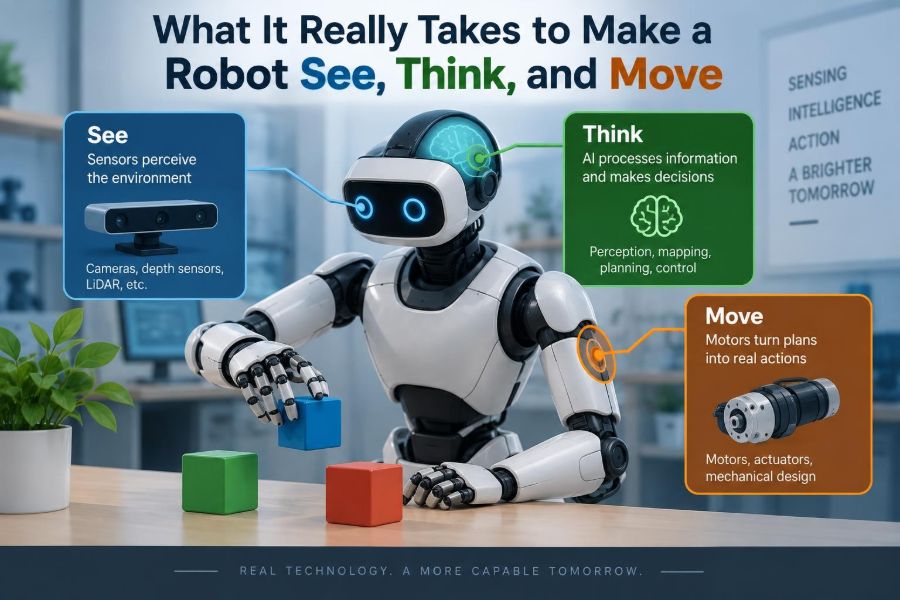
To make a robot see, think, and move, engineers must connect physical measurements to trustworthy estimates, convert goals into feasible plans, and use feedback to correct real-world error. Every link has limits: sensors are noisy, models are incomplete, actuators have constraints, and environments change.
The most dependable systems acknowledge those limits openly. They calibrate, estimate uncertainty, check outcomes, meet timing requirements, protect people, and recover gracefully when a plan no longer fits reality.
Robotics is the discipline of making decisions meet physics—repeatedly, safely, and with enough feedback to learn when the world has pushed back.
The remarkable part is not that a robot can follow a script in a perfect setting. It is that careful engineering can help it notice, reason, act, and recover in an imperfect one. 🦾👁️⚙️