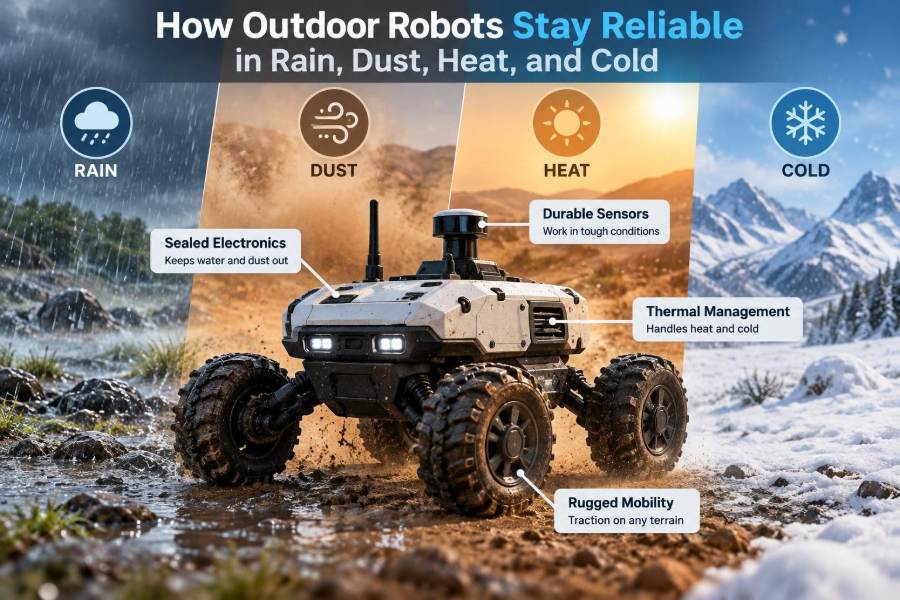

An autonomous mower starts its route under a clear morning sky. By noon, its cameras are streaked with dust, the pavement radiates heat, and a sudden shower leaves water pooled around curb edges. The robot still has to navigate safely, protect its electronics, and return to its charger.
That is the reality of outdoor robotics. Delivery rovers, farm vehicles, inspection drones, construction machines, and mobile security platforms do not operate in a carefully controlled laboratory. Their environment changes hour by hour, sometimes faster than their software can predict.
Weather resistance is not simply a matter of putting a robot in a sealed box. A design that blocks rain can trap heat. A coating that protects a circuit board can complicate repair. A sensor window that survives abrasion may distort the signal it needs to measure.
Reliable outdoor robots succeed because engineers treat weather as a whole-system design problem. Mechanical design, materials, electronics, sensing, power management, software, testing, and maintenance must work together. 🌦️
🌍 1. Start with the actual operating environment
“Outdoor” is not one condition. A robot used in a dry warehouse yard faces different hazards from one operating beside salted winter roads, in a greenhouse, or on a muddy farm.
Engineers begin by defining an environmental profile: the expected temperature range, humidity, rainfall, dust type, sunlight, wind, vibration, terrain, chemical exposure, and storage conditions. This profile drives nearly every later design choice.
- Fine mineral dust can enter gaps that larger debris cannot.
- Salt spray can accelerate corrosion even when no direct rain enters the enclosure.
- Repeated condensation can be more damaging than a brief downpour.
- Dark surfaces in direct sun can become much hotter than the surrounding air.
The important question is not “Can it survive rain?” but “What combination of exposure, duration, and duty cycle must it survive?”
🧭 2. Define the mission before choosing protection
A robot that pauses during heavy rain needs a different design from a robot required to continue an emergency inspection during a storm. The mission determines acceptable risk and allowable downtime.
Design teams should identify essential functions and degraded functions. For example, a rover may keep obstacle detection and braking active while limiting speed when camera quality declines.
Clear mission rules prevent expensive overdesign in low-risk areas and dangerous underdesign in safety-critical ones. They also give software engineers concrete triggers for changing behavior.
💧 3. Understand how water gets inside
Rain rarely enters an enclosure only through an obvious hole. Water follows cable jackets, collects around fasteners, wicks through seams, and is pushed into gaps by wind, pressure changes, or repeated wheel spray.
Capillary action matters at small clearances. A narrow gap can draw water inward, particularly when surfaces remain wet for long periods.
Engineers map possible water paths from every direction: top-down rainfall, side-driven rain, splash from below, washdown, snowmelt, and standing water. This is more useful than assuming a lid alone provides protection.
🛡️ 4. Use enclosure ratings as a starting language
Ingress-protection ratings provide a useful vocabulary for discussing resistance to solid particles and water. They do not replace a complete understanding of the robot’s mission, assembly quality, aging, or every exposure it may encounter.
A rating applies to a tested configuration under specified conditions. If a field technician changes a cable gland, leaves a service hatch unlatched, or installs a different connector, the practical protection level may change.
Engineers should document what each enclosure claim means for the product: which doors must be closed, which connectors must be capped, and whether protection applies during motion, cleaning, charging, or storage.
🧱 5. Build a layered defense against rain
Robust weather protection usually uses multiple barriers rather than trusting a single seal. An outer shell can shed water, internal channels can guide any intrusion away from sensitive parts, and local covers can protect especially vulnerable electronics.
Useful geometric features include overhangs, drip edges, recessed seams, downward-facing openings, and labyrinth paths. These features reduce reliance on perfect gasket compression alone.
A good design assumes that a little water may eventually reach a noncritical area. It then ensures that the water drains, cannot pool, and cannot reach high-voltage or signal-sensitive components.
🔩 6. Choose seals for the joint, not just the material
Gaskets, O-rings, foam seals, and molded elastomers work only when the joint supports them correctly. Surface finish, compression, screw spacing, flange stiffness, corner geometry, and assembly repeatability all affect performance.
Over-compressing a seal can permanently deform it. Under-compressing it can leave leak paths. Uneven fastener torque can create a seal that looks intact but fails at one corner.
Serviceable enclosures deserve special care because every opening cycle can introduce dirt, damage a gasket, or change its seating position. Design guides, alignment features, and replaceable seals make field maintenance safer.
🌫️ 7. Prevent condensation, not only leaks
A sealed box can still contain moisture. When internal air cools, water vapor may condense on circuit boards, connectors, and sensor optics, even though rain never penetrated the housing.
Condensation often appears after a warm operating period followed by a cold night, or when a robot moves from sunlight into a cool, humid area. Pressure changes can also draw moist air through small imperfections.
Possible responses include controlled ventilation, pressure-equalization elements, desiccant strategies, localized heating, and careful placement of temperature-sensitive electronics. The correct choice depends on the enclosure’s thermal behavior and service model.
🌡️ 8. Treat heat as an energy-balance problem
Heat comes from processors, motor controllers, batteries, radios, motors, sunlight, and warm ground. It leaves through conduction, convection, radiation, and sometimes active cooling.
In a sealed enclosure, electronics may be protected from dust and water but lose access to cooling airflow. Engineers must create a path for heat to travel from hot components to a chassis, heat spreader, or external surface.
Thermal design starts with realistic operating loads. A processor running a brief test sequence may remain cool, while the same processor performing perception and mapping continuously can create a very different internal temperature.
☀️ 9. Account for solar loading
Direct sunlight adds heat even when ambient air temperature is moderate. A dark metal cover can absorb significant radiant energy, and an enclosed battery compartment may heat faster than expected.
Surface color, finish, insulation, shade geometry, and orientation all influence solar heating. A reflective outer surface may reduce absorbed heat, while an internal thermal path still carries component heat outward.
Temperature sensors should be placed where they represent the parts that matter. A sensor in a shaded corner may report a comfortable value while a camera module or battery cell is much warmer.
❄️ 10. Design for cold starts and cold operation
Low temperatures change battery behavior, lubricant viscosity, material stiffness, display response, and actuator performance. A robot may boot successfully indoors yet struggle to move or recharge after sitting outside overnight.
Cold also creates mechanical risks. Plastics can become less forgiving, seals can stiffen, and ice can prevent a hatch, wheel, or joint from moving as intended.
Engineers often distinguish between storage temperature and operating temperature. A robot may tolerate being stored in the cold but require warm-up, reduced speed, or limited charging before full operation.
🔋 11. Protect the battery across weather extremes
Batteries are central to outdoor reliability because temperature affects available power, charging behavior, aging, and safety management. The battery system needs accurate sensing, conservative limits, and communication with the robot’s mission planner.
A battery-management system can report cell temperatures and restrict charging or discharging when conditions fall outside the pack’s approved operating limits. It should not be treated as permission to ignore thermal packaging.
Useful battery strategies include insulation, conductive paths where appropriate, controlled heaters, airflow management, and a dock that provides a protected charging environment. The chosen approach must avoid creating hot spots or trapping moisture.
🌪️ 12. Respect dust as both a mechanical and electrical hazard
Dust is abrasive, electrically troublesome, and surprisingly persistent. It can coat heat sinks, clog fans, scratch optical windows, contaminate lubricants, and form conductive paths when mixed with moisture.
Not all dust behaves alike. Dry sand, fine road dust, organic debris, cement powder, and metal particles create different problems for filters, seals, optics, and electrical insulation.
Designers should identify where dust settles during driving, braking, charging, and storage. Airflow patterns can concentrate contamination in places that appear protected from the outside.
🌀 13. Manage airflow without inviting contamination
Fans are effective thermal tools, but every fan creates an air path that may carry dust and moisture inward. A fan-based design needs serviceable filtration, sensible intake placement, and a plan for declining airflow as filters load up.
Passive cooling avoids many contamination paths but may require larger external surfaces, better thermal interfaces, or lower power limits. Some systems combine sealed electronics with external heat spreaders.
| Cooling approach | Main advantage | Key weather challenge |
|---|---|---|
| Passive conduction | Few moving parts and no airflow path | Requires effective heat transfer through the enclosure |
| Filtered forced air | Can remove heat efficiently | Filters clog and require inspection or replacement |
| Sealed liquid loop | Moves heat away from dense electronics | Adds plumbing, leak risk, and service complexity |
The best choice is the one that supports the robot’s maintenance capabilities as well as its peak thermal load.
👁️ 14. Keep cameras and optical sensors clear
Outdoor autonomy depends on perception, and perception depends on clean sensor surfaces. Rain droplets blur images, dust reduces contrast, mud blocks lenses, and glare can overwhelm cameras or other optical instruments.
Sensor placement matters. A camera mounted behind a wheel’s spray path will need far more cleaning than one placed high, recessed, and protected by a small visor.
Common sensor-cleaning approaches
- Hydrophobic coatings can encourage droplets to shed, but their durability must be evaluated.
- Air jets can remove loose dust but consume energy and may be ineffective against wet mud.
- Wipers or shutters provide active clearing but introduce moving parts and wear.
- Heaters can reduce fogging or help clear frost, with a power cost.
No cleaning method is universal. A robot needs monitoring that detects when perception quality has become too poor for a task.
📡 15. Make sensing resilient, not merely accurate
Every sensor has weather-dependent failure modes. Cameras are affected by visibility and glare; ultrasonic sensors can be influenced by surface conditions and environmental noise; satellite navigation may degrade near structures; radar-like sensing can encounter reflections and clutter.
Sensor fusion improves resilience when different sensing methods fail differently. The goal is not to guarantee perfect information, but to maintain enough trustworthy information for safe decisions.
Software should carry confidence estimates forward. If a vision system becomes uncertain in heavy rain, the planner can slow down, increase following distance, request confirmation from another sensor, or stop.
⚡ 16. Protect connectors and cable entries
Many field failures occur at boundaries: charging contacts, cable glands, external connectors, antenna feedthroughs, and harness transitions. These areas combine mechanical movement, water exposure, electrical current, and human handling.
Choose connectors appropriate to the expected environment, and orient them so water does not collect inside a cavity. Strain relief prevents cable movement from transferring force directly into seals or electrical contacts.
Where practical, use drip loops in cable routing. A loop placed below an entry point encourages water to drip away rather than travel along the cable into the enclosure.
🧂 17. Plan for corrosion from the beginning
Corrosion is an electrochemical process encouraged by moisture and certain contaminants. Salt, fertilizer, industrial pollutants, and trapped dirty water can make an otherwise minor exposure much more serious.
Material selection matters, but so does material pairing. Dissimilar metals in contact can create galvanic corrosion under wet conditions, especially if the joint retains electrolyte.
Protective coatings, compatible fasteners, drainage, isolation washers, sealed joints, and accessible inspection points all contribute to corrosion control. Designers should also consider scratches and worn edges, because real equipment does not remain cosmetically perfect.
🛞 18. Engineer moving mechanisms for dirt and water
Wheels, tracks, arms, hinges, brakes, and steering joints encounter grit, impact, vibration, and water. A mechanism that moves freely when clean may bind after contamination enters a narrow bearing or sliding surface.
Use guards, boots, labyrinth features, suitable bearings, and lubrication strategies that match the environment. Avoid placing critical moving interfaces where runoff naturally carries abrasive debris.
Drainage paths are important here too. Water trapped inside a joint can freeze, corrode parts, wash away lubrication, or create resistance that causes a motor to draw excessive current.
📳 19. Remember vibration and thermal cycling
Outdoor robots experience more than weather. Rough terrain and repeated starts can loosen fasteners, fatigue solder joints, rub cable insulation, and stress seals.
Thermal cycling adds another force: materials expand and contract at different rates. A rigidly mounted circuit board, connector, or sensor window may be stressed if its surrounding structure changes dimensions differently.
Good packaging uses appropriate compliance, strain relief, mounting patterns, and fastener retention. It also avoids routing wires across sharp edges or near moving components that can gradually wear through insulation.
🧠 20. Let software adapt to conditions
Weather-resilient hardware is essential, but software decides how the robot responds when conditions worsen. It can reduce speed, alter routes, increase sensor checks, postpone a nonessential task, or return to a safe location.
Useful inputs include internal temperatures, battery state, motor current, humidity indications, wheel slip, sensor-health metrics, rain detection, and communication quality. Individual readings are imperfect; trends and combinations are often more meaningful.
A well-designed system enters a graceful degradation mode rather than abruptly failing. It clearly defines which capabilities remain available and which actions are prohibited.
🚦 21. Build weather-aware safety states
Safety behavior needs explicit thresholds and transitions. If a critical camera is obscured, for instance, the robot should not continue a high-speed route simply because all other subsystems are functioning.
Common operational states include normal operation, limited operation, safe-stop, sheltered return, and maintenance-required. Each state should specify motion limits, sensing requirements, notification behavior, and recovery conditions.
Recovery is especially important. The robot should not repeatedly switch between two modes as rain intensity or temperature hovers near a boundary. Hysteresis, time delays, and operator review can prevent unstable behavior.
📶 22. Design communications for imperfect weather
Outdoor communication links can be affected by terrain, vegetation, structures, antenna orientation, and wet surfaces. Weather may not be the only cause of a lost connection, but the robot must cope with it safely.
Critical autonomy should not depend entirely on a continuous remote link. A robot needs a defined local behavior for communication loss, such as slowing, stopping, completing a short safe maneuver, or returning along a known route.
Antennas, cable entries, and external radios also need the same environmental protection as the rest of the platform. A robust chassis does little good if its communication hardware corrodes first.
🧪 23. Test combinations, not isolated conditions
A component test in dry heat and a separate water-spray test are valuable, but field failures often arise from combinations. Consider dust after rain, heat while charging, cold with vibration, or mud followed by freezing temperatures.
Testing should include realistic assembly variation and realistic use. Run the robot, open and close service panels, recharge it, expose it to contamination, clean it, and repeat the cycle.
Engineers should inspect not only whether the robot still operates, but also whether seals have shifted, drains have clogged, connectors have changed resistance, filters have loaded, and sensor performance has drifted.
🔍 24. Use failure analysis to improve the next design
When a robot fails outdoors, the immediate symptom may hide the true cause. A motor shutdown might originate in water intrusion, a blocked vent, an overheated controller, a corroded connector, or software that interpreted a noisy signal incorrectly.
Preserve evidence where possible: environmental logs, temperature records, fault codes, photos, contamination patterns, and the state of seals and fasteners. Recreating the full sequence is often more informative than replacing the failed part and moving on.
Strong teams convert field lessons into design changes, assembly checks, maintenance instructions, and better diagnostic signals. Reliability grows through this feedback loop.
🧰 25. Make maintenance part of the engineering
Outdoor protection degrades. Filters fill, coatings wear, gaskets age, drains clog, optical windows scratch, and debris accumulates behind guards. A robot that cannot be inspected easily will eventually become less reliable.
Design maintenance tasks to be visible, simple, and difficult to perform incorrectly. Clearly separate routine cleaning from high-risk work involving batteries, high voltage, sealed electronics, or safety sensors.
Practical service features
- Accessible filters with a clear inspection path.
- Replaceable sensor covers instead of replacing an entire module.
- Drain openings that can be checked without major disassembly.
- Diagnostics that identify a failing fan, wet connector, or degrading sensor.
- Fasteners and panels designed for repeated service cycles.
Maintenance documentation should explain what “good condition” looks like, not merely list a calendar interval.
📋 26. Design for manufacturing consistency
A weatherproof prototype can fail in production if seal placement, adhesive curing, cable routing, torque, or surface preparation varies. Environmental reliability depends on repeatable assembly as much as on a clever CAD model.
Production instructions should identify critical-to-seal features and include appropriate verification steps. A simple visual check may catch a twisted gasket, while a functional test may reveal a blocked vent or incorrectly seated connector.
Designing for repeatability may mean adding alignment tabs, poka-yoke features, torque specifications, or interfaces that make incorrect assembly physically difficult. These changes often improve repair quality as well.
💰 27. Balance protection, weight, cost, and repairability
Every protective feature has trade-offs. Thicker enclosures add mass. More seals increase assembly time. Active heating consumes energy. Fully potted electronics may resist moisture well but be difficult to repair.
Good engineering does not mean maximizing every protection measure. It means selecting the right level of protection for the mission, consequences of failure, expected maintenance, and total lifecycle of the machine.
A modular architecture can help isolate expensive protected subsystems from components that naturally wear. For example, a replaceable outer sensor cover may preserve a sealed sensing module beneath it.
✅ 28. The core principle: manage exposure, detect degradation, fail safely
Reliable outdoor robots are not made weatherproof by one material, one seal, or one rating. They are built around a disciplined chain of decisions: understand exposure, block or redirect hazards, monitor changing conditions, maintain vulnerable parts, and reduce capability safely when uncertainty rises.
The most resilient designs assume that weather will eventually test every weakness. They provide drainage instead of hoping water never enters, thermal paths instead of hoping electronics stay cool, sensor confidence checks instead of assuming clear perception, and service plans instead of assuming protection lasts forever.
Outdoor reliability comes from designing the robot, its software, and its maintenance process as one system that anticipates the real world. 🌧️🤖🔧