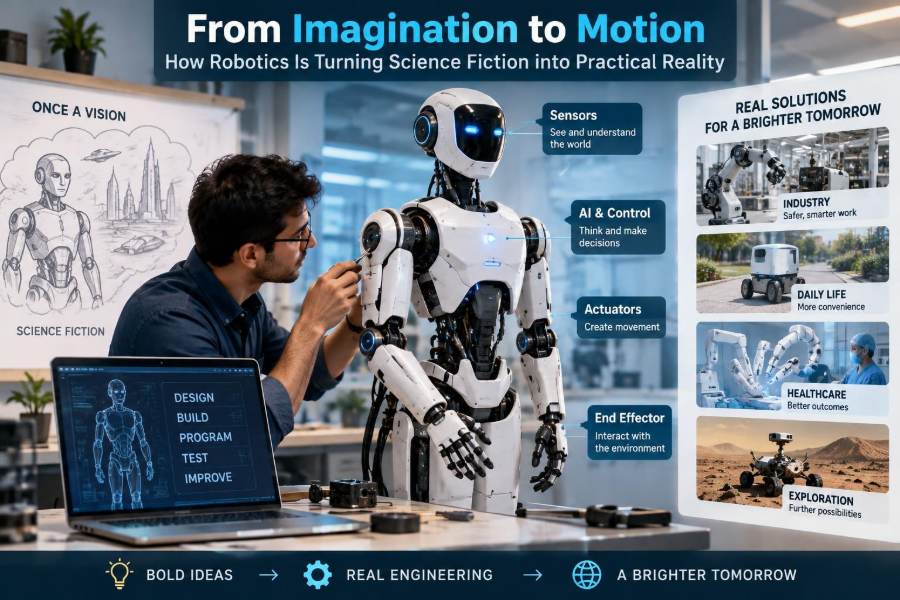

A warehouse worker walks beside a low, wheeled robot that carries shelves to a packing station. In a rehabilitation clinic, a patient practices standing with a powered exoskeleton. On a farm, a camera-equipped machine moves between crop rows, looking for weeds that a human may never notice from a tractor.
Scenes like these once belonged mainly to science-fiction films. The practical versions are less dramatic: they move cautiously, stop often, require supervision, and excel at narrowly defined tasks rather than possessing human-like general intelligence.
That distinction is exactly why robotics matters. Useful robots are not magical replacements for people; they are engineered systems that convert sensing, computation, and energy into reliable physical action in places where work is repetitive, hazardous, precise, or difficult to scale.
For students and professionals, the real story is not whether robots will resemble fictional characters. It is how engineers turn an ambitious idea into a machine that can perceive its surroundings, make bounded decisions, move safely, and keep working when the real world refuses to behave like a laboratory.
🎬 Science Fiction Set the Goal, Not the Specification
Science fiction gave robotics memorable aspirations: autonomous helpers, mechanical explorers, surgical machines, and vehicles that navigate on their own. It also encouraged the useful question behind every robotics project: what physical capability would make a human task safer, easier, or more accurate?
Engineering begins after that question. A fictional robot may understand any request, traverse any terrain, and never run out of power. A real design needs measurable requirements: payload, speed, operating time, positioning error, allowable force, temperature range, cost, and a defined safe response to faults.
The gap between imagination and specification is not a failure of robotics. It is the disciplined process that makes practical machines possible.
🧩 A Robot Is a System, Not a Single Machine
A robot is often described as a machine that senses, decides, and acts. That definition is simple, but it highlights why robotics is a systems discipline. A strong motor cannot compensate for poor sensing, and sophisticated software cannot overcome a weak mechanical structure.
Most robots combine several layers:
- Mechanical structure to support loads and guide motion.
- Actuators, such as electric motors or hydraulic cylinders, to create movement.
- Sensors to measure position, force, images, distance, or other conditions.
- Control hardware and software to convert measurements into commands.
- Power, communications, and safety systems that keep the machine usable.
Designing the interfaces between these layers is often harder than optimizing any one component.
🦾 The Body Determines What Motion Is Possible
Robot bodies are built from links, joints, frames, transmissions, wheels, tracks, grippers, and compliant materials. Their geometry determines where the robot can reach, how stiff it is, and how it handles loads.
A six-axis industrial arm can orient a tool in many directions inside a bounded workspace. A mobile robot can travel over a large area but may not reach a high shelf without an added lift. A soft gripper can handle irregular fruit gently, but it may be less precise than a rigid metal jaw.
Mechanical choices create trade-offs before software is written. Extra joints improve dexterity but add mass, cost, calibration work, and possible failure points.
⚡ Actuators Turn Commands into Force
An actuator is the component that produces useful motion. Electric motors dominate many robots because they are controllable, efficient in suitable operating ranges, and compatible with batteries and electronic drives. Pneumatic actuators are common where fast, compliant motion is useful, while hydraulics remain valuable for demanding heavy-duty force applications.
Motion is shaped by more than motor size. Gearboxes increase torque but may reduce speed and introduce backlash, the small lost motion caused by gaps in a transmission. Belt drives, lead screws, harmonic drives, and direct-drive arrangements each offer different compromises.
A robot that moves beautifully without a payload may still fail its purpose. Engineers therefore size actuators around worst-case forces, accelerations, duty cycles, and thermal limits rather than a brief demonstration.
🔋 Energy Is Often the First Hard Limit
Science-fiction robots rarely need charging. Mobile robots do. Batteries must power locomotion, computers, sensors, cooling, and sometimes manipulators, while adding weight that itself requires more energy to move.
This makes energy budgeting a central design activity. Engineers estimate average and peak power, account for conversion losses, and define what happens as the battery discharges. A delivery robot may be able to return to a dock at low charge; a robot carrying a load must also stop safely if it cannot finish its route.
Practical autonomy is often constrained less by intelligence than by energy, charging access, and the time available for maintenance.
👁️ Sensors Give Robots Evidence, Not Certainty
Sensors do not provide a perfect picture of the world. They provide measurements affected by noise, delay, limited range, changing light, reflections, vibration, and mounting errors.
Encoders measure joint or wheel rotation. Cameras capture visual information. LiDAR estimates distance using laser light. Force-torque sensors measure contact loads. Inertial measurement units combine accelerometers and gyroscopes to estimate motion and orientation.
Each sensor answers a different question, and each has blind spots. A camera may struggle in glare or darkness; a LiDAR may be confused by certain reflective or transparent surfaces. Reliable robots treat sensing as evidence that must be checked, filtered, and combined.
🧠 Perception Converts Measurements into Meaning
Perception is the process of turning raw sensor data into useful descriptions: a person is nearby, a box edge is here, the robot is drifting from its route, or a part is incorrectly oriented.
Some perception tasks use conventional geometric methods, such as finding lines or matching a measured scan to a map. Others use machine-learning models trained to recognize objects or estimate poses. Neither approach removes the need for careful testing.
A perception system can be accurate in a curated dataset yet unreliable when dust covers a lens, products change packaging, or shadows fall across a work area. The deployment environment is part of the algorithm’s specification.
🗺️ Localization Answers the Question: Where Am I?
Before a robot can move purposefully, it needs an estimate of its own position and orientation. This is localization. A factory vehicle may use reflectors, floor markers, wheel encoders, laser scans, or a prepared map. An outdoor machine may combine satellite positioning with cameras and inertial sensors.
Wheel odometry, estimating travel from wheel rotation, gradually accumulates error when wheels slip. Satellite signals can be weak near buildings or obstructed by foliage. For this reason, many systems use sensor fusion: combining several imperfect sources to create a more dependable estimate.
A robot does not need a philosophically perfect answer to “where am I?” It needs an estimate accurate enough for its task, along with a way to recognize when confidence is too low.
🧭 Planning Turns a Goal into a Route
Planning selects a sequence of actions that takes a robot from its current state to a goal while respecting obstacles and constraints. For a mobile robot, that may mean choosing a corridor through a warehouse. For an arm, it may mean moving a tool around a fixture without hitting nearby equipment.
Good plans account for more than shortest distance. They consider turning radius, joint limits, payload stability, restricted areas, timing, and the fact that other people or machines can move unexpectedly.
Many systems plan at multiple levels: a high-level route through the facility, a local path around immediate obstacles, and low-level commands that the motors can actually follow.
🎛️ Control Keeps Motion on Target
Control is the continuous correction that keeps a robot close to its intended motion. A controller compares a desired position, speed, or force with sensor feedback and adjusts actuator commands to reduce the difference.
The familiar thermostat is a simple analogy: it measures temperature, compares it with a setpoint, and changes heating behavior. A robot controller performs this loop much faster and across many coordinated joints or wheels.
Feedback is essential because physical systems are never exact. Loads shift, gears flex, floors vary, and batteries change voltage. Without feedback, a robot can only hope that reality matches its model.
📐 Kinematics Connect Joint Motion to Tool Motion
Kinematics describes geometry and motion without focusing on the forces that caused them. Forward kinematics calculates where an arm’s tool will be when its joint angles are known. Inverse kinematics works backward, finding joint configurations that place the tool at a requested location and orientation.
Inverse kinematics can have several answers, no answer, or answers that place the robot near an awkward configuration. An arm reaching around an obstacle may satisfy the target pose while putting a joint close to its limit.
This is why “move the gripper here” is not a trivial instruction. The controller also needs a feasible posture, a collision-free path, and motion smooth enough for the payload.
🧱 Dynamics Matter When Speed and Load Increase
Dynamics adds mass, inertia, gravity, friction, and force to the picture. A lightweight arm moving slowly may tolerate simple control. The same arm moving quickly with a heavy tool can vibrate, overshoot, or draw more current than expected.
Engineers use dynamic models to estimate required torque and to tune motion profiles. Smooth acceleration and deceleration reduce shock loads, protect gearboxes, and help prevent a carried object from slipping.
The lesson is practical: a successful prototype motion is not automatically a safe production motion. Repetition rate, payload variation, and long-term heat buildup change the design problem.
🤝 Collaborative Robots Change the Workspace
Collaborative robots, often called cobots, are designed for use in workspaces shared with people under defined conditions. Their value is not that they are universally safe by default; safe collaboration depends on the application, tool, speed, load, layout, and safeguards.
A robot arm placing lightweight parts beside an operator presents different hazards from one carrying a sharp tool or heavy component. Reduced-speed modes, force limitation, protective stops, safety-rated sensing, and physical separation can all be part of a risk-reduction strategy.
Collaboration works best when task boundaries are clear: people handle judgment, variation, and exceptions, while the robot handles repetitive positioning or material movement.
🛡️ Safety Is Designed into the Whole Cell
Robot safety is not merely an emergency-stop button. It begins with hazard identification: crushing points, unexpected startup, falling loads, electrical hazards, sharp tools, unstable navigation, and failures that could place a person in danger.
Risk reduction may include guards, interlocked doors, light curtains, speed limits, safe operating zones, lockout procedures, warning signals, and carefully designed recovery steps. The appropriate measures depend on the robot and its environment.
Safety functions must also be validated and maintained. A sensor that is misaligned, bypassed, or ignored during a rushed troubleshooting session can invalidate an otherwise thoughtful design.
🏭 Factories Show the Power of Repeatability
Industrial robots became widespread where environments can be structured and tasks are repeated at scale. Welding, painting, palletizing, machine tending, dispensing, and pick-and-place work are well suited to controlled fixtures, predictable part presentation, and repeatable cycle times.
The robot’s benefit is not simply speed. It can apply the same programmed path, force, or timing across many cycles, making process variation easier to measure and improve.
Yet industrial deployment still requires engineering around tool wear, part tolerances, changeovers, cable routing, quality checks, and downtime. A robot cell is a production system, not an isolated arm behind a fence.
📦 Logistics Robots Work in a Less Structured World
Warehouses increasingly use autonomous mobile robots to move carts, shelves, totes, or individual inventory containers. These systems can reduce unnecessary walking and make material flow more responsive when orders change.
Navigation is only one challenge. The fleet must coordinate traffic, charging, elevator access, loading stations, and human crossings. It also needs practical rules for blocked aisles, dropped items, and destinations that are temporarily unavailable.
Robots often perform best when the facility is redesigned around them: clear lanes, consistent labels, reliable wireless coverage, and workstations positioned for safe handoff.
🌾 Field Robotics Faces Nature’s Variability
Agricultural robots operate amid uneven ground, weather, dust, changing daylight, growing plants, and biological variation. A fruit that looks ready in one image may be partly hidden, moving in the wind, or too delicate for a rigid gripper.
Useful field systems include machines for targeted spraying, crop monitoring, autonomous guidance, and selective harvesting in appropriate crops. Their performance depends heavily on crop type, field layout, weather conditions, and how much variation the task can tolerate.
The farm is a reminder that autonomy gets harder when the environment cannot be standardized. Robustness often matters more than an impressive demonstration under ideal conditions.
🏥 Medical Robots Extend Precision, Not Clinical Responsibility
Medical robotics can support surgeons, therapists, clinicians, and laboratory teams through precise positioning, controlled instrument motion, rehabilitation assistance, or automated handling of samples. These systems operate in settings where accuracy, hygiene, workflow, and human oversight matter deeply.
A surgical robot does not independently decide the appropriate treatment. In established clinical use, it is typically a sophisticated tool directed by trained professionals within carefully defined procedures.
Medical applications demand rigorous attention to validation, usability, cybersecurity, sterilization where relevant, and failure behavior. The consequences of error are high, so claims about capability must remain specific and evidence-based.
🚒 Robots Enter Places People Should Avoid
Robots can inspect hazardous sites, handle suspicious materials, work near radiation, explore damaged structures, and monitor environments with toxic or explosive risks. In these roles, even partial remote capability can reduce direct exposure for human teams.
Hazardous environments also defeat normal assumptions. Communications may fail behind concrete or underground, heat may damage electronics, and debris can trap mobile platforms. A remotely operated robot may be more appropriate than full autonomy when human judgment is essential.
The practical goal is not to eliminate people from the operation. It is to place people farther from the immediate hazard while preserving their decision-making role.
🌊 Exploration Robots Go Where Access Is Difficult
Underwater vehicles, planetary rovers, and inspection robots illustrate another kind of science-fiction dream made practical: extending observation into inaccessible environments. They collect imagery, measurements, and samples where a person cannot easily go.
These machines must cope with communications delay, pressure, temperature extremes, uncertain terrain, and limited energy. An underwater robot may rely on tethers for power and data, while a distant rover must act cautiously because immediate intervention is impossible.
Exploration robotics rewards graceful degradation. If one sensor becomes unreliable, the system should limit its mission or switch to a safer mode rather than continue with false confidence.
🧠 Artificial Intelligence Is Useful, but It Is Not the Robot
Artificial intelligence can help robots recognize objects, interpret language, predict grasp success, or choose actions from complex data. It is a valuable toolset, especially where hand-written rules would be too brittle.
But an AI model is only one component. It still needs well-calibrated sensors, compute hardware, a control interface, physical constraints, and safety checks. A model that identifies an object correctly does not guarantee that the robot can reach, grasp, or carry it safely.
Embodied intelligence means intelligence expressed through a physical body. The body’s limits, sensor uncertainty, and consequences of contact make robotics more demanding than screen-based software alone.
📚 Data Must Represent the Real Operating Conditions
Learning-based robotics depends on training, test, and operational data that reflect the task. A grasping system trained on clean objects against a plain background may struggle with damaged packages, cluttered bins, or seasonal product changes.
Data quality includes labels, camera calibration, diversity of examples, and a clear definition of acceptable error. Teams should test not only typical cases but also difficult conditions: glare, occlusion, unusual orientations, and sensor dropouts.
When the robot encounters a case outside its confidence range, the safest response may be to slow down, request help, or route the item to an exception process.
🔄 Simulation Speeds Learning, but Reality Has the Final Vote
Simulation lets engineers test mechanisms, paths, controllers, and navigation logic before building expensive hardware or risking equipment. It is especially useful for exploring many design alternatives quickly.
However, simulated friction, lighting, cable behavior, contact forces, and sensor noise are approximations. The difference between simulation and deployment is often called the sim-to-real gap.
Good teams use simulation to eliminate poor ideas early, then conduct structured real-world testing. They measure discrepancies, update models, and avoid treating a virtual success as proof that a physical system is ready.
🧪 Prototyping Should Retire Risks Early
A common mistake is building a polished-looking prototype before answering the hardest technical question. If the main uncertainty is whether a gripper can handle delicate objects, test the gripper first. If navigation is uncertain, test it in a representative aisle before designing a complete enclosure.
Risk-driven prototypes are often unattractive but highly informative. Cardboard mockups can test reach. A single motorized joint can reveal torque and thermal limits. A manual teleoperation setup can collect useful task data before autonomy is attempted.
Early experiments should have clear pass criteria. “It seemed to work” is less useful than recording success conditions, failure modes, and the changes needed for the next trial.
🧰 Reliability Is Built Through Unexciting Details
Real robots encounter loose connectors, dust, vibration, battery aging, worn wheels, network interruptions, and operators using equipment in unexpected ways. Reliability comes from designing for these ordinary realities.
Useful practices include strain relief for cables, accessible service points, temperature monitoring, replaceable wear parts, event logging, fault codes that support diagnosis, and recovery procedures that do not require rewriting software.
Mean time between failures is not the only concern. A robot that fails safely and can be restored quickly may be more valuable than one that fails less often but requires specialist intervention every time.
🔐 Connected Robots Need Cybersecurity Boundaries
Many robots connect to fleet managers, engineering workstations, cameras, cloud services, or industrial networks. Connectivity supports updates and monitoring, but it expands the system’s attack surface.
Security should include controlled access, authenticated updates, network segmentation where appropriate, logging, backup and recovery plans, and a clear process for managing credentials. Remote access that is convenient during commissioning can become a serious weakness if left unmanaged.
Cybersecurity is also a safety concern when a compromised system can alter motion, disable monitoring, or interrupt a process at the wrong time.
👷 Jobs Change Through Task Redesign
Robotics can remove repetitive lifting, improve consistency, and create roles in maintenance, supervision, integration, and process improvement. It can also change job demands, shift control over work pace, and require workers to learn new tools.
Outcomes depend on implementation. Introducing robots without involving the people who understand the daily process can create workarounds and resentment. Involving operators early often reveals practical constraints that are invisible in a process diagram.
The most productive question is not “will robots replace this job?” but “which tasks should be automated, which require human judgment, and how will responsibility be shared?”
⚖️ Ethics Begins with Design Choices
Robotics raises questions about surveillance, accountability, bias in perception systems, accessibility, environmental impact, and who benefits from automation. These are engineering concerns because they arise from choices about sensors, data, interfaces, deployment locations, and business processes.
For example, a workplace camera may improve navigation while collecting information about people. Designers should consider whether the data are necessary, how long they are retained, who can access them, and whether a less intrusive approach could work.
Accountability must remain clear. When a robot makes an error, organizations need records, escalation paths, and people authorized to stop, inspect, and improve the system.
🎓 Skills That Make Robotics Engineers Effective
Robotics rewards breadth and depth. Mechanical design, electronics, embedded programming, control theory, computer vision, machine learning, systems engineering, and human factors all contribute, but no individual must master every area at once.
Students can build strong foundations by learning to model physical systems, read sensor data, program reliable state machines, use version control, and document tests. Working professionals benefit from understanding the neighboring disciplines that shape their interfaces.
- Build small projects that include sensing, actuation, and feedback.
- Measure performance rather than relying on visual impressions.
- Practice debugging across hardware and software boundaries.
- Learn to communicate risks and limitations clearly.
🪜 A Practical Path from Idea to Deployment
A disciplined robotics project moves from need to evidence. Start with the task and its environment, not a preferred robot platform. Define what success looks like, who will operate the system, and what failures are unacceptable.
- Observe the current process and identify variability, hazards, and bottlenecks.
- Write measurable requirements for throughput, accuracy, payload, uptime, and safety.
- Prototype the highest-risk capability first.
- Test in increasingly realistic conditions and record failure cases.
- Design the complete workflow, including maintenance and exceptions.
- Deploy gradually, monitor performance, and improve with user feedback.
This path may feel slower than rushing toward a demonstration, but it is how promising motion becomes dependable capability.
🚀 The Core Principle: Practical Robots Earn Trust Through Evidence
The most useful robots do not need to imitate fictional heroes. They need to perform a defined task reliably enough that people can safely build a workflow around them. That requires clear requirements, suitable mechanics, trustworthy sensing, feedback control, thoughtful safety design, and realistic testing.
Progress in robotics is often incremental: a gripper that handles one more type of package, a navigation system that recovers from a blocked aisle, a rehabilitation device that fits more comfortably, or an inspection robot that reaches a hazardous corner. Those increments accumulate into meaningful change.
The enduring lesson is that imagination supplies direction, while engineering supplies proof. When teams respect both, robotics can turn compelling ideas into machines that genuinely help in the physical world.
Robotics becomes practical not when a machine looks intelligent, but when it repeatedly makes the right physical action under real-world constraints. That is how imagination becomes motion—and motion becomes value. 🦾🔧🌍