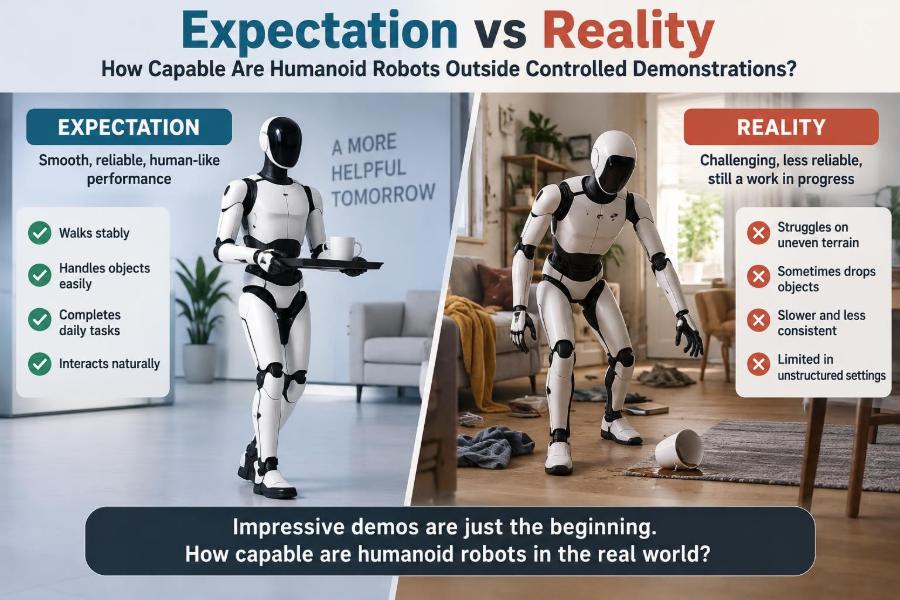

A humanoid robot walks onto a brightly lit stage, waves, picks up a box, and speaks to an audience. The demonstration is impressive—and often genuinely difficult to engineer. Yet a few minutes later, viewers may wonder whether the same machine could unpack groceries in a cramped kitchen, climb a wet stairwell, or work a full shift in a busy warehouse.
That gap between a polished demonstration and an ordinary workplace is where the most useful questions begin. Humanoid robots are becoming more mobile, perceptive, and capable, but real environments are full of variation, interruptions, fragile objects, people, and surprises.
For engineering students, this is a lesson in evaluating claims. For working professionals, it is a practical question about safety, cost, workflow design, and whether automation solves a real operational problem.
The right answer is neither “humanoids are almost human” nor “they are just publicity.” Their current capabilities are substantial in carefully selected tasks, while their limitations outside controlled demonstrations remain central to responsible deployment.
🎭 Why Demonstrations Create Strong Expectations
A robot demonstration is a performance, but that does not mean it is deceptive. It usually shows a system doing something its designers have worked hard to make reliable. The problem is that viewers may unconsciously extend that capability far beyond the conditions shown.
If a robot folds one shirt on a known table, people may infer that it can manage any laundry task. In engineering, however, performance is always conditional: object type, lighting, floor condition, speed requirement, sensor quality, operator supervision, and failure tolerance all matter.
🧭 Capability Is Not General Intelligence
A robot can be highly capable at a narrow task without possessing broad, human-like understanding. It may identify a tote, grasp its handle, and place it on a conveyor because its perception and motion policies have been tuned for that workflow.
That does not automatically transfer to a loosely packed bag, an unfamiliar latch, or a blocked aisle. Task competence is not the same as general competence. This distinction helps prevent both overconfidence and unfair dismissal of useful automation.
🏠 The Real World Is an Unstructured Test Site
Factories and warehouses are not completely chaotic, but they contain far more variation than a lab. Pallets shift, labels tear, floors collect dust, workers leave carts in temporary locations, and objects arrive in different orientations.
A home is even less structured. Furniture changes, cables appear on the floor, pets move unpredictably, and many objects are soft, reflective, transparent, breakable, or partly hidden. These details are routine for people and difficult edge cases for robots.
📦 What Humanoid Robots Can Do Well Today
Current humanoid platforms can show meaningful ability in locomotion, basic manipulation, visual recognition, teleoperation, and repetitive material movement. In favorable settings, they can carry items, move between workstations, open some doors, place objects into bins, and perform simple inspections.
They are most promising when the job has repeatable physical actions but benefits from a human-compatible body shape. Examples include moving containers designed for human hands, operating existing carts, or working in spaces where changing the entire facility would be expensive.
🧍 Why the Human Form Is Attractive
Buildings, shelves, stairs, tools, and work surfaces were largely designed around human dimensions. A robot with two arms, hands, and legs can potentially use that infrastructure rather than requiring dedicated rails, fixed grippers, or redesigned aisles.
But human shape is not automatically optimal. Wheels are generally simpler and more energy-efficient on smooth floors. A fixed industrial arm can be faster and more precise at one station. Humanoids make the strongest case where adaptability to human-built spaces outweighs the complexity of legs and hands.
⚙️ Walking Is a Control Problem, Not a Magic Trick
Walking requires continual balance control. The robot estimates its body position, contacts with the ground, joint motion, and disturbances, then commands motors quickly enough to avoid falling. A small slip can become a large problem because the robot has mass, momentum, and limited recovery time.
Flat, dry flooring is a reasonable starting point. Ramps, loose mats, clutter, uneven thresholds, slippery patches, and stairs raise the difficulty sharply. A robot may traverse them in testing yet still need slower operation or supervision for dependable commercial use.
🦿 Dynamic Balance Has a Cost
Legged motion spends energy not only on forward movement but also on stabilizing the body. Each step requires sensing, computation, motor control, and enough actuator capacity to recover from disturbances.
This is why a successful walk across a stage should not be read as proof of all-day mobility. Runtime, heat management, battery swaps, fall recovery, and wear on joints determine whether locomotion is practical over an entire shift.
✋ Hands Are Harder Than Arms
An arm can place a rigid object accurately when the grasp is known. A hand must deal with contact forces, friction, object weight, shape variation, and accidental collisions. Human hands handle these issues through sensitive touch, compliant muscles, and experience built across countless objects.
Robot hands can be effective, especially with objects designed for the task. Yet general-purpose dexterity remains challenging. Thin plastic bags, tangled cables, loose fabric, deformable food packaging, and objects packed tightly together are much harder than a rigid box with a clear handle.
🫳 Grasping Depends on More Than Vision
A camera can suggest where an object is, but it does not fully reveal whether it is stuck, hollow, slippery, fragile, or heavier on one side. Tactile sensing—detecting pressure and contact at the hand—can help, as can force sensing at joints and wrists.
Even then, contact-rich manipulation needs careful control. The robot must recognize when to push, pull, wiggle, regrasp, or stop. People perform these adjustments almost automatically; robots need explicit sensing and well-tested policies to do them safely.
👁️ Vision Fails in Ordinary Ways
Robot perception is often shown under clear lighting with uncluttered backgrounds. Outside that setting, reflections from shrink wrap, low light, shadows, occlusion, dust on a lens, and visual similarity between objects can degrade performance.
A perception system also has to decide what matters. Recognizing “a box” is different from finding the one box with a specific label, checking whether it is damaged, and locating a safe grasp point while people move nearby.
🧠 Perception Is Not Understanding
Modern machine-learning systems can classify images, estimate poses, and propose actions from large amounts of training data. But a plausible action can still be wrong in context. A robot may identify a cup without knowing it contains hot liquid, or see a door handle without understanding that the door is locked.
Reliable operation requires a chain of reasoning: perceive the scene, estimate uncertainty, plan a motion, monitor the result, and recover when the plan fails. Weakness in any link limits the overall system.
🔄 The Edge-Case Problem
An edge case is an uncommon condition that the system did not handle well during development. In a controlled demo, engineers reduce edge cases by selecting objects, arranging the environment, and rehearsing the sequence.
In deployment, edge cases accumulate. A bin is dented, a barcode is missing, a worker changes the order of operations, or a package leaks. A robot does not need to fail often for these events to dominate downtime if recovery requires a person each time.
🧩 Autonomy Has Levels, Not a Single Switch
It is more accurate to ask which parts of a job are autonomous. A machine may navigate between marked stations independently, but use a remote operator when it encounters a blocked route. It may grasp standard items autonomously while asking for help with unusual ones.
This is not necessarily a weakness. Useful systems are often designed around graceful handoff rather than an unrealistic requirement for zero human involvement. The operational question is how frequent, fast, and scalable those handoffs are.
🎮 Teleoperation Changes the Picture
Teleoperation lets a human control or guide a robot from another location. Depending on the system, the operator may specify high-level goals, intervene through a graphical interface, or directly command arms and hands.
It can make a robot productive before full autonomy is available and can generate examples for improving robot policies. However, teleoperation adds staffing needs, communication delays, training requirements, and a different safety case. A remotely assisted robot should not be described as fully autonomous.
🧪 Simulation Helps, but Reality Still Wins
Simulation allows engineers to test thousands of motions, train control policies, and model falls or collisions without damaging expensive hardware. It is particularly valuable for locomotion and repetitive planning.
The challenge is the “sim-to-real” gap: friction, sensor noise, flexible materials, backlash in joints, and imperfect object models rarely behave exactly as simulated. Strong teams use simulation as one tool, then validate heavily on physical hardware.
🔋 Energy, Heat, and Duty Cycle Matter
A robot that can perform a task for several minutes has demonstrated feasibility. A robot that can perform it repeatedly through a work period has demonstrated much more. Batteries add weight, motors generate heat, and high-force actions can drain energy quickly.
Engineers therefore examine duty cycle: how long the system works, rests, charges, cools, or receives maintenance. A slower but consistent robot may be more useful than a fast robot that frequently stops.
🛠️ Reliability Includes Recovery
Reliability is not only the probability that a robot completes a normal action. It also includes what happens after an error. Can it detect that it dropped an object? Can it safely step back, replan, and continue? Can a worker reset it in seconds rather than calling a specialist?
A mature deployment measures recovery paths as carefully as nominal performance. In real operations, a clear, safe recovery procedure can create more value than a small improvement in peak speed.
🧯 Falling Is a Safety and Availability Issue
A fall can damage the robot, nearby goods, or the environment. Around people, it also raises safety concerns, particularly for a heavy machine with moving limbs. This is why speed, force limits, exclusion zones, and emergency-stop systems matter.
Designers may use compliant actuation, which allows controlled give under force, as well as fall detection and conservative motion limits. These choices can improve safety but may reduce speed or payload. Safety engineering involves these trade-offs rather than a single feature.
👷 Working Around People Requires More Than Avoidance
A robot must not merely avoid collisions. It should move in ways people can predict, respect personal space where appropriate, signal its intentions, and behave safely when a person unexpectedly enters its path.
Workplace integration also includes training. Employees need to know the robot’s operating boundaries, emergency procedures, and what kinds of intervention are permitted. Poorly designed human-robot interaction can turn a technically capable machine into an operational hazard.
🏭 The Best Early Tasks Are Bounded
Humanoid robots are most likely to succeed first in bounded workflows: limited spaces, a defined set of objects, repeatable routes, and clear success criteria. “Move standardized containers from this rack to that conveyor” is more deployable than “handle whatever arrives.”
Bounded does not mean trivial. A task can still require walking, lifting, visual inspection, and manipulation. The key is that engineers can characterize the variation and design the environment, tools, and fallback procedures around it.
🏡 Why Home Robots Are a Higher Bar
Homes demand breadth rather than repetition. A useful domestic humanoid might need to understand different rooms, family routines, delicate possessions, stairs, pets, and ambiguous instructions. It would also need to operate safely without an operations team close by.
Some home tasks may arrive sooner through specialized devices: robot vacuums, automated lawn equipment, assistive tools, or mobile manipulators for specific needs. A broadly capable household humanoid faces a much wider reliability challenge.
📊 How to Read a Robot Claim Critically
When you see a video or announcement, ask what is not visible. Is the task repeated? Are the objects randomized? Is a person off camera? Did the robot operate continuously? What happens when it misses, drops, or encounters an unfamiliar item?
- Look for the stated environment and task boundaries.
- Separate remote assistance from autonomous execution.
- Ask whether motion is shown at normal working speed.
- Consider setup time, recovery time, and maintenance—not only successful clips.
- Check whether the task needs a humanoid body at all.
These questions are not cynical. They are the same questions used in responsible engineering reviews.
📏 Metrics That Matter Beyond a Highlight Reel
A useful evaluation measures outcomes over many attempts and conditions. Relevant metrics can include task completion rate, time per cycle, intervention frequency, damage rate, energy use, recovery time, and the range of objects or layouts handled.
| Demo question | Deployment question |
|---|---|
| Can it do the action once? | Can it do the action repeatedly and recover from errors? |
| Does it look fluid? | Is its cycle time useful for the workflow? |
| Can it handle this object? | How much object and layout variation can it handle? |
| Can it move safely nearby? | Can people work around it predictably over time? |
💰 Economics Is Part of Capability
A robot can be technically successful and still be a poor deployment choice. Organizations must account for purchase or service cost, integration, facility changes, supervision, maintenance, spare parts, training, insurance, and downtime.
Conversely, a robot does not need to replace a person completely to be valuable. It may remove an ergonomically difficult step, cover a repetitive night shift, or keep a process moving during labor shortages. The relevant comparison is the whole workflow, not a single dramatic task.
🔧 Integration Usually Beats Raw Cleverness
Many successful automation projects begin by modifying the process: use standardized totes, improve lighting, place markers where appropriate, define handoff points, and create clear exception bins. These changes make the work easier for both people and robots.
There is a useful engineering principle here: do not demand universal adaptability when modest environmental design can produce dependable performance. The best solution may be a humanoid, a wheeled robot, a fixed arm, or a combination of all three.
🧑🔧 Skills Students Should Build
Humanoid robotics sits at the intersection of mechanical design, controls, embedded systems, computer vision, machine learning, safety, and operations. Students gain an advantage by learning to connect these fields rather than treating a robot as only a coding or mechanical problem.
- Build intuition for sensors, calibration, uncertainty, and noisy data.
- Practice motion planning and feedback control on physical systems.
- Learn how to define test cases and document failures.
- Study human factors and machine safety alongside autonomy.
- Work with real hardware whenever possible; field problems reveal hidden assumptions.
🧰 Advice for Teams Considering Deployment
Start with a process observation, not a robot purchase. Map the physical actions, object variation, cycle-time needs, failure consequences, and available human support. Identify the narrowest task that would create measurable value if it worked consistently.
Then run a pilot with explicit acceptance criteria. Decide in advance how intervention will be logged, who owns recovery, what conditions stop operation, and how performance will be compared with the existing process. A pilot without these details can produce impressive anecdotes but little decision-quality evidence.
🚫 Common Evaluation Mistakes
One common mistake is treating human resemblance as a proxy for usefulness. Legs, hands, and a head-shaped sensor array can make a machine intuitively relatable, but the application determines value.
Another is equating an AI model’s apparent conversational ability with physical competence. Language can help a robot receive instructions or select a known skill, yet physical work still depends on sensing, contact control, hardware limits, and safe execution.
🌱 What Progress Will Probably Look Like
Progress is unlikely to arrive as one moment when robots become universally useful. More often, capabilities will spread task by task: better grasping of known items, more reliable navigation in shared spaces, faster recovery, improved remote assistance, and broader operation within carefully engineered environments.
This incremental path may seem less cinematic, but it is how complex technologies become dependable. A robot that quietly completes a bounded task every day is a more meaningful milestone than a spectacular action that cannot yet be repeated in normal operations.
🔮 The Honest Near-Term Outlook
Humanoid robots are credible candidates for some physical jobs because human environments create real compatibility advantages. Their ability to move, perceive, and manipulate is advancing, and demonstrations can reveal authentic technical progress.
At the same time, broad autonomy in messy, changing environments remains difficult. The central constraints are not just intelligence in the abstract; they are reliable contact, perception under uncertainty, energy, recovery, safety, and integration into a real process.
🦾 The Core Principle: Judge the System, Not the Clip
The fairest way to assess humanoid robots is to examine the complete system: the machine, its sensors, software, operators, environment, safety controls, maintenance plan, and task boundaries. A video may show an exciting capability, but deployment depends on all the surrounding engineering.
This perspective leaves room for genuine optimism. It recognizes that a constrained task can be valuable, that assisted autonomy can be commercially useful, and that difficult limitations are engineering work to be solved—not reasons to abandon careful evaluation.
Humanoid robots are becoming capable tools, but their real-world value will be determined by dependable performance in specific environments, not by how human-like a single demonstration appears. 🦾⚙️🔍