
A production manager sees the same problem at the end of every shift: orders are waiting, a repetitive workstation is hard to staff, and experienced operators are spending valuable time on a task that adds little judgment. A robot appears to offer a clean answer—more output, fewer bottlenecks, and consistent operation.
Then the quotation arrives. The robot arm is only one line item among tooling, guarding, programming, integration, installation, training, maintenance, and possible changes to the surrounding process. The question becomes less exciting and more useful: when will this investment actually earn back its cost?
There is no universal payback period for industrial automation. A robot can be an excellent investment in one cell and an expensive way to automate an unstable process in another. The difference is usually not the robot model; it is the economics and engineering around the application.
A sound robot business case connects cycle time, labor, quality, uptime, product mix, safety, and risk. That connection is what turns a vendor quote into a decision.
🎯 Start With the Real Meaning of “Pay for Itself”
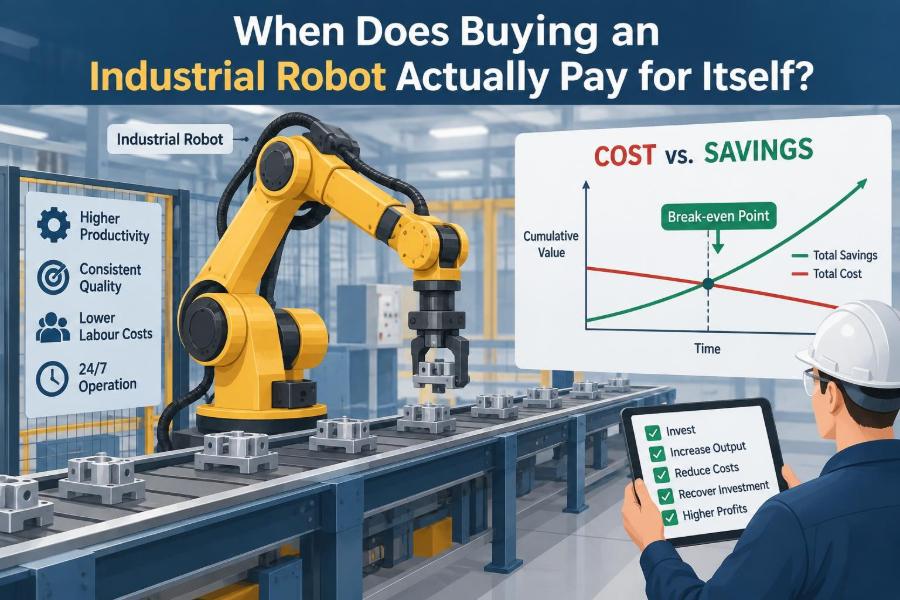
When people say a robot “pays for itself,” they usually mean that cumulative financial benefits equal the initial investment. This is commonly called the payback period. If a cell costs $300,000 to deploy and produces $100,000 in net annual benefit, its simple payback is about three years.
Simple payback is useful because it is easy to explain, but it is not a complete investment measure. It does not show what happens after payback, how benefits change over time, or whether money spent now would produce a better return elsewhere.
The right question is therefore not merely “Can we automate this task?” It is “Can this automation generate dependable value, after all relevant costs and operating constraints are included?”
🏗️ Define the Automation Boundary Before Doing Math
An industrial robot is rarely a standalone purchase. The investment is the complete robotic cell: robot, end-of-arm tooling, fixtures, sensors, safety system, controls, material presentation, programming, commissioning, and integration with upstream and downstream equipment.
For example, a palletizing arm may need a conveyor, pallet dispenser, slip-sheet handling, case orientation, floor-space changes, and a method for operators to refill packaging. Counting only the arm price can make a project look far cheaper than it is.
Draw the process boundary first. Ask what must happen before the robot can begin work, what the robot handles, and what must happen afterward. Costs and bottlenecks often sit just outside the initial boundary.
💵 Separate Upfront Costs From Lifetime Costs
Capital expenditure is the money required to design, buy, install, and launch the system. Operating expenditure is what the cell consumes while it is running. Both belong in a realistic calculation.
| Cost category | Typical items to include |
|---|---|
| Upfront deployment | Robot, controller, tooling, fixtures, guarding, engineering, programming, installation, validation |
| Facility changes | Electrical service, compressed air, extraction, foundations, network connections, layout changes |
| Ongoing operation | Energy, consumables, preventive maintenance, spare parts, software support, calibration where needed |
| Change-related cost | New grippers, fixture modifications, programming updates, revalidation, operator retraining |
Some costs are uncertain at the quotation stage. Rather than hiding that uncertainty, estimate a range and identify the assumption behind it. A business case built on transparent ranges is more credible than one built on false precision.
👷 Understand What Labor Savings Really Mean
Labor is often the largest proposed benefit, but “one robot replaces one person” is usually an oversimplification. A robot may remove direct labor from a workstation while creating work elsewhere: loading materials, inspecting exceptions, clearing faults, changing tools, or maintaining the cell.
The relevant number is the avoidable labor cost, not simply the wage rate of the person currently doing the task. If an employee is reassigned to a needed job, the company may gain capacity or avoid future hiring, but it may not immediately reduce payroll.
Labor savings are strongest when the robot allows a position to remain unfilled, eliminates recurring overtime, supports an additional shift without equivalent staffing, or frees skilled workers for work with higher operational value.
🕒 Measure Available Production Time, Not Clock Time
A robot may be capable of fast motion, but its business value depends on productive time. Scheduled hours are reduced by breaks, changeovers, material shortages, planned maintenance, cleaning, faults, and stops caused by other machines.
Before estimating output, measure how the current process actually spends its time. A basic time study can reveal whether the manual task is the constraint or whether operators are mostly waiting for parts, labels, inspection approval, or the next machine.
Automating a station that is not the bottleneck can improve ergonomics or quality, but it may not increase plant output. That distinction matters when output growth is part of the return calculation.
⏱️ Calculate Cycle Time at the Cell Level
Robot suppliers may quote a repeatability specification or an ideal motion time. Neither is the same as a completed production cycle. Cell cycle time includes approach, gripping, motion, placement, sensor checks, fixture actions, communication delays, and any waiting for adjacent equipment.
Consider a pick-and-place task. A robot may move quickly between two points, but the real cycle can be limited by a clamp opening, a conveyor index, or the time required for adhesive to cure. Optimizing arm speed alone will not solve those constraints.
Use a full sequence diagram or simulation for more complex applications. It should include normal motion as well as practical events such as replenishment, reject handling, and tool changes.
📈 Identify Whether Extra Throughput Can Be Sold
More units per hour create financial value only when those units can be used. If customer demand already exceeds capacity, automation may protect revenue, reduce lead time, or enable growth. If demand is limited, higher theoretical throughput may simply create inventory.
Ask where the newly available capacity goes. It might support a profitable product line, reduce subcontracting, stabilize delivery performance, or permit longer unattended operation. Each route has a different value and different level of certainty.
When revenue is included as a benefit, use contribution margin rather than total sales value. Revenue must still cover material, shipping, sales, and other variable costs.
✅ Put Quality Gains Into Measurable Terms
Robots can improve consistency by applying the same programmed motion, force, position, or process sequence repeatedly. That can reduce variation in dispensing, welding, fastening, machine tending, inspection positioning, and packaging.
Yet a robot does not automatically create quality. It can repeat a poor path very consistently if the fixture is inaccurate, the part shifts, a sensor is unreliable, or the process parameters are wrong.
Quantify quality benefits using actual costs: scrap material, rework labor, inspection time, customer returns, containment activity, and production capacity lost to defects. Do not claim a generic “quality improvement” without linking it to a known failure mode.
🦺 Treat Safety as a Value Driver, Not a Spreadsheet Trick
Robots are often considered for hazardous, highly repetitive, hot, sharp, heavy, or ergonomically difficult jobs. Reducing exposure to risk is a legitimate reason to automate, even when it is hard to convert every benefit into a dollar figure.
Safety should not be justified by assigning speculative savings to injuries that may never occur. Instead, document the hazard, the current controls, the residual risk, and how the proposed cell changes the task. This supports a responsible engineering decision.
A robot also introduces hazards: stored energy, pinch points, unexpected restart, dropped loads, and interaction with automated equipment. A safe cell requires risk assessment, appropriate safeguarding, validated safety functions, and procedures for normal operation and recovery.
🔄 Account for Changeovers and Product Variety
High-volume, stable production is often easier to automate because the same motion and tooling are used repeatedly. High product variety does not rule out robotics, but flexibility has a cost.
A cell handling ten box sizes may need adjustable guides, recipe management, vision guidance, quick-change grippers, and verification that the correct program is selected. These additions can be worthwhile, but they should be priced and tested rather than assumed.
Ask how often the product changes and how disruptive each change is. A robot that takes forty minutes to switch over may still be valuable for long runs, while a short-run operation may need a different automation strategy.
🧰 End-of-Arm Tooling Often Determines Success
The end effector is the device attached to the robot wrist: a gripper, vacuum cup, welding torch, screwdriver, dispenser, or other process tool. It is the point where general-purpose robot motion meets a real, imperfect part.
Tooling must cope with part tolerances, surface conditions, orientation, weight, center of gravity, contamination, and occasional damaged components. A beautifully selected robot cannot rescue a gripper that drops parts or fails to pick them reliably.
During feasibility work, test the hardest expected part condition, not only the ideal sample. This is especially important for flexible bags, glossy surfaces, mixed pallets, castings, and parts with variable geometry.
👁️ Know When Vision Adds Value—and Complexity
Machine vision can locate randomly oriented parts, inspect features, read codes, and guide robots when fixed fixtures are impractical. It can reduce dedicated tooling and make a cell more adaptable.
It also depends on lighting, camera placement, image quality, part presentation, calibration, and exception handling. A vision system that works in a controlled demonstration may need careful engineering to perform reliably in a dusty, reflective, or changing factory environment.
Use vision when it solves a defined problem that simpler methods cannot solve economically. A mechanical locator is sometimes less flexible, but it may be more robust and easier to maintain.
🔌 Include the Supporting Infrastructure
Robotic systems need more than floor space. They may require sufficient electrical capacity, clean compressed air, network connectivity, safety-rated control interfaces, extraction for fumes or dust, and environmental protection from washdown, heat, or contaminants.
Material flow matters just as much. If a robot must be fed by an operator who walks across the facility for every batch, the cell may move work rather than remove it. Good automation design considers the entire path of material and information.
A site survey early in the project prevents late discoveries such as inadequate power, ceiling obstructions, weak flooring, or an aisle conflict with forklift traffic.
🧪 Prove Technical Feasibility Before Promising Returns
A return-on-investment model assumes the system can perform the task. For novel, variable, or demanding applications, that assumption should be tested through samples, trials, prototypes, or simulation.
Feasibility questions include whether the robot can reach every required point, whether the payload includes the tool and cable forces, whether cycle time is achievable, and whether parts can be presented consistently. For process applications, test quality as well as motion.
A proof of concept does not eliminate all risk, but it can expose the expensive unknowns before the plant commits to a full installation.
📊 Build a Simple Annual Net-Benefit Model
A practical first-pass model does not need complex finance software. It needs traceable assumptions. Estimate annual benefits, subtract annual operating costs, then compare the result with the total deployed capital cost.
Annual net benefit = labor avoided or redeployed
                   + overtime or subcontracting avoided
                   + contribution from usable added output
                   + scrap and rework reduction
                   + other measurable savings
                   - maintenance, consumables, energy, and support costs
Then calculate:
Simple payback period = total deployed capital cost / annual net benefit
This equation is only as good as its inputs. Document where each input came from: production records, time studies, maintenance history, supplier testing, or a clearly labeled estimate.
🧮 Use Cash Flow for Longer-Lived Decisions
For major projects, annual net benefit and simple payback are not enough. Cash flow occurs at different times: most capital is spent early, ramp-up may delay benefits, and later years may include upgrades or major component replacement.
Organizations often use measures such as net present value, internal rate of return, or discounted payback. These methods account for the fact that money available now is worth more than the same nominal amount received later.
The finance method should match the organization’s decision process. Engineers do not need to become accountants, but they should understand the assumptions that convert technical performance into an investment recommendation.
🌱 Model Ramp-Up Instead of Assuming Day-One Performance
Few production cells reach stable target output immediately after installation. Operators need training, programs need tuning, fixtures may need adjustment, and rare failure modes appear only during extended production.
A realistic forecast includes commissioning time and a ramp-up period with lower availability or speed. This is not pessimism; it is a recognition that commissioning is part of building a reliable manufacturing system.
Define acceptance criteria before deployment. They might cover safe operation, sustained cycle time, product quality, changeover time, and the ability to recover from common faults.
🛠️ Plan for Reliability, Maintenance, and Recovery
A robot cell that runs without frequent intervention creates value. One that needs a specialist every time a sensor faults can consume the gains it was intended to deliver. Reliability is therefore an economic variable, not merely a maintenance concern.
Design for routine care: accessible components, documented lubrication and inspection schedules, spare parts for likely failures, alarm messages that help technicians diagnose faults, and orderly cable routing. Also plan who responds on each shift.
Recovery procedures deserve particular attention. If a part is dropped or a safety device is triggered, trained personnel should be able to restore operation safely and consistently without improvising changes to the program.
👥 Include Operators and Technicians Early
The people who run the current process know its awkward parts: trays that arrive bent, labels that peel, components that stick together, and variations that are invisible in a process map. Their involvement can prevent costly design oversights.
Automation also changes roles. An operator may become a cell attendant who loads material, confirms recipes, performs quality checks, and responds to exceptions. Maintenance teams may need training in robot safety, controls, and systematic fault finding.
Early involvement is not only about acceptance. It is a practical way to improve maintainability, safety, and uptime.
📐 Compare the Robot With Alternatives
A six-axis industrial robot is versatile, but versatility is not always the lowest-cost solution. A dedicated mechanism, conveyor-based automation, collaborative robot, gantry, or process redesign may better fit the task.
For example, a simple linear transfer may move parts faster and more predictably than an articulated robot when the path is fixed. Conversely, a robot may avoid expensive hard automation when future products or positions are likely to change.
Compare alternatives on the same basis: total cost, throughput, flexibility, floor space, safety, maintainability, integration effort, and lifecycle risk. The best answer is the one that meets the operating need, not the one with the most impressive motion.
🤝 Understand Collaborative Robot Trade-Offs
Collaborative robots, often called cobots, are designed with features that can support work near people under suitable conditions. They are not automatically safe in every application, and they are not automatically cheaper to deploy.
Payload, reach, speed, tooling geometry, sharp edges, and the surrounding machine all affect the required safety approach. A cobot performing a low-force assembly task may reduce guarding needs, while a fast palletizing application may still require substantial safeguarding.
Select a collaborative system because its interaction model fits the work, not because “cobot” is assumed to mean no safety engineering.
⚠️ Avoid Counting the Same Benefit Twice
Double counting is a common way to create an attractive but misleading business case. If labor is already counted as saved because a person is removed from a station, do not also count the same output as new profit unless the staffing and production logic genuinely support both claims.
Likewise, improved cycle time may increase capacity, but its financial benefit depends on demand. Reduced scrap may free capacity, but that capacity should not be valued twice through both scrap savings and additional sales without careful separation.
A useful check is to ask: “Would this benefit still exist if every other claimed benefit were removed?” If not, the claims may overlap.
🎲 Use Sensitivity Analysis for Uncertain Assumptions
Every forecast contains uncertainty. Rather than presenting one optimistic number as the answer, test how payback changes when important variables move.
- What if the cell achieves a lower availability than planned?
- What if product demand remains flat?
- What if labor is redeployed rather than removed?
- What if the gripper needs replacement more often than expected?
- What if changeovers take longer than the design target?
Often, two or three assumptions dominate the outcome. Those are the assumptions worth validating first through trials, production data, or a revised process design.
🧱 Watch for the Hidden Bottleneck
Automation can shift a constraint rather than remove it. A robot may unload a machine faster, only for inspection, packaging, material replenishment, or a downstream oven to become the new limitation.
This is not necessarily a failure. It becomes a problem when the return calculation assumed that the original station controlled total output. Map the broader value stream and identify what limits flow before and after automation.
In some cases, the robot still pays back through labor, safety, or quality. It simply should not be sold internally as a throughput project.
📦 Consider Product Life and Program Longevity
A custom automation cell may have a difficult return if the product is near the end of its life or a redesign is already expected. The remaining production volume matters as much as annual volume.
For uncertain product futures, build flexibility deliberately. Modular tooling, adjustable fixtures, documented programs, and extra controller capacity can make later changes easier. These features increase initial cost, so their value depends on the likelihood and importance of future variation.
Do not confuse flexibility with unlimited adaptability. Every cell has practical limits set by reach, payload, process physics, and safety constraints.
📝 Create an Assumption Register
An assumption register is a short list of statements that the business case relies on, along with an owner and a plan to verify each one. It can be more valuable than a polished spreadsheet because it exposes what the team does not yet know.
Typical entries include expected uptime, part presentation quality, annual demand, operator coverage, gripper life, changeover duration, and integration responsibility. Mark each assumption as confirmed, estimated, or untested.
This record also helps after launch. If the project underperforms, the team can distinguish between an execution issue and an original assumption that proved inaccurate.
📋 Specify Acceptance Tests in the Purchase Agreement
Clear acceptance testing protects both buyer and integrator. It defines what “working” means before the project reaches the factory floor, reducing disputes based on vague expectations.
Tests may include a representative range of parts, specified cycle time, defined quality criteria, safe operation, documented changeovers, and a sustained run at the customer site. The test conditions should state who provides material, utilities, operators, and production data.
Be careful not to require performance the surrounding process cannot support. A cell cannot demonstrate continuous output if material supply or downstream handling is intermittent.
🏭 Hypothetical Example: A Machine-Tending Cell
Imagine a manufacturer where an operator loads and unloads a machining center. The task is repetitive, staffing is difficult on the evening shift, and the machine sometimes waits for attention. The company considers a robot with a gripper, raw-part rack, finished-part conveyor, guarding, and integration to the machine controller.
The initial model includes total cell cost, expected maintenance, and the cost of installation downtime. Benefits include avoided overtime, the ability to keep the machine attended for longer periods, and less variation in loading sequence. The team does not count an entire operator wage as immediate savings because the operator will move to another constrained department.
During testing, the team discovers that oily parts occasionally slip in the gripper. Solving that issue adds tooling cost but prevents unreliable running. The project may still be attractive, but its economics must be recalculated with the real design—not the original concept.
🚫 Recognize the Weak Business Case Early
Some applications should not be automated yet. Warning signs include highly unstable incoming parts, rapidly changing product designs, no defined owner for maintenance, low utilization, uncertain demand, or a manual process that has not been standardized.
In these situations, process improvement may be the better first investment. Reduce variation, improve material presentation, document work methods, and remove obvious waste. Automation becomes easier and more valuable once the process is predictable.
Declining or delaying a robot project is not anti-automation. It is good engineering judgment when the required conditions are not in place.
🧭 Decide With a Balanced Scorecard
Not every legitimate benefit fits neatly into a payback calculation. A balanced decision combines financial return with strategic and operational considerations.
- Financial: capital cost, ongoing cost, cash flow, and sensitivity to assumptions.
- Operational: capacity, uptime, quality, material flow, maintainability, and changeovers.
- People and safety: ergonomics, hazard reduction, training needs, and role changes.
- Strategic: product life, customer requirements, future flexibility, and manufacturing capability.
This approach prevents a narrow spreadsheet result from overriding serious technical or safety concerns—and prevents vague strategic language from concealing a weak economic case.
🔑 The Core Principle: Automate a Stable, Valuable Constraint
An industrial robot is most likely to pay for itself when it addresses a recurring task with enough volume, a reasonably stable process, measurable pain, and a clear way to capture the resulting benefit. That benefit might be avoidable labor, usable capacity, lower scrap, improved safety, or a combination of several factors.
The strongest projects are built from observed production data, tested technical assumptions, complete cell costs, and a plan for operating the system after installation. They do not depend on ideal uptime, vague quality claims, or labor savings that cannot actually be realized.
Robotics is not a shortcut around process engineering. It is a powerful extension of it.
Buying an industrial robot pays off when the complete system solves a verified production problem and its measurable lifetime value exceeds its complete lifetime cost. Start with the process, test the uncertain assumptions, and let the numbers reflect how the factory truly runs. 🦾📊🏭