
A packaging line is falling behind because an operator must load parts, check labels, and move finished cartons to a pallet. The work is repetitive, but demand changes every few weeks. Building a fully fenced automation cell may feel excessive; leaving the task entirely manual may not be sustainable either.
That is the kind of decision that brings collaborative robots, often called cobots, into the conversation. They are designed to work in a shared workspace with people under defined conditions, but that does not mean they are simply slower industrial robots with friendlier marketing.
The choice affects safety design, throughput, floor space, programming effort, staffing, and the ability to change a process later. A cobot can be an excellent fit for the right job—and an expensive compromise for the wrong one.
The useful question is not “Which robot is better?” It is: what level of speed, separation, precision, and flexibility does this particular process require?
🤖 Start With the Two Robot Categories
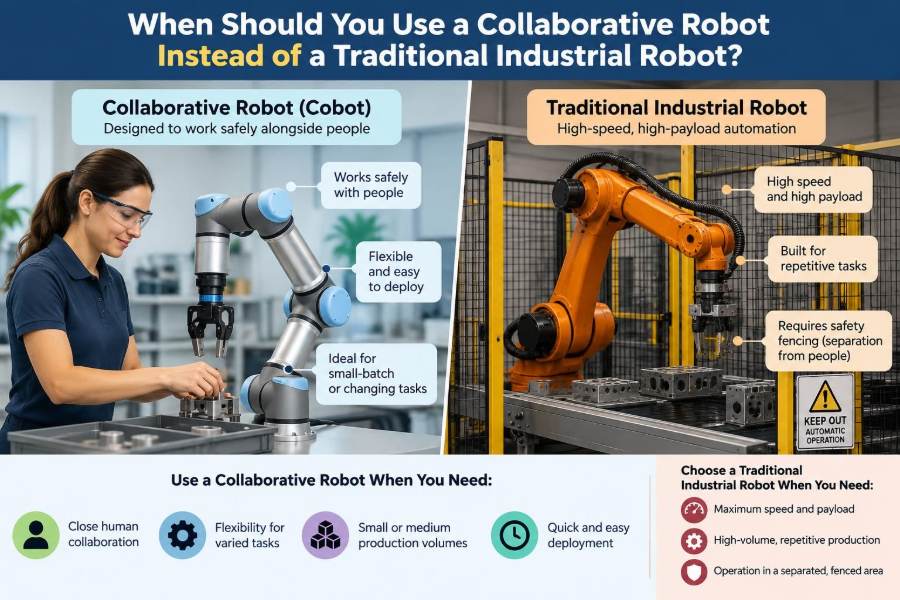
A traditional industrial robot is usually built for high speed, payload, reach, repeatability, and continuous production. It commonly operates inside a safeguarded cell, using fences, interlocked gates, safety scanners, or other measures that prevent people from entering hazardous space while it moves.
A collaborative robot is designed with features that can support operation near people, such as force or torque sensing, limited power and force, and safety-rated motion functions. “Collaborative” describes a use case and safety approach, not a promise that every cobot is safe in every situation.
🧭 Define the Actual Job Before Selecting Hardware
Robot selection should begin with the process, not a product catalog. Map the work: what enters the station, what the robot must do, what decisions a person makes, and what happens when something is misaligned or missing.
For example, “load a machine” can mean gently placing small parts in a fixture every few minutes, or rapidly feeding sharp metal blanks into a stamping press. Both are machine-tending tasks, but their hazards and performance demands are entirely different.
- Part weight, size, and surface condition
- Required cycle time and expected production volume
- Tooling, fixtures, conveyors, and downstream equipment
- Human tasks that remain at the station
- Failure modes, including jams and dropped parts
👥 Choose a Cobot When Human and Robot Work Must Interleave
A cobot is often appropriate when a person and robot must take turns at the same station. The robot may perform a repetitive move while the operator inspects a part, replenishes a tray, performs a skilled adjustment, or handles exceptions.
This arrangement can reduce walking and handoffs. It is particularly useful where human judgment remains essential but the physical motions around it are monotonous. The robot becomes a workstation assistant rather than a replacement for the whole cell.
🔄 Use Collaboration for Variable, Mixed-Model Work
High-mix, low-volume production is a common cobot application. If a facility changes among several products, a robot that can be redeployed or taught new positions with modest effort may provide more value than a dedicated hard-automation line.
Consider a hypothetical electronics assembly station that handles several enclosure sizes. An operator may select the product recipe, place components in a fixture, and let the cobot drive screws. The value comes from repeatable fastening while retaining the worker’s ability to manage variants and unusual parts.
🏭 Prefer Industrial Robots for Sustained High Throughput
When output depends on very short, uninterrupted cycles, a traditional industrial robot is often the stronger option. It can move rapidly within a guarded zone because the design does not assume people will share that moving envelope during normal automatic operation.
A cobot may complete the same motion, but running it in a collaborative mode can require lower speeds or reduced forces. If a line needs maximum parts per minute, trying to make a cobot behave like a high-speed robot can undermine the business case.
⚖️ Compare Payload as a System, Not a Part Weight
Payload includes more than the component. The robot must carry the gripper, adapter plate, cables or hoses, sensors, and sometimes multiple parts. Tool mass and its center of gravity also influence how a robot can accelerate and stop.
Many cobots handle modest loads well, while industrial robots cover a much wider range, especially for large products, heavy tooling, and long reach. Always calculate the complete end-of-arm load instead of choosing a robot based on a part’s weight alone.
📏 Check Reach, Orientation, and Access Paths
A robot may have enough nominal reach and still fail to access the work. Joint limits, fixture walls, cables, tool geometry, and the orientation needed to insert or fasten a part all matter.
Cobots can be compact and easy to position near an operator, but their arm geometry may not suit a deep machine enclosure or a wide pallet pattern. A simulation, a physical mock-up, or at least a detailed reach study can uncover these issues before equipment is ordered.
🎯 Separate Repeatability From Absolute Accuracy
Repeatability is a robot’s ability to return to the same commanded location. Absolute accuracy is how close that location is to the real-world coordinate expected without further correction. A robot can be highly repeatable yet require calibration to align precisely with a fixture or machine.
Both cobots and industrial robots may need vision, compliance devices, precise fixturing, or periodic calibration for demanding jobs. Do not assume collaboration makes a robot naturally better at delicate assembly.
🛡️ Understand What “Collaborative” Safety Really Means
Collaborative operation is achieved through risk reduction, not through the robot label. Safety functions may include monitored stopping when a person enters a zone, hand guiding, speed and separation monitoring, or power-and-force limiting during contact.
The applicable approach depends on the task and the local regulatory framework. A qualified risk assessment should evaluate the complete system: robot, gripper, workpiece, fixtures, machine tools, conveyors, and foreseeable human actions.
🧱 Remember That End Effectors Can Create the Main Hazard
A rounded robot arm may look harmless, while the tool on its wrist is not. A vacuum gripper can drop a workpiece after a loss of air; a screwdriver has rotating bits; a sharp-edged part can turn a low-force contact into a laceration risk.
Pinch points between the robot and a fixture are another frequent concern. The workpiece’s shape, the gripper’s jaws, and the environment can matter more than the arm itself during a safety review.
🚧 Do Not Confuse a Cobot With a Fence-Free Cell
Some cobot installations need guards, scanners, interlocked doors, or other protective measures. A cobot that tends a CNC machine, for example, may need safeguarding because of the machine’s moving spindle, hot chips, coolant, sharp parts, or a high-energy event inside the enclosure.
Likewise, collaborative speed may be suitable while a person is nearby, but higher speed may be permitted only after the area is clear. This hybrid approach can preserve productivity without pretending that all hazards have disappeared.
🧰 Favor Cobots Where Fast Changeovers Matter
Facilities with short production runs often benefit from simpler redeployment. Many cobot interfaces offer hand guiding, graphical programming, or reusable templates that help technicians set up common movements without writing every motion from scratch.
That does not eliminate engineering work. New grippers, fixtures, product recipes, and safety conditions still require validation. The advantage is that a well-designed cobot station can reduce the effort of moving automation from one suitable task to another.
💻 Match Programming Method to Your Team
If operators or manufacturing technicians will adjust positions frequently, an approachable interface can be a practical advantage. Simple tasks such as pick-and-place, dispensing, or screwdriving may be easier to maintain when the people closest to the process understand the program structure.
Complex applications still benefit from robot programmers, controls engineers, and integrators. Vision guidance, external axes, database connections, coordinated machines, and recovery logic can become sophisticated regardless of whether the arm is collaborative.
🧩 Design for the Exceptions, Not Just the Happy Path
A demonstration often shows a robot handling perfect parts in an uncluttered environment. Production introduces empty trays, skewed components, damaged labels, missing fasteners, sensor faults, and people who need to clear jams.
Ask what the station does when it cannot complete a pick or insertion. A useful cobot system identifies the condition, reaches a safe state, gives a clear message, and allows a person to recover without creating a new hazard or losing process traceability.
👁️ Add Vision Only When It Solves a Real Variation
Machine vision can locate randomly oriented parts, verify presence, read codes, and inspect features. It is valuable when fixtures would be costly or when product position genuinely varies.
It is not a substitute for basic process discipline. Good lighting, stable presentation, sensible tolerances, and clean parts often improve reliability more than adding a camera to compensate for an unstable upstream process.
🔧 Consider Compliance for Contact-Rich Tasks
Assembly operations sometimes require the robot to accommodate small positional errors while inserting a pin, plugging in a connector, or seating a component. Mechanical compliance, force sensing, or force-controlled motion can help the robot respond to contact instead of forcing the part along a rigid path.
This is a good cobot use case when the forces are modest and a person may assist with unusual assemblies. However, force sensing does not solve poor part design, inadequate fixturing, or excessive insertion forces.
📦 Evaluate Machine Tending by Hazard and Autonomy
Cobots are frequently used to load and unload machine tools because they can handle repetitive transfers in a compact footprint. They work well when an operator needs to remain nearby for setup, inspection, tool changes, or managing small batches.
For long, unattended runs with heavy workpieces and rapid machine cycles, a traditional industrial robot or a more enclosed automated cell may be more appropriate. The best choice depends on whether flexibility or maximum autonomous output is the central objective.
🧪 Use Cobots Carefully in Inspection and Test
Inspection often combines repetitive positioning with human judgment. A cobot can present a part to a camera, gauge, tester, or operator at a consistent angle, reducing awkward reaches and improving process consistency.
This application suits collaboration when people need frequent access and the tooling is low hazard. If a test fixture uses high voltage, heat, lasers, or moving mechanisms, the safety design must address those hazards independently of the robot type.
📍 Account for Floor Space Beyond the Robot Footprint
A cobot can reduce the need for a large fenced perimeter, but the full station still needs space for material presentation, operator posture, maintenance access, electrical equipment, and safe recovery from faults.
Conversely, a larger industrial cell may occupy more area yet improve material flow by integrating conveyors, buffers, and automatic inspection. Floor-space decisions should be based on the whole workflow, not on the arm’s base diameter.
⏱️ Measure the Whole Cycle, Including Human Time
Robot motion time is only one part of a cycle. Loading trays, opening doors, waiting for a machine, scanning a label, inspecting a feature, and clearing a completed part all affect output.
A cobot may improve a station even if it moves more slowly than an industrial robot, because it frees the operator to perform another useful task in parallel. On the other hand, if the robot makes a skilled worker wait at every cycle, the apparent automation may create a new bottleneck.
💰 Compare Total Cost of Ownership, Not Purchase Price
A fair comparison includes engineering, integration, safety equipment, tooling, installation, training, validation, maintenance, spare parts, and expected downtime. A lower-cost arm can become an expensive project if the application requires extensive custom fixtures and complex recovery logic.
Traditional robots may cost more to deploy in a guarded cell, but their speed and durability can justify that investment in stable, high-volume work. Cobots can offer a better return where redeployment and reduced integration effort are genuinely valuable.
🔌 Plan the Supporting Equipment Early
The robot is only one component. Reliable automation also needs grippers, part-present sensors, a method to confirm a successful pick, power and pneumatic routing, fixtures, controls integration, and often a material-handling strategy.
A common mistake is treating the arm as the project and treating everything around it as an afterthought. In practice, the peripheral equipment often determines whether the cell runs reliably during an ordinary shift.
🧑🏭 Involve Operators During Cell Design
Operators understand the small variations that process documents may not capture: a tray that occasionally sticks, a part that arrives oily, a product variant with a different label location, or an inspection cue that is difficult to automate.
Early involvement also improves ergonomics. Position screens, replenishment points, emergency controls, and handoff locations so that people can work comfortably rather than reaching around the robot or repeatedly interrupting it.
📚 Treat Standards and Training as Project Requirements
Robot safety is a systems engineering responsibility. Relevant standards, local requirements, manufacturer documentation, and site safety procedures should guide the design, verification, and change-control process. Requirements vary by region and application, so this work should involve competent safety and automation professionals.
Training should cover normal operation, safe stopping, restart conditions, fault recovery, tool changes, and the limits of permitted adjustments. A well-designed station can still become unsafe if changes are made without reassessing their effects.
🧯 Avoid the Most Common Selection Mistakes
- Choosing a cobot because it appears to eliminate safety engineering
- Sizing payload from the part alone and ignoring the gripper
- Using nominal reach without checking access and joint limits
- Assuming a hand-guided demo proves production reliability
- Ignoring part presentation, fixture quality, and recovery from failures
- Comparing robots without calculating throughput for the full process
Each mistake comes from evaluating the arm in isolation. The remedy is to assess the complete station under realistic operating conditions.
🗺️ Use a Practical Decision Sequence
A structured evaluation makes the choice easier and more defensible. Begin by documenting the current task, including motion, variation, hazards, cycle time, quality requirements, and staffing constraints.
- Define the required output and allowable downtime.
- Measure the part, tool, reach, and access requirements.
- Identify every hazard in the complete workstation.
- Decide whether people must share the workspace during normal operation.
- Compare cobot and industrial-cell concepts on throughput, flexibility, and lifecycle cost.
- Prototype the riskiest steps before committing to a full deployment.
📊 A Quick Fit Comparison
| Process condition | Cobot is often a strong fit | Traditional industrial robot is often a strong fit |
|---|---|---|
| Human involvement | Frequent handoffs, inspection, or skilled exceptions | People can remain outside a defined automatic cell |
| Production pattern | Changing products and moderate volumes | Stable products and sustained high volume |
| Motion demand | Moderate speeds and modest payloads | High speed, heavy loads, long reach, or demanding duty |
| Layout goal | Compact shared workstation | Integrated cell with buffering and autonomous flow |
| Safety strategy | Risk-reduced shared operation where feasible | Separation and safeguarding for energetic processes |
This comparison is a screening tool, not a safety approval. Individual robot models and task details can change the conclusion.
🔍 Recognize When a Hybrid Design Is Best
The decision is not always cobot versus industrial robot. A station can use collaborative features during loading and setup, then operate at higher speed after people leave the area. It can also use a conventional robot in a guarded process while a cobot handles nearby kitting or inspection.
Hybrid designs acknowledge that production has different modes. The right automation may change behavior as people enter, leave, replenish material, or request maintenance access.
🧠 Build for Process Stability First
Robots repeat what they are given. If parts arrive inconsistently, fixtures shift, labels vary, or upstream steps create frequent defects, automation may make the consequences repeatable rather than make the process better.
Before selecting a robot, stabilize presentation, clarify quality criteria, and identify the true sources of variation. A simple, stable task is often more valuable to automate than an impressive but fragile demonstration.
🏁 Choose the Robot That Fits the Work
Use a collaborative robot when the process benefits from close human interaction, frequent changeovers, compact deployment, modest loads, and flexible task sharing. Use a traditional industrial robot when speed, payload, reach, continuous output, or separation from energetic hazards dominates the requirement.
Neither option is inherently more advanced. The better solution is the one that meets production needs while managing risk through sound engineering, appropriate safeguarding, and a realistic plan for operation and recovery.
A cobot is the right choice when collaboration solves a real process problem—not simply when avoiding a fence seems convenient. Start with the task, design the whole system, and let the evidence guide the robot choice. 🦾🛠️👥