
A warehouse robot pauses at an aisle intersection. Its camera sees a pallet edge, its lidar detects a nearby object, its wheel encoders report steady motion, and its inertial sensor says it has rotated slightly. Which signal should it trust?
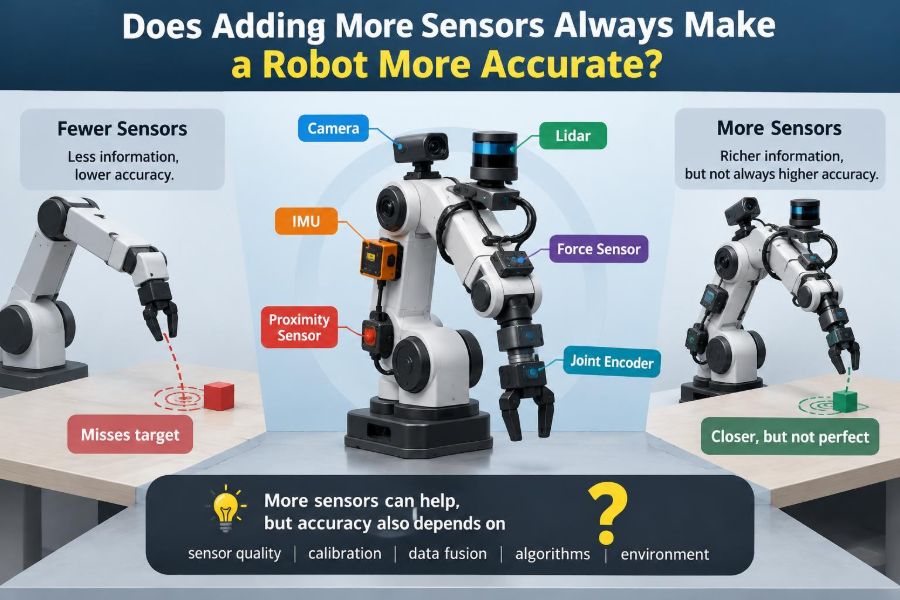
Adding another sensor can feel like an obvious upgrade. More measurements should mean a clearer picture of the world—and sometimes they do. But a robot does not become accurate simply because it has accumulated more hardware.
Every sensor adds information, uncertainty, timing requirements, processing demands, and another possible way for the system to fail. A poorly integrated sensor can make a robot less predictable than a simpler design.
The useful question is not “How many sensors can we add?” It is: Which uncertainty does this sensor reduce, and can the robot use the measurement reliably?
🎯 Accuracy Starts With the Task
Accuracy has no single meaning in robotics. A robotic arm placing electronic components may need repeatable motion measured in fractions of a millimeter. A lawn mower robot may only need to stay safely inside a boundary and avoid obstacles.
Before selecting sensors, define what must be accurate: position, orientation, speed, object identity, contact force, map location, or timing. A sensor that improves one quantity may contribute little to another.
For example, a high-resolution camera can help identify a package label but does not directly tell a mobile robot how far it has traveled. Wheel encoders are useful for that, although they can be wrong when wheels slip.
🧭 Sensors Measure Different Parts of Reality
No sensor observes “the world” completely. It measures a physical signal and converts it into data. Cameras measure light, lidars measure reflected laser returns, microphones measure pressure changes, and encoders measure shaft rotation.
That distinction matters because the source of error differs. A camera may struggle with glare or darkness. A lidar may have trouble with some reflective, transparent, or absorptive surfaces. An encoder cannot recognize that a wheel is spinning without moving the robot.
A good sensor suite uses measurements that answer distinct questions rather than collecting several versions of the same weak signal.
📏 Precision, Accuracy, and Repeatability Are Not Identical
Accuracy describes closeness to the true value. Precision describes how tightly repeated measurements cluster. Repeatability describes whether a robot performs the same action consistently under similar conditions.
A sensor can be precise but inaccurate. Imagine a range sensor that consistently reports an object 3 centimeters farther away than it really is. Its readings may barely vary, yet the fixed offset still causes error.
More sensors may reduce random variation, but they do not automatically correct systematic offsets. Calibration and model quality are essential.
🔍 More Measurements Can Reduce Uncertainty
Extra sensors are valuable when they provide independent evidence. If a camera estimates a dock’s location and lidar measures its geometry, combining the two can give a more robust estimate than either sensor alone.
This benefit is strongest when the sensors fail in different ways. A camera may lose detail in low light while lidar remains useful; lidar may provide sparse geometry while the camera supplies rich visual context.
Engineers often describe this as reducing uncertainty. The robot has more evidence about its state, but only if it correctly accounts for the reliability of each measurement.
🎲 Redundancy Is Not the Same as Diversity
Two identical sensors can provide redundancy: if one fails electrically, the other may keep the system operating. But identical sensors may also share the same environmental weakness.
Two cameras placed similarly can both be blinded by direct sunlight. Two wheel encoders can both be fooled by the same slippery floor. In contrast, camera-plus-lidar or encoder-plus-inertial-measurement combinations are more diverse.
Redundancy is still useful, especially in safety-critical designs, but it should not be mistaken for complete protection against common-mode failures.
🌧️ Every Sensor Has Operating Conditions
Sensor specifications are usually measured under stated conditions: distance ranges, lighting, temperature, vibration, surface reflectivity, and motion speed all affect results. A sensor that performs well in a laboratory may behave differently on a dusty factory floor or wet sidewalk.
Consider a delivery robot using a depth camera. Bright outdoor sunlight can interfere with certain active depth methods, while rain or dirt on the optical window can degrade image quality. Adding a second similar depth camera may not solve the underlying issue.
The right addition might be a sensor based on a different physical principle, or it may be a mechanical change such as a hood, heater, cleaner, or better placement.
📡 Noise Is Part of Every Measurement
Sensor noise is unwanted variation in a measurement. It can arise from electronics, photon limits in imaging, surface texture, vibration, quantization, or changing environmental conditions.
A robot should not treat every reading as equally certain. If a ranging sensor fluctuates while viewing a distant angled surface, software should represent that measurement as less reliable than a stable close-range return.
Simply averaging readings can help with some random noise, but it cannot fix bias, delayed data, or a sensor observing the wrong target.
⚖️ Bias Can Survive Sensor Fusion
Bias is a consistent deviation from the true value. An IMU, or inertial measurement unit, may report a small nonzero rotation even when stationary. Over time, integrating that error can produce a substantial orientation estimate error.
If several sensors have related biases, combining them may reinforce a wrong estimate. For instance, two cameras calibrated with the same incorrect focal length assumption can agree with each other while still estimating distance poorly.
Fusion algorithms need bias models, periodic corrections, and checks against known references. More data cannot compensate for an unrecognized common error.
🧪 Calibration Connects Data to the Physical Robot
Calibration estimates the relationship between a sensor’s raw output and real-world quantities. For a camera, this includes optical properties and its position relative to the robot. For an encoder, it can include effective wheel diameter and ticks per revolution.
Multi-sensor robots also need extrinsic calibration: the physical position and orientation of each sensor relative to the others. If the software thinks a lidar is mounted 2 centimeters to the left of its actual location, fused obstacle positions can shift.
Calibration can drift after impacts, maintenance, temperature changes, or hardware replacement. It is a continuing engineering process, not just a setup checklist.
⏱️ Time Synchronization Is a Hidden Accuracy Requirement
A robot moves while its sensors measure. If a camera image is timestamped late, then paired with an IMU reading from a different instant, the software may infer a geometry that never existed.
This is particularly damaging on fast robots and moving manipulators. A fraction of a second can correspond to meaningful travel or rotation.
Reliable systems timestamp measurements close to acquisition, account for communication delays, and synchronize clocks where necessary. Adding sensors without solving timing can add contradictions rather than clarity.
🧩 Sensor Fusion Is an Estimation Problem
Sensor fusion combines measurements to estimate a hidden quantity, such as robot pose: its position and orientation. The robot does not directly observe its pose with perfect certainty; it infers it from imperfect signals.
Methods range from simple weighted averages to probabilistic estimators such as Kalman filters, particle filters, factor graphs, and learned perception models. The correct choice depends on motion, sensor behavior, computational limits, and failure consequences.
The key principle is weighting. A capable estimator gives more influence to measurements that are likely reliable in the present situation, not merely to sensors with impressive data rates.
🧠 A Sophisticated Algorithm Cannot Create Missing Information
Software can extract useful structure from noisy data, but it cannot reliably recover information a sensor never captured. A camera pointed into darkness does not provide texture for vision algorithms to track.
Similarly, a mapping algorithm may struggle in a long, featureless corridor because many locations look alike. Adding another camera with the same view offers limited help.
Algorithm design and sensor design must work together. Often the better solution is a changed viewpoint, a different modality, environmental markers, or a revised task workflow.
💻 Compute Limits Change What “Better” Means
Each sensor creates a stream of data that must be transmitted, stored, processed, and interpreted. High-resolution cameras and dense point clouds can consume substantial bandwidth and compute time.
If an overloaded processor delays obstacle detection, the robot may react later despite having richer data. In real-time robotics, timely adequate estimates can be safer and more useful than delayed detailed estimates.
Evaluate sensor additions as a system budget: processor load, memory, power, network capacity, thermal limits, and worst-case latency all matter.
🔋 Power, Weight, and Packaging Are Engineering Constraints
A mobile robot has limited battery energy and payload capacity. More cameras, lidars, lights, heaters, processors, and cables can shorten operating time or force a larger platform.
On a robot arm, a sensor mounted near the end effector adds mass and changes dynamics. That can reduce speed, require retuning, or make compliant contact harder to control.
Physical integration also affects reliability. A well-chosen sensor mounted where it remains clean, rigid, and protected can outperform a theoretically superior one placed in a vulnerable location.
🪞 Placement Determines What a Sensor Can See
A sensor’s field of view can be blocked by the robot itself, a gripper, cargo, or the environment. A forward-facing camera may be excellent for navigation but unable to inspect the underside of a grasped part.
Mounting height, angle, baseline, vibration isolation, and lens cleanliness deserve early design attention. These details influence data quality before any algorithm begins.
A useful design review asks: What objects are visible at the relevant distances, during the robot’s actual motions, under expected occlusions?
🛞 Localization Shows Why Complementary Sensors Help
Mobile robot localization illustrates sensible sensor combination. Wheel encoders estimate movement smoothly and at high rate, but wheel slip accumulates position error. An IMU captures acceleration and rotation, but its errors also drift when integrated.
A lidar or camera can compare observed surroundings with a map or landmarks, providing occasional corrections. In open, feature-poor, or changing areas, satellite positioning or artificial markers may add another reference.
No single modality is universally best. The combination works because each source covers a weakness of another under the intended operating conditions.
🤖 Manipulation Needs Sensing Beyond Vision
A robot picking irregular objects may use vision to locate an item, but vision alone does not always reveal whether the gripper has made secure contact. Force-torque sensing, motor current, tactile sensing, or compliant mechanical design can supply feedback at contact.
Yet adding tactile arrays does not automatically make grasping accurate. The signals must be fast enough, protected from wear, calibrated, and connected to a control policy that knows how to react.
For many tasks, a modest camera plus reliable force thresholding provides more value than a complex sensor stack that cannot be maintained.
🚗 Safety Sensing Requires Fault Thinking
When sensors support collision avoidance or human-robot interaction, design must consider failures, not just normal performance. A measurement can be missing, stale, corrupted, obstructed, or plausible but wrong.
Safety-oriented systems often use independent channels, diagnostics, conservative speed limits, safe stopping behavior, and defined fallback states. The appropriate approach depends on the application and its risk assessment.
More sensors can improve fault detection, but they also increase the number of connectors, cables, configurations, and software paths that must be verified.
🔄 Conflicting Readings Need a Policy
What happens when the camera classifies a path as clear but lidar reports an obstacle? A robot needs explicit rules rather than an accidental winner determined by software order.
Possible responses include slowing down, requesting another observation, treating the area as occupied, or switching modes. The right choice depends on what each sensor measures and the cost of a false alarm versus a missed obstacle.
Conflict is not always a defect. It can reveal a transparent barrier, poor lighting, map error, or a sensor fault that deserves diagnosis.
🧹 Maintenance Is Part of Sensor Performance
Optical sensors can collect dust, water spots, oil, or scratches. Connectors loosen, cables fatigue, and mounting brackets shift. These are ordinary operational realities, not rare edge cases.
A robot that relies on many sensors needs inspection procedures, health monitoring, cleaning access, replacement plans, and recalibration workflows. Complexity has an ongoing operational cost.
Designers should ask whether technicians can safely reach the sensor, verify its condition, and restore calibration without rebuilding the robot.
🧱 Complexity Creates New Failure Modes
Every additional component introduces interfaces: electrical power, data transport, device drivers, coordinate frames, timestamps, firmware versions, and configuration files. Failures often occur at these boundaries.
A sensor may be physically healthy but publish data in the wrong frame, at an unexpected rate, or with a changed calibration file. These integration errors can be difficult to spot because the data may look reasonable.
Simple architectures are not automatically better, but complexity must earn its place through a clear improvement in task performance or resilience.
📊 Evaluate the Whole System, Not a Datasheet
Datasheets describe useful capabilities, but laboratory range, resolution, and frame rate do not predict complete robot behavior. Integration, scene geometry, motion, latency, and software determine the operational result.
| Question | What it reveals |
|---|---|
| What uncertainty does the sensor reduce? | Whether it has a distinct job |
| When does it become unreliable? | Environmental and operational limits |
| What is the end-to-end delay? | Whether data is useful for control |
| How will faults be detected? | Whether failure is manageable |
| What must be maintained? | Long-term deployment burden |
Testing should include representative lighting, surfaces, speeds, clutter, weather where relevant, and degraded conditions. A carefully chosen scenario is more revealing than a long demonstration in ideal conditions.
🧭 Start With an Error Budget
An error budget allocates how much uncertainty the system can tolerate from different sources. For example, an inspection robot may need a target location estimate accurate enough that its camera can center the area of interest.
Break the error into contributors: sensor noise, calibration uncertainty, mechanical flex, control tracking, latency, map uncertainty, and environmental variation. This prevents a team from upgrading a sensor when a loose mount or delayed control loop dominates the error.
The budget does not need false precision. Its purpose is to identify the largest contributors and direct effort where it will matter most.
🧰 Add Sensors Through Controlled Experiments
When considering a new sensor, establish a baseline with the current system. Measure task-level outcomes such as successful picks, localization stability, false stops, inspection coverage, or time to recover from disturbances.
Then add one meaningful change and test across representative conditions. Record not only average performance, but also failure behavior, latency, setup time, and maintenance implications.
- State the specific failure or uncertainty to address.
- Define a task-level acceptance criterion.
- Test normal and degraded conditions.
- Check timing, calibration, and fault handling.
- Keep the sensor only if the benefit justifies system cost.
🧑🔧 Common Mistake: Solving a Mechanical Problem With Data
Some apparent sensing failures are really mechanical ones. A vibrating camera produces blurred images; a flexible bracket changes calibration; a loose wheel creates inconsistent odometry.
Adding another sensor may mask symptoms while leaving the root cause untouched. Improving stiffness, shielding, illumination, traction, cable routing, or end-effector design can yield a larger improvement.
Robotics is inherently multidisciplinary. Sensor performance depends on mechanics, electronics, control, software, and the environment around the robot.
🗺️ Common Mistake: Treating the Map as Ground Truth
Maps can become stale. Warehouse layouts change, shelves move, seasonal foliage alters outdoor scenes, and people leave objects in new locations. A robot that trusts a map too strongly can reject valid current observations.
Additional sensing helps only when the estimator can distinguish temporary change, permanent change, and faulty data. This requires thoughtful map-update policies and confidence handling.
For dynamic environments, accuracy includes recognizing when the robot should admit uncertainty rather than force an overconfident answer.
🧑💻 Common Mistake: Trusting Defaults
Factory settings for exposure, filtering, coordinate conventions, and confidence thresholds are starting points, not guarantees of suitability. A default optimized for general use may be poor for a particular reflective surface, robot speed, or lighting arrangement.
Configuration should be versioned and documented. Teams need to know which calibration, firmware, and processing parameters produced a particular test result.
This discipline becomes increasingly valuable as sensor count grows, because otherwise troubleshooting turns into guessing.
🔭 When More Sensors Are Clearly Worth It
Additional sensors are often justified when the robot faces variable conditions, needs to detect faults, works near people, or must perform different perception tasks at once. They are also useful when a single sensor’s failure mode would be unacceptable.
Strong candidates have a defined role: detecting wheel slip, confirming grasp contact, covering a blind zone, correcting long-term drift, or maintaining performance when illumination changes.
The goal is not minimal hardware at all costs. It is purposeful sensing: enough independent, reliable information to meet the task safely and consistently.
✅ The Core Principle: Useful Information Beats Sensor Count
A robot becomes more accurate when new sensing meaningfully reduces a relevant uncertainty, arrives in time, is correctly calibrated, and is fused with an appropriate model. It becomes more complicated whenever another device is added.
That trade-off is not a reason to avoid rich sensor systems. It is a reason to design them deliberately, test them in realistic conditions, and plan for their maintenance and failure behavior.
The best robot may have one sensor or many. What matters is whether each one earns its place in the system.
More sensors make a robot more accurate only when they provide trustworthy, timely, and actionable information that the complete system can use well. Build for the uncertainty you actually face, not for the largest possible sensor list. 🦾📡🧭