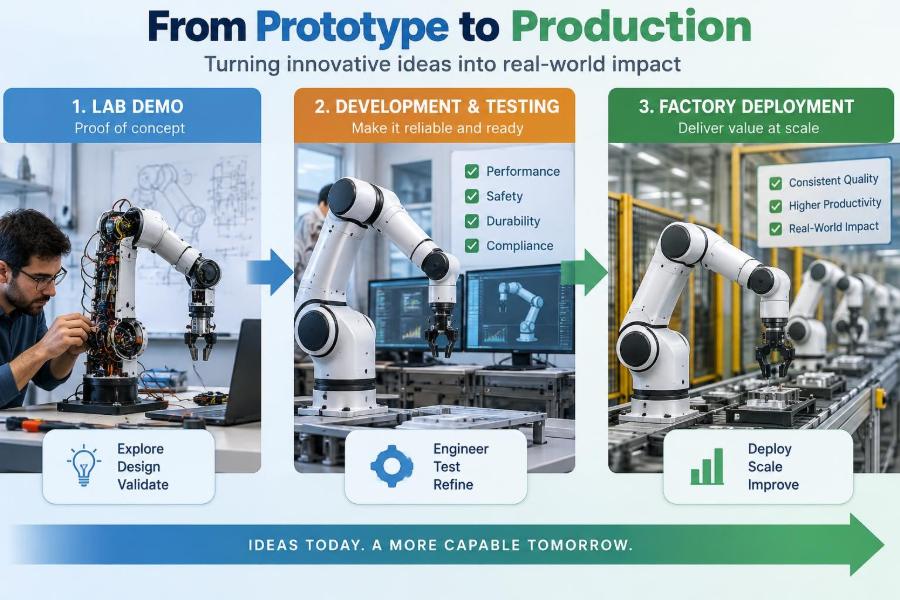

A robot picks up a part flawlessly during a lab demonstration. It recognizes the object, plans a path around an obstacle, and places the part in a tray. The audience sees a success.
On a factory floor, that same robot may face scratched parts, changing lighting, compressed-air pressure swings, cable wear, impatient operators, network outages, and a production target that leaves little room for retries. A compelling demo is only the first proof that an idea can work.
Moving from prototype to production means turning a fragile success into a system that performs safely, repeatedly, and economically in an imperfect environment. That transition is where much of robotics engineering happens.
For students, it reveals why a robot is never just an arm, a mobile base, or an AI model. For working professionals, it provides a practical lens for evaluating whether a promising automation concept is truly ready to deploy.
🧭 The Gap Between a Demo and a Deployment
A prototype answers a narrow question: Can this technical approach perform the task under chosen conditions? A production deployment answers a broader one: Can the complete system perform the task over time, within a real operation, without creating unacceptable safety, quality, or maintenance burdens?
That difference changes the engineering priorities. In a demo, teams often optimize for capability. In production, they must balance capability with availability, repeatability, recoverability, cost, and human usability.
🎯 Start With the Job, Not the Robot
Successful projects begin by defining the work that must be done. “Automate packaging” is too broad. “Pick sealed pouches from a conveyor, orient labels upward, and place them in cartons at the required line rate” is a usable starting point.
The task definition should describe inputs, outputs, variation, exceptions, and success criteria. It also needs to capture what a skilled operator does when the normal sequence fails; those recovery actions are often more revealing than the nominal task.
📏 Turn Business Needs Into Measurable Requirements
Requirements translate operational needs into engineering constraints. They prevent the team from declaring victory based on a visually impressive but irrelevant demonstration.
- Throughput: units completed per shift, hour, or cycle.
- Quality: placement accuracy, inspection coverage, defect handling, or process consistency.
- Availability: the portion of scheduled time the system can productively operate.
- Changeover: time and effort needed to run another product variant.
- Safety: required protective functions and acceptable operating modes.
A requirement should be testable. “Fast” becomes a target cycle time under defined conditions; “easy to use” becomes a defined training level and set of routine actions an operator can perform.
🔍 Observe the Existing Process Closely
Before selecting hardware, engineers need to study the current workflow where it happens. Watch material arrive, wait, get handled, rejected, reworked, and recorded. Ask operators what makes a shift difficult, but also verify those answers through observation.
Manual processes frequently contain subtle adjustments: an operator feels whether a part is seated, notices a damaged edge, or changes grip when a bin is nearly empty. Automation must either reproduce those judgments, redesign the process to remove them, or hand uncertain cases back to people.
🧩 Define the System Boundary
A robot cell is a system, not an isolated machine. Its boundary may include upstream conveyors, fixtures, sensors, safety devices, operator stations, electrical panels, networks, and downstream equipment.
Unclear boundaries cause late surprises. For example, a robot integrator may deliver a cell that meets its own cycle-time target, while the upstream feeder cannot present parts consistently enough for that target to matter.
Assign ownership for every interface: who supplies parts in the required orientation, who provides production signals, who maintains compressed air, and who approves changes to product data.
🧱 Reduce Variation Before Adding Intelligence
Many difficult robotics problems are really uncontrolled-process problems. If parts arrive tangled, randomly stacked, oily, and dimensionally inconsistent, perception and grasp planning must cope with all of that variation.
Sometimes the best solution is a modest mechanical change: a guide rail, a separator, a standardized tote, or a fixture that establishes a repeatable reference. This is not “cheating.” It is sound system design.
Reliable automation often begins by making the world easier for the robot to understand. Advanced sensing is valuable, but it should solve variation that cannot reasonably be removed upstream.
🦾 Choose the Right Robot Architecture
Robot selection should follow the task geometry and operating environment. A six-axis industrial arm offers flexible orientation and reach. A SCARA robot is often suited to fast planar assembly. A collaborative robot may simplify certain shared-workspace applications, but it is not automatically the best option for speed, payload, or risk reduction.
Mobile robots add another layer of uncertainty because navigation, traffic, charging, and floor conditions affect the task. A fixed robot may be preferable when the work location is stable; mobility earns its complexity when work locations or material flows genuinely change.
🖐️ Treat the End Effector as a First-Class Design
The gripper or tool is where the robot meets reality. A capable arm with an unreliable end effector will still fail the application. Engineers must consider part geometry, mass, surface finish, allowable contact points, orientation, contamination, and how the tool will release a part.
Vacuum cups can be simple and fast, yet porous, dusty, or warped surfaces may reduce holding force. Mechanical fingers offer positive grasping but can jam or damage delicate parts. A good design also detects failure, using methods such as vacuum sensing, finger-position feedback, or downstream presence checks.
👁️ Design Vision for Production Conditions
Machine vision in a demo may work with carefully placed objects and favorable lighting. In production, the camera sees reflections, dust, moving products, vibration, worn labels, and occasional occlusion.
Lighting is often more important than camera resolution. A controlled backlight can make a silhouette easy to measure; diffuse illumination can reduce glare on shiny surfaces. Camera mounting must preserve calibration and resist vibration.
Vision systems should report confidence or clear failure states. When an image is ambiguous, the safe production behavior may be to reject, re-present, or request assistance rather than making an unjustified guess.
🧪 Prove the Hard Cases Early
Teams naturally test clean, representative samples. Production readiness requires deliberately seeking edge cases: the smallest and largest approved parts, warped material, damaged packaging, low battery conditions, warm equipment, poor lighting, and shift-change setups.
A useful test matrix records input conditions, expected behavior, observed result, and recovery time. The goal is not to prove that failure never occurs. It is to discover how the system fails and whether it fails in a controlled, detectable way.
⏱️ Model the Entire Cycle, Not Just Robot Motion
Robot motion time is only one part of cycle time. A cell may also wait for a conveyor, camera exposure, part settling, gripper confirmation, safety-zone clearance, or data exchange with another machine.
Consider a hypothetical pick-and-place cell. Shortening arm travel by a fraction of a second may have no production effect if the camera or feeder is the bottleneck. Time studies should separate each stage so improvements target the real constraint.
📈 Plan for Availability and Recovery
Throughput is meaningful only when the system is available. A cell that runs quickly but needs frequent expert intervention may deliver less useful output than a slightly slower cell that operators can recover easily.
Design recovery sequences explicitly. What happens after a failed pick, a dropped part, a vision timeout, a full reject bin, or an emergency stop? The answers should preserve safety and product traceability, not simply command the robot to try again indefinitely.
🛡️ Engineer Safety From the Beginning
Safety cannot be added as a fence around a finished robot. It influences layout, access points, operating modes, tooling, software behavior, and commissioning plans.
A proper risk assessment identifies hazards, who may be exposed, and the protective measures needed. Depending on the application, safeguards may include perimeter guarding, interlocked doors, safety-rated scanners, emergency stops, enabling devices, speed limits, and clearly defined manual modes.
Applicable safety requirements vary by jurisdiction, machine type, and site. Teams should involve qualified safety personnel and validate the final installation rather than assuming a robot manufacturer’s features make the entire cell safe.
🤝 Understand Collaborative Operation Realistically
Collaborative robot systems are often discussed as though they can simply operate beside people without additional engineering. In reality, safe collaboration depends on the complete application: tool shape, payload, speed, pinch points, workspace, and the tasks people perform nearby.
A lightweight arm can still create hazards with a sharp tool or a heavy workpiece. Conversely, a conventional industrial robot can support efficient human interaction when guarded zones, handoff stations, and operating procedures are thoughtfully designed.
🔌 Build a Robust Electrical and Pneumatic Foundation
Lab setups can tolerate exposed cables and temporary power arrangements. Production equipment needs cable routing, strain relief, grounding, protection against abrasion, appropriate enclosure design, and serviceable connections.
Pneumatic systems require equally careful treatment. Pressure loss, leaks, moisture, and delayed valve response can appear as intermittent robot faults. Sensors that monitor critical pressure or vacuum conditions can make these issues diagnosable before they become mysterious quality problems.
🧠 Make Software Maintainable, Not Just Functional
Production robot software will be read and modified by people who did not write the first version. Clear state machines, named parameters, comments around non-obvious decisions, and structured fault handling are practical reliability features.
A state machine organizes behavior into explicit modes such as initialize, wait for part, inspect, pick, place, recover, and stop. This is easier to troubleshoot than a long chain of hidden conditional logic.
Keep configuration separate from core behavior where possible. Product dimensions, camera settings, and approved motion recipes should not require someone to edit low-level code during a routine changeover.
🔗 Integrate With Factory Control Systems
A robot cell rarely operates alone. It may exchange signals with programmable logic controllers, manufacturing execution systems, barcode readers, quality databases, conveyors, and other machines.
Integration requires agreement on more than communication protocols. Systems need a shared meaning for signals: when is a part considered accepted, what happens if data is missing, which system owns the stop command, and how are duplicate transactions prevented after a restart?
Interface documents and simulated handshake tests expose misunderstandings early, when they are cheaper to correct.
🗂️ Preserve Traceability Where It Matters
Not every application needs detailed records, but many production processes benefit from knowing what happened to each unit or batch. Traceability can connect an identifier with inspection results, recipe version, timestamps, and disposition.
The design should account for imperfect reality: unreadable codes, duplicated labels, lost network connections, and manual rework. Collect data that supports quality and troubleshooting; collecting every available signal without a use case can create storage and maintenance burdens.
🧬 Control Versions and Changes
Production reliability depends on knowing which software, configuration, vision model, and mechanical revision are running. An undocumented adjustment can make a later failure nearly impossible to reproduce.
Use version control for code and maintain controlled records for robot programs, recipes, electrical drawings, and mechanical changes. Before deployment, define who can approve changes and how those changes are tested, released, and rolled back.
🏭 Design the Cell Layout Around People and Flow
Layout affects safety, productivity, and maintainability. Operators need clear access for loading, unloading, replenishing consumables, clearing normal faults, and observing status without entering hazardous space unnecessarily.
Maintenance teams need room to replace a gripper, reach a sensor, open a panel, and inspect cables. Material should move through the cell with minimal crossing paths, awkward lifting, or accumulation that blocks walkways.
A 3D model is useful, but a taped outline on the actual floor can reveal sightline and access problems that are easy to miss on a screen.
🔧 Design for Maintenance and Spare Parts
Every component eventually needs attention. Select commonly supportable components where practical, document part numbers, and identify which spares are necessary to avoid a long outage.
Wear items should be accessible. If replacing a suction cup requires disassembling guards or recalibrating several unrelated devices, a small maintenance task can become a production event. Preventive checks should focus on credible failure modes, such as loose fasteners, filter condition, cable fatigue, or fixture wear.
👷 Involve Operators and Technicians Early
The people who run and maintain a cell are not merely end users; they are sources of design knowledge. Their feedback can improve alarm wording, tool access, loading ergonomics, fault recovery, and changeover steps.
Training should be role-specific. An operator may need to start, stop, replenish, and respond to approved alarms. A technician may need diagnostic tools and safe maintenance procedures. An engineer may need controlled access to motion tuning and software changes.
🚨 Build Useful Fault Handling
Alarms should tell people what happened, why it matters, and what action is appropriate. “Error 1047” is not useful on its own. “No part detected after feeder request; inspect feeder and confirm part supply” gives a trained operator a starting point.
Classify faults by severity. Some conditions require an immediate safe stop; others can trigger a retry, a reject action, or a request for material. Avoid automatic retries that can turn a minor issue into damaged equipment or repeated bad product.
✅ Validate With Factory Acceptance Testing
Factory acceptance testing, often called FAT, evaluates equipment before it ships or leaves the integrator’s facility. It verifies agreed functions using defined test cases, representative parts, safety checks, and documentation reviews.
FAT cannot perfectly recreate the final site, but it is an opportunity to find software defects, missing signals, mechanical interference, and unclear acceptance criteria before installation pressure increases. Record open issues with an owner and a closure plan rather than relying on informal promises.
🏁 Commission Carefully at the Site
Site acceptance testing, commonly called SAT, verifies performance in the real operating environment. Here, utilities, actual material flow, local networks, neighboring machines, and operator procedures become part of the test.
Commissioning should proceed in controlled stages: verify installation, test safety functions, exercise individual devices, confirm interfaces, run slow cycles, then increase toward intended operating conditions. Rushing directly to full speed makes faults harder to isolate and can create unsafe situations.
📊 Use a Ramp-Up Plan Instead of a Big-Bang Handover
A production ramp-up is a learning period, not a single switch from incomplete to complete. Start with limited operating windows, supervised shifts, or a constrained product mix when feasible. Capture failures, classify them, and fix root causes before expanding use.
Track practical measures such as completed cycles, interventions, fault categories, recovery time, rejected parts, and changeover performance. These records reveal whether the system is becoming stable or merely being kept alive by constant expert attention.
🧯 Avoid Common Prototype-to-Production Mistakes
Several patterns repeatedly undermine otherwise promising projects:
- Optimizing a demonstration path while ignoring feeder consistency and fault recovery.
- Using hand-selected samples rather than the true range of production material.
- Leaving safety assessment and operator workflow until the mechanical design is fixed.
- Embedding product-specific values in code instead of controlled recipes.
- Measuring average cycle time while overlooking downtime and intervention frequency.
- Assuming a vendor component’s capability guarantees system-level performance.
These are not signs of weak robotics knowledge alone. They usually reflect incomplete systems thinking.
💰 Evaluate Economics Beyond Labor Replacement
Automation economics can include labor availability, quality consistency, ergonomic risk, traceability, capacity, waste reduction, and resilience during demand changes. It should also include integration effort, floor-space changes, utilities, maintenance, training, consumables, and expected downtime.
A technically feasible robot may still be a poor deployment candidate if product demand is too variable, the task changes frequently, or a simpler fixture would solve the underlying problem. The best decision is not always to automate immediately.
🔄 Design for Product and Process Change
Factories evolve. Packaging changes, suppliers vary, product sizes expand, and adjacent equipment is replaced. A rigid solution can become obsolete even while its core robot remains healthy.
Plan reasonable flexibility from the start: adjustable fixtures, recipe-driven motion, reserved input/output capacity, and documented calibration methods. However, flexibility has a cost. Designing for every imaginable future variant can make today’s system unnecessarily complex, so prioritize likely changes.
🌐 Keep Cybersecurity in the Deployment Scope
Connected robots, cameras, industrial PCs, and remote-support tools create useful capabilities, but they also introduce cyber risks. A production cell should have defined user access, managed credentials, appropriate network segmentation, and a process for software updates.
Security measures must be coordinated with operations. An unplanned update or blocked communication path can stop production, while unrestricted remote access can create an unacceptable exposure. Treat cybersecurity as an engineering interface, not just an IT afterthought.
📚 Create Documentation People Can Use Under Pressure
Documentation earns its value when someone can use it at 2 a.m. during a fault. Provide current drawings, pneumatic diagrams, network information, safe operating procedures, spare-part lists, backup files, recovery instructions, and calibration guidance.
Good documentation is concise where action is needed and detailed where diagnosis is needed. Screenshots, labeled photos, and clear revision dates often help more than a large manual filled with generic statements.
🔭 Treat Deployment as the Start of the Next Design Cycle
Once the robot is producing, operating data and user feedback become evidence for improvement. Repeated failures may reveal a mechanical tolerance issue, a poorly placed sensor, a confusing workflow, or a requirement that was never made explicit.
Make changes deliberately. Observe, hypothesize, test under controlled conditions, validate the effect, and update documentation. This turns field learning into engineering knowledge instead of a collection of undocumented workarounds.
🧠 The Core Principle: Engineer the Whole Sociotechnical System
A factory robot succeeds when hardware, software, material presentation, safety, facility infrastructure, maintenance practices, and human work all support one another. The arm may be the most visible component, but it is rarely the only constraint.
Prototype work proves possibility. Production engineering proves repeatable value under ordinary variation, occasional faults, and real operational pressure. That requires disciplined requirements, early testing of difficult conditions, clear ownership, and respect for the people who will live with the system every day.
The path from lab demo to factory deployment is not about making a robot look impressive; it is about making an entire work system dependable. 🦾🏭🔧