
A warehouse worker notices that a robot can move sealed cartons all day, yet hesitates when a carton is slightly crushed or placed at an unusual angle. A technician could change the robot’s code, test it, and deploy the update—but that takes time, specialist knowledge, and careful safety checks.
Now imagine the worker showing the robot one good pick, correcting its first attempt, and letting it practice in a simulated copy of the workcell before trying again. That sounds less like traditional programming and more like teaching.
This shift matters because robots are leaving tightly controlled factory lines. They are entering hospitals, farms, homes, laboratories, and smaller businesses, where objects, layouts, and priorities change more often.
Technology can indeed help robots learn new tasks without a person writing every motion as explicit code. But “without programming” does not mean without engineering, data, limits, or accountability. It means the programming moves partly into examples, objectives, models, and feedback.
🧭 What “Teaching a Robot” Really Means
Teaching a robot means supplying information from which it can choose or generate useful behavior. That information may be a demonstration, a reward signal, a natural-language instruction, a set of images, or a sequence of corrections.
Traditional programming specifies the procedure: move here, close the gripper, lift by this distance, and stop if a sensor crosses a threshold. Learning-based systems instead infer some part of that procedure from experience.
The distinction is not absolute. Nearly every practical robot combines hand-written software with learned components. A learned grasp planner may sit inside a conventional safety controller, motion planner, and production database.
🧩 Why Traditional Robot Programming Is Hard to Scale
Conventional robot programming works very well when the environment is predictable. A car-body welding cell repeats known motions with fixtures that hold parts in nearly identical locations.
It becomes costly when variation grows. Different products, flexible materials, cluttered bins, changing lighting, or human coworkers create cases that are difficult to enumerate in rules.
Every exception can require integration work: measuring the environment, updating coordinate frames, tuning paths, validating collisions, and retesting the entire sequence. Teaching methods aim to reduce this burden for the parts of a task that depend on perception and adaptation.
🧠 The Robot Still Needs a Foundation
A robot cannot learn in a vacuum. It needs sensors to observe, actuators to act, and software that translates high-level choices into safe motor commands.
Typical foundations include cameras, force sensors, joint encoders, maps of the workspace, kinematic models, and collision limits. Learning changes how decisions are made; it does not remove the need for reliable mechanics and control.
For example, a model may decide where to grasp a mug. Lower-level controllers still regulate joint torque and speed so the arm follows the requested motion without becoming unstable.
📚 Learning From Demonstration
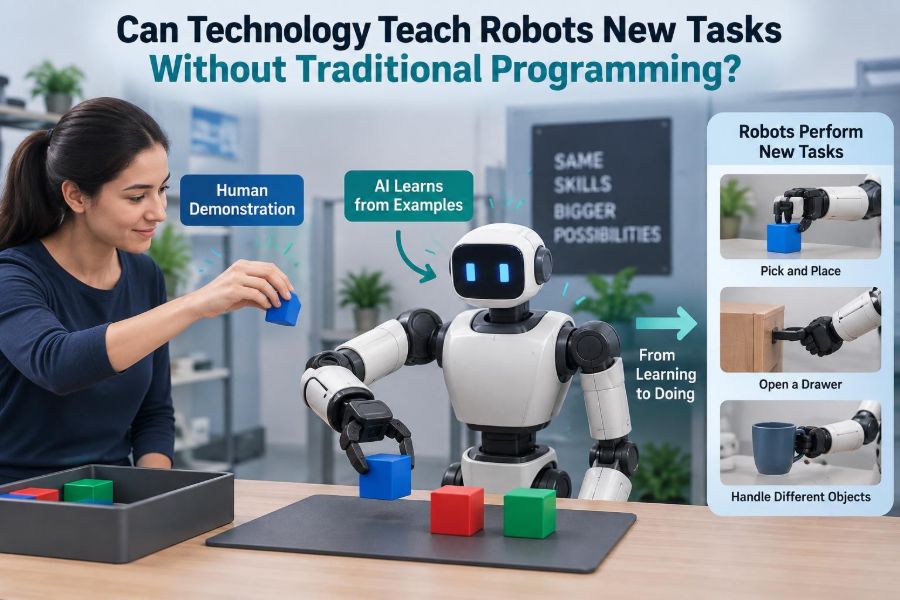
In learning from demonstration, also called imitation learning, a person shows the task and the system records relevant state-action pairs. The teacher might guide a robot arm by hand, use a joystick, wear a motion-tracking device, or demonstrate in virtual reality.
A simple example is placing items into a tray. Rather than coding a separate trajectory for every starting position, the robot observes demonstrations and learns a relationship between what it sees and the movements that usually succeed.
Demonstrations are especially useful when people can perform the task intuitively but cannot easily describe all the rules. However, they must cover meaningful variation; one perfect example rarely represents the full workplace.
🎮 Teleoperation Makes Expertise Recordable
Teleoperation lets a human directly control a robot from a nearby console or a remote interface. The resulting data can capture camera views, gripper force, arm positions, and operator actions at the same time.
This turns skilled work into a reusable training resource. A trained operator may show a robot how to manipulate a cable, inspect a surface, or recover a part that shifted unexpectedly.
Teleoperation also reveals a limitation: controlling a robot is not automatically the same as teaching it. Delay, awkward interfaces, and differences between human and robot movement can introduce poor examples that require filtering or additional practice.
🏆 Reinforcement Learning Uses Goals and Feedback
Reinforcement learning teaches by trial and feedback. Instead of being told every correct move, an agent receives a reward for desirable outcomes and learns a policy—a rule for selecting actions in each situation.
A simulated robot might receive positive feedback for putting a part in the correct bin and negative feedback for dropping it, colliding, or taking too long. Over many attempts, it can discover action sequences that improve the expected reward.
This approach is powerful for decisions with many possible paths, but it can be inefficient and unpredictable if the reward is poorly designed. It is usually safer to conduct broad exploration in simulation rather than around people or expensive equipment.
🎯 Reward Design Shapes Robot Behavior
A reward is not the same as a human intention. If a task reward only values speed, a robot may learn rushed movements that are unsuitable for fragile parts. If it only values task completion, it may select unnecessarily awkward or energy-intensive routes.
Good reward design represents several priorities, such as completion, smoothness, force limits, distance from obstacles, and time. Even then, a reward is an approximation of what the organization wants.
Engineers should inspect not only success rates but also the behavior used to reach success. A robot that “wins” an evaluation by exploiting a loophole in the setup has not necessarily learned a useful real-world skill.
🧪 Simulation Gives Robots a Safer Practice Space
A simulator is a software model of a robot and its environment. It can provide thousands of virtual attempts without wearing out hardware, blocking a workcell, or creating immediate physical hazards.
Simulated practice is useful for learning locomotion, manipulation strategies, visual policies, and recovery behaviors. It also lets teams vary object locations, friction, lighting, and camera positions more easily than in a physical lab.
Simulation is not a perfect substitute for reality. Small errors in contact forces, material flexibility, camera noise, or timing can matter greatly when a task involves insertion, delicate handling, or tight tolerances.
🌉 The Sim-to-Real Gap Is a Real Engineering Problem
The difference between simulated and physical performance is called the sim-to-real gap. A grasp that works on a digital object may fail when the real surface is glossy, deformable, dusty, or slightly different in shape.
Teams reduce this gap by calibrating models, adding realistic sensor noise, randomizing conditions during training, and performing controlled real-world fine-tuning. Domain randomization deliberately varies simulated conditions so a policy does not depend too heavily on one artificial setup.
The goal is not a flawless digital twin. It is a training process that produces behavior robust enough to tolerate the differences that will occur on the actual robot.
👁️ Computer Vision Helps Robots See Task-Relevant Details
Computer vision converts images or depth data into information a robot can use. Depending on the system, it may identify an object, estimate its pose, detect a defect, segment a work area, or track a person’s hand.
Modern vision models can reduce the need for manually defined image features. Yet visual recognition alone does not guarantee reliable action: a robot must connect perception to geometry, grasp constraints, and safe movement.
Lighting changes, occlusion, reflections, and look-alike objects remain practical concerns. A vision component should be evaluated in the actual viewing conditions, not only on curated images from a development workstation.
✋ Force and Touch Close the Loop
Many tasks cannot be solved reliably by sight alone. When inserting a plug, folding fabric, opening a stiff container, or handling fruit, contact forces reveal information that cameras may miss.
Force-torque sensors, tactile pads, motor-current measurements, and compliant mechanisms can help a robot detect contact and adjust. Rather than driving blindly to a fixed point, it can slow down, search gently, or stop when resistance exceeds a safe threshold.
This is one reason teaching physical tasks is difficult: the robot must learn not just where objects are, but how they respond when touched.
🗣️ Natural Language Can Specify Intent, Not Magic
Language-capable models can help users express goals in ordinary terms, such as “sort the clean tools into the upper tray” or “bring the blue container to the inspection table.” They can also translate instructions into task plans, request clarification, or retrieve relevant operating procedures.
Language is useful because it expresses purpose and context. But phrases like “put it over there” are ambiguous unless the system can identify the object, the destination, and the current scene.
A responsible system grounds language in sensor data, approved actions, and workspace constraints. It should ask for clarification or decline an action when the instruction is unclear or outside its authorized capability.
🧱 Task Planning Breaks Goals Into Actions
A high-level request usually contains several smaller steps. “Prepare a sample” may involve finding a vial, selecting a tool, opening a rack, moving liquid, checking labels, and logging completion.
Task planning represents these steps and their dependencies. A planner may choose a sequence, while learned modules handle perception or choose a grasp that fits the current object pose.
This division is practical: symbolic planning handles explicit rules and order, while learning handles uncertainty that is hard to describe with fixed logic. The plan can still be rejected if a precondition is not met—for example, if the required container is absent.
🦾 Motion Planning Turns Intent Into Safe Movement
Once a robot knows what it wants to do, it must find a physically feasible path. Motion planning considers joint limits, obstacles, reachability, and sometimes timing or force constraints.
A learned policy may propose a useful action, but a motion planner or safety layer can check whether the arm can perform it without hitting a shelf, fixture, or person. This is a key reason real systems are usually layered rather than purely end-to-end.
Learning can accelerate or improve motion generation in some cases, but it does not eliminate the geometric realities of a robot’s body and workspace.
🧰 Foundation Models May Provide Broad Starting Skills
Foundation models are trained on large and diverse datasets and can be adapted to multiple downstream tasks. In robotics, they may connect images, language, demonstrations, and action representations to give a system broader prior knowledge than a model trained for one narrow job.
The appeal is clear: a robot may need fewer task-specific examples to recognize familiar objects or interpret common instructions. The limitation is equally clear: broad training data does not guarantee correct behavior in a particular facility.
Physical capability, sensor placement, local procedures, and safety rules still determine what the robot can actually do. A general model is a starting point, not a deployment certificate.
🔄 Few-Shot Learning Reduces Repetition
Few-shot learning describes adapting to a new task from a small number of examples. For a robot, those examples might show how a new package type is picked or how a different fixture is loaded.
It is most plausible when the new task resembles skills the robot already has. A system that understands basic picking may adapt more readily to a new box shape than to a completely new process requiring tools it has never used.
Few examples can also mislead a system if they omit edge cases. Practical teaching should deliberately include normal cases, common variations, and known failure conditions rather than only ideal demonstrations.
🛠️ No-Code Interfaces Lower the Barrier, Not the Standard
Some robot platforms provide graphical workflows, demonstration buttons, drag-and-drop task blocks, or plain-language interfaces. These tools let domain experts contribute without becoming full-time robot programmers.
That can be valuable because the person who understands the work often knows the exceptions: which parts are delicate, what “clean” means, and when a result should be rejected. Their knowledge can enter the system earlier.
However, no-code should not mean no validation. Someone still needs to define permissions, test the workflow, manage versions, and verify that changes do not create hazards or degrade performance.
📏 Measuring Success Requires More Than Completion
A robot can finish a task yet still perform poorly. It may damage a part, consume excessive time, require frequent human rescues, or fail whenever the lighting changes.
Useful evaluation considers the task’s real requirements:
- Completion quality and error types
- Consistency across expected conditions
- Cycle time and recovery time
- Contact forces, collisions, and safety interventions
- Human effort needed for supervision and correction
Metrics should match the operational goal. A research demo may prioritize novel capability, while a production cell often prioritizes repeatability, traceability, and predictable recovery.
⚠️ Exploration Must Be Constrained Around People
A learning system often improves by trying alternatives. In a physical workplace, unconstrained alternatives may create unacceptable risks: unexpected motion, dropped loads, pinching, collisions, or contamination.
Safe learning setups use boundaries such as speed limits, force limits, monitored zones, emergency stops, collision detection, and human approval before a new behavior is activated. Risk controls depend on the machine, load, environment, and applicable requirements.
Training should begin with the lowest-risk version of a task. A harmless sorting exercise is a very different deployment challenge from handling sharp tools, medical materials, high heat, or heavy payloads.
🛡️ Safety Is a System Property
It is tempting to ask whether an algorithm is safe. In practice, safety emerges from the whole system: mechanical design, controller limits, sensors, workspace layout, procedures, maintenance, supervision, and the behavior model.
For example, a well-trained grasp model cannot compensate for a poorly secured camera mount or an outdated obstacle map. Conversely, robust guarding and interlocks can prevent a software error from becoming an injury.
Learning-based behavior should be treated as one component within a deliberately engineered safety architecture. Teams should involve qualified safety and controls professionals when deploying robots in consequential environments.
🔍 Data Quality Determines What the Robot Can Learn
Training data encodes assumptions about the world. If all demonstrations use one color of object, one operator, or one lighting condition, the resulting system may silently rely on those patterns.
Data should be reviewed for coverage, labeling quality, sensor faults, and the presence of rare but meaningful cases. Failed attempts are often informative: they show what situations the system needs to recognize, avoid, or escalate.
Data governance also matters. Recorded video, voice, or operator actions may contain sensitive information, so collection and retention should follow organizational policy and relevant privacy obligations.
🧑🏫 Human Corrections Are a Valuable Training Signal
People do not need to provide only complete demonstrations. A supervisor can mark an attempted placement as wrong, nudge a robot toward a better pose, rank two alternatives, or identify a condition requiring escalation.
This feedback can be more efficient than recording every movement from scratch. It is especially helpful when a robot is close to doing the right thing but needs adjustment for a local workflow.
Correction interfaces should make the robot’s interpretation visible. If a user cannot see what object, target, or plan the system believes it selected, they cannot reliably correct the underlying misunderstanding.
🧯 Recovery Skills Matter as Much as Happy Paths
Real work includes dropped objects, empty bins, blocked routes, misread labels, and tools that are not where they should be. A useful robot needs ways to detect these conditions and recover safely.
Recovery might mean retrying from a different view, returning an item to a safe location, asking a person for help, or stopping with a clear diagnostic message. It should not mean repeatedly applying force until something changes.
Designing recovery behavior early often prevents fragile automation. A system that knows when to pause can be more valuable than one that attempts every situation with false confidence.
🏭 Where This Approach Fits Best Today
Technology-assisted teaching is promising where tasks are repetitive but variable, examples are available, and mistakes can be bounded. Common categories include bin picking, inspection support, sorting, mobile navigation in structured spaces, and assistance with material handling.
It is less suitable when training opportunities are scarce, failures are extremely costly, task requirements change faster than validation can occur, or the robot lacks the physical dexterity required. Some jobs remain better served by fixed automation or skilled human work.
The right question is not “Can a model learn this?” but “Can this whole system perform the task reliably enough, with acceptable risk and operating effort?”
🧭 Choosing Between Rules, Learning, and Hybrids
Different task components call for different methods. Rules are strong when requirements are explicit and stable. Learning is useful when perception or interaction varies too much for exhaustive rules. Hybrid systems often provide the most practical balance.
| Approach | Best fit | Common limitation |
|---|---|---|
| Rule-based programming | Stable, precisely defined sequences | Fragile when conditions vary |
| Learning from examples | Tasks with demonstrable patterns | Depends on representative data |
| Reinforcement learning | Optimization with measurable feedback | Can require extensive training and careful constraints |
| Hybrid architecture | Real deployments needing adaptation and controls | More integration complexity |
A robot might use vision learning to locate objects, rules to enforce inventory policy, a planner to sequence actions, and conventional controls to execute motion safely.
🧑💻 Skills Robotics Professionals Need Now
Robotics engineers increasingly need both software and systems thinking. Useful skills include coordinate transforms, control theory, sensing, data handling, simulation, machine learning evaluation, and human-machine interface design.
Equally valuable are operational skills: observing the real task, speaking with operators, documenting assumptions, and designing tests that resemble deployment rather than a convenient lab demonstration.
Students can build this mindset by treating every project as a system. Ask what the robot senses, what it assumes, what can fail, how it detects failure, and what it does next.
🧪 A Practical Workflow for Teaching a New Task
A disciplined workflow prevents teams from treating learning as a shortcut around engineering.
- Define the task outcome, allowed objects, and unacceptable failures.
- Identify what varies in the environment and what sensors can observe it.
- Choose the simplest method that fits: rules, demonstrations, learning, or a hybrid.
- Collect representative examples, including difficult but expected cases.
- Train and test first in simulation or a controlled physical setup where appropriate.
- Add operational limits, fallback behavior, and clear escalation paths.
- Validate under realistic conditions before limited deployment.
- Monitor performance and update through a controlled change process.
The process is iterative. A failure found during validation may reveal a missing sensor, an unclear task definition, or a training gap—not merely a model that needs more data.
🚫 Common Mistakes When “Teaching” Robots
One frequent mistake is assuming a successful demonstration proves general capability. A robot may have memorized a camera angle, object position, or operator habit rather than learned the intended task.
Another is allowing users to change behavior without preserving versions, test records, and rollback options. When a problem occurs, teams need to know what changed and how to restore a known-good configuration.
Finally, teams sometimes focus on the model while neglecting gripper design, calibration, lighting, and workcell organization. Better physical design can make a learning problem dramatically easier.
📈 Continuous Learning Needs Change Control
A robot can potentially learn from new experience after deployment, but unrestricted online learning can make its behavior difficult to predict. The model that was validated last month may no longer be the one operating today.
For many applications, a safer pattern is to log new data, review it offline, test an updated model in a controlled environment, and deploy only after approval. This preserves traceability while still allowing improvement.
Continuous improvement is valuable when paired with controlled releases, performance monitoring, and a clear owner for operational decisions.
🌍 The Broader Impact on Work
Task teaching can shift work rather than simply remove it. Operators may spend less time repeating a fixed motion and more time supervising, handling exceptions, improving workflows, and contributing their process knowledge.
That transition is not automatic or uniformly positive. Organizations need training, realistic staffing plans, and interfaces that respect the people expected to use the systems. A technically capable robot that creates confusing new burdens will not deliver its promised value.
The best deployments treat frontline knowledge as an input to system design, not as an obstacle to be engineered away.
🔮 What Progress Is Likely to Look Like
Robots will likely become easier to instruct, better at linking language with perception, and more capable of reusing skills across related tasks. Better simulation, tactile sensing, and data tools can make adaptation faster and less dependent on hand-coded behavior.
Progress will remain uneven. Tasks requiring reliable contact with irregular objects, long-horizon planning, or operation in messy public environments are far harder than demonstrations suggest.
The meaningful milestone is not a robot that can produce an impressive one-time result. It is one that can perform useful work repeatedly, recognize its limits, and fail in manageable ways.
✅ The Core Principle: Teach Within Engineered Boundaries
Technology can teach robots new tasks without traditional programming in the narrow sense of manually specifying every step. Demonstrations, rewards, simulation, language interfaces, and learned perception can all supply part of the behavior.
Yet successful robot teaching depends on clear task definitions, representative data, physical capability, safe control layers, testing, and ongoing monitoring. Learning is most useful when it is assigned to the uncertain parts of a task rather than asked to replace every form of engineering.
The practical future is not “programming versus teaching”; it is building robots that learn where learning helps and remain constrained where reliability and safety demand it.
Robots can learn new tasks, but dependable automation comes from pairing that learning with careful system design, thoughtful human oversight, and honest limits. 🦾🧠⚙️