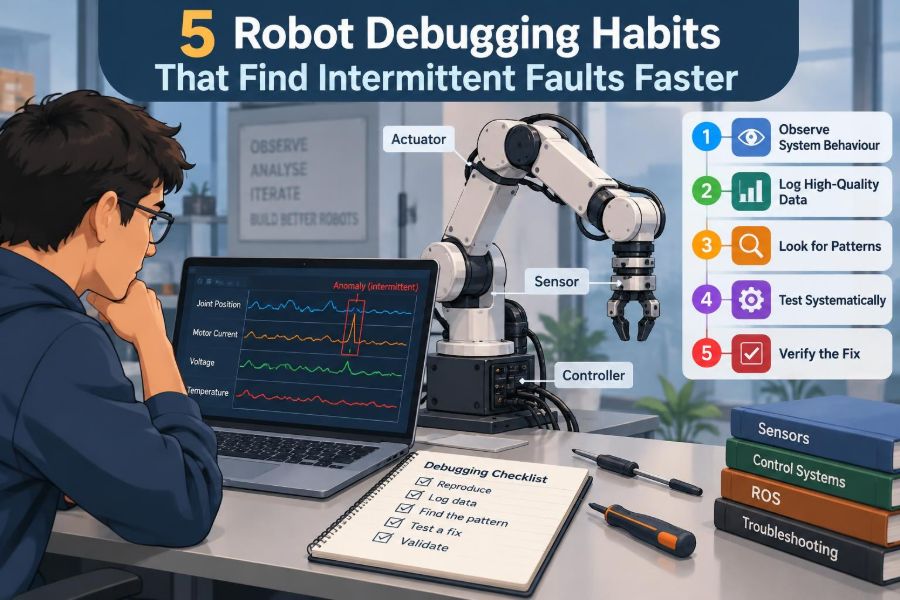

The robot completes twenty cycles perfectly, then stops halfway through the twenty-first. A restart clears the problem. Logs show no obvious crash, operators cannot reproduce it on demand, and the fault vanishes just as the team begins watching.
This is the difficult territory of robotics debugging: the failure that exists at the boundary between mechanics, electronics, software, timing, environment, and human operation. Treating it as a random glitch usually makes it take longer to find.
Intermittent faults matter because a robot can appear ready while carrying an unmeasured risk into production, field deployment, or a student demonstration. A single missed sensor reading, loose connector, delayed message, or marginal power event can create an apparently unrelated symptom.
The fastest teams do not rely on luck or repeated resets. They build debugging habits that turn a rare event into observable evidence, then use that evidence to shrink the search space. 🔎
🧭 1. Start with a symptom, not a suspected cause
“The encoder is bad” is a theory. “The arm pauses for 180 milliseconds while moving upward near full extension” is an observation. Begin every investigation by separating those two statements.
A precise symptom prevents early assumptions from directing every later test. It also gives teammates a shared description of what they are trying to reproduce.
- What did the robot do?
- What was it expected to do?
- When, where, and under what operating state did it differ?
📝 2. Write a one-line failure definition
Create a short, testable definition before changing code or hardware. Include the observable effect, the operating context, and a measurable boundary where possible.
For example: During autonomous pickup, the base command drops to zero for one control cycle after a vision update. This is far more useful than “navigation occasionally freezes.”
The definition may evolve, but writing it exposes vague language. If a failure cannot yet be measured, define the closest measurable proxy.
📋 3. Capture the operating envelope
Intermittent behavior is often conditional. Record the robot configuration and surroundings whenever the symptom occurs, including battery condition, payload, temperature, floor surface, network state, software version, and recent operator actions.
Do not wait until a failure happens to decide what context is important. Make a compact run sheet that can be completed during normal testing.
- Robot identity and build revision
- Firmware, application, and configuration versions
- Mission or test sequence
- Time since startup and number of completed cycles
- Environmental or physical changes
⏱️ 4. Treat time as a signal
Many elusive faults are timing faults in disguise. Ask whether the failure appears after a warm-up period, near a periodic task, after a communication timeout, or only when two events occur close together.
Use timestamps from a common clock where possible. A log saying that two events happened “around the same time” is weaker than one that can establish which event came first.
Also record duration. A five-millisecond voltage dip and a five-second controller reboot suggest very different paths of investigation.
📈 5. Build a minimum useful telemetry set
Logging every variable can overload storage, alter timing, and bury the important event. Instead, define a small set of signals that answers the first diagnostic questions.
For a motor problem, that might include command, measured speed, position, motor current, bus voltage, fault flags, mode state, and loop timing. For networking, include sequence numbers, latency, packet loss indicators, connection state, and message age.
Good telemetry links cause, command, response, and system state in one timeline.
🎯 6. Use the five-habit loop deliberately
The core habits in this article form a loop: observe precisely, preserve evidence, reproduce safely, isolate one variable, and verify the fix under stress. They are simple, but skipping any one of them leaves room for a convincing false conclusion.
Intermittent debugging is not a single clever test. It is controlled reduction of uncertainty, repeated until the remaining explanation can be checked directly.
| Habit | Primary question | Useful output |
|---|---|---|
| Observe | What exactly changed? | Precise symptom and timeline |
| Preserve | What evidence will disappear? | Logs, states, and physical context |
| Reproduce | What conditions trigger it? | Repeatable test case |
| Isolate | Which variable matters? | Reduced fault domain |
| Verify | Did the remedy remove the mechanism? | Evidence of robust behavior |
🧊 7. Freeze the evidence before resetting
The instinct to restart is understandable: it restores operation. It can also erase the most valuable information in the entire incident.
Before resetting, capture fault registers, controller mode, message queues, active task states, sensor readings, and the last segment of high-rate data. Photograph physical indicators, cable positions, and any unusual display state if those may change during recovery.
Design a safe “freeze and collect” procedure so operators know when stopping is appropriate and when a safety action must take priority.
🗂️ 8. Preserve raw data alongside summaries
A dashboard summary is convenient, but aggregate values can hide a one-cycle event. Keep the original time-stamped records for failed runs when practical, along with the script or tool used to decode them.
Annotate copies rather than overwriting raw files. An early interpretation can be wrong, while unmodified data allows another engineer to revisit the event with a new hypothesis.
This habit is especially important when faults are rare enough that a similar run may not occur again soon.
🔁 9. Reproduce the failure ethically and safely
Reproduction turns a mystery into an experiment. But do not recreate a fault by bypassing interlocks, disabling safety monitoring, or placing people near unexpected motion.
Use reduced speed, unloaded mechanisms, simulation, guarded test areas, or a hardware-in-the-loop setup where appropriate. Define abort conditions before each test.
- What motion or energy is possible if control is lost?
- Which safety layer remains active during testing?
- Who can stop the test, and how?
🎲 10. Convert “random” into a trigger matrix
List the conditions that might matter, then vary them intentionally. Common axes include cold versus warm startup, stationary versus moving, low versus high load, quiet versus congested network, and isolated versus concurrent subsystems.
A trigger matrix does not require testing every combination immediately. It helps identify high-value comparisons and prevents a team from repeating nearly identical trials.
Mark each run as pass, fail, or inconclusive. The pattern is often clearer in a table than in memory.
🧪 11. Change one variable per trial
When a failure is frustrating, teams often update firmware, reseat cables, adjust gains, and add delays all at once. If the symptom disappears, nobody knows which action mattered.
Make one meaningful change, run a defined test, and record the outcome. If multiple changes are necessary for safety or logistics, document them as a bundle and treat the result as weaker evidence.
Isolation is slower per run but much faster than rediscovering the same fault later.
🔌 12. Inspect power integrity under dynamic load
A supply can look healthy at idle and still dip during acceleration, braking, actuator engagement, or radio transmission. Observe voltage where the affected device receives power, not only at the battery or bench supply.
Look for loose grounds, connector heating, undersized conductors, shared return paths, inadequate decoupling, and protection devices operating near their limits. Current and voltage should be correlated with the symptom timeline.
Do not assume a brownout must produce a full reboot. Marginal power can disturb a sensor, reset one peripheral, or corrupt communication without stopping the main processor.
🧷 13. Treat connectors as moving components
Connectors fail intermittently because robots vibrate, bend cables, encounter temperature changes, and experience repeated maintenance. A cable that passes a static continuity test may still open during motion.
Inspect strain relief, latch engagement, pin seating, cable routing, flex points, shielding termination, and signs of rubbing. With safe power conditions, controlled movement of a harness can be a useful test, but it is not a substitute for proper inspection.
Record exactly which connector was touched or reseated. “Fixed after maintenance” is not enough evidence for a root cause.
📡 14. Measure communication freshness, not just connection
A status indicator that says “connected” does not prove that control data arrives on time. In distributed robots, stale but valid-looking data can be more dangerous than an obvious disconnect.
Log sequence counters, message timestamps, receive age, queue depth, retries, and state transitions. Check whether the receiver can distinguish a delayed command from a newly issued one.
For critical interfaces, define the expected behavior when data becomes stale: hold, ramp down, stop, or enter a safe state. Make that behavior visible in logs.
🧠 15. Instrument state machines at their transitions
Robotic software often behaves through modes: initialize, home, idle, acquire target, move, grasp, recover, and fault. An intermittent issue frequently occurs at the boundary between modes rather than inside the steady-state control law.
Log every transition with the old state, new state, triggering condition, timestamp, and relevant guard values. This creates an interpretable narrative without logging every line of software execution.
Unexpected transitions, repeated transitions, and missing transitions are all diagnostic clues.
🕰️ 16. Monitor deadlines and loop jitter
Control software may be logically correct yet fail when a critical loop runs late. Measure actual loop period, execution time, missed deadlines, and scheduling delays rather than assuming the configured rate is achieved.
Watch for work that occasionally takes much longer: file writes, memory allocation, network calls, image processing spikes, garbage collection in managed environments, or lock contention.
Averages are not enough. A stable average can conceal a rare deadline miss that matches the field symptom.
🧵 17. Make concurrency visible
Race conditions often disappear when a debugger changes timing, which makes them particularly deceptive. Add lightweight event traces around shared resources, callback order, lock acquisition, and ownership changes.
Prefer designs that make ownership explicit. A sensor message, actuator command, or shared buffer should have a clear producer, consumer, lifetime, and synchronization rule.
When testing a suspected timing issue, controlled load can help expose it: increase message rate, processor load, or task overlap while maintaining safety limits.
🧮 18. Check units, bounds, and numerical edges
Some intermittent faults occur only at a rarely reached value: an angle wrapping near a boundary, a counter overflowing, a distance becoming zero, or a command just exceeding a limit after rounding.
Log units in field names or metadata, validate inputs at system boundaries, and add explicit handling for invalid sensor values. Treat NaN, infinity, stale data, and out-of-range values as states to manage, not exceptional events to ignore.
Replaying the values immediately before failure is often more revealing than reading the final error message.
🧱 19. Build a fault tree from evidence
Once enough observations exist, organize hypotheses by mechanism rather than by component preference. For example, a motor pause might stem from lost command, rejected command, controller fault, power disturbance, mechanical jam, or incorrect feedback.
Each branch should suggest an observation that would strengthen or weaken it. This stops brainstorming from becoming an unranked list of possibilities.
Useful fault-tree questions
- What must be true if this hypothesis is correct?
- What evidence would rule it out quickly?
- Which test has the least risk and highest information value?
🔍 20. Compare a good run and a bad run
A failed run alone can be noisy. A matched successful run provides a baseline for timing, current, latency, state order, and environmental conditions.
Align traces around a common event, such as a command edge or state transition. Then look for the first meaningful divergence rather than the largest value after the robot has already failed.
This “first divergence” mindset helps distinguish cause from downstream effects.
🧰 21. Use temporary instrumentation with discipline
Add probes, counters, assertions, and diagnostic messages to answer a specific question. Every added measurement can change timing, memory use, electrical loading, or network traffic.
Document what the instrumentation changes and remove or reduce it after learning what you need. For high-rate systems, use ring buffers, event markers, or sampled traces instead of uncontrolled console output.
Instrumentation should make the system more observable without becoming the newest source of intermittency.
🧯 22. Separate containment from correction
A watchdog reset, retry, fallback mode, or operator restart can reduce operational impact. That is valuable containment, but it is not automatically a correction.
Track both questions: how will the robot fail safely today, and what mechanism is producing the fault? A recovery action may also provide evidence if it logs the state that caused it.
Never let a successful automatic retry erase the incident record. Recovered faults are still faults.
✅ 23. Verify the mechanism, not only the symptom
A change that makes the issue disappear for one afternoon may be coincidence. A strong fix explains why the observed failure occurred and why the modified design blocks that mechanism.
For example, replacing a suspect cable is stronger when inspection and testing support an intermittent connection, and when the replacement includes improved strain relief or routing. Adding a delay is weaker unless it addresses a demonstrated timing dependency.
Write the expected causal chain before declaring closure.
🏃 24. Test the fix beyond normal conditions
After a fix, run the original triggering case and nearby cases that stress the same mechanism. If thermal expansion was plausible, test cold and warm operation. If load mattered, test the intended load range. If timing mattered, test under realistic concurrent activity.
Use a sufficient number of cycles to gain confidence for your application, while recognizing that testing alone cannot prove a rare event is impossible. Design improvements and monitoring often complement repeated trials.
Keep the acceptance criteria visible before testing begins.
📚 25. Turn the incident into a regression test
An intermittent fault becomes organizational progress when it is converted into a repeatable check. This might be a simulated message delay, a hardware harness movement inspection, a startup stress sequence, or an assertion on stale sensor data.
Automate what can be automated, especially software-level replay and state-transition checks. For physical effects that cannot be automated, create a clear maintenance or commissioning procedure.
The goal is not merely to close a ticket. It is to prevent the same class of surprise from returning in a later revision.
🤝 26. Make debugging handoffs reproducible
Intermittent problems often outlast a shift, a lab session, or a project assignment. A useful handoff includes the exact build, latest symptom definition, known triggers, failed hypotheses, data locations, safety constraints, and next highest-value test.
Avoid handoffs such as “it seems better now.” Replace them with evidence: “No failure observed in the defined warm-load test after the harness replacement; state-transition logging remains enabled for field monitoring.”
Clear records let a new investigator continue reasoning instead of restarting the search.
🧭 27. The core principle: reduce uncertainty on purpose
The five habits work because they replace story-driven debugging with evidence-driven debugging. Observe the event precisely, preserve what it leaves behind, reproduce it under controlled conditions, isolate variables, and verify that the remedy addresses the real mechanism.
Robots are coupled systems, so the first visible failure is not always the first failure. The best investigators follow timelines, compare runs, and ask what changed immediately before the system diverged.
Intermittent faults become manageable when every test is designed to eliminate uncertainty rather than merely make the robot run again. 🔍🤖🛠️