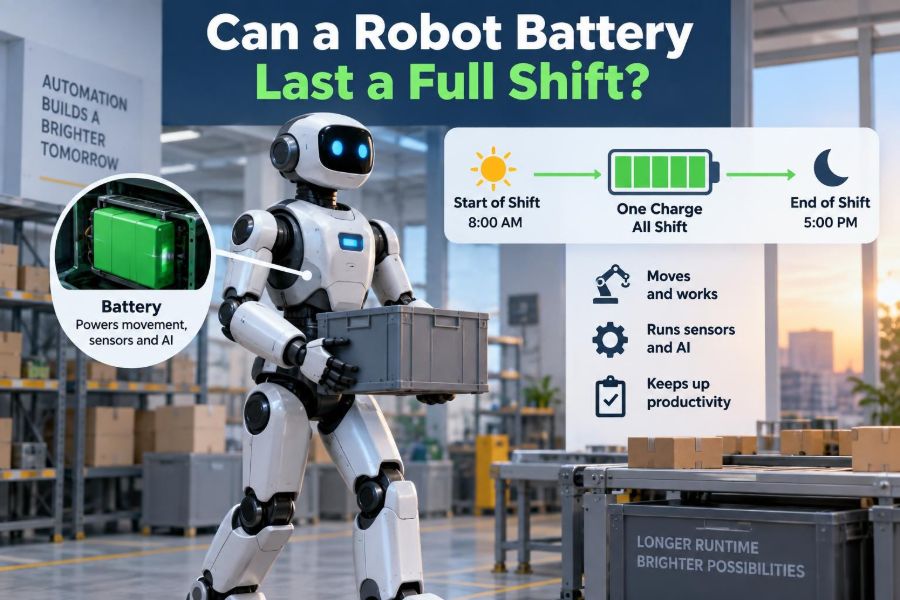

An autonomous mobile robot begins its morning moving pallets from receiving to storage. Its dashboard reports a healthy charge, its route is clear, and production is on schedule. Eight hours later, the same robot may still be working—or it may be waiting at a charger while a queue grows behind it.
That difference is not decided by battery capacity alone. Travel distance, payload, floor condition, lift activity, wireless communication, temperature, charging rules, and even software choices all draw energy from the same limited source.
For a student designing a prototype, battery life can determine whether a robot completes a demonstration. For an engineer responsible for a fleet, it can determine staffing, throughput, safety margins, and whether an automation project meets its promised availability.
So, can a robot battery last a full shift? Often it can, but only when “full shift” is defined carefully and the entire robot-energy system is designed around the real duty cycle. ⚡
🔋 1. Start by Defining “a Full Shift”
A shift is a calendar period, commonly several hours long, but a robot does not necessarily work continuously throughout it. It may travel, wait, scan, lift, communicate, recharge, or remain in standby.
The useful question is therefore not simply, “Can the battery last eight hours?” It is: Can the robot complete its required work during the shift while staying within safe battery limits?
- How long is the operating window?
- How much of that time is active motion?
- What tasks must be completed before the shift ends?
- Are planned charging opportunities available?
📋 2. Measure the Duty Cycle, Not Just Clock Time
A duty cycle describes how a robot spends time and energy during operation. A delivery robot that drives for two minutes and waits for three has a very different energy profile from a towing robot that pulls a cart continuously.
Build a timeline from actual or expected tasks. Include acceleration, cruise travel, stopping, lifting, sensing, computing, idle time, and charging.
Duty cycle turns an optimistic battery claim into an engineering estimate. It also reveals where a system wastes energy without producing useful work.
⚙️ 3. Separate Energy From Power
Energy is the total amount of work a battery can supply, commonly expressed in watt-hours (Wh). Power is the rate at which that energy is delivered, expressed in watts (W).
A battery may contain enough energy for a long shift but still struggle with high-power peaks during acceleration, climbing, or lifting. Voltage sag and protective limits can then stop the robot before the energy estimate suggests it should.
The basic relationship is useful: energy = power × time. Real robots, however, rarely draw constant power, so engineers add the energy used across each operating state.
🧮 4. Estimate Shift Energy From Operating States
Divide the shift into states with approximately known power demands. Then multiply each state’s average power by its duration and add the results.
Shift energy ≈ Σ(average power in each state × time in that state)
For example, travel, lifting, idle electronics, and onboard computing may each have separate entries. This method is more dependable than using only a motor’s nameplate rating or a battery’s advertised capacity.
Measurements from a representative robot are best. Early designs can use conservative estimates, then update the model as testing produces real data.
📦 5. Payload Changes More Than Many Teams Expect
Carrying a payload increases rolling resistance and the energy needed for acceleration. If the robot raises the payload, the lift mechanism must also supply gravitational potential energy.
A robot tested with an empty platform can appear to have excellent endurance. The same machine may behave very differently when carrying its maximum permitted load over a busy production shift.
- Test empty, typical, and maximum payload cases.
- Consider how the payload shifts the center of mass.
- Include repeated lifting and lowering, not just horizontal travel.
- Account for trailers, carts, or attachments where applicable.
🏃 6. Acceleration and Braking Consume Real Energy
Steady travel is only part of the story. Every acceleration adds kinetic energy to the robot and payload, and repeated stop-start movement can consume much more energy than a long, smooth route.
Regenerative braking may recover some energy in certain designs, but recovery is never perfect. Whether useful regeneration occurs also depends on motor drives, battery acceptance, speed, traction, and control strategy.
Smoother routing and appropriately limited acceleration can improve endurance while also reducing wear on wheels and drive components.
🛞 7. Floors, Wheels, and Slopes Affect Range
Rolling resistance varies with tire material, wheel diameter, bearing condition, floor texture, debris, and load. Small wheels crossing joints, thresholds, or uneven flooring can require repeated bursts of extra motor power.
Slopes matter even when they look modest. Climbing requires energy, while descending does not guarantee equivalent energy recovery.
Map the operating environment rather than assuming a laboratory floor represents the facility. A route with ramps, doors, transitions, and congested areas should be modeled as such.
🏗️ 8. Vertical Work Has a Direct Energy Cost
When a robot lifts a load, it must do work against gravity. The minimum mechanical energy depends on mass, gravitational acceleration, and height; the real electrical input is higher because motors, transmissions, and hydraulics have losses.
Lift energy (mechanical) = mass × gravity × lift height
Repeated short lifts can matter as much as occasional tall ones. Engineers should count cycles over the entire shift, including lifts performed during positioning or alignment.
🧠 9. Motors Are Not the Only Electrical Loads
Modern robots carry computers, motor controllers, safety systems, cameras, lidar, depth sensors, radios, displays, and sometimes cooling hardware. These auxiliary loads can draw power continuously, including while the robot is stationary.
For a low-speed or intermittently moving robot, non-drive electronics may account for a substantial share of shift energy. Ignoring them produces a range estimate that is too generous.
Measure standby power and active-compute power separately. The difference can expose opportunities for careful power management.
📡 10. Communication Is Small Per Moment, Important Over Time
Wi-Fi, cellular, Bluetooth, fleet communication, and sensor data streaming all consume energy. Their impact is usually less dramatic than traction motors, but it becomes relevant during long idle periods or on compact robots with limited battery capacity.
Poor coverage can cause devices to retry transmissions or operate at higher effort. Network design is therefore connected to energy design, not just connectivity.
Communication should remain reliable for safety and supervision. Energy optimization must never remove a required safety or control function.
🌡️ 11. Temperature Changes Battery Behavior
Battery performance depends on temperature. Cold conditions can reduce available capacity and increase internal resistance, while excessive heat can accelerate aging and trigger protective limits.
The battery is not the only temperature-sensitive component. Motors, inverters, chargers, and computing hardware can also derate or require cooling.
A robot that meets endurance targets indoors may not meet them in a chilled warehouse, outdoors in winter, or near heat-producing industrial equipment. 🌡️
🧪 12. Battery Chemistry Shapes the Trade-Offs
Different battery chemistries offer different balances of energy density, power capability, cycle life, charging behavior, temperature tolerance, cost, and safety requirements. There is no universally best chemistry for every robot.
Lithium-ion families are common in mobile robotics because they can provide useful energy density and power. Within that broad category, cell choices still differ significantly.
Selection should start with the application: required energy, peak current, charging schedule, environment, enclosure constraints, maintenance plan, and risk controls.
🧩 13. The Battery Pack Is More Than a Collection of Cells
A usable robot battery pack includes cells, interconnects, fusing, contactors, wiring, connectors, thermal features, enclosure protection, and a battery management system (BMS).
The BMS monitors conditions such as cell voltage, current, and temperature. It may limit charging or discharging to protect the pack, which means the robot’s accessible energy can be less than a simple cell-capacity calculation suggests.
Pack design must also tolerate vibration, shock, moisture, service handling, and foreseeable electrical faults.
📉 14. Nameplate Capacity Is Not Fully Usable Capacity
A pack marked with a nominal capacity should not automatically be planned down to zero state of charge. Many systems reserve energy at the lower end to protect the battery, avoid severe voltage sag, and ensure controlled shutdown.
Likewise, keeping a battery at its absolute upper limit continuously may not be ideal for longevity. The usable operating window is a system decision shaped by the BMS, manufacturer guidance, and application needs.
Design with usable energy, not only nominal energy. That distinction is central to honest shift calculations.
📆 15. Batteries Age While the Robot Is Doing Its Job
Battery capacity and power capability generally decline with use and time. High temperature, frequent high-current operation, deep cycling, and unfavorable storage conditions can influence the rate of change.
A new robot may complete a shift comfortably, then gradually lose its margin. Planning only around day-one performance creates an avoidable operational surprise.
Fleet planning should define an acceptable end-of-life condition and verify that the robot can still perform its essential duty cycle at that point.
🛡️ 16. Keep an Energy Reserve for Safety and Recovery
A robot should not plan to arrive at zero charge exactly as the shift ends. It may need enough energy to reach a safe location, complete a controlled stop, communicate status, or handle a route disruption.
Reserve requirements depend on the application. A robot operating far from its charger, around people, or in a facility with variable traffic needs a more conservative plan than a tightly controlled demonstration platform.
Reserve is not wasted capacity. It is an operational and safety margin.
🔌 17. Charging Strategy Can Make a Full Shift Possible
A robot does not always need one battery discharge to cover the entire calendar shift. If the workflow permits, charging during planned pauses can extend productive operation.
Opportunity charging means taking short, useful charges during breaks, loading delays, inspections, or other natural idle periods. It can reduce the size of the battery required, but it makes charger availability and scheduling more important.
Charging behavior must match battery capabilities and the charging system’s controls. Faster is not automatically better if it raises heat, reduces lifetime, or causes operational congestion.
🚦 18. Charger Queues Are a Fleet-Level Problem
One robot may have a workable charging plan, while ten robots sharing too few chargers may not. If many units request charge at similar state-of-charge thresholds, they can create a queue at exactly the wrong time.
Fleet management should consider charger location, connector compatibility, charging rate, expected arrival patterns, and what robots do while waiting. A blocked charger can be as disruptive as a depleted battery.
Staggered dispatch, charge thresholds, and task assignment can help distribute demand across time.
🔄 19. Battery Swapping Changes Downtime Into a Process
Swappable batteries can reduce waiting for a charge, especially where a robot must remain available for long periods. The trade-off is added inventory, handling equipment, pack tracking, and safe procedures for changing packs.
Swap systems must prevent incorrect installation, damaged connectors, mixed battery conditions, and unsafe manual handling. Automated swapping introduces its own alignment and reliability requirements.
For some applications, swapping is excellent. For others, a fixed pack with well-managed charging is simpler and more economical.
📊 20. Compare Common Operating Approaches
| Approach | Main benefit | Main constraint | Best fit |
|---|---|---|---|
| Large onboard battery | Long operation between charges | Added mass, cost, and charging time | Predictable routes with limited charging access |
| Opportunity charging | Extends availability with smaller packs | Requires reliable chargers and scheduling | Workflows with frequent natural pauses |
| Battery swapping | Rapid return to service | Needs spare packs and controlled handling | High-utilization operations with support infrastructure |
| Mixed fleet scheduling | Balances work and charge demand | Requires good software and monitoring | Multi-robot deployments with variable tasks |
The best choice is usually the one that makes the entire operation resilient, not merely the one that gives the largest theoretical runtime.
🧭 21. Route Planning Is Energy Planning
Route planners typically minimize distance or travel time, but energy can be a separate objective. A slightly longer smooth route may consume less energy than a shorter route with congestion, ramps, rough thresholds, or frequent stops.
Energy-aware planning can consider payload, traffic, grade, floor conditions, and the distance to charging. It can also avoid sending a low-charge robot on a task that leaves too little reserve for return travel.
Good routing reduces uncertainty as well as consumption. 🤖
📏 22. Test Under Representative Conditions
Bench tests are valuable, but they do not replace operational testing. Run the robot on actual routes, with representative loads, normal sensors and communications enabled, and realistic traffic interruptions.
Record energy use across multiple runs because conditions vary. Observe worst plausible cases, not only smooth demonstrations on a favorable day.
- Start with a known state of charge.
- Log battery voltage, current, temperature, and state of charge.
- Record payload, route, task count, and charge events.
- Note faults, delays, wheel slip, and environmental changes.
📈 23. Use Telemetry to Replace Assumptions
Telemetry lets engineers compare the energy model with real behavior. A current sensor and time-stamped operating states can show whether travel, lifting, standby, or another subsystem is responsible for unexpected consumption.
Useful metrics include energy per task, energy per distance, idle energy per hour, charge time, peak current, temperature trends, and the charge remaining at task completion.
Do not interpret one metric in isolation. A low energy-per-distance value may hide excessive idle time, while a low average power value may hide damaging current peaks.
🔍 24. Investigate Energy Drift Early
If a robot begins consuming more energy for the same job, treat it as diagnostic information. The cause may be aging batteries, low tire pressure where relevant, worn bearings, misalignment, extra payload, dirty sensors causing detours, or a software change.
Gradual drift is easy to miss when operators focus only on whether the robot still finishes. Trend data helps identify a problem before it becomes a missed-shift event.
A practical maintenance program includes energy performance, not just mechanical uptime.
🧰 25. Improve Efficiency Before Oversizing the Pack
Adding battery capacity can solve an endurance problem, but it can also increase mass, package size, charging demand, and cost. First examine whether the robot is using energy efficiently.
High-value questions
- Can acceleration and speed profiles be smoother?
- Can routes avoid unnecessary distance or stops?
- Are wheels, bearings, and drivetrains in good condition?
- Can computers or sensors use lower-power modes when safe?
- Can charging occur during existing idle periods?
After these improvements, a larger battery may still be the right answer. The point is to make that decision with evidence.
⚠️ 26. Avoid the Most Common Runtime Mistakes
Several shortcuts repeatedly lead to disappointing field endurance. They are usually failures of system definition rather than failures of battery chemistry.
- Using nominal battery energy as if every watt-hour were available.
- Calculating only motor energy and ignoring electronics.
- Testing with no payload or on an ideal floor.
- Ignoring battery aging and environmental temperature.
- Assuming every planned charge will be immediately available.
- Operating without a reserve for delays or safe recovery.
Each mistake makes a runtime estimate look better on paper. Together, they can make a deployment unreliable.
🧑🏫 27. A Practical Design Workflow
Start with the work, then size the energy system around it. This order prevents the common mistake of selecting a battery first and trying to make the operation fit afterward.
- Define tasks, shift length, payloads, routes, and availability targets.
- Describe operating states and estimate or measure their power.
- Calculate energy for typical and demanding duty cycles.
- Add reserve and account for usable capacity, temperature, and aging.
- Select a charging or swapping strategy.
- Test the complete system and refine the model using telemetry.
This workflow applies to classroom robots, warehouse vehicles, field machines, and many other mobile systems.
✅ 28. The Core Principle: Design for the Mission, Not the Battery Label
A robot battery can last a full shift when the usable energy, peak-power capability, charging plan, and safety reserve match the actual mission. There is no meaningful universal answer based on amp-hours or shift duration alone.
The strongest designs treat battery life as a whole-system problem: mechanics affect electrical demand, software affects routes and idle time, facilities affect charging, and operations affect whether the robot can do useful work when needed.
A full-shift robot is not defined by the largest battery; it is defined by a verified energy plan for real work, real conditions, and real uncertainty. 🔋⚙️📈