
Nature has spent millions of years evolving highly efficient ways for animals to walk, crawl, swim, fly, jump, grip, and balance. Engineers can study these biological systems and use them as inspiration for machines. This approach is known as bioinspired robotics or biomimetic robotics. 🐆🦎🐟
A bioinspired robot does not necessarily copy an animal perfectly. Instead, it borrows useful principles from biology. A robotic fish may reproduce the side-to-side motion of a tail, a quadruped robot may imitate the coordinated gait of a dog, and a climbing robot may use gripping mechanisms inspired by gecko feet.
Creating such a robot requires knowledge from several engineering disciplines, including mechanical design, electronics, control systems, programming, sensors, biomechanics, and materials science.
For students and hobbyists, building a small bioinspired robot can be an excellent way to learn how machines interact with the physical world. More advanced bioinspired robots are being explored for search and rescue, environmental monitoring, medicine, agriculture, underwater inspection, and space exploration. 🌍⚙️
🧬 What Is a Bioinspired Robot?
A bioinspired robot is a machine whose design or behavior is influenced by biological organisms.
Engineers may imitate:
- 🐕 Animal walking patterns
- 🐍 Snake-like crawling
- 🐟 Fish swimming
- 🐦 Bird wing movement
- 🦎 Gecko-style climbing
- 🦘 Jumping mechanisms
- 🐙 Soft tentacle movement
- 🐜 Cooperative insect behavior
The objective is usually not to build a mechanical copy of the animal. Instead, engineers identify a useful biological feature and translate it into an engineering system.
For example, a robotic fish does not need real muscles or bones. It can use servo motors, flexible joints, and polymer fins to reproduce a similar swimming motion.
🧠 Why Copy Animal Movement?
Animals are extremely efficient at moving through environments that can be difficult for conventional machines.
Wheeled robots perform well on smooth floors and roads, but they may struggle with:
- Stairs
- Rocks
- Mud
- Debris
- Narrow gaps
- Uneven terrain
Legged animals naturally handle many of these environments.
Similarly, propeller-driven underwater vehicles are effective, but fish can maneuver using flexible fins and bodies that produce smooth, efficient movement.
Bioinspired designs may provide advantages such as:
- Greater mobility
- Better adaptability
- Improved energy efficiency
- Reduced noise
- Enhanced stability
- Access to difficult environments
- More natural human-robot interaction
🐾 Step 1: Choose an Animal and a Movement to Mimic
The first step is deciding what biological behavior you want the robot to reproduce.
It is better to select one specific movement rather than trying to imitate an entire animal.
For example:
🐍 Snake Robot
You might focus on lateral undulation—the wave-like motion snakes use to move across the ground.
🐟 Robotic Fish
You could reproduce tail oscillation to create forward thrust.
🐕 Quadruped Robot
You might focus on a walking or trotting gait.
🦎 Gecko Robot
You could study climbing and gripping mechanisms.
🦘 Jumping Robot
You could investigate how elastic energy is stored and released through the legs.
The biological motion you choose determines the mechanical structure, number of motors, sensor requirements, and control algorithm.
🔍 Step 2: Study the Animal’s Biomechanics
Before designing the robot, study how the real animal moves.
Biomechanics combines biology and mechanics to explain how forces, joints, muscles, and body structures create motion.
Ask questions such as:
- Which joints move?
- How many degrees of freedom are involved?
- Which movements happen at the same time?
- What is the range of motion?
- How does the animal maintain balance?
- How does it interact with the ground or water?
- Where is its center of mass?
For example, when studying a four-legged animal, observe how each leg moves during a gait.
A walking sequence might involve alternating leg movements so that multiple feet remain on the ground for stability.
Understanding the principle is more important than copying every anatomical detail. 🧠
📐 Step 3: Simplify the Biological Model
Real animals are extremely complex.
A human leg contains bones, muscles, tendons, nerves, joints, blood vessels, and sophisticated sensory systems.
A small robot does not need to reproduce all of this.
Engineers simplify biological systems into manageable mechanical models.
For example, a robotic leg might contain only:
- Hip joint
- Knee joint
- Foot
Each joint may be powered by a servo motor.
This simplified arrangement may provide enough movement to demonstrate walking without reproducing every muscle and tendon.
This process is known as abstraction.
🦴 Step 4: Design the Robot’s Mechanical Structure
Once the movement is understood, engineers create the mechanical body.
Important design factors include:
- Weight
- Strength
- Joint placement
- Range of motion
- Center of gravity
- Material flexibility
- Motor placement
Common materials for small robots include:
- 3D-printed plastics
- Acrylic
- Aluminum
- Carbon-fiber components
- Lightweight wood
- Flexible polymers
3D printing is especially useful for bioinspired robotics because complex animal-like shapes can be manufactured relatively easily. 🖨️
For early prototypes, simple and lightweight construction is often better than highly complicated structures.
⚙️ Step 5: Select the Actuators
An actuator creates movement.
In animals, muscles are the actuators.
In robots, movement can be created using:
- Servo motors
- DC motors
- Stepper motors
- Linear actuators
- Pneumatic actuators
- Shape-memory alloys
- Artificial muscles
- Soft pneumatic systems
🔄 Servo Motors
Servo motors are popular for small bioinspired robots because they can move to precise angular positions.
A servo might control:
- A leg joint
- A robotic tail
- A wing
- A neck
- A fin
For example, a robotic fish could use one or more servos to oscillate its tail from side to side.
🧩 Degrees of Freedom
A degree of freedom, or DOF, represents an independent type of movement.
A simple hinge joint has one degree of freedom.
A more complex joint may rotate in several directions.
Suppose a quadruped robot has:
- 2 joints per leg
- 4 legs
It would have:
2 × 4 = 8 actuated degrees of freedom
Adding more degrees of freedom can make movement more realistic but also increases:
- Cost
- Weight
- Power consumption
- Programming complexity
Beginners should generally start with fewer joints.
🔋 Step 6: Design the Power System
A mobile robot needs a reliable power source.
Small robots commonly use rechargeable batteries.
Important considerations include:
- Battery voltage
- Battery capacity
- Motor current
- Controller requirements
- Expected operating time
Motors can draw large currents, especially when starting or carrying loads.
The power system must therefore be sized correctly.
A typical architecture might be:
Battery → Power distribution → Motor driver/servos → Control electronics
Voltage regulators may provide separate power levels for microcontrollers and sensors.
🧠 Step 7: Choose a Microcontroller
The robot needs an electronic “brain” to coordinate movement.
Popular development platforms can control motors, read sensors, and execute motion algorithms.
The controller may perform tasks such as:
- Generate gait sequences
- Read sensor data
- Adjust motor positions
- Maintain balance
- Detect obstacles
- Communicate wirelessly
Simple robots can use compact microcontrollers, while advanced systems may require embedded computers capable of running robotics software and artificial intelligence.
🦾 Step 8: Program the Animal-Like Motion
The next challenge is programming coordinated movement.
For a simple robot, motion may be created using predefined sequences.
Imagine a four-legged robot.
A basic walking pattern might follow:
- Lift front-left leg.
- Move it forward.
- Place it down.
- Move rear-right leg.
- Repeat with the opposite pair.
The timing of each joint determines whether the robot walks smoothly or falls.
These repeating movement patterns are known as gaits.
🐕 Common Gaits in Legged Robots
Animal-inspired legged robots may reproduce several gait patterns.
🚶 Walking
Slow but stable.
Several feet remain in contact with the ground.
🏃 Trotting
Diagonal pairs of legs move together.
This allows faster movement.
🐎 Galloping
Leg movements occur rapidly in coordinated sequences.
Galloping can produce high speed but is much more difficult to control.
For a beginner robot, walking is usually the easiest gait to implement.
🌊 Creating a Robotic Fish
Fish offer a completely different form of bioinspiration.
Many fish generate propulsion by creating waves along the body and tail.
A simplified robotic fish might contain:
- Waterproof body
- Flexible tail
- Servo motor
- Microcontroller
- Battery
- Fin structure
The servo produces an oscillating motion:
Left → Center → Right → Center → Repeat
Changing the frequency and amplitude of this movement changes swimming speed.
More advanced robots use multiple articulated segments to create realistic traveling waves along the body.
🐍 Creating a Snake Robot
Snake robots typically consist of several linked body segments.
Each joint moves slightly out of phase with the neighboring joint.
For example:
Joint 1 → 0°
Joint 2 → 20°
Joint 3 → 40°
Joint 4 → 60°
As these joint angles continuously change, a traveling wave passes along the robot’s body.
This produces snake-like movement.
Snake robots are particularly interesting for:
- Disaster zones
- Pipe inspection
- Confined spaces
- Rough terrain
Their narrow bodies allow them to reach locations that conventional robots cannot easily access.
📡 Step 9: Add Sensors
Animals depend heavily on sensory feedback.
Without vision, touch, balance, and body-position awareness, coordinated movement would be extremely difficult.
Robots also need sensors.
Useful sensors include:
- Accelerometers
- Gyroscopes
- Distance sensors
- Cameras
- Pressure sensors
- Force sensors
- Joint encoders
- Touch sensors
- Infrared sensors
⚖️ Inertial Measurement Units
An inertial measurement unit, or IMU, commonly contains accelerometers and gyroscopes.
It can help estimate:
- Orientation
- Rotation
- Acceleration
A legged robot can use this data to determine whether it is leaning or beginning to fall.
🔁 Open-Loop vs. Closed-Loop Control
A major concept in bioinspired robotics is the difference between open-loop and closed-loop control.
➡️ Open-Loop Control
The robot executes predetermined movements without checking the result.
For example:
Move servo to 30° → wait → move servo to 60°
This is simple but cannot adapt easily.
🔄 Closed-Loop Control
Sensors continuously provide feedback.
For example:
Measure body tilt → Compare with desired angle → Correct leg positions
This makes the robot more adaptive.
Animals naturally use closed-loop control constantly, with the nervous system adjusting muscle activity based on sensory information.
⚖️ Step 10: Control Balance
Balance is one of the greatest challenges in legged robotics.
When a robot lifts a foot, its support area changes.
If the center of mass moves outside the support region, the robot may fall.
Engineers can improve stability by:
- Lowering the center of gravity
- Widening the stance
- Moving slowly
- Monitoring body angle
- Coordinating joint movements
- Using dynamic balance algorithms
Simple robots often use static stability, ensuring that the center of mass remains over the supporting feet.
More advanced robots use dynamic balancing while running or jumping.
🧮 Using Inverse Kinematics
Suppose you want the robot’s foot to move to a particular location.
You need to determine the required joint angles.
This is known as inverse kinematics.
The basic problem is:
Desired foot position → Calculate joint angles
Instead of programming each joint independently, the engineer can command:
“Move the foot 5 centimeters forward.”
The control system calculates how the hip and knee should rotate.
Inverse kinematics is widely used in:
- Robotic arms
- Humanoid robots
- Quadrupeds
- Walking robots
🧠 Central Pattern Generators
Scientists studying animal movement discovered that some rhythmic movements are produced by neural circuits called central pattern generators, or CPGs.
These biological networks can create repeating patterns such as:
- Walking
- Swimming
- Breathing
Robotics researchers sometimes create mathematical versions of these systems.
A robotic CPG can generate smooth oscillating motor commands.
For example:
Oscillator 1 → Front-left leg
Oscillator 2 → Front-right leg
Oscillator 3 → Rear-left leg
Oscillator 4 → Rear-right leg
Adjusting relationships between these oscillators can produce different gaits.
🐙 Soft Robotics and Animal Movement
Traditional robots use rigid metal or plastic structures.
However, many animals rely heavily on flexible tissues.
Consider:
- Octopus arms
- Elephant trunks
- Worms
- Jellyfish
These organisms inspired the field of soft robotics.
Soft robots may use:
- Silicone
- Rubber
- Flexible polymers
- Pneumatic chambers
- Hydraulic systems
When air pressure changes inside a soft chamber, the structure bends.
This can create smooth, muscle-like movement.
Soft robots may be safer for interaction with people because they contain fewer rigid components. 🐙
🦎 Adhesion Inspired by Geckos
Geckos can climb smooth walls because their feet contain millions of microscopic structures that create strong surface interactions.
Engineers have studied these structures to develop dry adhesives for climbing robots.
Bioinspired climbing systems may use:
- Microstructured adhesive pads
- Suction
- Magnetic feet
- Claws
- Directional adhesives
The mechanism depends on the surface the robot needs to climb.
🦘 Energy Storage Inspired by Jumping Animals
Animals such as kangaroos and fleas store elastic energy before jumping.
Robots can use a similar strategy.
Instead of relying entirely on powerful motors, elastic components such as springs can store energy slowly and release it quickly.
The process is:
Motor loads spring → Spring stores energy → Mechanism releases → Robot jumps
This can generate much higher instantaneous power than the motor could directly provide.
🐦 Creating Bioinspired Flying Robots
Birds and insects have inspired many flying robots.
Flapping-wing robots are often called ornithopters when inspired by birds.
Creating them is challenging because wings must provide both:
- Lift
- Thrust
Wing design may involve:
- Flapping frequency
- Wing angle
- Wing flexibility
- Airfoil shape
- Body weight
Small insect-inspired robots can be especially difficult because aerodynamic behavior changes dramatically at tiny scales.
🧪 Step 11: Build a Prototype
Do not expect the first design to work perfectly.
Engineering usually involves repeated prototyping.
A practical sequence is:
Concept → Simple model → Testing → Failure analysis → Modification → Improved prototype
Early prototypes should focus on answering basic questions.
For example:
- Can the leg lift the robot?
- Is the motor strong enough?
- Does the joint move smoothly?
- Is the battery too heavy?
- Can the robot maintain balance?
Solving one problem at a time is more effective than attempting a highly advanced robot immediately.
📊 Step 12: Measure Performance
Engineering requires measurement.
You can evaluate the robot using metrics such as:
- Walking speed
- Energy consumption
- Step length
- Maximum slope
- Turning radius
- Stability
- Payload
- Movement accuracy
For a robotic fish, measurements could include:
- Swimming speed
- Tail frequency
- Turning ability
- Power consumption
These measurements help determine whether design changes actually improve performance.
🤖 Artificial Intelligence in Bioinspired Robotics
Artificial intelligence can help advanced robots adapt to changing environments.
Machine-learning systems may allow robots to learn how to:
- Walk efficiently
- Recover from disturbances
- Avoid obstacles
- Adapt to rough terrain
- Adjust gait
- Recognize objects
One important approach is reinforcement learning.
In reinforcement learning, the robot or simulation receives rewards for successful behavior.
For example:
Move forward efficiently → Positive reward
Fall over → Negative reward
Through repeated trials, the system may learn improved movement strategies.
💻 Simulation Before Building
Physical prototypes can be expensive and slow to modify.
Engineers often test robot designs first in computer simulations.
Simulation can model:
- Gravity
- Friction
- Joint motion
- Motor forces
- Collisions
- Ground contact
Thousands of movement strategies can potentially be evaluated digitally before transferring the best ones to a real robot.
Simulation is especially useful for machine-learning-based locomotion.
🔋 Improving Energy Efficiency
Animals are generally very efficient compared with many robots.
Bioinspired robots can improve efficiency by:
- Reducing unnecessary weight
- Using elastic components
- Optimizing gait timing
- Recycling mechanical energy
- Reducing motor friction
- Using lightweight structures
Energy efficiency is crucial for mobile robots because battery capacity limits operating time.
⚠️ Common Challenges When Building Bioinspired Robots
Several problems appear frequently.
⚖️ Balance Problems
Legged robots can fall if movement timing is incorrect.
🔋 Limited Battery Life
Multiple motors consume substantial energy.
⚙️ Weak Actuators
Motors may not provide enough torque.
🧱 Excessive Weight
Heavy frames reduce speed and increase power requirements.
🧩 Mechanical Backlash
Loose joints can reduce movement accuracy.
🧠 Complex Programming
Coordinating many motors requires sophisticated control algorithms.
The best approach is usually to begin with a simple mechanical design and gradually add complexity.
🌍 Applications of Bioinspired Robots
Bioinspired robots have many potential uses.
🚨 Search and Rescue
Snake-like robots may enter collapsed structures.
🌊 Ocean Exploration
Robotic fish can inspect underwater environments while potentially producing less disturbance than propeller-driven systems.
🌾 Agriculture
Legged robots may move across uneven fields.
🏥 Medicine
Tiny bioinspired robots are being studied for minimally invasive medical applications.
🚀 Space Exploration
Legged robots may navigate rocky planetary surfaces.
🔧 Industrial Inspection
Climbing robots can inspect bridges, tanks, pipelines, and other structures.
🎓 A Simple Beginner Project Idea
A good first project is a two-servo walking robot.
Possible components include:
- Microcontroller
- Two small servo motors
- Lightweight frame
- Battery
- Simple feet
One servo can move the legs while the other shifts the robot’s weight.
The robot alternates between:
Shift weight → Lift foot → Move forward → Place foot → Shift weight again
Although this is much simpler than true animal locomotion, it demonstrates several important concepts:
- Actuation
- Balance
- Timing
- Gait control
- Mechanical design
Once this works, additional joints and sensors can be added.
🛡️ Safety Considerations
Small educational robots are generally low risk, but safety still matters.
Important precautions include:
- Keep fingers away from moving joints.
- Disconnect power before mechanical adjustments.
- Avoid short-circuiting batteries.
- Use suitable battery protection and chargers.
- Do not overload motors.
- Secure rotating or spring-loaded mechanisms.
- Test jumping robots away from people and fragile objects.
Larger robots can produce substantial forces and require professional mechanical and electrical safety measures.
❓ Frequently Asked Questions
What is bioinspired robotics?
Bioinspired robotics involves designing robots or control systems based on principles observed in biological organisms.
What animal is easiest to imitate with a beginner robot?
Simple crawling, fish-tail, or basic legged mechanisms are usually easier than complex flying or dynamically balancing robots.
What motors are commonly used?
Small servo motors are popular because they allow precise angular control. DC motors and other actuators may be used depending on the design.
Do bioinspired robots need artificial intelligence?
No. Simple robots can use programmed motion sequences. AI becomes useful when the robot needs to adapt to changing environments.
Why are sensors important?
Sensors allow the robot to detect orientation, obstacles, contact, and movement, enabling closed-loop control.
Can a robot move exactly like an animal?
It can imitate certain movement principles, but perfectly reproducing biological motion is extremely difficult because animals contain complex muscles, tendons, nerves, and sensory systems.
What is the biggest challenge in legged robotics?
Maintaining balance while coordinating multiple joints is one of the most difficult problems.
🎯 Conclusion
Building a bioinspired robot is an excellent example of how biology and engineering can work together. 🤖🧬 Instead of designing machines entirely from first principles, engineers can study animals that have already evolved effective solutions to movement, balance, gripping, swimming, climbing, and jumping.
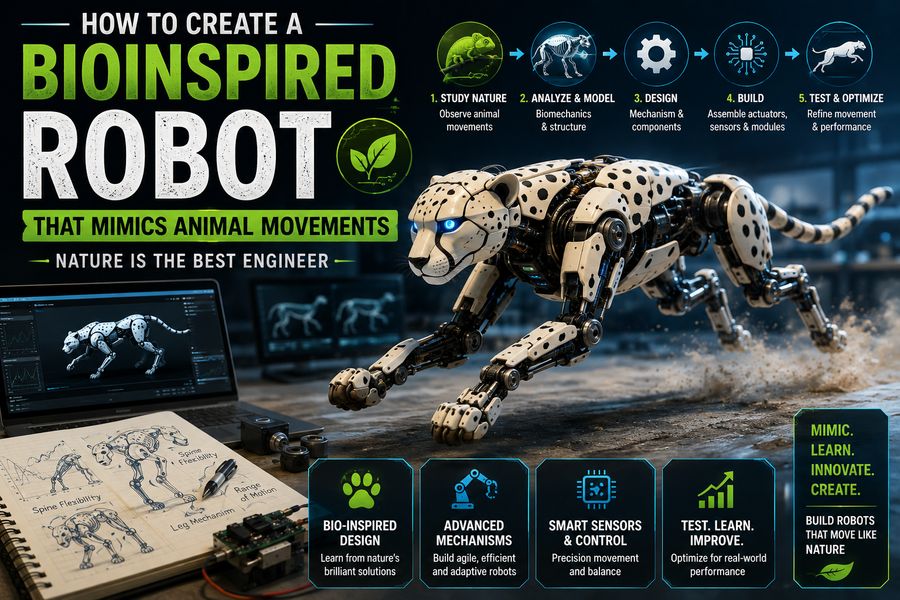
The development process typically begins by selecting an animal movement, studying its biomechanics, simplifying the biological system, designing a mechanical structure, selecting actuators, programming coordinated movement, and adding sensors for feedback.
More advanced designs may use inverse kinematics, central pattern generators, artificial intelligence, soft robotics, and machine learning to produce increasingly realistic and adaptive behavior.
The most important principle is not to copy nature mechanically. It is to understand why a biological movement works and then reproduce that principle using practical engineering components. 🐾⚙️
A successful bioinspired robot may look very different from the animal that inspired it while still using the same underlying strategy.
As robotics technology advances, these nature-inspired machines could become increasingly useful in disaster response, medicine, underwater exploration, industrial inspection, agriculture, and space exploration. 🌍🚀
Nature provides the inspiration; engineering transforms that inspiration into motion.