
A robot arm tightening a bolt, a powered leg helping someone climb stairs, and a warehouse robot lifting a box all face the same physical problem: the real world does not stay perfectly still. People move unexpectedly, objects vary in shape, and contact surfaces flex, slip, or resist.
A conventional motor-and-gear system can be extremely strong and precise. But when its output is rigid, even a small positioning error can create a sharp impact or unexpectedly large force. That is a poor fit for robots designed to work near people, handle fragile items, or walk across uneven ground.
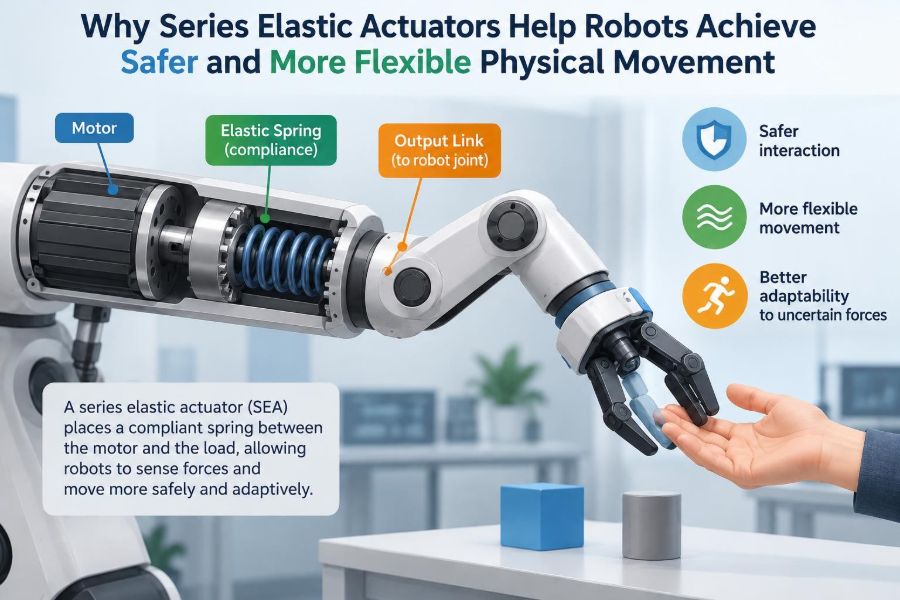
Series elastic actuators, often called SEAs, address this challenge by deliberately placing a compliant element—usually a spring—between the motor and the robot’s load. At first this can seem counterintuitive: why add flexibility to a machine that needs control?
The answer is that carefully measured flexibility can make force easier to sense, impacts easier to manage, and movement more natural. Understanding why requires looking beyond motors alone and treating a robot as a physical system that stores, releases, and responds to energy.
🧭 The core idea behind a series elastic actuator
An SEA contains a motor, transmission, spring, and output link arranged in series. “In series” means that force flowing from the motor to the load must pass through the spring.
When the actuator pushes on something, the spring deflects slightly. That deflection is not merely tolerated; it is a useful signal and a mechanical buffer. The robot can observe how much the spring compresses or stretches, then regulate the force it applies.
⚙️ Rigid actuation and compliant actuation
A rigid actuator tries to make the output follow the motor’s commanded position as closely as possible. Compliance means the output can move relative to the motor because the spring sits between them.
Neither approach is automatically better. Rigid systems suit tasks needing high structural stiffness, such as precise machining with a well-supported fixture. Compliant systems are often preferable when the environment is uncertain or contact is part of the task.
| Characteristic | Mostly rigid actuator | Series elastic actuator |
|---|---|---|
| Contact response | Can transmit impacts quickly | Spring cushions and spreads interaction |
| Force estimation | Often relies on dedicated force sensing or models | Spring deflection can provide a direct estimate |
| Position bandwidth | Can be higher in suitable conditions | Limited by elastic dynamics and control design |
| Best fit | Stable, predictable, stiff environments | Human interaction and uncertain contact |
🌱 A spring is a mechanical memory of force
A spring stores energy when it deforms. For an approximately linear spring, force is related to displacement by F = kx, where k is stiffness and x is deflection.
If a robot measures spring deflection and knows the spring’s calibrated stiffness, it can estimate output force. This is why the elastic element is often described as a force sensor built into the power path, rather than a passive add-on.
📏 Why spring deflection makes force sensing practical
Motor current can sometimes estimate torque, but friction, gearbox losses, temperature, and changing transmission behavior can make that estimate imperfect. A separate load cell can be accurate, yet it adds components and must survive the machine’s mechanical loads.
In an SEA, measuring relative motion across the spring can provide a local force measurement. Designers may use encoders, magnetic sensors, strain sensing, or other methods to measure that small relative displacement.
The measurement still needs calibration. Spring behavior can deviate from the ideal model because of hysteresis, mounting friction, or temperature effects, especially in compact mechanisms.
🛡️ Softer contact reduces peak impact forces
Imagine a robot hand moving toward a tabletop. With a rigid drive, an unexpected early contact may stop the output abruptly. The motor and transmission can then generate a high, short-duration contact force before software reacts.
With a series spring, part of that sudden motion becomes spring compression. This lengthens the interaction and can reduce the peak force for a given collision scenario. It does not make collision harmless, but it gives both mechanics and control more room to respond.
🤝 Why physical compliance matters around people
Robots that assist rehabilitation, carry tools beside workers, or operate in homes encounter people who cannot be modeled as fixed obstacles. Their posture, motion, strength, and attention vary continuously.
Compliance makes interaction feel less like pushing against a locked mechanism. If a user changes direction or resists a motion, the actuator can yield within its designed range while the controller detects the force change and adjusts its behavior.
This is one ingredient in safer design, not a replacement for risk assessment, protective limits, sensing, emergency stops, and thoughtful task planning.
🦿 Legged robots use springs differently
Walking and running are repeated contact events. Each footstrike brings a rapid exchange of momentum with the ground, and the ground may be sloped, soft, or uneven.
SEAs can help legged robots regulate contact force while allowing joints to absorb part of a disturbance. In a step-down event, for example, a compliant ankle or knee drive may accommodate unexpected extra travel instead of immediately resisting it with the full rigidity of the drivetrain.
Biological legs also use tendons and soft tissues to store and return energy, although robotic springs are not simple copies of anatomy. The useful engineering lesson is that controlled elasticity can support dynamic locomotion.
🧍 Exoskeletons need cooperation, not domination
An exoskeleton shares a limb with a person. Misalignment between the device joint and the person’s anatomical joint is difficult to eliminate because bodies are not rigid linkages and clothing can shift.
High actuator stiffness can turn small alignment errors into uncomfortable interface forces. A series elastic actuator can help regulate assistance force and tolerate some relative motion, making the device more cooperative.
It cannot solve poor fit, bad ergonomics, or unsafe control logic. Designers still need careful mechanical alignment, pressure distribution, user-specific adjustment, and conservative limits.
📦 Gentle handling is also a force-control problem
A gripper handling fruit, flexible packaging, laboratory samples, or irregular consumer goods cannot rely only on a fixed closing position. The same finger position may barely touch one object and crush another.
Force-controlled compliant actuation lets the gripper close until it reaches a commanded contact force. If the object moves slightly during transport, the spring can accommodate some displacement without an immediate large increase in grip force.
This is especially useful when object geometry or stiffness is uncertain. It does not eliminate the need for tactile sensing where slip detection or detailed contact information matters.
🎯 Force control becomes more direct
Position control asks the robot to reach a location. Force control asks it to create or maintain a chosen interaction force. Many real tasks need both: a polishing tool must follow a surface while pressing with a controlled amount of force.
Because spring deflection approximates transmitted force, an SEA controller can compare measured force with desired force and adjust motor motion accordingly. The motor may move farther than the output to compress the spring, or back off to reduce compression.
This separation between motor-side movement and output-side force is central to SEA behavior.
🎛️ Impedance control shapes the robot’s feel
Impedance control specifies a relationship between motion and force, similar to choosing how a virtual spring and damper should behave. Rather than commanding a joint to hold one unyielding angle, the controller can make it resist displacement gently, firmly, or somewhere in between.
An SEA provides physical elasticity that works alongside this software-defined behavior. A rehabilitation device, for instance, may offer low resistance during one phase of an exercise and greater guidance during another.
The resulting “feel” depends on the spring, sensors, controller, transmission, and task—not on the spring alone.
🧮 The spring stiffness is a design trade-off
A very soft spring gives large deflection for modest force. That can improve force resolution and impact absorption, but it may make the output feel sluggish or allow too much positional error under load.
A very stiff spring reduces deflection and can support firmer positioning. However, it produces a smaller sensing signal for the same force and offers less compliance during contact.
Designers choose stiffness by considering the expected force range, allowable deflection, desired force sensitivity, geometry, control bandwidth, and safety goals. There is no universal “best” SEA spring.
📐 Travel limits protect the elastic element
Every spring has a useful deflection range. If it is compressed, stretched, or twisted beyond its intended travel, it may yield, buckle, fatigue prematurely, or damage nearby components.
Good actuator design includes mechanical stops, software limits, and fault handling that prevent uncontrolled travel. The stops themselves must be designed carefully: repeatedly crashing into a hard stop can defeat the very impact-management benefits the spring was meant to provide.
Engineers also account for rare but plausible conditions, such as a joint being externally forced while the controller is powered down.
🔄 Energy storage can improve dynamic movement
During a cyclic motion, a spring can store energy during one phase and return some of it later. A hopping mechanism is an intuitive example: compression during landing can contribute to push-off.
Whether this reduces electrical energy use in a complete robot depends on the task and losses in the spring, transmission, motor, and electronics. It is not safe to assume that adding a spring automatically makes a machine efficient.
Still, energy storage can reduce instantaneous motor power demands and help shape dynamic motions when the spring timing and stiffness match the task.
🌊 Resonance is useful only when it is controlled
Adding elasticity creates a resonant system: the motor-side mass, output-side inertia, and spring can oscillate. In some repetitive tasks, designers can use this behavior constructively.
In many precision tasks, though, unwanted oscillation causes overshoot, vibration, or instability. The controller must account for flexible dynamics instead of treating the output as a rigid extension of the motor shaft.
High-gain control is not automatically the answer. Excessive gain can amplify noise or excite the very resonance the system must manage.
🧠 Control loops need the right measurements
Practical SEA control commonly combines measurements of motor position, output position, and spring deflection. Depending on the robot, it may also use velocity estimates, inertial sensing, current sensing, and contact information.
A typical architecture includes a fast inner motor-control loop and an outer loop that regulates force, position, impedance, or a combination. Timing matters because delays reduce phase margin and can make a compliant system oscillate.
Filtering is also a compromise. Too little filtering lets noise corrupt force estimates; too much filtering delays the signal needed for responsive contact control.
⏱️ Bandwidth sets the speed of useful response
Control bandwidth describes how quickly a system can track changing commands or reject disturbances. An SEA often has lower force or position bandwidth than an equivalent rigid transmission because the spring introduces additional dynamics.
This is not necessarily a flaw. For slow, deliberate human assistance or contact-rich assembly, well-regulated compliance may matter more than extremely fast motion.
For high-speed precision applications, designers must verify that the actuator can respond quickly enough without unacceptable oscillation. The desired task, rather than a general preference for softness or speed, should drive the choice.
🧱 Transmissions still shape the real behavior
Gear reductions increase torque, but they can add backlash, friction, reflected inertia, and compliance of their own. These effects can obscure the clean spring behavior shown in simplified diagrams.
Backlash creates a region where motor motion may not immediately change output force. Friction can make small force commands difficult to reproduce. High reduction ratios can make the motor’s apparent inertia feel large at the output.
An effective SEA design considers the spring and transmission as one coupled mechanical system, not as independent modules.
🪛 Mechanical placement changes what the spring protects
The elastic element may be placed in a rotary joint, along a linear actuator, in a tendon drive, or within a transmission path. Its location affects packaging, sensing, stiffness, and exposure to external loads.
A spring near the output can measure forces close to where they are applied, but it may need to withstand a demanding environment. A spring placed elsewhere may be easier to package yet include more transmission effects in the measurement.
There is no single layout that fits all robots. Joint size, required torque, cable routing, maintenance access, and available sensors all matter.
🧪 Calibration turns deflection into trustworthy force
Before a spring-deflection signal can serve as a force estimate, the actuator needs calibration. Engineers apply known loads or torques and record the relationship between sensor output and actual deflection or force.
The process can reveal offsets, nonlinear regions, hysteresis, and mounting effects. Calibration should cover the expected operating range, not only a convenient small-load region.
Over time, rechecking may be necessary after maintenance, sensor replacement, or substantial wear. A force controller is only as trustworthy as the mechanical and sensing assumptions underneath it.
🌡️ Temperature, wear, and fatigue are not minor details
Repeated spring cycling can lead to fatigue if stresses are poorly managed. Bearings, cables, gears, adhesives, and sensor mounts also wear, changing the actuator’s effective behavior.
Temperature can affect sensor electronics, lubricant viscosity, motor performance, and sometimes spring properties enough to matter for precision force control. Outdoor and industrial robots face additional contamination, moisture, and shock concerns.
Robust SEA design therefore includes material selection, sealing where needed, fatigue analysis, inspection plans, and diagnostics that detect drift before it becomes a performance or safety issue.
🚧 Compliance does not eliminate safety engineering
A compliant actuator can reduce some contact hazards, but a large robot moving quickly still has substantial kinetic energy. A spring may soften one part of an impact while other links, sharp tools, pinch points, or moving payloads remain dangerous.
Safe robot systems use layered protections, such as speed and force limits, workspace separation, collision detection, guarded hardware, fault monitoring, and safe stopping behavior. Requirements depend on the specific application and should be evaluated by qualified engineers.
“Compliant” should never be interpreted as “safe under all conditions.”
🧰 Variable stiffness actuators go one step further
A conventional SEA generally has a fixed physical spring stiffness. A variable stiffness actuator, or VSA, changes effective stiffness through adjustable geometry, multiple springs, antagonistic mechanisms, or other arrangements.
This can be attractive when a robot needs both a soft interaction mode and a firm positioning mode. The added capability often brings extra motors, mass, mechanical complexity, and control challenges.
SEAs and VSAs are related but not interchangeable terms. An SEA is defined by its series elastic element; a VSA is defined by adjustable stiffness.
🧩 Not every flexible component makes a true SEA
Belts, cables, plastic structures, and long links can all flex unintentionally. That flexibility may reduce stiffness, but it does not automatically create a useful series elastic actuator.
A purposeful SEA has a known compliant element in the force path, measurable deflection, and a control strategy that uses its behavior. Unmodeled flex is usually a source of uncertainty rather than a reliable force-sensing feature.
This distinction helps prevent a common design mistake: calling mechanical looseness “compliance” without verifying its repeatability or safety implications.
🧭 Choosing an SEA starts with the task
The most useful first question is not “Should this robot have springs?” It is “What interactions must this robot manage?” Consider expected contact forces, motion speed, environment variability, allowable deflection, and consequences of error.
- Choose an SEA when controlled contact, force sensing, impact tolerance, or human interaction are central requirements.
- Consider rigid actuation when stiffness, positioning bandwidth, and highly predictable contact dominate.
- Evaluate hybrid designs when different joints or operating modes have different demands.
A robot arm may even use compliant actuation at its end effector while relying on stiffer drives elsewhere.
🔍 Questions to ask during early design reviews
Early choices about spring stiffness and sensing architecture are difficult to undo once packaging and transmission decisions are fixed. A focused review can expose assumptions before they become expensive hardware changes.
- What force range must be measured, and what resolution is actually useful?
- How much output deflection is acceptable during normal work and unexpected contact?
- What resonant frequencies arise with realistic loads?
- How will the actuator behave after sensor failure, power loss, or a mechanical stop?
- Can calibration be performed and verified in the field?
These questions connect physical design, software, and maintenance rather than treating them as separate stages.
🛠️ Common implementation mistakes
One mistake is selecting a spring solely for softness, then discovering that normal loads create too much deflection for the task. The opposite mistake is choosing a spring so stiff that its deflection signal is difficult to resolve and its protective effect is minimal.
Other frequent problems include ignoring gearbox friction, underestimating sensor noise, tuning position loops as if the output were rigid, and omitting robust end-stop design. Each can make an otherwise promising actuator feel unstable, inaccurate, or unexpectedly harsh.
Testing with realistic payloads and contact conditions is essential. Bench tests with no load rarely reveal all the dynamics of a working robot.
🧑💻 A practical learning path for engineers
Students can begin with a simple rotary setup: a motor drives an arm through a torsional spring, while encoders measure motor-side and output-side angle. The angular difference estimates spring twist and therefore torque after calibration.
Start by characterizing the spring and observing open-loop behavior. Then implement modest force control, log the signals, and test against a safe compliant target. Increase complexity only after the basic measurements are believable.
Working professionals can apply the same discipline through simulation, hardware-in-the-loop tests, and controlled contact experiments. The important habit is to validate the complete actuator, not just individual component specifications.
🔮 Where series elasticity is most likely to matter
SEAs are especially relevant in rehabilitation devices, prosthetic joints, exoskeletons, humanoid and legged robots, collaborative manipulation, powered tools with force regulation, and adaptive grippers. These applications share a need to interact with an uncertain physical world.
They are less compelling when the task is isolated, highly structured, and dominated by rigid precision. Even then, a compliant wrist or tool interface may still offer advantages at the point of contact.
The technology’s value comes from matching mechanical behavior to the job, not from adding springs as a trend.
🧠 The central principle: controlled give creates useful control
Series elastic actuators demonstrate a broader robotics lesson: mechanical design and software control are partners. A spring changes the physics before the controller makes its next calculation.
By converting force into measurable deflection, absorbing part of an impact, and allowing limited relative motion, an SEA gives a robot a more manageable way to touch the world. The cost is added dynamics, design complexity, and limits on rigid high-bandwidth behavior.
The goal is not to make robots soft everywhere; it is to place and control compliance where physical interaction benefits from it.
When robots must share space, forces, and tasks with an unpredictable world, a carefully designed series elastic actuator can turn flexibility from a source of error into a source of control. 🦾⚙️🤝