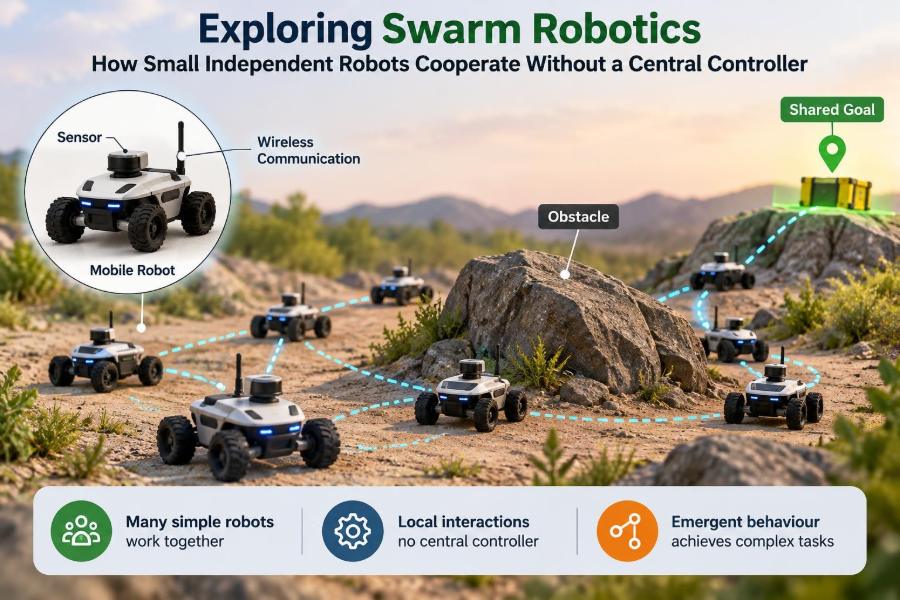

A warehouse shelf is blocked, a crop field has uneven ground, or a disaster site changes faster than any map can be updated. A single sophisticated robot may be able to handle part of the task, but it can also become a bottleneck—or a single point of failure.
Now picture dozens or hundreds of smaller robots. Each has limited sensing, limited computing power, and no master robot issuing detailed instructions. Yet, as a group, they can spread out, avoid collisions, locate targets, and adapt when some members stop working.
This is the central idea behind swarm robotics: achieving useful collective behavior through local interactions. The approach takes inspiration from ants, bees, fish, and other natural systems, but it is an engineering discipline with its own hard design problems.
For students, swarm robotics connects control theory, embedded systems, communication networks, artificial intelligence, and mechanical design. For working engineers, it raises practical questions about reliability, safety, testing, and whether a distributed fleet is actually the right solution.
🐜 What Swarm Robotics Means
Swarm robotics is the study and design of multiple robots that coordinate through decentralized rules. Rather than relying on one central controller that knows every robot’s position and assigns every action, individual robots make decisions from local sensor readings, short-range messages, and simple internal state.
A swarm is not merely “many robots in the same place.” The robots must influence one another in a way that produces a coordinated group outcome, such as exploring an area, transporting objects, forming a pattern, or monitoring a changing environment.
🧩 The Difference Between a Fleet and a Swarm
A fleet can be centrally scheduled. For example, warehouse vehicles may receive routes from a server that holds a global map and resolves traffic conflicts. That can work extremely well in structured facilities with reliable connectivity.
A swarm emphasizes distributed decision-making. A robot may choose its direction because nearby space is crowded, a neighbor has reported a useful target, or it has detected a local signal. Real systems often sit between these extremes, using central oversight with swarm-like local behaviors.
🌱 Why Nature Inspires Engineers
Ant colonies can find efficient paths without any ant understanding the entire terrain. Fish schools turn rapidly without a leader calculating every trajectory. These examples suggest that simple local interactions can generate organized patterns at scale.
Biology is an inspiration, not a blueprint. An ant uses chemical trails, body contact, and evolutionary adaptations that are difficult to reproduce exactly. Engineers instead extract principles: reinforce useful information, respond to nearby neighbors, distribute tasks, and avoid dependence on one critical unit.
🔄 Emergence: Order From Local Rules
Emergent behavior occurs when the group displays a pattern that no single robot explicitly stores as a complete plan. For instance, each robot might move away from close neighbors, align roughly with their heading, and stay within a certain distance. The result can resemble coordinated flocking.
This is powerful because the system need not compute every possible interaction from a central location. It is also difficult because a small change in one rule can create unintended group behavior, including clumps, oscillations, or robots drifting away from the task area.
📍 Local Sensing Sets the Robot’s View
Most swarm robots operate from a partial, local view. Their sensors may include cameras, lidar, ultrasonic range sensors, inertial measurement units, wheel encoders, microphones, chemical sensors, or contact switches.
Every sensor has limits. A camera can be affected by lighting, lidar may struggle with certain surfaces, and wheel odometry accumulates error. Robust swarm design assumes that robots will occasionally perceive incomplete or incorrect information rather than assuming perfect localization.
📡 Communication Without a Command Center
Robots may exchange information through radio, infrared light, visible signals, sound, or physical contact. Short messages might contain a robot identifier, a direction to a discovered target, a warning about an obstacle, or a task status.
Communication is rarely continuous or flawless. Wireless links can drop, messages can arrive late, and shared channels can become crowded. Good swarm algorithms degrade gracefully when messages are delayed or missing instead of requiring every robot to receive every update.
📣 Stigmergy: Communicating Through the Environment
Stigmergy is indirect coordination through changes to a shared environment. Ants provide the classic example: a food-finding ant leaves a pheromone trail, influencing where later ants travel.
Robots can use physical or digital equivalents. They might place markers, update a shared map cell, leave a small beacon, or deposit an object in a designated area. A search robot that marks inspected spaces can reduce repeated work without holding a detailed conversation with every other robot.
🧠 Simple Rules Can Produce Complex Results
A robot’s control policy can be surprisingly compact. It may say: avoid obstacles, maintain spacing from nearby robots, follow a detected gradient, and switch roles when its battery drops below a threshold.
The challenge is not writing rules that sound sensible individually. It is understanding how they interact across many robots and many environmental conditions. A rule that improves separation may reduce connectivity; a rule that follows neighbors may cause the whole group to follow a mistaken leader.
🧭 Consensus Helps the Group Agree
In distributed systems, consensus means reaching agreement through exchanges among neighboring units. A swarm might use consensus to estimate a shared direction, select between possible sites, or converge on a common time reference.
Agreement does not always mean every robot holds exactly the same value. Often, the useful goal is practical convergence: enough robots make compatible decisions for the collective task to proceed. Engineers must account for communication delays, disconnected subgroups, and faulty readings.
🗺️ Collective Exploration and Coverage
Coverage tasks require a group to inspect as much of an area as possible. Examples include scanning a greenhouse for plant stress, surveying an industrial floor, or searching a hazardous location where sending people is risky.
One approach is to make robots prefer poorly explored regions while repelling one another at short range. Another divides the area into local territories that shift as robots move. The right method depends on whether the map is known, whether the terrain changes, and how accurately robots can determine where they are.
🎯 Search and Target Detection
Finding a target differs from covering an area. A target may be rare, mobile, hidden, or only detectable at close range. A search swarm must balance spreading out widely with sharing discoveries quickly enough for the group to respond.
Consider a hypothetical spill-detection swarm in a large facility. One robot could detect an unusual gas concentration, while others move upwind or around the perimeter to estimate the source. The group’s value comes from combining observations, not treating one sensor reading as certainty.
🚚 Cooperative Transport
Several small robots can move an object too heavy or awkward for one unit. They may push from different sides, attach to handles, or carry modular pieces beneath a platform.
This task exposes a key difficulty: force coordination. If robots push in conflicting directions, they waste energy or rotate the load. Practical systems need local force sensing, compliant mechanical interfaces, or rules that allow robots to reposition when they detect ineffective effort.
🧱 Formation Control and Collective Shape
Formation control directs robots to maintain a geometric arrangement: a line for sweeping, a ring around a location, or a grid for sensing. Robots generally use relative distances or bearings to neighbors rather than relying solely on a shared global coordinate system.
Rigid formations are not always desirable. In cluttered terrain, a formation should stretch, split, or bend around obstacles and then reform. A useful design defines what relationships matter most instead of forcing a perfect shape in every circumstance.
🔀 Task Allocation Without a Dispatcher
In a decentralized swarm, robots need a way to decide who does what. A robot may estimate its own cost to perform a task based on distance, battery level, available tools, or local congestion.
Distributed bidding is one option: robots advertise capabilities and choose locally among competing assignments. Simpler systems use thresholds, where a robot takes a task only when a local signal becomes strong enough. The best method depends on how costly communication is and how quickly tasks change.
👥 Division of Labor and Flexible Roles
Not every robot must be identical in behavior, even if the hardware is identical. Some robots can temporarily become scouts, relays, carriers, or monitors based on conditions they detect.
Role flexibility improves resilience. If a communications relay fails, another nearby robot may take its place. But role-switching needs safeguards; otherwise, too many robots may abandon exploration to become relays, leaving the primary task unfinished.
🔋 Energy Is a Collective Constraint
A swarm may have many robots, but it does not have unlimited operational time. Battery depletion changes coverage, communication range, mobility, and the availability of robots for urgent work.
Energy-aware rules can direct low-charge robots toward a station while healthy robots fill gaps. Charging infrastructure itself can become a coordination problem: if every robot returns at once, queues form and the active swarm shrinks. Energy planning belongs in the group policy, not only in individual battery monitoring.
🕸️ Network Topology Changes Constantly
Network topology describes which robots can communicate with which others. As robots move, obstacles block signals, or units fail, those connections change. A swarm split into separate communication groups may still perform local work, but it can no longer coordinate as one fully informed team.
Some applications use mobile relay robots or require each robot to maintain a minimum number of nearby connections. These choices can conflict with exploration: traveling farther may improve sensing coverage while making the network more fragile.
🛡️ Fault Tolerance Is a Major Advantage
Distributed swarms can continue operating after individual robots fail because no single unit is necessarily indispensable. This is called fault tolerance, and it is especially valuable when repair is difficult or the environment is hazardous.
Fault tolerance is not automatic. If all robots depend on the same fragile communication protocol, navigation landmark, or charging station, a common failure can disable the group. Engineers must identify shared dependencies as carefully as individual component failures.
⚠️ Decentralization Creates New Failure Modes
Removing a central controller avoids one bottleneck, but it can make failures harder to diagnose. A local sensor error can spread through neighbor-following behavior. Multiple robots can independently choose the same narrow route and create congestion.
Other risks include message storms, unstable feedback loops, and deadlock, where robots block one another without a rule for yielding. The solution is not necessarily more communication; it may be clearer priorities, randomized waiting, bounded retries, or explicit recovery modes.
🚧 Safety Requires Layers of Protection
Swarm-level intelligence does not replace robot-level safety. Each robot needs basic protections such as speed limits, obstacle avoidance, emergency stopping behavior, and constraints that prevent unsafe actuation.
For human-shared spaces, safety design must consider the collective effect. Ten small robots converging on a signal can create a larger hazard than one robot. A practical system defines exclusion zones, limits local density, and provides a reliable way for people to pause or clear the fleet.
📏 Measuring Whether a Swarm Actually Works
A compelling demonstration is not enough. Engineers need metrics matched to the mission: area covered, targets found, time to completion, energy used, communication load, collision rate, or performance after robot losses.
Metrics should reveal trade-offs. A strategy that finishes quickly may consume more energy. Another may cover every reachable area but take too long for a time-critical inspection. Evaluate both average behavior and difficult cases, because rare failures can matter greatly in field deployment.
🧪 Simulation Comes Before Hardware
Simulation lets developers test many robots, varied maps, sensor noise, packet loss, and failure scenarios without building a large physical fleet. It is particularly useful for discovering unexpected interactions between local rules.
However, simulations can hide real-world issues: wheel slip, radio interference, uneven lighting, motor variation, and imperfect object contact. The sim-to-real gap is the difference between simulated performance and physical performance. Build prototypes early enough to expose those assumptions.
🔍 Testing the Edge Cases
Testing should intentionally create stressful conditions. Remove a subset of robots, block a communication corridor, introduce a false target reading, reduce battery capacity, or place an obstacle where the map says there is open space.
A useful question is not only “Does the swarm succeed?” but “How does it fail?” Predictable degradation is often preferable to sudden collapse. Logging local observations, messages, decisions, and timing is essential for reconstructing distributed failures later.
🧰 A Practical Development Workflow
Start with one clearly defined collective objective and a small set of measurable constraints. Build the simplest local policy that could achieve it, then add complexity only when testing shows a specific gap.
- Define the mission, operating environment, and safety boundaries.
- Choose what each robot can sense, share, and do independently.
- Model communication loss, sensor uncertainty, and robot failure from the start.
- Test in simulation, then with a small physical group.
- Scale gradually while monitoring congestion, energy use, and recovery behavior.
This workflow prevents a common mistake: designing an impressive collective behavior before confirming that the sensing and communication assumptions are realistic.
💻 Hardware and Software Building Blocks
A small swarm robot typically combines a mobile base, motors and motor drivers, a compute board or microcontroller, sensors, a wireless interface, and a battery-management approach. The exact mix depends on whether the task requires indoor navigation, aerial motion, underwater operation, or stationary sensing.
Software is often organized in layers: low-level motor control, state estimation, local navigation, communication, task logic, and safety supervision. Clear interfaces between layers help engineers replace a sensor or revise a coordination algorithm without rewriting the entire system.
🧑🏫 Learning Projects That Reveal Real Problems
A tabletop swarm can teach the fundamentals without expensive hardware. Try a group of wheeled robots that spread across a marked area, avoid one another using distance sensors, and illuminate an LED when they detect a colored target.
Then change one assumption at a time: disable communication, add a barrier, give one robot a weaker battery, or inject incorrect target reports. The lesson is not merely to make the robots move together. It is to observe which local assumptions produce robust behavior and which make the group brittle.
🏭 Where Swarm Robotics Fits Best
Swarm methods are most attractive when a task is naturally distributed, the environment is broad or uncertain, and losing one robot should not end the mission. Environmental monitoring, agricultural sensing, inspection, search support, and distributed construction research are often discussed in this context.
They are less compelling when a task needs high force, fine manipulation, strict centralized accountability, or a highly optimized route through a stable environment. A single capable robot or centrally managed fleet may then be simpler, safer, and less expensive to operate.
⚖️ Autonomy, Accountability, and Responsible Use
As swarms gain autonomy, designers must decide what humans can observe, override, and audit. A system that cannot explain its decisions is difficult to trust in safety-sensitive settings, even when its local rules are technically sound.
Privacy also matters when robots use cameras, microphones, or location data. Responsible deployment includes limiting data collection to the mission, protecting stored data, establishing human intervention procedures, and testing behavior around people rather than treating those questions as afterthoughts.
🔮 Future Directions and Realistic Expectations
Advances in sensing, onboard computing, low-power communication, and learning-based methods may expand what small groups can do. Researchers are exploring adaptive behaviors that respond to unfamiliar conditions while still enforcing safety and mission constraints.
But more autonomy does not erase engineering fundamentals. Physical contact remains difficult, batteries remain finite, radio links remain imperfect, and validating large numbers of interacting robots remains demanding. Progress will depend as much on dependable systems engineering as on clever algorithms.
🦾 The Core Principle of Swarm Robotics
Swarm robotics is not about making every robot intelligent enough to understand the whole mission. It is about designing local capabilities, communication rules, and recovery behaviors so that useful global behavior emerges from many limited agents.
The strongest swarm designs are explicit about their assumptions: what robots can sense, when they can communicate, how they handle uncertainty, and what happens when some units fail. Decentralization is a tool, not a shortcut; it works best when the task genuinely benefits from distributed action.
A swarm succeeds when simple, reliable local decisions add up to a safe and adaptable collective result. That idea is what makes the field both challenging and broadly useful—from classroom experiments to future systems working where one robot alone would be too slow, too fragile, or too limited. 🐜📡🦾