
A warehouse robot rounds a pallet stack just as a worker pushes a cart through its camera view. For a moment, the robot cannot see the aisle ahead. A delivery robot loses sight of a curb behind a parked van. A surgical instrument disappears behind tissue.
None of these situations is unusual. Robots operate in a physical world full of corners, clutter, shadows, dust, reflections, and moving people. A camera image can be sharp and still be incomplete.
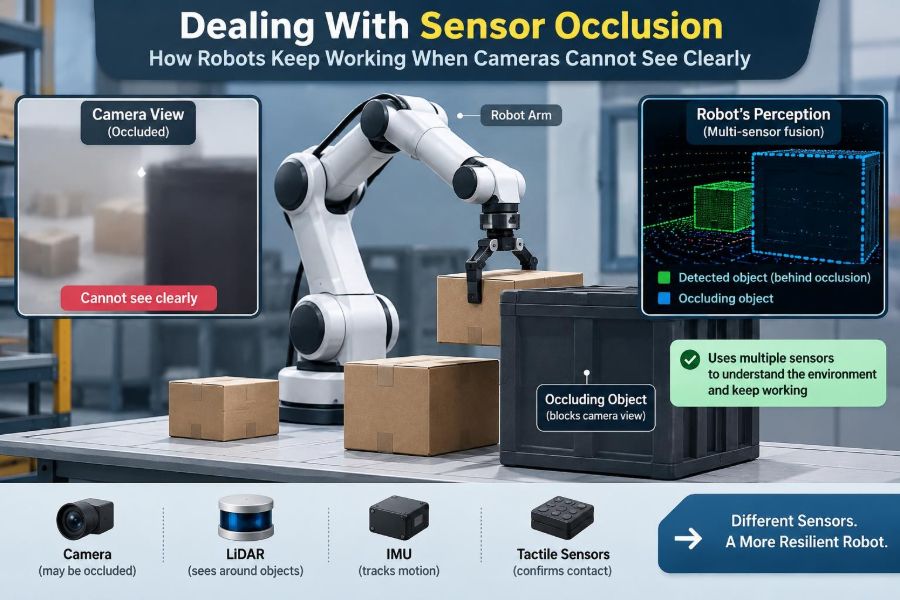
This problem is called sensor occlusion: an object, surface, or environmental condition blocks a sensor’s view of information the robot needs. Handling it well is not about making robots magically see through walls. It is about recognizing uncertainty, using other evidence, and behaving safely until visibility returns.
For students, occlusion connects perception algorithms to real robot behavior. For working engineers, it is a reminder that a high-accuracy detector in an open test scene is only one part of a dependable system.
👁️ What Sensor Occlusion Actually Means
Occlusion occurs when something prevents a sensor from measuring a target or part of the environment. With a camera, a box may hide a person’s legs. With lidar, a metal rack can block laser returns from everything behind it. With ultrasonic sensing, a nearby surface may create confusing echoes.
Occlusion is not identical to sensor failure. The camera may be functioning perfectly; it simply has no direct line of sight. This distinction matters because a robot should respond differently to missing information than to a dead device.
🧩 Visibility Is Not the Same as Existence
A common perception mistake is treating “not detected” as “not present.” Cameras only report what is visible in their field of view, at a useful resolution, under workable lighting. An obstacle can still exist outside the frame, behind another object, or in a blind region close to the robot.
Robust systems maintain a difference between free space, which has been observed as clear, and unknown space, which has not been adequately observed. Unknown does not automatically mean dangerous, but it should never be silently treated as confirmed empty.
📷 Why Cameras Are Especially Vulnerable
Vision is rich: a camera can help classify people, read signs, identify grasp points, and estimate scene structure. Yet it is passive and line-of-sight dependent. A single camera also compresses a three-dimensional scene into a two-dimensional image, making depth and overlap harder to infer.
A pedestrian partly hidden behind a cart may look like a small, fragmented shape. A robot trained mainly on fully visible objects can miss it or assign low confidence. Stereo cameras add depth cues, but each camera can still be blocked or struggle with low-texture surfaces.
🌫️ Occlusion Is More Than an Object in Front
Physical blockage is the clearest form, but visibility can be effectively lost in other ways. Fog, rain droplets, dust, glare, motion blur, and overexposure reduce useful image information even when nothing fully covers the lens.
Lens contamination deserves special attention. A thin layer of grime may not produce an obvious black image; it can quietly degrade contrast and distort bright edges. That makes it harder to detect than a complete camera outage, especially in outdoor and industrial deployments.
🏭 Where Robots Encounter Occlusion
Occlusion patterns depend on the task. Indoor mobile robots encounter shelving, open doors, carts, and people. Manipulators create their own occlusions when an arm or gripper moves between a wrist camera and the workpiece.
- Autonomous vehicles lose road users behind parked vehicles and large trucks.
- Agricultural robots contend with leaves, branches, soil, and changing sunlight.
- Inspection robots encounter pipes, supports, narrow passages, and dirty lenses.
- Home robots face furniture, pets, blankets, and objects at floor level.
The right mitigation begins with an honest inventory of these scene-specific conditions.
🗺️ Blind Spots Are Designed Into Systems
Every sensor placement creates blind zones. A front-facing camera may not see beside the chassis; a roof-mounted lidar can have difficulty with objects close to its base; a bumper sensor only reacts after the robot is already near contact.
These are geometry problems before they become software problems. Teams should model sensor fields of view, mounting height, range limits, and regions blocked by the robot’s own body. A blind spot can then be covered, constrained operationally, or treated as a source of uncertainty.
📐 Field of View, Range, and Resolution
A wide-angle camera sees more scene but allocates fewer pixels to a distant object. A narrow camera provides detail but can miss activity just outside its frame. No single choice is universally correct.
At long range, a person may occupy too few pixels for reliable classification. At short range, the same person may be beneath the camera’s viewing angle. Sensor selection must connect optical properties to the smallest object, distance, speed, and reaction time the robot must handle.
⏱️ Dynamic Occlusion Changes the Planning Problem
A fixed wall blocks a view predictably. A moving forklift, swinging door, or passing person creates dynamic occlusion: the hidden region changes from moment to moment. It may reveal a hazard just after the robot commits to motion.
Planning should therefore account for what could emerge from hidden areas. A robot approaching the end of a shelf aisle may slow down, widen its clearance, or pause briefly—not because it detected a person, but because the view is insufficient to rule one out.
🧠 Perception Works With Beliefs, Not Certainties
Robots combine noisy sensor data into an internal representation of the world. This may be a grid map, a set of tracked objects, or a learned scene model. The representation should include confidence or uncertainty rather than storing only a single asserted answer.
For example, a tracker can retain a pedestrian’s estimated position and velocity for a short time after the person passes behind a pillar. The estimate becomes less certain as time passes. Treating that growing uncertainty explicitly is safer than either pretending the person vanished or assuming an exact path forever.
🧾 Object Tracking Bridges Short Gaps
Object tracking associates observations over time. When a detector sees the same cart in consecutive frames, tracking estimates its continuing state, often including location, velocity, and identity.
During brief occlusion, prediction can sustain the track. A simple model might assume constant velocity; more advanced approaches can incorporate likely motion constraints. Prediction is useful, but it must be bounded. People can stop, turn, or accelerate in ways a simple motion model does not anticipate.
🔮 Prediction Must Degrade Gracefully
It is tempting to extrapolate a hidden object’s path and keep moving normally. That can be reasonable for a brief, low-risk gap with stable motion. It becomes risky when the object has been hidden for long, its behavior is unconstrained, or the consequence of error is severe.
A good system expands the possible region an object might occupy as evidence gets older. This is sometimes described as uncertainty growth. The robot’s speed and route should reflect that widening envelope.
🧭 Mapping Distinguishes Structure From Temporary Blockage
Localization and mapping systems help a robot remember stable layout: walls, shelving, doorways, and machine locations. That context can prevent it from repeatedly “discovering” the same obstruction or becoming disoriented when one camera view is blocked.
But a map is not a live guarantee. A mapped aisle can contain a newly placed pallet. A previously open doorway can be closed. Reliable navigation layers current observations over prior maps instead of allowing old maps to overrule present uncertainty.
📡 Sensor Fusion Provides Different Evidence
Sensor fusion combines measurements from sensors with different strengths. Cameras provide appearance; lidar supplies geometric range samples; radar can remain useful in conditions that degrade optical sensing; wheel encoders and inertial measurement units estimate the robot’s own motion.
Fusion does not mean every sensor sees everything. It reduces the chance that one limitation controls the entire system. A camera may identify a worker while lidar confirms a nearby occupied region, even if the worker’s lower body is hidden.
🧰 Choosing Complementary Sensors
| Sensor | Useful contribution during visual difficulty | Key limitation |
|---|---|---|
| Camera | Appearance, labels, texture, signs | Lighting and line-of-sight sensitive |
| Lidar | Distance and shape of visible surfaces | Also blocked by solid objects |
| Radar | Range and relative motion in many adverse conditions | Lower spatial detail for many tasks |
| Ultrasonic | Close-range obstacle presence | Limited range and angle-dependent echoes |
| Encoders and IMU | Short-term self-motion estimation | Cannot reveal external obstacles |
Fusion should be driven by failure modes, not by a belief that more sensors automatically create safety. Each added sensor brings calibration, synchronization, maintenance, and disagreement-handling work.
⚖️ When Sensors Disagree
A camera may label a clear aisle while lidar reports an unexpected return. The correct response is not always to trust the newest or most sophisticated sensor. Engineers need rules based on sensor health, geometry, expected error, and the cost of a wrong decision.
In a collision-sensitive zone, a conservative policy may treat credible occupancy from either sensor as a reason to slow or stop. In other settings, filtering may be needed to avoid reacting to known artifacts. The policy must be tested against real operating conditions.
🛑 Safe Behavior Under Uncertainty
Occlusion handling culminates in behavior. The robot can reduce speed, stop, wait for a clearer view, select an alternate viewpoint, reroute, increase following distance, or request human assistance.
The suitable action depends on context. A floor-cleaning robot may pause near an occluded doorway. A high-speed mobile platform may need to begin slowing much earlier because stopping distance grows with speed. A manipulator may retract to expose a target before attempting a grasp.
🚦 Speed Is a Perception Parameter
Speed is often treated as a productivity setting, but it also determines how much time perception has to respond. Faster travel means fewer sensor updates before reaching a hidden corner and more distance needed to stop.
A practical design principle is to link speed to visible safe distance. When the robot can observe a long, clear path, it may move efficiently. When the path ahead is largely occluded, it should behave as though its usable horizon has shrunk.
🔄 Active Perception Changes the View
Robots do not always have to accept their first viewpoint. Active perception means moving a camera, sensor, arm, or entire base to gather better evidence. A mobile robot can edge forward slowly to see around a corner; a manipulator can rotate an object before inspection.
These actions cost time and may introduce new risks, so they should be deliberate. The goal is not constant movement of sensors, but choosing observations that reduce uncertainty enough to support the next action.
🦾 Self-Occlusion in Manipulation
A robot arm is frequently its own worst visual obstruction. As it reaches for a part, links, grippers, cables, and the held object can block a fixed overhead or wrist-mounted camera.
Good cell design considers camera placement and planned arm configurations together. Multiple viewpoints, model-based prediction of arm shape, and intermediate “look” poses can help. The robot should also avoid assuming that a part stayed in the same pose simply because it is temporarily hidden.
🧱 The Occluded-Space Problem
In occupancy mapping, a sensor return confirms that something was hit at a particular location. The space before that return may be marked as observed free, but space behind it remains unobserved because the beam could not pass through the object.
This distinction prevents a serious mapping error: “painting” empty space behind visible obstacles. For navigation, an occluded region should retain an unknown state until viewed from another angle or otherwise justified by reliable information.
🧪 Training Data Must Include Partial Views
Machine-learning perception models learn from examples. If training images mostly contain centered, fully visible objects, a model may struggle with cut-off, crowded, or partially hidden targets.
Datasets should include realistic partial occlusions, varied object overlaps, difficult lighting, and background clutter. Synthetic data and augmentation—such as placing masks over portions of images—can help broaden variation, but they do not replace recordings from the actual sensor and environment.
🔍 Detection Confidence Is Not a Safety Guarantee
A detector’s confidence score reflects the model’s internal scoring, not a universal probability that the result is correct. Scores can be poorly calibrated, especially when the robot encounters scenes unlike its training data.
Use confidence as one input to decision-making, alongside range, tracking history, sensor health, and task risk. A low-confidence shape directly in a robot’s path may deserve a more cautious response than a high-confidence object far outside its reachable area.
🧼 Sensor Health Monitoring Catches Quiet Degradation
Robots should monitor whether their sensors are producing plausible data. Useful checks include image brightness trends, blur indicators, dropped-frame detection, camera exposure status, lidar return patterns, temperature, and synchronization errors.
Health monitoring cannot always identify the cause of bad data, but it can trigger a safer operating mode. Maintenance procedures should also include cleaning, alignment inspection, protective housing checks, and validation after replacement.
🧪 Test Occlusion Deliberately
Testing only in open, tidy spaces creates false confidence. Teams should create controlled scenarios: a person appearing from behind a barrier, a cart crossing a camera view, a dirty lens, an object held in front of a sensor, and a partially blocked route.
Record not just whether detection occurred, but the whole chain: uncertainty estimate, tracker behavior, planner decision, braking distance, alerts, and recovery. Tests should be conducted with appropriate safety controls, especially when people share the space.
📏 Measure System Behavior, Not Just Model Accuracy
Detection metrics are useful, but a robot is a system. A vision model can perform well on labeled frames while the overall robot still reacts too late because of communication delay, filtering, compute load, or weak braking behavior.
Evaluate end-to-end questions: Did the robot keep a safe separation? Did it recognize that the view was degraded? Did it return to normal operation only after enough evidence was restored? These are operational outcomes users actually experience.
🧑🤝🧑 Human-Robot Spaces Need Extra Margin
People are variable, can be partially hidden, and do not always follow designated routes. In shared workspaces, a robot should not depend on people being continuously visible or behaving predictably.
Clear operating zones, suitable speed limits, warning methods, and conservative behavior near doors, aisle ends, and intersections all reduce exposure. Technical sensing is only one layer; workspace design and operating procedures are equally relevant.
⚠️ Common Design Mistakes
- Equating no detection with clear space: this erases uncertainty behind obstacles.
- Adding a second identical camera as the only backup: both may share the same glare, dirt, or blocked viewpoint.
- Overtrusting prediction: hidden objects do not have to continue their previous motion.
- Using a static map as live truth: real environments change.
- Testing only nominal conditions: the first real occlusion then becomes the first meaningful test.
Most of these errors come from treating perception as a finished answer rather than an uncertain measurement process.
🛠️ A Practical Design Workflow
- Identify objects, regions, and events the robot must safely respond to.
- Map fields of view, blind spots, mounting constraints, and likely occluders.
- Define what counts as observed free, occupied, unknown, and sensor-degraded.
- Select complementary sensing and establish calibration and timing checks.
- Specify speed, stopping, rerouting, and escalation behavior for uncertainty.
- Test expected and unexpected occlusions, then update both hardware and software.
This workflow makes occlusion a design input early, when changes to sensor placement or task layout are often less expensive.
🔐 Safety Claims Require Careful Boundaries
No perception stack can eliminate uncertainty in every condition. Sensor performance depends on environment, installation, maintenance, software updates, and interactions among components. A mitigation that works in one facility may not transfer directly to another.
For applications where failures can harm people or property, safety decisions require hazard analysis, validation, and the applicable engineering and regulatory processes. This article describes design principles, not a substitute for a system-specific safety case.
🌱 The Core Principle: Manage What You Cannot See
The strongest robots do not merely attempt to maximize detections. They represent missing information honestly, gather more evidence when possible, and choose actions appropriate to the remaining uncertainty.
That principle scales from a simple vacuum robot approaching a sofa edge to a complex industrial platform navigating a busy facility. Better sensors help, but dependable behavior comes from connecting sensing, estimation, planning, and operations into one coherent response.
When a robot cannot see clearly, the right goal is not false certainty—it is safe, informed action while visibility is incomplete. 🦾👁️🚦