
A robot has successfully moved a part to the right location thousands of times. Then a slightly warped component arrives, or a person’s hand brushes against the robot’s tool, or a peg meets a hole a fraction of a millimeter off-center. A rigid machine can respond to that tiny mismatch with surprisingly large forces.
People handle these situations almost without thinking. When we close a drawer, shake hands, insert a charging cable, or hold a cup, our muscles and joints yield slightly while our senses guide the motion. We are not merely moving through space; we are adapting to contact.
Robots need a version of that ability. It is called compliance, and it is one of the ideas that makes machines safer, more capable, and more useful outside perfectly controlled environments.
Compliance does not mean a robot is weak, vague, or unable to be precise. It means the robot can manage forces intelligently when the real world refuses to match its mathematical model.
🤝 What Compliance Means in Robotics
In robotics, compliance describes how readily a system yields or changes its motion when an external force acts on it. A compliant robot does not insist on following its planned position at all costs. Instead, it allows a controlled amount of displacement, force, or both.
Imagine pressing a spring against a table. As the table pushes back, the spring compresses. That relationship between applied force and resulting movement is a basic form of compliance. A robot can achieve a similar response through physical components, control software, or a combination of the two.
The opposite concept is stiffness: resistance to deformation. Neither property is inherently better. A milling operation often needs high stiffness; placing a delicate lid onto a container benefits from compliance.
🧱 Why Pure Position Control Can Fail
Traditional industrial robots are often programmed to reach specified positions and orientations. This works well when fixtures are accurate, parts are repeatable, and the task avoids uncertain contact.
But position commands alone do not tell a robot what force is acceptable after it reaches the target. If the target point lies inside a solid object because of a setup error, the controller may continue driving toward that point. The result can be excessive contact force, damaged parts, a stalled joint, or a safety stop.
Real workpieces vary. Tools wear, surfaces flex, objects shift, and calibration drifts. Compliance gives the robot a controlled way to absorb those differences rather than turning every discrepancy into a collision problem.
🌍 Contact Changes the Rules of Motion
A robot moving freely in air mainly needs to control its own dynamics: mass, acceleration, gravity, and joint motion. Once it touches something, the environment becomes part of the system.
The contact surface may be hard like steel, soft like foam, slippery like glass, or moving like a conveyor. It may also have unknown geometry. The robot’s motion now produces forces, and those forces change the motion in return.
This is why contact tasks are harder than point-to-point motion. The robot must reason about an interaction, not just a destination. Assembly, sanding, polishing, surgery, food handling, and collaborative work all depend on that distinction.
🪀 The Spring-Damper Mental Model
A useful first model of compliant behavior combines a spring and a damper. The spring creates a restoring force when displaced. The damper resists rapid motion, helping prevent bouncing or oscillation.
In a simplified one-dimensional case, force can be expressed as F = kx + bv, where k is stiffness, x is displacement, b is damping, and v is velocity. This is a model, not a complete description of every robot contact, but it captures the central tradeoff.
High stiffness means a small displacement can create a large force. Low stiffness allows more movement under the same load. Damping determines whether the response settles smoothly or vibrates after impact.
📏 Compliance Is Not the Same as Accuracy
A common misunderstanding is that compliant robots are inaccurate. More precisely, a compliant robot may deliberately allow deviation in selected directions or under selected force conditions.
Consider inserting a round peg into a hole. The robot may need to be very accurate along the insertion axis while allowing slight sideways motion to correct a tiny misalignment. That is not careless motion; it is task-specific flexibility.
Good robotic design separates the motions that must be constrained from the motions that can yield. The goal is not maximum softness everywhere. The goal is the right mechanical response for the task.
🧭 Direction Matters: Cartesian Compliance
Compliance is often described in Cartesian space: the three translational directions and three rotational directions of a tool in space. A robot can be stiff in one direction and compliant in another.
For example, a polishing tool may regulate its force normal to a curved surface while remaining fairly stiff along the planned path. A door-opening robot may need rotational compliance around the handle’s axis while maintaining a secure grip.
This directional behavior is often represented by a stiffness matrix. The mathematics can become substantial, but the practical question is simple: when pushed in each direction, how should the tool move or push back?
🦴 Mechanical Compliance Built Into Hardware
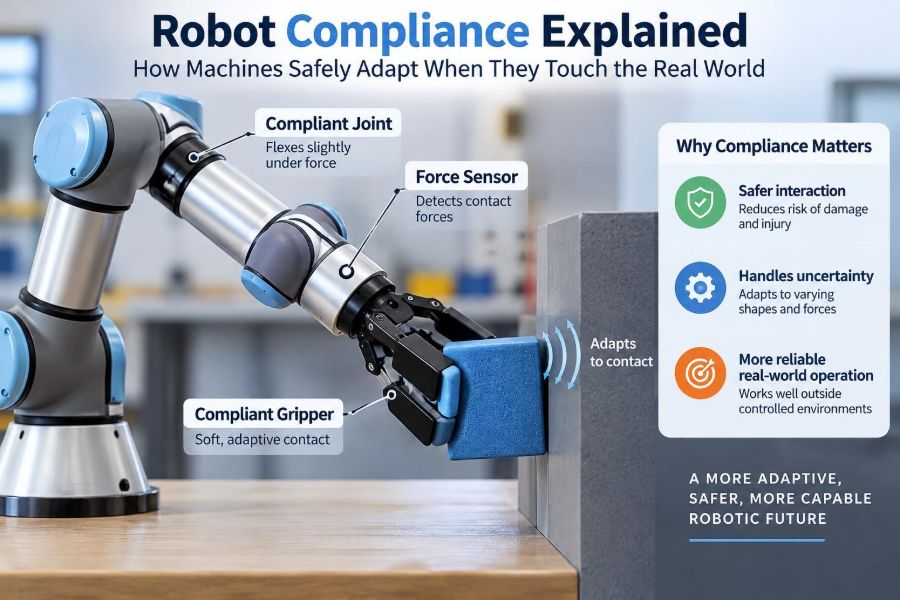
Mechanical compliance comes from physical elements that deform or move under load. Springs, flexures, rubber mounts, compliant fingertips, and flexible couplings are familiar examples.
A remote center compliance device, often used in assembly, can let a tool shift and rotate slightly around a designed virtual point. That passive motion helps a peg find a hole even when initial alignment is imperfect.
Hardware compliance can react immediately, without waiting for a sensor reading or controller update. Its limitation is that the response is largely fixed by the mechanism. Changing the task may require changing hardware or accepting a compromise.
💻 Active Compliance Created by Control
Active compliance uses sensors and software to make a robot behave as if it had a chosen spring-and-damper response. The controller measures force, torque, position, velocity, or motor current, then adjusts commanded motion.
This approach can change behavior between tasks. A robot can approach an object gently, increase stiffness once a part is seated, then switch to a different force target for testing or manipulation.
Active compliance is flexible, but it depends on sensing quality, actuator capability, control-loop timing, and a stable model of the robot and its environment. Software cannot safely compensate for every poor mechanical choice.
🧩 Hybrid Systems Often Work Best
Many practical robots use both physical and active compliance. A soft gripper or spring-loaded wrist handles fast, small impacts, while force feedback makes larger or slower adjustments.
This layered approach is valuable because physical elasticity can protect the system during brief unexpected contact. Meanwhile, active control provides task-level decisions that a passive mechanism cannot make on its own.
For example, a packaging robot may use compliant fingers to avoid crushing variable products, then use measured force to confirm it has made contact before lifting. The hardware manages local uncertainty; the control system manages the sequence.
🧠 Impedance Control: Shaping the Robot’s Behavior
Impedance control specifies a desired relationship between motion and force. Rather than commanding the robot to hold an exact position, it commands behavior resembling a virtual mass, spring, and damper.
If an external force pushes the tool, the controller permits a calculated displacement. If the force disappears, the virtual spring can guide the tool back toward its reference trajectory. Damping helps the response remain controlled.
This is especially useful when the robot must move while maintaining safe contact. The controller is not simply “following force”; it is shaping how the robot should react to force.
🎯 Admittance Control: Motion From Measured Force
Admittance control takes a related but distinct approach. It measures external force and converts that force into a motion adjustment. The robot’s underlying position controller then follows the updated motion command.
It is often practical on robots that are mechanically stiff and already have strong position control. A force sensor can tell the controller to move away, yield, or follow a surface according to a programmed virtual dynamic model.
The terms impedance and admittance are sometimes used loosely in conversation. Their implementation details differ, but both aim to make contact behavior predictable rather than rigidly positional.
🖐️ Force-Torque Sensors Give Contact a Voice
A six-axis force-torque sensor can measure forces and moments at a robot wrist. “Six-axis” means three force directions and three twisting effects, or torques.
These sensors help a robot detect not only that it touched something, but how it touched it. A sideways force may indicate a misaligned insertion. A growing torque can reveal that a tool is dragging or binding.
Sensor readings require care. The robot’s own tool weight, acceleration, cable forces, thermal drift, and electrical noise can affect measurements. Calibration and compensation are essential before treating every reading as meaningful contact.
⚡ Motor Current Can Offer a Simpler Signal
Many robot joints estimate torque from motor current, since producing torque generally requires electrical current. This can provide a useful, low-cost indication of unexpected resistance.
However, current-based estimates are indirect. Gear friction, transmission backlash, temperature, gravity loading, and model error can obscure small external forces. They are often suitable for broad collision detection or limited compliance, but may not replace a well-placed force-torque sensor in precision contact work.
The right sensing method depends on the forces that matter, their location, and the accuracy required to distinguish them from the robot’s normal behavior.
🧷 Series Elastic Actuators Store a Little Give
A series elastic actuator places an elastic element, often a spring, between a motor and the load. Measuring the spring’s deflection provides an estimate of transmitted force.
The elastic element also reduces the harshness of impacts and can improve force control in some applications. This makes the concept attractive for legged robots, rehabilitation devices, and machines designed to interact closely with people.
There is a tradeoff. Elasticity can reduce high-frequency precision and complicate control because the motor position is no longer identical to the output position. Designers must account for the spring dynamics rather than pretend they are absent.
🔩 Assembly Is Where Compliance Becomes Obvious
Insertion tasks expose the limits of rigid control quickly. A robot placing a connector, bearing, cap, or peg encounters tolerances in both the part and the fixture. Even a small angular error can make edges collide.
A compliant strategy might approach slowly, detect initial contact, reduce lateral stiffness, and use a small search motion while limiting force. If the part enters smoothly, the robot continues. If force or torque rises unexpectedly, it retracts and tries a defined recovery path.
Blindly pushing harder is rarely a reliable solution. It can jam parts, scrape surfaces, bend pins, or conceal an underlying alignment problem.
🧽 Surface Tasks Need Controlled Pressure
Sanding, deburring, cleaning, painting, polishing, and ultrasonic inspection often require a tool to follow a surface with a controlled contact load. Too little force produces poor process results; too much can damage the part or consume the tool.
Surface geometry is rarely perfect, even when a CAD model is available. A force-controlled tool can compensate for small height changes as it follows a planned path.
Compliance does not eliminate the need for process knowledge. The acceptable force depends on material, tool, speed, contact area, and finish requirements. A stable force controller must be paired with a valid process window.
🍓 Grasping Fragile and Variable Objects
Food, textiles, medical supplies, consumer packaging, and agricultural products are difficult to handle because their shape and stiffness vary. A gripper that uses one fixed closing position may either miss a small item or crush a soft one.
Compliant fingers conform to local shape, spreading contact over a larger area. Force feedback can stop closure after a chosen grip force is reached, rather than after the fingers reach a fixed distance.
Grip force still needs margins. Too little allows slipping; too much causes damage. Surface friction, acceleration during transport, and object weight all influence the needed force, so a successful grasp is more than a gentle squeeze.
👥 Collaborative Robots Need More Than Softness
Collaborative robots are designed for work in or near shared human spaces under defined operating conditions. Compliance can reduce contact forces and make interactions feel less abrupt, but it is only one part of a safety strategy.
Safe deployment may also involve risk assessment, speed limits, separation monitoring, emergency stopping, tool design, workspace layout, and validation of the specific application. A soft cover or low-stiffness controller does not automatically make any robot safe around people.
Human contact is especially complex because people move unpredictably and different body regions tolerate force differently. Treat compliance as a useful control property, not as a substitute for engineering safety work.
🛡️ Collision Detection and Compliance Serve Different Jobs
Collision detection identifies an unexpected contact and usually triggers a reaction such as stopping, retracting, or entering a fault state. It is a protective function.
Compliance is broader. It can support intentional contact continuously, such as maintaining a light force against a surface or guiding a part through an insertion. It may also help make unintended contacts less severe.
A robot can have collision detection without useful force control, and it can have force control while still requiring a separate protective collision response. Confusing these roles can leave gaps in both performance and safety.
📉 Stability Is the Hard Part
Contact controllers can become unstable when their assumptions are wrong or their response is too aggressive. The robot may chatter against a hard surface, oscillate after touching an object, or amplify vibration through a flexible tool.
Delay is a common cause. Sensors, filtering, communication, and control computation all take time. By the time the controller reacts, the robot may already have moved further into contact than expected.
Environment stiffness matters too. A controller that behaves well against soft foam may oscillate against rigid metal. Engineers tune and test the complete robot-tool-environment system, not a controller in isolation.
⏱️ Contact Transitions Deserve Special Attention
The moment before and after first contact is often the most demanding phase. The robot shifts from free-space motion, where position tracking dominates, to contact motion, where force behavior matters.
Approaching too fast increases impact energy. Switching control modes abruptly can cause a jump in the commanded force or position. A more reliable sequence slows near the expected surface, detects contact using a threshold with sensible filtering, then ramps into force regulation.
Thresholds should account for sensor noise and normal motion loads. A threshold set too low creates false contacts; one set too high allows impacts that the system was meant to avoid.
🧰 Choosing Stiffness, Damping, and Force Limits
These settings should begin with the task, not with arbitrary controller values. Ask what force is needed to complete the process, what displacement can be tolerated, and what contact directions are uncertain.
- Use higher stiffness where geometric accuracy is essential and the environment is well understood.
- Use lower stiffness in uncertain directions where alignment or human interaction requires yielding.
- Add enough damping to settle contact without making the response sluggish or unstable.
- Set force and torque limits below levels likely to damage the part, tool, fixture, or nearby person.
Initial values should be conservative and tested with representative parts. The final tuning is usually empirical because friction, cable routing, and fixture flexibility are difficult to model perfectly.
🗺️ Compliance Belongs in Task Planning
A common mistake is treating compliance as a last-minute controller feature. It works better when planned from the start: choose the approach direction, expected contact points, allowable search region, recovery actions, and the sensing needed to verify success.
For a connector insertion, the plan may include vision for coarse alignment, a compliant wrist for local error, force sensing for contact confirmation, and a timeout that triggers safe withdrawal if insertion does not progress.
Each layer addresses a different uncertainty. Better perception does not remove the need for compliant contact, and compliance does not excuse poor fixture design.
🧪 Test With Real Variation, Not One Perfect Part
A demonstration can look excellent when every part comes from the same batch and sits in the same fixture. Robustness appears when the system sees the variation it will face in service.
Test representative changes in part location, orientation, surface condition, stiffness, wear, payload, and speed. Include cases where the robot should reject, stop, or recover rather than finish.
Record force and torque traces during successful cycles. These traces can become useful baselines for detecting drift, tool wear, unusual friction, or a fixture that has begun to loosen.
🚧 Common Failure Modes to Watch For
Several patterns recur in contact applications. They are not always caused by the controller alone, but each deserves investigation.
- Jamming: lateral misalignment or excessive stiffness prevents a part from entering.
- Chatter: insufficient damping, delay, or a poorly matched environment produces repeated impacts.
- False contact: acceleration, cable drag, or noise crosses a poorly chosen force threshold.
- Tool damage: force limits are missing, too high, or applied in the wrong reference frame.
- Unreliable recovery: the robot retries without diagnosing whether the part is absent, rotated, or obstructed.
Logs, slow-motion observation, and controlled tests are more informative than guessing from a single failed cycle.
🔍 A Practical Debugging Sequence
When a compliant task behaves unpredictably, start by separating mechanics, sensing, and control. Verify that the tool, fixtures, fasteners, and cable routing are rigid or flexible in the intended ways.
- Confirm coordinate frames and the location of the sensor relative to the contact point.
- Check sensor zeroing, payload compensation, and readings while the robot moves freely.
- Reduce speed and test gentle contact against a known surface.
- Introduce one compliant direction at a time before enabling a full multi-axis strategy.
- Increase task complexity only after force traces and recovery behavior are repeatable.
This progression may feel slow, but it prevents a tuning problem from hiding a mechanical or calibration error.
🧬 Variable Stiffness Is an Active Research Direction
Some systems aim to change their mechanical stiffness during operation. A robot could remain soft while approaching an uncertain object, then become stiffer after establishing a secure grasp or a stable support point.
Variable-stiffness mechanisms and adjustable control gains can broaden what a machine can do, particularly where tasks alternate between safety-sensitive contact and precision action. They also add mechanical, sensing, and control complexity.
The central challenge is not merely changing stiffness. The robot must know when to change it, by how much, and how to do so without causing an abrupt or unstable transition.
🌱 Compliance Makes Automation Less Brittle
Highly structured automation succeeds by removing variation: precise fixtures, repeatable components, and carefully defined paths. That remains valuable. But many useful jobs cannot eliminate all variation economically or physically.
Compliance helps robots tolerate small unknowns rather than requiring every object and surface to be perfectly presented. This can expand automation into refurbishment, small-batch assembly, warehouse handling, service work, and operations involving natural materials.
It does not make a robot universally adaptable. Large uncertainties still require perception, planning, or human assistance. Compliance is best understood as one capability in a larger system for dealing with the physical world.
🧠 The Core Principle: Control the Interaction
Robot compliance is ultimately about changing the question from “Did the robot reach the exact coordinate?” to “Did the robot interact with the environment in the intended way?” Position remains important, but force, motion, timing, and safety limits become equally meaningful during contact.
Effective solutions combine appropriate mechanics, trustworthy sensing, stable control, thoughtful task planning, and realistic validation. The exact mix differs between a surgical instrument, an assembly arm, a warehouse gripper, and a collaborative workstation.
The most capable contact robots are not those that are always soft or always rigid. They are the ones that can be firm when precision demands it and yielding when the world demands adaptation.
Compliance lets robots treat contact not as an error to fight, but as information to use. That shift is what allows machines to work more safely and skillfully alongside imperfect objects, changing surfaces, and people. 🦾🤝⚙️