
A robot arm can recognize a box with cameras, but vision alone may not tell it whether the box is about to slide from its gripper. A warehouse worker solves that problem almost instantly: the fingers feel the surface shift, then tighten just enough.
That small adjustment depends on touch. Human hands continuously sense contact force, vibration, temperature, shape, and motion across the skin. Giving machines even a useful subset of that ability is one of the central challenges in robotics.
Tactile sensing helps robots handle the real world when objects are shiny, hidden, soft, irregular, fragile, or moving. It turns a gripper from a device that merely closes into one that can interpret contact and respond to it.
For students, tactile sensing connects mechanics, materials, electronics, signal processing, control, and machine learning. For practitioners, it often determines whether a manipulation system works reliably outside a carefully staged demonstration.
🖐️ Touch Closes the Gap Between Seeing and Handling
Vision estimates where an object is and what it may be. Tactile sensing measures what happens at the contact interface: whether contact occurred, how hard the robot is pressing, where the force is concentrated, and whether the object is moving relative to the finger.
A camera may identify a ripe peach, yet it cannot directly measure bruising risk during grasping. A tactile sensor near the gripper surface can provide the feedback needed to limit force while still maintaining a secure hold.
🧠 What a Robot Means by “Touch”
In robotics, touch is not one measurement. It is a family of contact-related signals collected by one sensor or several sensors distributed across a hand, fingertip, foot, tool, or wearable device.
Tactile sensing commonly describes measurements across a contact area. Force sensing often refers to the net load applied to a component. The distinction matters: a wrist force-torque sensor can tell that a load changed, while a tactile array can reveal whether pressure sits on one edge of a fingertip.
📍 Contact Detection Is the First Question
Before interpreting a surface, a robot needs to know whether it has touched anything. A simple binary sensor can report contact or no contact, useful for end stops, collision detection, and confirming that a part reached a fixture.
Binary feedback is inexpensive and robust in many applications, but it does not reveal force magnitude or location. A robot that only knows “contact happened” may continue pushing with excessive force unless another controller or sensor limits the motion.
⚖️ Pressure, Force, and Stress Are Related but Different
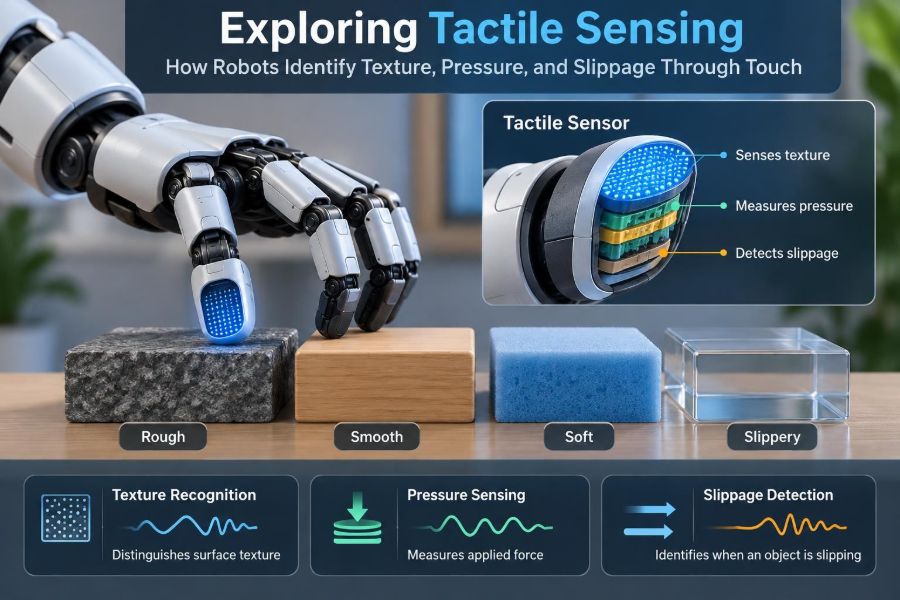
Force is a push or pull, usually measured in newtons. Pressure is force spread over area. The same gripping force can be gentle on a broad rubber pad and damaging when concentrated at a small hard edge.
Engineers also use stress to describe internal forces within a material. Tactile sensor outputs are often informally called pressure maps, but their calibration may not perfectly represent physical pressure everywhere. Sensor geometry, cover material, and loading direction all affect the reading.
🗺️ Why Spatial Resolution Changes What a Robot Can Know
A single sensing element reports an overall response at one location. A tactile array contains many elements, sometimes called taxels, arranged across a surface. Its output resembles a low-resolution image of contact.
Higher spatial resolution can identify edges, multiple contact points, and uneven loading. It also increases wiring, data volume, cost, and susceptibility to cross-talk, where force at one point influences neighboring readings. Resolution should match the task rather than simply be maximized.
🧱 Texture Is a Pattern, Not Just a Label
Texture includes large-scale features such as ridges and grooves, and fine-scale roughness that produces tiny vibrations during sliding. A robot rarely “feels sandpaper” as a single static number; it infers texture from changing contact patterns.
For example, dragging a sensor over corrugated plastic produces periodic variations. Sliding over fabric produces a different combination of deformation and vibration. Speed, normal force, sensor skin, and direction of travel can all change these signals.
〰️ Static Touch and Active Touch Serve Different Goals
Static touch examines a surface while the sensor is held in place. It can reveal shape, contact area, or compliance—the tendency of an object to deform under load.
Active touch deliberately moves across or into an object. A small lateral stroke may reveal texture; a controlled press may estimate stiffness; a gentle roll can help identify an edge. This is similar to how a person runs a finger across a surface rather than only resting a hand on it.
🧲 Normal and Shear Forces Explain Grasp Stability
At a contact surface, force has directions. Normal force acts perpendicular to the surface and presses the gripper into the object. Shear force acts parallel to the surface and is associated with dragging or impending sliding.
A stable grasp depends on both. Increasing normal force generally allows more resistance to shear, but more force can deform or damage an object. Tactile sensing makes it possible to monitor this trade-off closer to the actual contact point.
🧊 Friction Is Useful but Variable
Friction helps a robot hold an item, but it is not a fixed property stored in a database. It changes with surface contamination, moisture, wear, contact force, material compliance, and the direction and speed of motion.
A gripper calibrated on clean cardboard may behave differently on a dusty package or a smooth film wrapper. Good tactile control does not assume one friction value will always be correct; it monitors the contact and adapts when conditions change.
🚨 Slip Detection Looks for Relative Motion
Slip occurs when the object moves relative to the gripper surface. The earliest stage, often called incipient slip, can begin locally at part of the contact patch before the whole object falls or visibly shifts.
Detecting this early matters because a small force adjustment may recover the grasp. Once an item has accelerated downward, the robot may need a much larger correction—or may be unable to catch it safely.
📳 Vibrations Often Provide the Earliest Slip Clue
When surfaces begin to slide, microscopic features repeatedly catch and release. This can produce high-frequency vibrations in the sensor, finger structure, or mounting hardware. Humans perceive related cues as a faint buzz or change in feel.
Fast sensors such as piezoelectric elements are well suited to dynamic vibration signals. They are less suitable by themselves for measuring a steady force over a long period, so many systems combine dynamic and static sensing methods.
🔌 Resistive Sensors Trade Simplicity for Drift Concerns
In resistive tactile sensors, electrical resistance changes as a conductive material is compressed or as conductive paths come into contact. Force-sensitive resistors and conductive polymer layers are common examples.
They can be thin and relatively simple to interface with. However, their response may be nonlinear, may vary from unit to unit, and can drift with repeated loading, temperature, or time under load. Calibration must reflect the conditions of use rather than assume a universal force-to-voltage curve.
⚡ Capacitive Sensors Measure Changing Geometry
Capacitive tactile sensors detect a change in capacitance caused by altered electrode spacing, overlap, or dielectric material under compression. They can offer sensitive measurements and support array-based designs.
Parasitic capacitance from wires, electronics, moisture, and nearby objects can complicate measurement. Shielding, careful layout, stable readout circuits, and baseline compensation are often as important as the sensing layer itself.
🧬 Piezoelectric Materials Excel at Change
Piezoelectric materials generate electrical charge when mechanically strained. Their strong response to changing force makes them useful for impacts, vibration, texture scanning, and slip-related events.
The same principle creates a limitation: a piezoelectric signal tends to fade under a constant static load. If an application needs both a sustained grip-force estimate and rapid slip detection, a hybrid sensor stack can be more capable than either technology alone.
🧲 Magnetic Tactile Sensors Track Tiny Deflections
Many magnetic designs place a small magnet beneath an elastomer skin and measure its motion with magnetic field sensors. Pressing or shearing the skin shifts the magnet, producing a signal related to the applied deformation.
These sensors can estimate multiple force directions and work well with soft covers. Their design must account for external magnetic fields, mechanical alignment, hysteresis in the elastomer, and the fact that deformation is not always a simple one-to-one measure of force.
💡 Optical Sensors Turn Deformation into Images
Optical tactile sensors use a camera, illumination, and a deformable surface to observe contact geometry. Markers embedded in the skin, reflective coatings, or changes in illumination can reveal shape and shear deformation with rich spatial detail.
They can be powerful for tasks such as grasp analysis or detailed surface inspection. The trade-offs include camera latency, lighting design, sensor bulk, durability of the skin, and the computational work required to interpret images in real time.
🧪 Choosing a Sensor Means Choosing a Measurement
No tactile technology is universally best. The useful question is: what physical signal must the robot reliably observe at the required speed, range, and contact area?
| Sensor approach | Typical strength | Common limitation |
|---|---|---|
| Resistive | Thin, simple contact and load sensing | Drift and nonlinear response |
| Capacitive | Sensitive array measurements | Electrical interference and packaging demands |
| Piezoelectric | Fast events and vibration | Weak for sustained static loads |
| Magnetic | Multi-axis deformation sensing | Alignment and magnetic interference |
| Optical | Rich contact images | Bulk and processing requirements |
A practical design may use a wrist force-torque sensor for global loads, tactile pads for local contact, and motor current estimates for a low-cost supplementary signal.
🧤 The Sensor Skin Is Part of the Instrument
The compliant outer layer is not merely protective packaging. Its thickness, hardness, texture, and shape determine how forces spread to the sensing elements. A soft thick skin can improve conformity around an object but may blur fine contact detail.
A harder thin skin may preserve sharper spatial features but offer less protection and conform less well to irregular surfaces. Selecting the cover material therefore means balancing durability, sensitivity, friction, hygiene, and task-specific geometry.
📐 Calibration Connects Raw Signals to Physical Meaning
Calibration relates a sensor’s raw output—voltage, capacitance, image displacement, or resistance—to known loads and motions. For a simple sensor, this may mean applying controlled normal forces. For a tactile array, it may also involve testing position, shear, temperature, and repeated loading.
Calibration is not a one-time ritual. Mechanical wear, sensor aging, and replacement of the skin can change the response. Systems that need quantitative force estimates should include periodic verification and clear rules for handling readings outside the calibrated range.
🌡️ Temperature, Hysteresis, and Creep Can Mislead Control
Hysteresis means a sensor produces a different output at the same load depending on whether the load is increasing or decreasing. Creep means the response changes slowly while the load is held steady. Both are common in compliant materials.
Temperature can shift electrical properties and alter the stiffness of a soft skin. Filtering helps with noise, but it cannot fully correct an unmodeled physical change. Designers should test sensors through the expected temperature and loading cycles, not only at a room-temperature bench setup.
🔄 Signal Processing Extracts Useful Contact Features
Raw tactile data are often noisy and high-dimensional. A controller may use low-pass filtering to estimate stable force, high-pass filtering to isolate vibration, thresholds to detect contact, and spatial calculations to find the center of pressure.
Feature selection should follow the task. A sorting robot may need a robust contact flag and total load. A dexterous hand manipulating a connector may need shear direction, contact patch shape, and rapid transient detection.
🤖 Control Converts Feeling into Action
Sensing alone does not prevent drops. The control system must decide how to react: stop closing, increase grip force modestly, reposition the fingers, slow motion, or release an incorrectly grasped object.
A common approach is force control, which regulates a target contact force. Another is impedance control, which makes the robot behave as if it has a chosen stiffness and damping, allowing safer compliant interaction. In practice, tactile feedback may refine both strategies at the fingertip level.
🪜 A Simple Slip-Recovery Loop
Consider a hypothetical two-finger gripper lifting a smooth bottle. It first closes until each finger registers contact, then increases normal force to a conservative initial level. During lifting, it monitors changes in shear signal and vibration.
- If the tactile signals remain stable, the robot maintains its grip.
- If a slip-like pattern appears, it briefly pauses or reduces acceleration.
- It increases normal force by a limited increment rather than clamping at maximum force.
- If slip persists or force reaches a safe limit, it sets the object down or changes the grasp.
This structure protects delicate items better than a controller that responds to every uncertainty by squeezing harder.
🏭 Manufacturing Uses Touch for Variation, Not Just Force
In manufacturing, tactile sensing can confirm that a component is seated, distinguish an empty fixture from an occupied one, guide insertion when visual alignment is imperfect, and detect unexpected contact during assembly.
Insertion tasks are especially revealing. A peg may appear aligned in a camera image but still bind because of small offsets or tolerances. Force and tactile patterns can help a robot detect that it is scraping an edge and perform a compliant search rather than forcing the part.
📦 Logistics and Retail Need Gentle, Adaptive Grasping
Mixed-item handling involves packaging with very different friction and stiffness: cartons, flexible pouches, bottles, produce, and wrapped goods. A fixed gripper command that succeeds on one item may crush another or fail to hold a slippery one.
Tactile feedback supports adaptive gripping, but deployment still requires practical engineering. Sensor covers must withstand abrasion, cleaning, dust, repeated impacts, and replacement without recalibrating an entire cell from scratch.
🏥 Assistive and Medical Robotics Raise the Safety Bar
Prosthetic hands, rehabilitation devices, surgical tools, and care robots benefit from contact awareness because they operate near people or delicate biological tissue. Touch can help limit force and identify unintended contact.
It does not remove the need for safety analysis, mechanical limits, emergency stops, and validated control behavior. In medical or human-contact applications, tactile readings are one input among many; sensor failure, latency, and incorrect interpretation must be anticipated explicitly.
🦿 Robot Feet Also Need Tactile Information
Tactile sensing is not limited to hands. Sensors in robotic feet can estimate load distribution, detect foot contact, identify a shifting center of pressure, and help distinguish stable support from partial edge contact.
Ground-contact data can complement inertial sensors and joint encoders. On uneven terrain, however, footwear compliance and surface properties complicate interpretation, so foot sensors should be integrated with whole-body estimation rather than treated as a perfect ground-truth source.
🧠 Machine Learning Can Classify Patterns, With Boundaries
Machine learning can classify tactile signals into categories such as material type, grasp condition, or slip likelihood. It is especially useful when the relationship between raw signals and a label is too complex for a hand-written rule.
Its limits are practical: models can fail when the sensor cover wears, scan speed changes, an unfamiliar object appears, or training data do not represent real operating conditions. Combining learned classifiers with physical constraints, confidence checks, and safe fallback behavior is often more reliable than relying on a label alone.
🧩 Multimodal Perception Produces Better Decisions
Vision provides object pose and scene context. Tactile sensing confirms local contact. Joint encoders reveal finger motion, while wrist force sensors capture overall interaction loads. Each modality has blind spots that another can partially cover.
For example, vision may predict where to grasp a cable connector, tactile feedback may confirm the rim has been found, and force sensing may show that insertion is resisting. Sensor fusion is valuable when it produces a clearer action decision, not merely because more data are available.
🛠️ Common Design Mistakes and Better Alternatives
- Mistake: selecting a sensor from its peak sensitivity alone. Better: define required range, bandwidth, durability, and contact geometry first.
- Mistake: treating raw values as precise force without calibration. Better: document uncertainty and calibrate under realistic loading.
- Mistake: mounting a tactile pad on a rigid, poorly aligned fingertip. Better: design the mechanics and sensor surface together.
- Mistake: using a single threshold for every object. Better: adapt thresholds or control targets to task context and sensor confidence.
- Mistake: responding to suspected slip with unlimited force. Better: impose safe force limits and consider regrasping or setting down.
🧰 A Practical Development Workflow
Begin with a narrow contact question, such as “Has the gripper contacted the rim?” or “Is the part sliding during lift?” Build a test fixture that applies repeatable loads and motions before attempting a full manipulation task.
Then evaluate the entire loop: mechanics, electronics, sampling rate, filtering, decision logic, and actuator response. A tactile sensor that performs well in recorded data may still fail in a robot if the controller reacts too slowly or the gripper structure vibrates unpredictably.
🔮 Soft Robotics Expands the Role of Touch
Soft grippers naturally conform to irregular objects, but their deformation makes internal state estimation difficult. Embedded tactile, strain, pressure, or magnetic sensing can help infer where and how the soft structure contacts an object.
The opportunity is substantial, yet modeling remains challenging because soft materials are nonlinear and their shape changes continuously. Designers often benefit from combining approximate physical models with data-driven estimation and conservative control limits.
🌍 The Core Principle: Sense Contact Where Decisions Matter
The most useful tactile system is not necessarily the one with the densest array or most sophisticated algorithm. It is the system that measures the contact information needed to make a safer, more accurate action at the right time.
Texture recognition, pressure mapping, and slip detection all follow this principle. Measure the relevant physical change, understand the sensor’s limits, translate the signal into an appropriate control response, and keep mechanical and safety constraints in the loop.
When robots can interpret touch as feedback rather than treat contact as an error, they become far more capable of handling the variable physical world. That capability is built through careful sensing, realistic testing, and restrained, responsive control. 🦾🖐️🤖