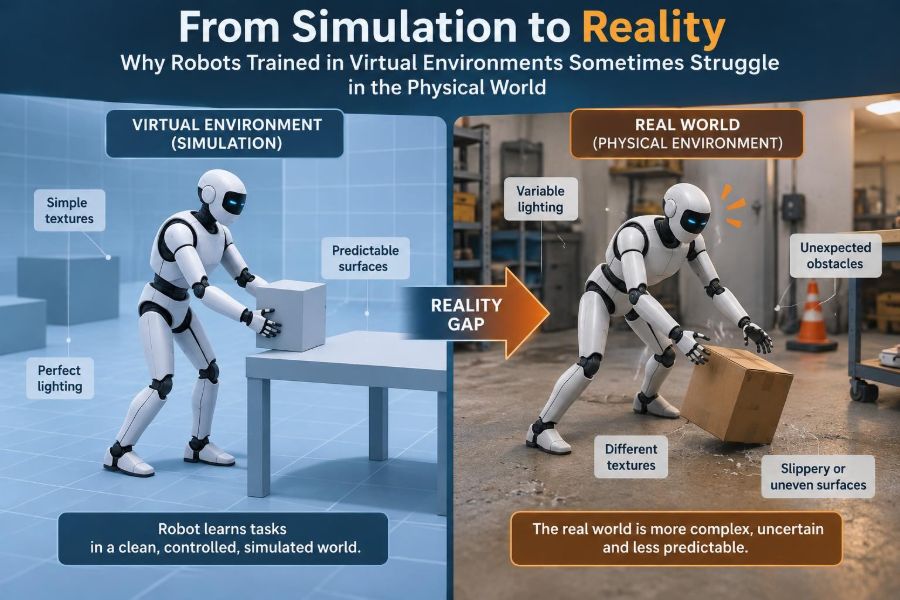

A robot picks up boxes flawlessly in a virtual warehouse. It recognizes every package, plans smooth paths around shelves, and works for hours without a collision. Then the same software is loaded onto a real robot, and the first box slides from its gripper.
Nothing may be visibly “wrong” with the robot. Its camera works, its motors move, and its control program is unchanged. Yet small differences—light reflecting from tape, a wheel slipping slightly, a joint flexing under load—can turn an impressive simulation result into an unreliable physical behavior.
This gap matters because simulation is now central to robotics engineering. It lets teams train, test, and fail at a speed and scale that would be expensive, slow, or unsafe with hardware alone.
But a simulator is not the world. Understanding where the mismatch comes from helps engineers use virtual environments wisely, diagnose failures faster, and build robots that transfer more reliably from screen to shop floor.
🌉 The Sim-to-Real Gap
The sim-to-real gap is the difference between how a robot behaves in simulation and how it behaves in the physical world. It applies to systems trained with machine learning, but it also affects conventional motion planning, perception pipelines, and feedback controllers.
A virtual robot operates under a mathematical model. A physical robot operates amid friction, vibration, wear, delayed signals, imperfect sensors, and objects that do not always sit where a database says they should.
The issue is not that simulation is useless. The issue is that a policy can learn to exploit details of its simulated world that are absent, altered, or unstable in reality.
🧪 Why Engineers Train Robots Virtually
Real-world robot training has practical limits. A legged robot can fall thousands of times during learning; a manipulator can damage itself, its workspace, or a delicate object; an autonomous vehicle cannot safely test every poor decision on public roads.
Simulation makes repeated trials cheap and reversible. Engineers can run parallel experiments, reset scenes instantly, collect complete internal state data, and create rare situations such as dropped parts or blocked aisles.
- It reduces wear on costly hardware.
- It allows dangerous or impractical failure cases to be tested safely.
- It speeds up iteration on mechanical designs and algorithms.
- It produces labelled sensor data without manually annotating every image.
These strengths make simulation an essential tool—not a final substitute for field validation.
🗺️ A Simulator Is a Model, Not a Duplicate
Every simulation makes choices about what to represent. A basic mobile-robot model may include wheel geometry and obstacle locations while ignoring tire deformation, motor heating, floor dust, wireless delay, and camera lens smudges.
That simplification is often sensible. Modeling every molecule of contact or every photon entering a camera would be computationally unrealistic. The engineering question is whether omitted effects matter for the task at hand.
A navigation system may tolerate a simplified battery model. A high-speed insertion task, where a peg must enter a tight opening, may be highly sensitive to tiny geometric and contact errors.
⚙️ Physics Engines Approximate Contact
Contact is one of the hardest parts of robotics to simulate. When a gripper touches a carton, the outcome depends on material stiffness, surface texture, pressure distribution, object mass, and the exact way the item is supported.
Physics engines approximate these interactions using numerical methods. They can produce useful behavior, but their contact models may not reproduce a real rubber pad compressing against a slightly dusty, irregular plastic part.
This is why a simulated grasp that appears stable can fail in reality. A few millimeters of unmodeled compliance or a different friction condition can change whether an object rotates, sticks, or slips.
🧱 Friction Is Variable, Not a Single Number
Simulators often assign a coefficient of friction to each surface pair. In reality, friction changes with wear, contamination, humidity, normal force, sliding speed, and direction of motion.
Consider a wheeled warehouse robot. Its route may work on clean concrete but drift on a polished patch, a painted line, or a floor with fine dust. A simulated wheel model that assumes consistent traction can make the controller look more confident than it should be.
Engineers should treat friction values as ranges when possible, especially for locomotion, pushing, grasping, and braking tasks.
🔩 Mechanical Tolerances Change Geometry
CAD models describe intended dimensions. Manufactured robots and fixtures have tolerances: small, permitted variations in lengths, hole positions, joint alignment, and assembly.
One deviation may be harmless. Several deviations can matter when a robot needs precise calibration or must interact with tightly constrained parts. A camera mounted at a slightly different angle can shift image-to-world estimates; backlash in a gearbox can alter the end-effector position.
Virtual scenes often begin too perfect. Adding plausible offsets to link lengths, sensor mounts, joint zero positions, and object poses makes training less dependent on ideal geometry.
🦾 Actuators Have Limits and Personalities
Motors do not instantly deliver the torque commanded by software. They have current limits, torque-speed curves, friction, thermal effects, saturation, and sometimes gear elasticity. Hydraulic and pneumatic actuators bring their own pressure dynamics and delays.
A simulated arm may accelerate and stop exactly as commanded. The real arm may lag, overshoot, or reduce available torque as conditions change. If a learned policy assumes unrealistically sharp control, it can become unstable when deployed.
Good actuator models include the limits most relevant to the task. Better still, they are checked against measurements from the actual robot rather than accepted as generic defaults.
⏱️ Timing Errors Can Break Stable Control
Robotic control relies on timing. Sensor readings arrive, software processes them, commands travel through networks or buses, and actuators respond. Each stage introduces latency and variation known as jitter.
In a simulator, these loops may run at clean, fixed intervals. On a physical system, a camera frame can arrive late, a computer can briefly run another process, or a communication packet can be delayed.
For slow tasks, this may have little effect. For balancing, dynamic walking, high-speed tracking, and contact-rich manipulation, timing mismatch can turn a stable simulated controller into one that oscillates or misses its target.
📡 Sensors Measure Imperfectly
Robots do not observe the world directly; they act on sensor measurements. Cameras have noise, blur, exposure limits, lens distortion, and occlusions. Encoders have resolution limits. Force sensors drift and may saturate under high loads.
A simulator can provide a perfectly clean depth image or exact object coordinates. A deployed robot receives incomplete, noisy evidence and must infer what is happening.
The distinction is crucial: training on ground-truth positions can teach a policy to solve an easier problem than the real robot will ever face.
💡 Vision Fails When Lighting Changes
Computer vision is especially vulnerable to appearance mismatch. A rendered object may have stable color and smooth illumination, while the real object is affected by shadows, reflections, glare, motion blur, and camera auto-exposure.
A shiny metal tool is a familiar example. Its pixels can change dramatically as the robot moves or overhead lighting shifts, even though the tool itself has not changed. Transparent and reflective objects are also difficult for many depth sensors.
Rendering more varied lighting helps, but teams still need to test with the actual camera in the actual environment. The physical optical path includes effects that are easy to overlook in a graphics pipeline.
🎨 The Appearance Gap Is More Than Color
The visual gap includes textures, backgrounds, shadows, lens properties, and scene clutter. It also includes what is missing: scuffs on bins, labels placed at odd angles, cable bundles, partial occlusions, and changing inventory.
A perception model can accidentally use a shortcut. If every simulated red object always appears in the same location or under the same shadow, the model may rely on context rather than truly recognizing the object.
Randomizing scenes and inspecting failure images are practical defenses. They reveal whether a model learned the task-relevant feature or merely a convenient visual pattern.
🎲 Domain Randomization Builds Useful Uncertainty
Domain randomization deliberately varies simulated conditions during training. Instead of one “best guess” at reality, engineers expose the robot to many plausible versions of it.
Variables may include object mass, friction, lighting, textures, camera placement, motor delay, sensor noise, and initial position. The aim is not photorealism in every detail; it is teaching a policy that remains effective when details move within realistic bounds.
Randomization can fail if ranges are arbitrary. Training a robot on impossible physics may make learning harder without improving deployment. Ranges should be informed by measurements, manufacturing tolerances, and expected operating conditions.
📏 System Identification Anchors Models to Hardware
System identification is the process of estimating model parameters from observed behavior. Engineers may command a joint through test motions and use encoder, current, and motion data to estimate friction, damping, delay, or effective inertia.
This does not create a perfect digital replica. It does make the simulator less speculative. Parameters can be updated as hardware changes, rather than left as values copied from an early design file.
For a practical workflow, identify the parameters with the biggest influence on the target behavior first. Modeling tiny effects is less valuable than correcting a major error in payload mass or actuator delay.
🪞 Digital Twins Need Ongoing Calibration
A digital twin is often described as a virtual representation connected to a physical asset. In robotics, the term is most useful when the model is actively updated with measurements and used to support decisions.
A calibrated twin can help predict reachability, validate trajectory changes, plan maintenance, or replay a failure. But calling any 3D model a digital twin can create false confidence.
Hardware ages. Belts loosen, joints wear, payloads change, and sensors are replaced. A twin that is not checked against current behavior gradually becomes another approximation.
🧠 Learned Policies Can Exploit Simulator Shortcuts
Machine-learning policies optimize the objective they are given. If a simulator contains a repeatable artifact that makes reward easier to obtain, the policy may use it even if an engineer never intended that behavior.
For example, a simulated mobile robot might learn that driving aggressively through an obstacle is acceptable because collision geometry is slightly permissive. A real bumper, wheel, or payload will not share that tolerance.
This is related to overfitting. The policy has become specialized to quirks of its training distribution instead of learning a broadly reliable strategy.
🏆 Reward Functions Can Teach the Wrong Behavior
Reinforcement learning uses rewards to encourage desired behavior. A reward that emphasizes speed but weakly penalizes force may produce a robot that reaches goals quickly by making harsh contacts.
In simulation, those contacts may appear harmless. In reality, they can damage parts, cause unstable grasping, or trigger safety stops. The problem is not learning itself; it is an incomplete definition of success.
Reward design should reflect operational priorities: task completion, safety margins, energy use, smoothness, recovery, and acceptable contact forces where those can be measured or estimated.
🧭 State Estimation Is Harder Outside the Simulator
Many simulated tasks provide the robot with exact pose, velocity, and map information. Physical robots must estimate state from sensors using methods such as filtering, visual odometry, or sensor fusion.
State estimation can drift or fail when features disappear, wheels slip, a camera is blocked, or the scene changes. If the training setup skips this uncertainty, the controller may receive cleaner inputs than deployment allows.
A stronger design either trains on realistic estimated states or explicitly tests the controller against likely estimation errors.
📦 Objects Are Not Identical in Production
A benchmark object in a simulation has one mesh, one mass distribution, and one center of gravity. Real inventory includes warped cartons, loose contents, variable fill levels, damaged edges, and packaging revisions.
Even nominally identical objects can behave differently. A bottle with liquid sloshing inside responds differently from an empty one. A fabric item cannot be treated like a rigid box.
Object variation should be part of requirements gathering. Teams need to ask not only “What is the nominal part?” but also “What states of this part will the robot encounter?”
🌍 The Environment Is a Moving Target
Real workplaces are shared systems. People move carts, place temporary items in aisles, open doors, change lighting, and modify layouts. Outdoor robots face wind, rain, uneven terrain, and seasonal appearance changes.
A controlled simulator can represent many of these disturbances, but it cannot guarantee that all future conditions were anticipated. This is why deployment needs monitoring and a defined fallback behavior.
Robustness means more than handling known variation. It also means recognizing when confidence is low and choosing a safer action, such as slowing down, stopping, or requesting assistance.
🧍 Humans Add Necessary Unpredictability
Human-robot environments cannot be reduced to perfectly scripted obstacles. People may hesitate, reverse direction, reach unexpectedly, or behave differently when carrying an object.
Simulation is valuable for rehearsing interaction scenarios, but it should not be used to assume that human behavior is fully predictable. Safety architecture needs independent protections such as speed limits, protected zones, sensing, and emergency-stop procedures.
For collaborative robots, reliable deployment involves technical performance, clear work design, training, and ongoing observation of how people actually use the system.
🦿 Dynamic Tasks Amplify Small Errors
Some robot tasks are forgiving: a slow arm moving between widely separated waypoints can tolerate moderate model error. Dynamic tasks compound errors rapidly because each action changes the starting condition for the next one.
Walking, running, catching, throwing, aerial control, and rapid insertion depend on momentum and precisely timed contact. A small delay or force mismatch can alter the entire motion sequence.
For these systems, short real-world trials during development are especially valuable. They reveal whether the simulated dynamics preserve the stability margins needed on hardware.
🧰 Contact-Rich Manipulation Needs Feedback
Tasks such as plugging in connectors, folding material, scraping surfaces, opening doors, and assembling parts involve uncertain contact. Purely open-loop commands—commands sent without adapting to feedback—are rarely sufficient.
Force-torque sensors, tactile sensing, compliant mechanisms, impedance control, and visual feedback can help a robot respond to what it actually touches. Compliance means allowing controlled flexibility rather than resisting every deviation rigidly.
Simulation can develop a starting strategy, while real sensing lets the robot correct for gaps that no model predicted.
🔁 Simulators and Reality Should Form a Loop
A productive workflow is not “train once in simulation, then deploy.” It is a loop: simulate, test on hardware, measure discrepancies, update models or training conditions, and test again.
- Define the task and the operating envelope.
- Build a model with the dominant mechanics, sensing, and timing effects.
- Train or validate algorithms across varied conditions.
- Run controlled hardware tests with safeguards.
- Analyze failures and feed observations back into simulation.
Each cycle improves either the robot, the model, or the understanding of where uncertainty remains.
🧪 Hardware-in-the-Loop Exposes Integration Problems
Hardware-in-the-loop testing connects real components to a simulated environment. A controller may run on the intended computer, or a real motor drive may receive commands while the broader robot and environment are virtual.
This approach can reveal software timing, interface, and electronics issues before full deployment. It is particularly useful when the complete platform is expensive, unavailable, or risky to operate during early development.
It still has boundaries: a real actuator interacting with a simulated load is not the same as interacting with a physical object. Its value lies in narrowing the integration gap, not erasing it.
🪜 Curriculum Learning Can Ease the Transition
Rather than exposing a robot immediately to the hardest randomized environment, teams can increase difficulty gradually. This is often called curriculum learning.
A manipulation policy might begin with a stationary object under clear lighting, then encounter varied poses, visual clutter, uncertain friction, and moving conveyors. A walking controller might progress from flat ground to slopes and uneven surfaces.
A curriculum should not become permanent shelter. The final evaluation must include the conditions that matter in deployment, including combinations of disturbances rather than one variation at a time.
🛡️ Safety Must Not Depend on a Perfect Model
Simulation can estimate risks, but physical safety should not rest on the belief that the model captured every failure mode. Independent safeguards are needed when a robot can harm people, equipment, or itself.
Depending on the application, these may include physical guards, torque and speed limits, workspace limits, collision detection, watchdog timers, emergency stops, supervised operation, and conservative recovery behavior.
Risk assessment should consider both normal operation and faults: stale sensor data, dropped communication, unexpected obstacles, calibration loss, and incorrect operator setup.
📊 Measure Transfer Instead of Declaring Success
A good simulation result is evidence, not proof of real-world readiness. Teams should define comparable test cases and measure what changes between virtual and physical execution.
| Question | Useful evidence |
|---|---|
| Does the robot complete the task? | Success and failure conditions across representative trials |
| How safely does it act? | Contact events, speeds, forces, clearance, and recovery behavior |
| Where does transfer fail? | Logged sensor data, video, timing traces, and physical inspection |
| Is performance stable? | Results across shifts, lighting, payloads, surfaces, and hardware states |
The goal is not to chase one flattering score. It is to identify operating boundaries and improve the system where evidence shows weakness.
🚫 Common Sim-to-Real Mistakes
Several avoidable choices repeatedly produce disappointing transfers:
- Using ideal object poses, exact state inputs, or noiseless sensors during all training.
- Trusting default physics parameters without comparing them with hardware behavior.
- Optimizing only for average performance and ignoring rare but costly failures.
- Testing hardware only at the end, when mechanical or software changes are expensive.
- Randomizing everything without measuring which variations are physically plausible.
- Equating a polished simulation demo with a validated deployment.
These mistakes share a theme: they hide uncertainty rather than making it part of the design process.
🔧 Practical Steps for Better Transfer
Start by identifying the variables that can most strongly alter outcomes. For a vision-guided picking robot, these may be illumination, object pose, camera calibration, gripper friction, payload variation, and latency.
Then build tests around those variables. Deliberately place objects near expected edge cases, vary lighting, change surface conditions, and inject realistic sensor noise or dropped frames. Record not just whether the robot failed, but how it failed.
Finally, design for recovery. A robot that can detect a poor grasp, set an object down safely, reobserve the scene, and try again may be more useful than one optimized only for its first attempt.
🎯 Choosing the Right Fidelity Level
Higher-fidelity simulation is not always better. It can be slower to build, harder to run, and still wrong in unexpected ways. The right level of detail depends on the decision the simulation must support.
For early layout planning, simple collision geometry may be enough. For training a force-sensitive assembly policy, contact properties and actuator behavior deserve far more attention. For camera perception, image formation and scene variation may matter most.
The useful principle is fidelity where sensitivity is high: model the factors that substantially change the outcome, and do not confuse visual realism with engineering relevance.
🤝 Simulation Remains One of Robotics’ Best Tools
The sim-to-real gap is not an argument against virtual training. Simulation enables safer experimentation, faster iteration, repeatable evaluation, and exploration of cases that hardware cannot easily reproduce.
Its value grows when engineers are explicit about assumptions. A simulator becomes more trustworthy when it is calibrated, challenged with variation, linked to hardware measurements, and treated as one part of a broader validation process.
The strongest robotics programs combine virtual scale with physical humility: they use models aggressively, then let real-world evidence correct them.
🧭 The Core Principle: Train for the World You Do Not Fully Know
Real environments contain uncertainty that cannot be completely modeled in advance. Successful transfer comes from preparing for that uncertainty through representative variation, realistic sensing and timing, feedback control, safety layers, and repeated hardware testing.
A robot does not need a flawless simulation to work well. It needs training and validation that discourage brittle shortcuts, reveal sensitive assumptions, and produce behavior that can adapt when reality differs from the plan.
The goal is not to make the virtual world perfect; it is to build robots that remain capable when the physical world is imperfect. 🦾🌍🔬