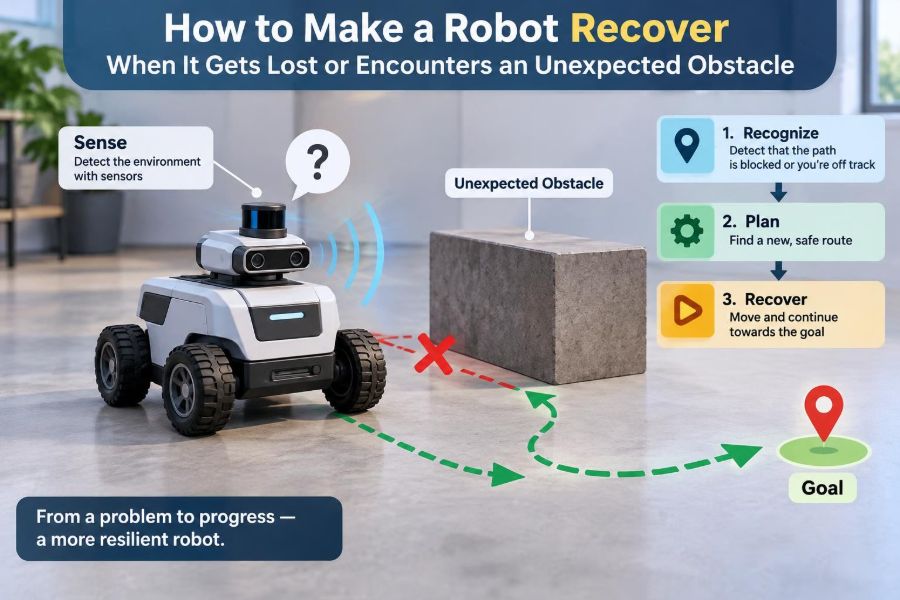

A delivery robot rounds a familiar corner, but a construction barrier now blocks the sidewalk. A warehouse vehicle finds its aisle occupied by a misplaced pallet. A small rover loses the visual marker it was using to navigate a lab floor.
None of these situations necessarily means the robot has failed. The real test is what happens next: does it stop safely, understand that its plan no longer fits reality, and find a sensible way forward?
Robots operate with incomplete information. Maps go stale, sensors become noisy, people move through shared spaces, and even a carefully designed environment can change between two runs.
Recovery is therefore not a single algorithm. It is a system capability that combines perception, localization, planning, safety behavior, communication, and careful testing.
🧭 Recovery Starts With Knowing What “Lost” Means
A robot is lost when its estimate of where it is, or how it is oriented, is no longer reliable enough for the task. It may still be moving, receiving sensor data, and following a map, but its internal position can be wrong.
An unexpected obstacle is different. The robot may know its location perfectly while discovering that the route ahead is no longer traversable. Good recovery logic distinguishes these conditions because their remedies differ.
- Lost robot: improve or re-establish localization.
- Blocked robot: update the local world model and replan.
- Uncertain robot: reduce speed, gather evidence, and avoid risky actions.
- Faulted robot: enter a safe state and request help if needed.
🎯 Define Recovery as a Mission Requirement
“The robot should recover” is too vague to engineer or test. Define the operational boundary: which spaces it may enter, what it may do when uncertain, how long it may search, and when it must stop.
A floor-cleaning robot can often pause and retry in a low-risk room. A mobile manipulator carrying a hot object needs much stricter behavior. Recovery quality should be judged against the consequences of a wrong decision, not merely by whether the robot eventually moves again.
🛑 Put Safety Before Autonomy
The first recovery action is often not movement. If an obstacle appears too close, localization confidence collapses, or sensors disagree sharply, the robot should stop or transition to a controlled low-speed mode.
Stopping must be physically safe as well as logically safe. A heavy platform may need a braking-distance model; a legged robot may need a stable stance; an aerial robot may need a hover or landing procedure. The safe action depends on the machine and its environment.
📍 Localization Is Always an Estimate
Localization is the process of estimating a robot’s position and orientation, often called its pose. Wheel encoders, inertial measurement units, cameras, lidar, GPS, and map features can all contribute.
No source is perfect. Wheels slip, an IMU drifts over time, cameras struggle with glare or darkness, and satellite signals can degrade near buildings. A robust robot treats its pose as an estimate with uncertainty, rather than a fact carved into software.
📊 Track Confidence, Not Just Coordinates
A pose such as “2.1 meters east of the doorway” is incomplete without an indication of trust. Localization systems commonly maintain a representation of uncertainty, whether as a covariance, a collection of hypotheses, or another confidence measure.
Use that confidence to change behavior. When uncertainty grows, the robot can slow down, avoid narrow passages, increase sensor checks, or choose a known landmark as its next destination. Waiting until the estimate becomes obviously wrong wastes the opportunity for gentle recovery.
🧮 Understand How Dead Reckoning Drifts
Dead reckoning estimates new position from previous motion, such as wheel rotations and turn measurements. It is useful because it works even when the robot cannot see external landmarks.
Its weakness is accumulation. A small wheel-radius error, repeated slip on polished concrete, or an imperfect turn estimate can gradually move the virtual robot away from the physical one. Treat dead reckoning as a short-term prediction, then correct it using independent observations.
👁️ Use Sensors That Fail Differently
Sensor fusion is valuable when sensors have different failure modes. A lidar scanner may measure wall geometry well in dim light, while a camera can recognize signs or visual landmarks that have little geometric structure.
Adding sensors is not automatically better. Each one creates calibration, synchronization, power, cost, and maintenance work. The goal is not maximum sensor count; it is enough independent evidence to make safe decisions in the intended operating conditions.
🗺️ Build Maps That Support Relocalization
A navigation map should contain features that can help a robot recognize where it is. Stable walls, shelving geometry, doorways, fixed reflectors, fiducial markers, or visual landmarks can all provide anchors.
Maps also need maintenance. A warehouse rearrangement, seasonal outdoor vegetation, or a moved workbench may invalidate assumptions. Record map versions, identify areas with frequent change, and avoid relying on temporary objects as primary landmarks.
🔎 Relocalize Instead of Guessing
When confidence falls below a threshold, do not simply continue along the old route. Start a relocalization procedure: compare current sensor observations with the map and search for plausible poses.
Some systems use global localization, considering many possible positions at once. Others navigate to a nearby landmark or perform a controlled scan. The correct method depends on map size, compute budget, and whether exploratory movement is safe.
🔄 Use a Deliberate Recovery Scan
A useful recovery maneuver can be small: stop, rotate in place, collect a fuller lidar scan, or pan a camera toward expected map features. This can reveal enough context to resolve ambiguity without sending the robot into unknown space.
Movement during a scan should be constrained. A robot that spins freely in a crowded corridor may create a new hazard while trying to solve the original one. Define a protected recovery envelope and monitor it continuously.
🚧 Separate Obstacles From Map Errors
A sensor return in front of the robot does not always mean “new obstacle.” It might be a person, a reflective surface artifact, a sensor fault, or a mapped object observed from an unusual angle.
Local perception should classify uncertainty where possible and consider persistence. A brief reading may justify slowing down; repeated readings from consistent viewpoints may justify marking an area blocked. This prevents both reckless motion and permanent overreaction to noise.
🧱 Maintain a Local Costmap
A costmap is a local grid or representation that assigns higher travel cost to areas near obstacles and prohibitive cost to occupied space. It combines map knowledge with live sensor observations.
Inflating obstacles by a safety margin matters because robots have width, turning limits, and imperfect localization. A path that clears a pallet by a few centimeters in simulation may be unacceptable in a real aisle with noisy sensing.
🛤️ Plan Locally Before Replanning Globally
A local planner makes short-horizon choices such as slowing, steering around a box, or waiting for a person to pass. A global planner chooses the broader route through the map.
When a chair is temporarily in the way, a local detour may be enough. When a hallway is closed, the global route must change. Combining both layers avoids expensive full replanning for every small interruption while still allowing meaningful route changes.
🧠 Avoid the “Obstacle Is Gone” Assumption
It is tempting to let an obstacle disappear from memory as soon as a sensor no longer sees it. That can be unsafe when the object is merely outside the sensor’s current view or occluded by a turn.
Use carefully designed persistence rules. Temporary obstacle information can decay over time, but it should not vanish instantly. Conversely, permanent memory of every transient person would eventually make a usable map unusable.
⏳ Give the Robot Timeouts and Escalation Rules
Recovery needs limits. Without them, a robot can oscillate between two routes, repeatedly rotate to scan, or wait forever for a blockage that will not clear.
A simple escalation ladder may be: retry local planning, back away to a safe pose, attempt relocalization, choose an alternate route, pause and notify an operator, then end the mission safely. Each stage should have an exit condition and a limit on retries.
🔁 Detect Oscillation and Repeated Failure
Oscillation occurs when the robot alternates between actions without making progress, such as steering left and right near the same obstacle. It often indicates that the planner’s assumptions do not match the available free space.
Monitor progress toward a goal, repeated poses, repeated control commands, and recovery attempts in the same area. When these signals occur, break the loop deliberately: change planning parameters, reverse to a known safe point, or escalate to supervision.
↩️ Keep a Safe Retreat Option
A robot that only knows how to move forward has limited recovery choices. Where feasible, record recently traversed free space and preserve a route to a safe retreat pose.
Retreat is not universally safe. A robot may have turned, a person may now occupy the path, or its rear sensors may be weaker. Before reversing, scan the relevant direction and apply the same clearance rules used for forward motion.
🚪 Design for Narrow Passages and Dead Ends
Narrow corridors amplify ordinary errors. Small pose uncertainty, obstacle inflation, and turning-radius limits can make a route that looked valid on a map impossible in practice.
Recognize these areas in advance. The robot can require higher localization confidence before entering, reduce speed, reserve enough space to turn around, or avoid the passage when carrying a wide load. Prevention is usually cleaner than recovering from a trap.
🤝 Treat Humans as Dynamic Participants
People do not behave like static obstacles. They can stop, reverse direction, emerge from occlusion, or interpret a robot’s movement incorrectly. Human-aware behavior should prioritize predictability, conservative speed, and comfortable clearance.
In a shared area, waiting may be the best plan. A robot should not aggressively weave around someone merely because a path technically exists. Its motion should communicate caution, especially near doorways, crossings, and workstations.
📢 Make the Robot’s State Understandable
Recovery becomes easier when nearby people and operators can understand what the robot is doing. A display, light pattern, sound, or status message can indicate “paused,” “replanning,” “needs clearance,” or “awaiting assistance.”
Communication should be concise and accessible. Do not rely solely on color, and do not make alerts so frequent that people ignore them. For remote operators, include the current confidence level, sensor health, map version, and a clear reason for escalation.
🧑💻 Build Human Assistance Into the System
Human intervention is not evidence of poor autonomy when it is planned and bounded. Some situations—an unfamiliar spill, a damaged sensor, a blocked fire route, or a severely changed environment—cannot be resolved safely through exploration.
Provide operators with enough information to act responsibly. A video feed alone may be misleading; pair it with map context, robot pose uncertainty, recent trajectory, and a way to command a safe stop. Protect remote-control modes with permissions and speed limits.
⚙️ Use a State Machine for Recovery Logic
A finite-state machine makes recovery behavior easier to inspect than a large collection of scattered exceptions. Typical states include navigating, slowing, blocked, scanning, relocalizing, retreating, waiting, requesting help, and faulted.
Each transition should state what evidence is required. For example, move from navigating to blocked when the planned path remains occupied for a defined observation period; move from blocked to replanning when a valid detour exists. Explicit logic is easier to test and audit.
🧪 Test the Failures You Expect—and the Ones You Do Not
Simulation is useful for testing route closures, sensor noise, wheel slip, and repeated planner failures safely. It cannot capture every reflective surface, lighting change, floor texture, or human behavior that appears in deployment.
Progress from simulation to controlled physical tests, then to supervised real operation. Vary one condition at a time when diagnosing behavior. A recovery system that succeeds only in an uncluttered lab has not yet demonstrated field readiness.
🧰 Create a Useful Failure-Test Matrix
Test cases should connect a disturbance to an expected safe response. This keeps teams from checking only whether the robot reached its destination.
| Disturbance | Expected behavior | Useful observation |
|---|---|---|
| Wheel slip | Localization confidence declines; robot seeks correction | Pose error and time to relocalize |
| Blocked route | Stop safely, update local map, replan or wait | Clearance and progress |
| Camera obscured | Degrade gracefully using other sensors or pause | Fault detection and false motion |
| Map changed | Reject invalid route and request help if needed | Recovery attempt count |
📈 Log Evidence for Every Recovery Event
When a robot gets stuck, a short message saying “navigation failed” is rarely enough. Log timestamps, pose estimates, uncertainty, sensor health, planned paths, control outputs, map state, and state-machine transitions.
Good logs turn field failures into engineering evidence. They can reveal whether the root cause was perception, calibration, planning, mechanical slip, timing, or an unsafe threshold. Capture data responsibly, especially in spaces where cameras may observe people.
🔧 Calibrate and Monitor the Physical Platform
Recovery is not only software. Loose wheels, worn tires, battery voltage drops, shifted cameras, dirty lenses, and a lidar mounted at a slight angle can degrade the assumptions behind navigation.
Include routine checks for sensor alignment, actuator response, braking behavior, encoder consistency, and clean optical surfaces. If hardware health is uncertain, software should know that and reduce the confidence assigned to affected measurements.
🧯 Handle Sensor Disagreement Explicitly
Suppose lidar indicates open space while a depth camera reports an obstacle. Simply averaging the readings can produce a dangerously confident answer. The disagreement itself is meaningful information.
Define rules for implausible or conflicting data. The robot may slow down, collect another observation, prefer the sensor most appropriate to the surface, or enter a safe stop. Critical systems should also detect stale data and communication delays.
🧩 Match Recovery Strategy to the Robot Type
A wheeled indoor robot can often stop, scan, and reverse. A drone must account for wind, altitude, battery reserve, and three-dimensional clearance. A robot arm may need to withdraw along a collision-checked path while maintaining a secure grip.
Recovery principles transfer across platforms, but details do not. Motion limits, failure consequences, sensing range, and safe states should be designed around the actual robot rather than copied from a different application.
⚖️ Balance Exploration Against Risk
When lost, a robot can sometimes explore until it finds a landmark. That may be reasonable in an empty, bounded test area. It is not automatically acceptable near people, machinery, traffic, stairs, or delicate equipment.
Set an exploration policy based on risk. Low-risk environments may permit slow, constrained search. Higher-risk environments should favor stopping, retreating, or requesting assistance. More autonomy is useful only when it remains within a defensible safety envelope.
🚫 Common Recovery Design Mistakes
Several patterns repeatedly create brittle behavior:
- Using a single sensor as unquestioned truth: every sensing modality has blind spots.
- Ignoring uncertainty: a precise-looking coordinate can still be wrong.
- Retrying indefinitely: repeated failure is information, not a reason to repeat forever.
- Testing only nominal routes: real recovery begins when the map is wrong.
- Confusing motion with progress: a moving robot may be stuck in a loop.
📋 A Practical Recovery Workflow
A compact workflow for a mobile robot is: detect a hazard or confidence drop; stop or slow to a safe mode; validate sensor freshness and health; update the local obstacle representation; attempt a bounded local response; relocalize or replan if necessary; then escalate when limits are reached.
The details should be tailored to the application, but the sequence prevents a common failure: allowing a robot to make larger, faster decisions precisely when it has the least reliable information.
🌱 Design the Environment to Help the Robot
Not every solution belongs on the robot. Clear aisle widths, consistent lighting, maintained maps, visible markers, designated charging areas, and rules for temporary storage can dramatically improve recovery behavior.
This is not “cheating.” Robotics is a system discipline. A reliable deployment aligns machine capability with the environment, workflow, and human expectations instead of demanding that perception solve every avoidable ambiguity.
🏁 The Core Principle: Fail Safe, Then Recover Deliberately
The strongest recovery systems do not pretend uncertainty is absent. They detect it early, make the robot safer before making it cleverer, gather better evidence, and place clear bounds on each attempt.
A robot that pauses, communicates, backs out carefully, or asks for help can be more capable in practice than one that drives confidently into an uncertain situation. Reliable autonomy is the ability to manage the unexpected without turning it into something worse.
A robot recovers well when it treats being lost or blocked as a controlled decision process: protect people and equipment first, rebuild confidence from evidence, and escalate before uncertainty becomes danger. 🦾🧭🚧