
A distribution center has a shift change in twenty minutes. Carts need moving, empty totes need collecting, and a pallet has been left partly in an aisle. None of these tasks is intellectually dramatic. Yet they are exactly the kinds of small, variable physical jobs that make operations slow when there are not enough trained people available.
For years, a video of a humanoid robot walking smoothly or folding a shirt was enough to draw attention. In 2026, the more useful question is less cinematic: can a machine complete a narrow task safely, repeatedly, and predictably inside a real facility where floors are imperfect, objects are misplaced, and people keep moving?
That shift matters because robotics is increasingly being judged by operational outcomes rather than demonstrations. The technology usually called embodied AI connects perception, reasoning, motion, and physical feedback so an AI system can act in the world rather than only produce text, images, or plans on a screen.
Humanoid robots are not about to replace every worker or solve every labor problem. But their movement from controlled demonstrations toward supervised workplace trials reveals a practical change in robotics: systems are becoming useful when they are designed around specific work, clear limits, and measurable reliability.
🧭 The Shift from a Demo to a Deployment
A demonstration is designed to show what a robot can do under favorable conditions. A deployment must survive the conditions that were not in the video: a slightly crushed box, a reflective wrapper, a busy aisle, a weak wireless signal, or a worker who changes the task order.
Workplace adoption therefore depends on more than an impressive capability. Teams need to know how often the robot finishes work, when it requests help, how quickly it recovers from failure, and whether its presence makes the surrounding process easier or harder.
The key distinction is simple: a demo proves possibility; a deployment must establish dependability within a defined operating envelope.
🧠 What Embodied AI Actually Means
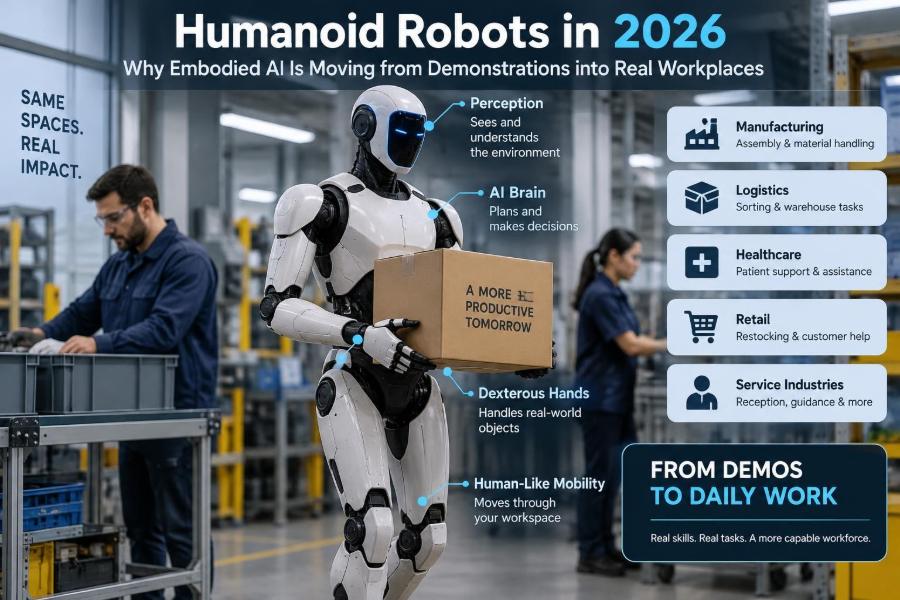
Embodied AI is AI connected to a body that senses and acts. A robot may use cameras, depth sensors, joint encoders, force sensors, microphones, and tactile sensors to perceive its surroundings. It then chooses and executes actions through motors, grippers, hands, wheels, or legs.
This creates a feedback loop. The robot observes an object, reaches toward it, detects contact, adjusts its grip, checks the result, and either continues or corrects itself. That closed loop is fundamentally different from generating a response in a chat window.
Language models can contribute to planning or operator interfaces, but language alone does not make a system capable of safe manipulation. Physical intelligence requires geometry, timing, contact awareness, and conservative behavior when observations are uncertain.
🧍 Why the Human Form Is Being Considered
Factories, warehouses, retail stockrooms, and service areas were built around human bodies. Shelves, door handles, carts, ladders, hand tools, worktables, and stairways all assume a person can reach, turn, step around obstacles, and use two hands.
A humanoid robot attempts to work in this existing infrastructure without requiring every site to be rebuilt for automation. Two arms can hold a container while opening a door. A human-like reach can access standard racks. A narrow body can fit through familiar passages.
That does not mean a humanoid is automatically the best machine. It means the form factor may be valuable where the workplace is too varied or too expensive to redesign around a specialized robot.
⚖️ Humanoids Are Not the Default Answer
Purpose-built robots often remain the better choice. A fixed industrial arm can move parts quickly and precisely at a stable workstation. A mobile robot with a low chassis can transport materials over smooth floors efficiently. A conveyor can outperform either one when the route never changes.
Legs, hands, many joints, and a tall body bring flexibility, but also cost, energy use, maintenance demands, and safety complexity. Engineering is about matching a system to constraints, not selecting the most human-looking platform.
| Work setting | Often suitable approach | Why |
|---|---|---|
| Repeatable fixed station | Industrial arm or dedicated machine | High speed and repeatability matter most |
| Long, predictable transport routes | Mobile robot or conveyor | Movement can be simplified |
| Variable human-designed spaces | Humanoid or mobile manipulator | Reach, navigation, and tool use may vary |
🏭 The First Jobs Are Usually Unremarkable
Early workplace tasks are likely to be repetitive but variable enough that conventional automation struggles. Examples include moving bins between stations, loading simple items into fixtures, sorting a limited set of materials, replenishing supplies, or handling lightweight packaging.
These jobs may look mundane, but they are commercially meaningful. Delays in material flow can idle expensive equipment or force skilled workers to spend time on transportation and staging rather than technical work.
A credible pilot starts with a task that is physically manageable, easy to observe, and valuable even if performed slowly at first.
📦 Material Handling Is a Natural Starting Point
Material handling offers a useful bridge between laboratory manipulation and real operations. Many facilities already have defined pickup and drop-off locations, repeatable object categories, and supervisors who understand the workflow.
Still, a tote is not merely a rigid cube in practice. It may be wet, poorly placed, partially blocked, or loaded unevenly. A robot must estimate whether it can safely lift the item, choose where to grasp, maintain balance, and detect whether the object slips.
That is why even simple transport reveals the value of integrated sensing and control.
👁️ Perception Must Work Beyond the Lab
Robots do not see objects as humans do. Cameras produce pixels; depth sensors estimate distance; software turns those signals into likely objects, surfaces, poses, and free space. Each step can be affected by lighting, glare, dust, shadows, transparent film, and clutter.
In a workplace, perception must also handle change. A model trained on neatly oriented cartons may fail when labels face away or mixed items overlap. Robust systems combine visual data with task constraints, confidence estimates, and checks after an action.
When confidence is low, the correct behavior is often to pause, reposition, ask for assistance, or select a safe alternative—not to guess boldly.
✋ Manipulation Depends on Contact, Not Just Vision
Seeing a handle is only the beginning. Opening a door or picking up a bag requires understanding force. The robot needs to detect contact, regulate grip pressure, respond to resistance, and stop if the motion differs from expectation.
Force control commands interaction behavior rather than only a position. Instead of insisting that a hand move to one exact coordinate, the controller can allow compliant motion while maintaining a limited force. This reduces the chance of damaging objects or pushing dangerously against a person.
Tactile sensing and joint torque sensing are useful here, but they do not eliminate difficulty. Soft, deformable, slippery, or irregular objects remain challenging for robots.
🚶 Mobility Is More Than Walking
Videos of bipedal walking attract attention because balance is hard. In workplaces, however, useful mobility also includes stopping accurately, turning in tight spaces, avoiding people, stepping around clutter, and carrying an object without destabilizing the body.
Some humanoid designs use wheels rather than legs, especially in facilities with level floors. This can reduce energy use and mechanical complexity while retaining an upper body suited to human-scale work. Other environments may require stepping over thresholds or navigating stairs, where legs offer a real advantage.
The practical question is not “can it walk?” but “can it move safely and productively through this site?”
🧩 Whole-Body Control Coordinates the Machine
A humanoid robot has many degrees of freedom: joints in the legs, torso, shoulders, elbows, wrists, hands, and sometimes neck. Moving one part can affect balance, reach, and collision risk elsewhere.
Whole-body control coordinates these joints toward several goals at once. The robot may need to keep its center of mass stable, avoid a shelf, hold a tray level, keep its hand on a handle, and move toward a target.
This is one reason workplace behavior can look slower than a staged demo. Deliberate motion is frequently the result of the controller respecting stability and safety constraints rather than a lack of ambition.
🗺️ Task Planning Connects Intent to Action
A supervisor might say, “Bring empty containers to line three.” That instruction hides many subproblems: locate a suitable container, identify a clear route, grasp it, travel safely, confirm the destination, and release it in the correct place.
Task planning breaks an objective into actions and checks whether each action succeeded. Modern AI can help interpret flexible instructions or select among known procedures. But reliable systems still need explicit rules for forbidden zones, load limits, priority tasks, and uncertainty.
A plan is useful only if it remains grounded in current sensor data. A route planned five seconds ago may no longer be clear.
🔁 Closed-Loop Recovery Separates Useful Systems
Failure is unavoidable in physical work. The engineering question is what happens next. If a grasp fails, a capable robot should recognize the failure, release safely, re-observe the scene, and choose a limited recovery action.
Recovery may include changing grasp points, moving an object slightly, returning to a known pose, or requesting human help. A robot that quietly repeats the same failed motion is not ready for an operational environment.
Good recovery logic also produces valuable data. Each exception can show whether the problem was perception, mechanics, control, process design, or an unrealistic task definition.
🧪 Simulation Speeds Learning but Cannot Replace Reality
Simulation lets engineers test controllers and task logic without risking hardware or interrupting a workplace. It can generate many variations in object positions, lighting, friction, and robot states at far lower cost than physical trials.
The limitation is the sim-to-real gap: a simulated cardboard box does not perfectly match a worn box with tape, dents, changing weight, and uncertain friction. Sensor noise, actuator backlash, and timing delays also matter.
Effective programs use simulation to explore possibilities, then validate on real hardware in increasingly realistic conditions. Simulation is a multiplier for testing, not proof that a task will work on site.
📚 Data Quality Matters as Much as Data Volume
Embodied AI benefits from data showing successful actions, mistakes, recovery attempts, and different environmental conditions. Video alone is often insufficient; engineers may need robot joint positions, forces, camera calibration, object state, and outcome labels.
A dataset can be large yet unhelpful if it contains only ideal demonstrations. Workplace robots need examples of occlusion, clutter, imperfect grasps, and safe handoffs. They also need data that reflects the actual tools, containers, and surfaces used at the target site.
For this reason, teleoperation—where a person guides the robot remotely or directly—remains a practical way to collect high-quality physical demonstrations.
🎮 Teleoperation Is a Bridge, Not a Failure
People sometimes treat remote operation as evidence that a robot is not autonomous. In reality, teleoperation can support several legitimate stages of deployment: collecting training data, handling edge cases, supervising new tasks, and maintaining productivity while autonomy improves.
The important operational distinction is transparency. Managers should know which work is autonomous, which work is assisted, and when an operator is controlling the robot. This affects staffing, safety responsibility, and performance measurement.
A useful progression is often supervised autonomy: the robot performs common steps independently and escalates rare or uncertain cases to a person.
🛡️ Safety Begins with System Design
Humanoid robots combine movement, mass, powered joints, and sometimes payloads in spaces shared with people. Safety cannot be added as a final software feature. It must influence mechanical design, speed limits, sensing, workspace rules, emergency stopping, and training.
Risk assessment should consider pinch points, falling objects, unstable loads, unexpected starts, loss of communication, sensor failure, and behavior near people. A robot that is safe while standing still may not be safe while carrying a load through a crowded aisle.
Facilities should involve safety professionals, operators, maintenance staff, and robot suppliers before a pilot begins. Applicable requirements vary by location and use case, so organizations should not assume one generic checklist is sufficient.
🚦 Speed Limits Can Be a Feature
Fast motion is attractive in a benchmark, but workplace productivity is not simply maximum joint speed. A hurried robot that triggers frequent stops, needs large exclusion zones, or drops objects can reduce total throughput.
Controlled speed gives sensors and planners time to react, reduces impact energy, and makes behavior easier for nearby workers to anticipate. As a task becomes better understood, speed may increase within validated limits.
The target is safe cycle-time reliability, not theatrical motion. A modestly paced system that completes a shift consistently may be more valuable than a faster one that requires constant resets.
👥 Human Factors Determine Whether a Pilot Sticks
Workers are not passive obstacles in an automation project. They understand informal workarounds, seasonal changes, damaged equipment, and task variations that may not appear in a process diagram.
Clear communication helps prevent both overtrust and distrust. Staff should know what the robot does, where it operates, how to stop it, who to contact when it behaves unexpectedly, and whether its role changes existing procedures.
The most productive pilots often treat frontline employees as expert collaborators. Their feedback can reveal poor handoff locations, confusing signals, impractical schedules, or tasks that looked simple from a conference room.
🧰 Integration Is Usually Harder Than the Robot
A robot rarely creates value in isolation. It may need to receive tasks from warehouse software, identify containers through existing labels, use charging infrastructure, report status to supervisors, and fit around maintenance windows.
These connections introduce mundane but decisive details: inconsistent item naming, missing location data, unreliable Wi-Fi coverage, inaccessible charging points, and unclear ownership when the workflow fails.
Before selecting a platform, map the entire job from trigger to confirmation. The robot’s motion is only one part of that system.
🔋 Energy, Charging, and Uptime Set Real Limits
Mobile humanoids must manage battery capacity, power peaks during lifting or walking, charging time, and safe battery handling. A machine may perform well for a short test yet be unsuitable for a full operational schedule if recharging creates inconvenient gaps.
Uptime also includes maintenance, calibration, software updates, sensor cleaning, and recovery after faults. A realistic business case counts the people and processes needed to keep the robot available, not only its nominal capability.
Many pilots begin with short, planned operating windows. This is sensible: it establishes maintenance patterns before the organization depends on the system.
📏 Measure the Workflow, Not the Hype
Useful metrics should reflect the actual purpose of the deployment. Depending on the task, teams may track completed cycles, successful picks, intervention rate, recovery time, damage incidents, task latency, operator effort, and availability.
Metrics need context. A low intervention rate may be misleading if operators quietly rearrange the environment before each run. A high completion rate may hide failures on difficult items that are excluded from the test.
Define success criteria before the pilot, record exceptions honestly, and compare performance with the existing process under similar conditions.
💰 The Economics Include More Than Labor
Automation value may come from reducing repetitive transport, covering awkward schedules, stabilizing a bottleneck, improving traceability, or keeping skilled workers focused on higher-value tasks. Labor substitution is only one possible component.
Costs include purchase or service fees, site preparation, integration, supervision, maintenance, training, insurance considerations, and downtime. The economic result depends heavily on utilization: a robot that performs one useful task occasionally may not justify complex support infrastructure.
Organizations should model conservative scenarios and avoid assuming a prototype’s best run represents routine performance.
🧱 Common Pilot Mistakes
Robotics pilots often fail for process reasons rather than a single technical flaw. The following mistakes are especially common:
- Choosing a task that is too broad: “work in the warehouse” is not an executable requirement.
- Ignoring edge cases: damaged packaging and blocked paths are part of real work, not anomalies to dismiss.
- Optimizing for a video: visible novelty is not the same as sustained operational value.
- Leaving ownership unclear: someone must manage daily exceptions, maintenance, and escalation.
- Changing the process constantly: a pilot needs a stable baseline before results can be interpreted.
🪜 A Better Path to Deployment
A staged approach reduces risk and produces clearer learning. Start with observation: document task variation, physical layout, object types, hazards, and current delays. Then select a bounded task with meaningful value and an acceptable manual fallback.
- Define the task, environment, payloads, and success criteria.
- Validate the robot in a controlled area using representative materials.
- Run supervised shifts with explicit stop and escalation procedures.
- Review failures by category and improve either the robot or the workflow.
- Expand operating hours or task variation only after reliability is demonstrated.
This process may feel slower than a dramatic launch, but it prevents organizations from scaling confusion.
🔧 What Engineers Need to Learn
Humanoid robotics is unusually interdisciplinary. Mechanical design affects control; control affects perception requirements; perception affects data collection; software architecture affects safety and maintenance. Engineers who can communicate across these boundaries are valuable.
Core skills include kinematics, dynamics, controls, computer vision, sensor fusion, motion planning, embedded systems, networking, and software testing. Equally important are practical skills: calibrating sensors, reading logs, designing experiments, and learning from failed runs.
For students, building a small mobile manipulator or simulating a pick-and-place system can teach the same systems thinking without requiring a full humanoid platform.
🧑🏭 What Operations Teams Need to Learn
Operations leaders do not need to become roboticists, but they need enough technical literacy to ask useful questions. What assumptions does the robot make about the environment? What happens when it cannot complete a task? Which conditions invalidate its safety case?
They should also resist evaluating a system solely by its human resemblance. A robot’s value comes from its fit within a process, its failure behavior, and its total cost of operation.
The best partnership pairs operational knowledge of the work with engineering knowledge of the machine’s capabilities and limits.
🌍 Workforce Change Will Be Uneven
Automation can change jobs by shifting which tasks people perform, not only by removing tasks. Repetitive material movement may decline in one area while demand grows for technicians, robot operators, process analysts, safety coordinators, and maintenance roles.
The outcome depends on organizational choices. Training, job redesign, transparent communication, and fair escalation procedures influence whether technology reduces strain or simply transfers pressure elsewhere.
It is reasonable for workers to ask how deployment affects workload, monitoring, safety, and advancement. Those questions should be addressed during planning, not after the system is already in use.
🔍 Claims Worth Examining Carefully
Humanoid robotics attracts ambitious claims. When evaluating them, ask whether the performance was demonstrated in an uncontrolled workplace, what task boundaries were used, how often people intervened, and whether the robot handled meaningful variation.
Also ask about the denominator. “Thousands of successful actions” sounds impressive, but success rates, task difficulty, duration, and recovery behavior provide the context needed to judge readiness.
Skepticism is not hostility to innovation. It is the discipline of distinguishing promising capability from proven operational performance.
🧠 The Core Principle: Fit Beats Form
Humanoid robots are moving toward real workplaces because embodied AI is improving the connection between perception, planning, control, and feedback. At the same time, the workplace need is real: many environments contain variable, physical tasks that are difficult to automate with fixed machines alone.
Yet the robot’s shape is not the central lesson. A humanoid succeeds when its body, software, safety controls, supervision model, and workflow all fit the job. It fails when novelty is allowed to substitute for task definition and operational discipline.
The most durable progress will come from narrow deployments that earn trust through repeatable work, transparent limits, and steady improvement—not from treating human resemblance as a capability in itself.
Embodied AI becomes valuable when a robot can do a clearly defined physical job safely, recover when reality differs from the plan, and fit into the people and systems already doing the work. 🦾🏭🔧