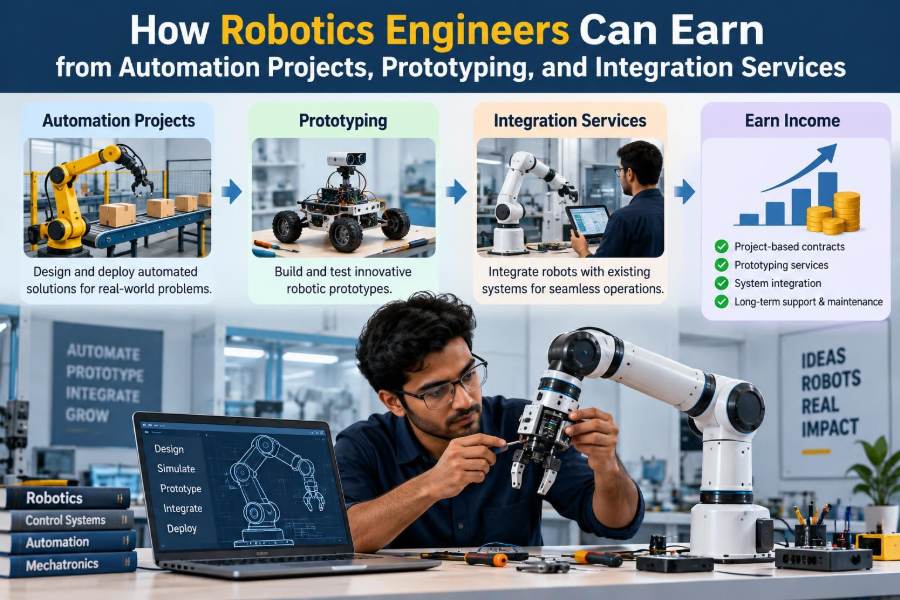

A small manufacturer has operators moving parts between two machines all day. A warehouse manager is struggling with mispicked orders. A research team has a promising mechanism but no working prototype. Each problem may look different, yet all can become paid work for a robotics engineer.
The opportunity is not limited to inventing a new robot or joining a large automation company. Engineers can earn by identifying repetitive work, designing a sensible technical solution, building the first workable version, and connecting equipment that currently does not communicate.
That work is valuable because automation projects are rarely “plug in a robot and walk away.” They involve process understanding, mechanical design, controls, safety, software, commissioning, training, and support. Clients pay for reduced friction in a real operation, not simply for a robot arm.
For students, freelancers, and working professionals, the practical question is how to turn technical ability into services that solve problems, can be scoped responsibly, and produce reliable income. The answer starts with choosing the right kind of problem.
🎯 Start with a Business Problem, Not a Robot
A client may ask for a collaborative robot, an autonomous mobile robot, or artificial intelligence. Those are possible tools, not necessarily the correct solution. Begin by asking what happens now, where time or quality is lost, and what outcome would justify a project.
For example, a packaging line may not need a complex vision-guided robot. If cartons always arrive in the same orientation, a simple fixture, conveyor sensor, and pick-and-place unit may be enough. A smaller system can be easier to maintain and safer to approve.
Your paid deliverable is improved operations. Robots, sensors, and code are the means of producing that result.
🧭 Recognize the Main Ways Engineers Earn
Robotics income often comes from a combination of project fees, retained support, and reusable intellectual assets. The right mix depends on experience, local industry, available tools, and comfort with commercial responsibility.
- Automation consulting: process audits, feasibility studies, technology selection, and project roadmaps.
- Prototyping: proof-of-concept machines, test rigs, custom end effectors, and research demonstrators.
- Systems integration: connecting robots, PLCs, vision systems, conveyors, machines, and operator interfaces.
- Engineering subcontracting: contributing design, controls, simulation, or software skills to an integrator.
- Productized tools: standardized cells, reusable modules, software libraries, or training packages.
Early in a career, subcontracting and narrowly scoped prototypes can be lower-risk ways to gain references. Larger turnkey integration work usually requires deeper safety, procurement, and commissioning capability.
🔎 Find Work Where Repetition Creates Cost
Automation is most credible when a task is repetitive, physically demanding, sensitive to inconsistency, or difficult to staff reliably. Look for motion that follows a stable pattern: loading, sorting, dispensing, inspection, labeling, screwdriving, palletizing, and machine tending.
Yet repetition alone is not enough. A task that changes every few minutes, has fragile or highly variable inputs, or occurs only occasionally may be poor automation territory. Sometimes a well-designed jig or better workstation layout provides more value than a robot.
Learn to notice “hidden handoffs.” If one worker waits for another, re-enters data from paper, or carries material across a room, there may be a useful integration or process-design opportunity.
🏭 Choose a Market You Can Learn Deeply
General robotics knowledge is useful, but domain knowledge helps an engineer sell and deliver. A food facility, machine shop, laboratory, and fulfillment center have different cleanliness rules, material flows, documentation needs, and downtime tolerance.
Choose one or two sectors where you can understand the vocabulary and workflows. A machine-shop automation specialist, for instance, should learn about cycle time, workholding, chip management, tool changes, part variation, and how operators recover from a fault.
Specialization does not trap you permanently. It gives prospects a reason to trust you over a technically capable engineer who has never seen their operation.
💡 Turn Observations into a Clear Value Proposition
A value proposition describes the operational improvement you help create. “I build robots” is broad. “I help small manufacturers automate repeatable machine-loading tasks without replacing their existing equipment” is more concrete.
Connect the service to outcomes the client can observe: fewer manual transfers, steadier throughput, better traceability, reduced exposure to an awkward task, or more consistent inspection. Avoid promising a specific financial return before measuring the process and confirming assumptions.
Strong positioning also includes boundaries. You might focus on low-volume production cells, prototypes for research groups, or integration of existing industrial equipment rather than full factory-wide digital transformation.
📝 Run a Discovery Visit Before Quoting
A discovery visit is an engineering activity, not a casual sales meeting. Observe the task across normal variation: different parts, shifts, batches, stoppages, operators, and changeovers. Ask what happens when something goes wrong, because recovery often determines whether a cell is genuinely useful.
Record measurements, photos where permitted, cycle timing, available utilities, floor space, access constraints, and existing control hardware. Clarify whether the client expects an operator to load materials, verify quality, or respond to alarms.
- What must enter and leave the process?
- What conditions make a part unacceptable?
- What upstream and downstream equipment constrains the cycle?
- How long can production be interrupted for installation?
- Who will maintain the system after handover?
These questions prevent a quote based on an idealized version of the work.
📊 Establish a Baseline Before Claiming Value
Measure the current process in a practical way. Useful baseline information may include typical cycle time, changeover effort, defect categories, operator touchpoints, unplanned stoppages, and the number of product variants.
Be careful with averages. A task that takes 30 seconds most of the time but occasionally requires five minutes of manual correction has a different automation challenge from a perfectly repeatable 30-second task. Capture exceptions as well as the main flow.
The baseline becomes the reference for acceptance testing and later improvement. It also helps a client decide whether the project is economically and operationally worthwhile.
🧪 Sell Feasibility Studies as Real Engineering
When uncertainty is high, offer a paid feasibility study rather than a fixed-price promise. The study can test gripping, vision reliability, reachable poses, part tolerances, cycle-time assumptions, or communication with existing machinery.
A useful output is more than a slide deck. It may include a process map, risk register, concept layouts, preliminary bill of materials, test results, and a recommended next step. This gives the client evidence for a larger decision while compensating you for technical investigation.
Feasibility work is especially appropriate for unstructured parts, challenging surfaces, delicate objects, and systems where old equipment has poorly documented interfaces.
🛠️ Build Prototypes That Answer One Important Question
A prototype should reduce a specific uncertainty. It is not necessarily a miniature final product. A benchtop gripper test can demonstrate whether a soft component can be picked without damage; a mocked-up conveyor can reveal whether spacing is adequate for vision.
State what the prototype proves and what it does not prove. A laboratory demonstration may establish kinematic feasibility, but it does not automatically prove industrial uptime, safety compliance, washdown resistance, or maintainability.
This distinction protects both sides. Clients receive useful evidence, while engineers avoid allowing a quick demonstration to be treated as an unqualified production guarantee.
🧩 Make Custom End Effectors a Practical Service
End effectors are the tools attached to a robot: grippers, vacuum cups, screwdrivers, dispensers, cutters, or inspection devices. They often decide whether an automation project succeeds because they create the physical connection between a robot and a real part.
Custom tooling can be a strong niche for engineers skilled in CAD, materials, pneumatics, sensors, and rapid fabrication. A tailored gripper may handle a product family more gently or reliably than a generic unit.
Design for adjustment and replacement. Wear items should be accessible, sensor cables protected, and contact surfaces easy to clean. An elegant mechanism that requires an expert to service it every week is rarely a good commercial design.
🖨️ Use Rapid Fabrication Without Mistaking It for Production Design
3D printing, laser cutting, and simple machining can accelerate prototypes dramatically. They allow engineers to test clearances, cable paths, grip geometry, and operator interaction before committing to expensive fabrication.
However, prototype materials may creep, crack, absorb moisture, or behave unpredictably under heat and repeated loads. Evaluate material suitability, fastening methods, fatigue, chemical exposure, and hygiene requirements before installing any part in a production environment.
A good workflow uses quick fabrication to learn early, then upgrades critical components to appropriate production materials and manufacturing methods when the risk justifies it.
🔌 Earn by Integrating Existing Equipment
Many valuable projects do not involve designing a robot from scratch. A facility may already own a robot, CNC machine, conveyor, camera, or scanner, but its equipment works as disconnected islands.
Integration means creating dependable coordination: a machine signals that it is ready, a robot loads a part, an inspection station reports a result, and a database records the batch. This may involve industrial networks, digital inputs and outputs, protocols, PLC logic, robot programs, and human-machine interfaces.
The client often values this work because it makes existing capital equipment more useful. But undocumented legacy systems can add significant uncertainty, so interface investigation belongs in the scope.
🧠 Understand the PLC–Robot–Vision Division of Work
A robust cell normally divides responsibilities rather than placing every decision in one program. A PLC, or programmable logic controller, commonly handles machine sequencing, interlocks, and industrial input/output. The robot controller manages motion. A vision system estimates position, reads codes, or checks visible features.
The exact arrangement varies, but clear ownership prevents confusion. Define which device is the source of truth for state, which signals authorize motion, how faults are reported, and what occurs if communications fail.
Integration work becomes easier to sell when you explain it in operational terms: “The system will not release a part until the inspection result is recorded,” rather than only naming communication protocols.
🧱 Design Cells Around Material Flow
A robot cell is a small production system, not merely an arm in a safety enclosure. Material must arrive in a predictable condition, be located reliably, pass through the process, and leave without creating a bottleneck.
Consider replenishment, rejected parts, containers, orientation, buffer capacity, and operator access from the earliest layout. If a worker must stop the cell every few minutes to refill a tiny tray, the apparent automation may add frustration rather than capacity.
Simple physical aids matter: locators, escapements, part-present sensors, gravity chutes, and poka-yoke features that make incorrect loading difficult. Often these unglamorous details produce the reliability that clients notice.
🛡️ Treat Safety as a Design Requirement
Industrial automation can create crushing, cutting, impact, electrical, pneumatic, and unexpected-start hazards. Safety is not a feature to add after motion paths are working; it changes the mechanical layout, control architecture, operating modes, and validation work.
Risk assessment should identify hazards throughout installation, normal operation, setup, cleaning, fault recovery, maintenance, and decommissioning. Protective measures may include guards, interlocked doors, safety-rated controls, emergency stops, safe speed limits, and clearly defined procedures.
Applicable requirements depend on location, industry, equipment, and project role. If you are not qualified to determine compliance, involve competent safety professionals and make that responsibility explicit in the project plan. Never present a collaborative robot as automatically safe in every application.
📐 Scope the Project in Phases
Phased work controls uncertainty and gives clients decision points. A typical sequence moves from discovery to concept, proof of concept, detailed design, build, factory testing, installation, site acceptance, and support.
| Phase | Purpose | Useful client output |
|---|---|---|
| Discovery | Understand process and constraints | Problem definition and baseline |
| Feasibility | Test major unknowns | Concept and technical risks |
| Detailed design | Specify the production solution | Drawings, controls plan, acceptance criteria |
| Build and test | Assemble and verify before shipment | Test record and operating demonstration |
| Commissioning | Install and tune in the real process | Site acceptance and training |
Each phase should have a decision, not just a date. The client can proceed, change direction, or pause based on evidence.
💰 Price the Work for Risk, Not Just Hours
Hourly billing is sensible for investigation, troubleshooting, and changing requirements. Fixed-price work can suit a well-defined deliverable, but it transfers more risk to the engineer. A hybrid approach often works: paid discovery, a fixed design package, and time-based support for unknown site conditions.
Estimate engineering time, purchased components, fabrication, software licenses, travel, subcontractors, testing, contingency, overhead, and the cost of warranty obligations. Do not quietly absorb procurement and project-management effort; those activities are part of delivery.
Pricing should also reflect the consequences of being wrong. A custom machine in a remote facility with a narrow shutdown window carries more risk than an office-based simulation task, even if both require similar design hours.
📄 Define Deliverables and Acceptance Criteria
Ambiguous phrases such as “fully automated” or “works reliably” invite conflict. Convert expectations into observable criteria: supported part types, defined input condition, target operating sequence, documented exclusions, test samples, and fault-recovery behavior.
For a hypothetical machine-tending cell, acceptance might require it to process specified part families when presented in approved fixtures, stop safely when a door opens, and communicate a completed-cycle signal to the host machine. It should not imply that it can handle any future part shape without engineering changes.
Document change control. When a client asks for new products, added inspection, or altered throughput after design approval, evaluate the effect on cost, timing, and safety before proceeding.
🧾 Manage Procurement and Component Substitution
Automation schedules can be affected by component availability, discontinued parts, and long fabrication lead times. Specify alternatives where possible, but do not substitute critical items casually. A different sensor, actuator, or controller may require retesting, program changes, and revised safety analysis.
Clarify who purchases hardware and who owns it before installation. If you procure on a client’s behalf, define payment timing, markups or handling fees where relevant, warranty flow, shipping responsibility, and what happens if an item arrives damaged.
Maintain a bill of materials with manufacturer part numbers, revisions, quantities, and approved substitutions. This becomes valuable during support and future expansion.
🧑💻 Develop Reusable Engineering Assets
Profitability improves when every project does not start from a blank screen. Reusable assets may include PLC templates, robot-state-machine patterns, alarm conventions, HMI screen components, CAD library parts, commissioning checklists, and documentation formats.
Reuse should not mean copying an old solution without thinking. Treat templates as tested starting points, then review them against the new process, equipment, safety functions, and customer requirements.
Over time, a repeatable module can become a productized offering: for example, a standard inspection station with configurable fixtures and software options. This reduces engineering effort while retaining room for application-specific work.
🧭 Use Simulation Carefully
Robot simulation can evaluate reach, collision risk, approximate cycle behavior, and layout options before equipment arrives. It is valuable for proposals and design reviews because it helps clients see how a cell may operate.
But a simulation is only as useful as its assumptions. Real systems introduce acceleration limits, gripper flex, part variability, network delays, sensor behavior, operator actions, and machine timing. Describe simulations as planning tools, not proof that every production condition has been solved.
When possible, validate the most important simulation assumptions with a physical test before making a contractual claim about throughput.
🧪 Test Before the Client’s Production Floor
Factory acceptance testing, often called FAT, is a structured test before equipment leaves the builder or integrator. It is the best place to find wiring errors, awkward maintenance access, inconsistent sequences, and missing alarms without disrupting the client’s operation.
Use realistic parts, fixtures, consumables, and fault scenarios. Test normal cycles, restarts, sensor failures, power recovery where appropriate, and manual modes. Record open issues and distinguish minor refinements from conditions that block shipment.
A rushed FAT often shifts debugging to the customer site, where every delay is more expensive and visible.
🚚 Plan Commissioning as a Separate Engineering Stage
Site acceptance testing and commissioning are not simply installation tasks. The machine must be integrated with real utilities, real materials, adjacent equipment, operators, and production schedules. Conditions will differ from the workshop.
Plan access, lifting, electrical isolation, network permissions, compressed air, floor preparation, safety review, production trials, and a rollback approach if installation affects a live process. Reserve time for tuning rather than promising immediate full output on the first day.
Clear communication matters. Daily updates that identify completed work, current risks, and decisions needed from the client build trust during an inevitably busy period.
📚 Make Documentation Part of the Product
Documentation lets a client operate and maintain the system without depending entirely on the original engineer. Deliver appropriate electrical drawings, pneumatic diagrams, mechanical drawings, source files as agreed, parts lists, backup procedures, operating instructions, and maintenance guidance.
Write for the people who will use the material. An operator needs startup, shutdown, alarm recovery, and escalation steps. A maintenance technician needs component identifiers, adjustment limits, and safe isolation information. An engineering team may need architecture and software documentation.
Good documentation is also a commercial advantage: it reduces avoidable support calls and makes future modifications easier to estimate.
👥 Train Operators, Maintenance Staff, and Engineers Differently
One generic training session rarely serves everyone. Operators need confidence with normal use and safe responses to routine faults. Maintenance staff need deeper knowledge of diagnostics and component replacement. Engineers may need instruction on parameter changes, backups, and controlled program revisions.
Training should include hands-on practice, not only a presentation. Ask participants to perform the startup sequence, identify a fault message, and demonstrate the correct recovery process.
Respect the knowledge of the people already running the process. Their feedback often reveals practical issues that did not appear during design reviews.
🔧 Create Recurring Revenue Through Support
After commissioning, clients may need remote troubleshooting, scheduled inspections, backups, spare-parts planning, software updates, calibration, or assistance when new products are introduced. These services can provide steadier revenue than waiting for the next large build.
Set support boundaries clearly: response windows, remote-access requirements, hourly rates or retainer coverage, travel arrangements, and what counts as warranty versus new work. Never promise permanent availability unless you have the capacity and systems to provide it.
Support agreements work best when the original installation includes clean documentation, secure backups, and a known method for remote diagnosis where permitted.
🤝 Build a Delivery Network Instead of Doing Everything Alone
Few individual engineers are equally strong in mechanical design, machining, electrical panels, safety validation, PLC programming, machine vision, cybersecurity, and project management. A reliable partner network expands what you can responsibly deliver.
Potential collaborators include fabricators, electricians, machine shops, safety specialists, software developers, controls contractors, and established systems integrators. Define responsibilities and review interfaces early, especially when multiple parties modify the same control system.
Partnership also helps graduates and career changers enter the field. Offering a well-defined capability to an experienced integrator can be more realistic than immediately selling a complete turnkey line.
⚠️ Avoid Common Commercial Mistakes
Technical talent does not remove project risk. The most damaging mistakes are often commercial: accepting vague requirements, underestimating commissioning, failing to document changes, and taking responsibility for equipment outside your control.
- Do not quote a production system from a single photo or brief phone call.
- Do not promise cycle time before defining part presentation and exception handling.
- Do not treat safety documentation as paperwork that can wait until the end.
- Do not let a prototype quietly become a production machine without redesign and validation.
- Do not accept unlimited revisions under a fixed fee.
Professional boundaries protect the client as well as the engineer. They make risks visible while there is still time to address them.
📈 Build Credibility Through Evidence
Clients usually want confidence that you can manage their kind of problem. Build a portfolio around evidence: anonymized case summaries, prototype videos where permission exists, design images, simulation screenshots, test methods, and clearly stated project roles.
If you are early in your career, show relevant coursework, personal builds, open demonstrations, internships, and contribution to supervised projects. Be accurate about what you did. Saying “I developed the gripper concept under a lead engineer’s review” is more credible than implying sole ownership of a whole production system.
Useful credibility also comes from reliability in small engagements. A careful site report, clean drawing package, or well-run test can lead to larger opportunities.
🌱 Create an Ethical Automation Practice
Automation can reduce exposure to hazardous, repetitive, or ergonomically difficult work, but it can also change job roles and create anxiety. Discuss implementation honestly. In many settings, the best result is not simply fewer people; it is moving people toward setup, quality, maintenance, exception handling, or higher-value production work.
Consider energy use, repairability, material waste, and the long-term burden placed on operators. A solution that is slightly less sophisticated but easier to repair locally may be the better engineering choice.
Trust grows when you recommend no automation when the process is unsuitable. That judgment can be more valuable than forcing a sale.
🗺️ Choose a Practical Starting Path
A student can begin with small demonstrators that solve real handling or inspection tasks, then learn to document requirements and tests. A controls engineer may start by subcontracting PLC or robot programming. A mechanical engineer may specialize in fixtures and end effectors before taking on full cells.
Working professionals should choose an adjacent opportunity rather than trying to master every discipline at once. The fastest learning comes from projects with a limited technical boundary and a clear customer outcome.
Keep a record of assumptions, failures, changes, and test results. That habit builds the project discipline needed when the equipment moves from a bench to someone’s business.
🏁 The Core Principle: Sell Reliable Outcomes
Robotics engineers earn sustainably when they combine technical skill with careful problem definition, staged risk reduction, disciplined integration, and support after handover. The project is successful when the client can operate a safer, more predictable, or more capable process without constant dependence on the original builder.
The strongest opportunities are rarely about using the newest technology for its own sake. They come from matching a proportionate solution to a well-understood task, documenting what it will do, and validating it under realistic conditions.
Build trust by solving a specific operational problem reliably, then let your technical range grow around the evidence you create.
Automation work becomes a durable engineering business when sound technical judgment is paired with clear scope, safe delivery, and measurable operational value. Start with one real problem, reduce uncertainty step by step, and treat every successful handover as the foundation for the next one. 🦾🔧📈