
A warehouse worker notices a carton has tipped sideways, a grocery employee finds a loose bag of produce, and a hospital aide needs supplies moved through a crowded corridor. These are ordinary situations for people. Each involves uncertainty, changing objects, and small decisions that are hard to write down as a fixed set of rules.
Traditional robots excel when their world is carefully arranged: the same parts arrive in the same orientation, the same motion repeats, and safety barriers keep people away. But many useful jobs do not look like that.
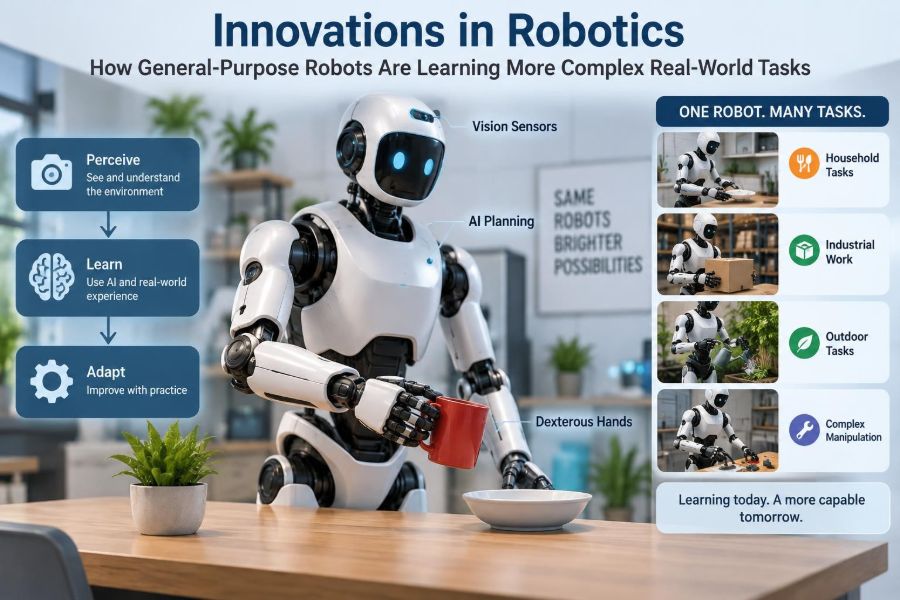
A new generation of general-purpose robots is being developed to operate in less structured settings. Rather than being built for one narrow task, these machines aim to perceive, reason, move, and adapt across a growing range of tasks.
That goal matters because it changes the engineering challenge. The question is no longer just how to make a robot move precisely. It is how to help a physical machine cope with the messy, variable world that people navigate without much thought.
🧭 What “General-Purpose” Really Means
A general-purpose robot is designed to perform more than one meaningful category of task without being rebuilt for each one. It may be able to fetch items, sort objects, open doors, carry tools, or assist with routine preparation after receiving new instructions or training.
This does not mean a robot can do every job equally well. Generality is a spectrum. A mobile manipulator that can handle several kinds of warehouse exceptions is more general than a fixed arm that only places one component in one fixture.
The key distinction is adaptability: the robot should transfer some knowledge from one situation to a related one, rather than starting from zero each time.
🏭 Why Fixed Automation Has Limits
Conventional industrial automation is remarkably effective when variation is low. Fixtures locate parts precisely, conveyors control timing, and engineered workcells reduce uncertainty before a robot acts.
Those strengths can become constraints when product packaging changes, objects arrive mixed together, or a task moves between locations. Reprogramming a specialized cell can require mechanical redesign, safety review, and substantial testing.
General-purpose robotics seeks to reduce that setup burden. The ambition is not to replace well-designed fixed automation everywhere, but to address tasks where fixed automation is too rigid or too costly to adapt.
🌍 The Real World Is an Unstructured Workspace
Roboticists often call homes, hospitals, farms, shops, and mixed-use warehouses unstructured environments. The term does not mean chaotic; it means the environment is not controlled tightly enough to guarantee the same scene every cycle.
Lighting changes through the day. Shelves are partially blocked. Objects deform, reflect light, or sit in unexpected positions. People move through the same space and may change the task priority without warning.
A capable robot must therefore make decisions from imperfect information. It needs to recognize what it sees, estimate what it can safely do, act, and check whether the action worked.
👁️ Perception Is More Than Object Recognition
Seeing a cup in an image is not enough. A robot also needs to estimate where the cup is in three-dimensional space, whether it is upright, whether something blocks its handle, and whether it contains liquid.
Modern systems combine cameras with depth sensors, force sensing, wheel encoders, and sometimes tactile sensors. Sensor fusion brings these signals together because each has weaknesses: cameras can struggle with glare, while force sensors only report contact after it occurs.
Perception must also be tied to action. A robot may not need a perfect scene model; it needs a model accurate enough to choose a safe grasp, route, or next observation.
🧠 World Models Turn Signals Into Situations
A world model is an internal representation of the robot’s surroundings and task state. It can include object locations, likely surfaces, free space, people nearby, and assumptions about what may happen next.
For example, a robot carrying a tray should represent more than the tray’s position. It may need to account for a person approaching, a doorway that may open, and the risk that a sudden stop could shift the load.
World models are always incomplete. Good systems track uncertainty instead of pretending every measurement is exact, then choose actions that are robust to reasonable errors.
🗣️ Language Makes Task Specification Easier
Natural-language interfaces can let users state goals such as “put the clean containers on the lower shelf” instead of selecting every motion from a programmed menu. This can make robots easier to direct, particularly when tasks change frequently.
Language alone is ambiguous. “The blue box” may refer to several objects, and “clean” cannot always be inferred reliably from appearance. A robot needs grounding: connecting words to objects, places, task rules, and questions it can ask.
In a well-designed workflow, language is used to express intent while structured constraints define what the robot is allowed to do.
🧩 Task Planning Breaks Goals Into Actions
Task planning converts a broad objective into ordered steps. “Restock this shelf” might require locating inventory, selecting an item, navigating to the shelf, finding free space, placing the item, and confirming the result.
Each step can fail for a different reason. The item may be unavailable, a route may be blocked, or the shelf may be full. Planning systems need alternatives and clear rules for when to pause for human input.
This is where general-purpose behavior becomes visible: the robot is not replaying one path but choosing among actions as the situation changes.
🦾 Motion Planning Solves the Geometry Problem
Once a robot knows what it wants to do, it must find a collision-free movement. Motion planning considers joint limits, obstacles, balance, tool shape, and the goal pose of an arm, hand, or mobile base.
A path that looks clear in a camera image may be impossible because an elbow would strike a shelf. Conversely, a direct path may be safe for the gripper but unsafe for a fragile object being carried.
Fast replanning is especially valuable in human-shared spaces. The robot should slow, reroute, or stop rather than assume its original path remains valid.
✋ Manipulation Is Harder Than Reaching
Picking up an object involves contact mechanics, not just geometry. A smooth bottle, flexible bag, cable, towel, and delicate electronic part all respond differently to pressure and motion.
A robot needs a grasp that is stable without damaging the object. It may also need to rotate, slide, pour, insert, or hand over the object—actions that depend on friction, weight distribution, and compliance.
Simple grippers remain useful because they are reliable for known items. More adaptable hands and tactile sensing expand what robots can handle, but add mechanical complexity and more signals to interpret.
🖐️ Tactile Feedback Closes the Contact Loop
Vision can estimate that a gripper has reached an object, but touch can reveal whether it actually has a secure hold. Tactile sensors may detect pressure patterns, slip, contact location, or changes in force.
Consider lifting a paper cup. A fixed closing force may crush it, while too little force lets it fall. Feedback allows the robot to adjust its grip as the object begins to move.
Tactile sensing is promising, but it is not a universal cure. Sensors must survive repeated contact, be calibrated, and produce useful signals under real workplace conditions.
⚙️ Compliance Makes Robots Less Brittle
Compliance means allowing controlled flexibility in a robot’s motion or force. It can come from springs, flexible actuators, software control, or a combination of these.
When inserting a plug, closing a drawer, or placing an item into a bin, tiny alignment errors are unavoidable. A perfectly rigid robot may jam or apply excessive force; a compliant one can yield slightly and use contact to find the correct fit.
Compliance must be carefully tuned. Too little makes interactions harsh, while too much can reduce positioning accuracy and make heavy-load control difficult.
📚 Learning From Demonstration Reduces Programming Work
In learning from demonstration, a person shows a robot an action through teleoperation, physical guidance, recorded examples, or another interface. The robot then learns patterns that may generalize to similar cases.
This approach is attractive for tasks that are easy to show but difficult to describe mathematically, such as folding a particular fabric item or arranging mixed tools in a kit.
Demonstrations require variety. If every training example has the same object position, lighting, and operator style, the robot may learn superficial cues rather than the underlying task.
🎮 Simulation Lets Robots Practice Safely
Simulation provides a virtual place to test navigation, grasping, and control policies before using physical machines. It can generate many object layouts and failure cases more quickly than a lab can stage them.
The limitation is the sim-to-real gap: simulated friction, sensor noise, object deformation, and contact behavior never match reality perfectly. A policy that succeeds in a virtual scene may fail when a real package is crumpled or a camera is slightly misaligned.
Engineers narrow this gap by varying simulation conditions, calibrating models, and validating carefully on hardware. Simulation accelerates development; it does not eliminate physical testing.
🔁 Reinforcement Learning Improves Action Choices
Reinforcement learning trains a system through trial, feedback, and reward. In robotics, it can help optimize a behavior such as balancing, grasping, or choosing a route under changing conditions.
Its appeal is that the programmer does not need to define every movement. Its challenge is that poorly designed rewards can encourage unintended shortcuts, and real-world trial and error can be slow or unsafe.
For that reason, practical systems often combine learned components with conventional controllers, constraints, simulation, and monitored deployment rather than letting a policy explore freely around people or equipment.
🧪 Data Quality Shapes Robot Capability
Large and varied datasets can expose a robot to different objects, backgrounds, handoffs, and task instructions. But quantity alone is not enough. Labels, sensor synchronization, coverage of rare cases, and accurate records of failures all matter.
A dataset collected in a pristine laboratory may not prepare a robot for glare from loading-bay doors or worn packaging in a busy facility. Data should resemble the conditions where the system will actually operate.
Teams also need to consider whether data collection captures sensitive spaces or personal information. Technical capability does not remove the need for responsible data practices.
🧠 Foundation Models Can Help With Generalization
Foundation models are trained on broad collections of data and can provide flexible representations for language, images, or both. In robotics, they may help a system connect an instruction to visual concepts or suggest high-level task steps.
They do not automatically make physical actions reliable. A model can identify a “drawer” yet still lack the geometric precision, force awareness, or safety knowledge needed to open a particular drawer.
The most credible use is as one component in a larger stack: perception, planning, control, verification, and safety checks each retain specific responsibilities.
📏 Verification Prevents Confident Mistakes
A general-purpose robot should verify important outcomes. After placing an object, it can check whether the object remains in the intended bin. After pressing a button, it can observe an indicator or ask a connected system for confirmation.
This principle is sometimes called closed-loop execution: act, observe the result, and adjust. It is safer than open-loop execution, where the robot assumes every command succeeded because it was sent.
Verification is especially important when errors compound. A misplaced item may seem minor until later steps rely on its supposed location.
🚦 Safety Is a System Property
Safe behavior does not come from a single emergency-stop button or a single intelligent model. It arises from mechanical design, sensing, speed limits, collision monitoring, workspace rules, training, maintenance, and clear escalation procedures.
Risk depends on the task. A robot carrying a lightweight package in an open aisle presents different hazards from one moving a heavy tool near a person. Risk assessment should focus on credible failure modes, not only normal operation.
When uncertainty is high, a safe robot should choose a conservative action: slow down, keep distance, stop, or request help.
🤝 Human-Robot Collaboration Requires Clear Roles
Collaboration works best when people understand what the robot can do, what it cannot infer, and how it signals uncertainty. Vague expectations encourage unsafe workarounds, such as reaching into a robot’s workspace to “help” while it is active.
Useful designs make intent visible through predictable movement, status indicators, and clear handoff states. The robot should not surprise a nearby worker with a sudden reach or turn.
Humans remain essential for judgment, exception handling, oversight, and tasks involving social context. Automation should be designed around real work practices, not an imaginary worker-free environment.
📦 Warehouse Tasks Show Both Promise and Limits
Warehouses are a natural testbed because they combine repeatable logistics with substantial variation. Robots can navigate, transport goods, scan inventory, and sometimes pick items from totes or shelves.
The difficult cases reveal the broader challenge: crushed cartons, transparent wrapping, tangled products, changing stock layouts, and mixed human traffic. A robot that succeeds only with ideal items may not solve the operational bottleneck.
Strong deployments identify a bounded workflow first, measure exception rates, and create a human recovery process. Generality grows through reliable handling of more exceptions, not through claiming universal ability.
🏥 Healthcare Environments Demand Extra Caution
Mobile robots can support logistics in healthcare settings by moving supplies, linens, or meals. These tasks can reduce repetitive transport, but the environment includes vulnerable people, tight corridors, privacy concerns, and changing priorities.
Robots intended to interact physically with patients or assist with clinical procedures face a much higher bar. Performance, supervision, hygiene, validation, and regulatory requirements depend heavily on the intended use.
A helpful principle is to separate administrative and transport assistance from clinical decision-making. The latter requires specialized evidence, governance, and professional accountability.
🌾 Farms and Construction Sites Expose Environmental Challenges
Outdoor work adds uneven terrain, weather, dust, changing light, and biological variation. A fruit may be hidden by leaves; soil may be softer after rain; a construction site can change layout in a single day.
These settings reward robots that can perceive uncertainty and operate robustly, but they also punish fragile assumptions. Hardware sealing, traction, battery planning, and sensor cleaning can be as consequential as the learning algorithm.
General-purpose capability in the field often means handling a useful range of expected conditions, not operating without preparation in every possible environment.
🔋 Hardware Still Sets the Boundaries
Software cannot fully overcome limits in reach, payload, battery capacity, actuator power, sensor placement, or thermal management. A robot may understand a task but lack the grip strength or endurance to complete it safely.
Mechanical design and AI development therefore need to proceed together. Better hands may create richer data for learning; better perception may allow a simpler gripper to be used more effectively.
Maintainability matters too. A capable machine that takes too long to recharge, clean, calibrate, or repair may be impractical in daily operations.
📊 Evaluating Generality Requires Better Tests
A polished demonstration can show potential, but it does not establish dependable performance. Evaluation should include variation in objects, layouts, lighting, instructions, interruptions, and recovery from mistakes.
Useful questions include:
- What conditions were represented during testing?
- How does the robot detect and recover from failure?
- Which tasks require human intervention?
- Does performance remain stable after ordinary wear and environmental change?
Clear reporting of boundaries is more useful than a vague claim that a robot is “general.” It helps users decide whether the system fits their actual environment.
⚠️ Common Mistakes in General-Purpose Robot Design
One frequent mistake is treating a language-capable model as a complete robot brain. Language can help specify goals, but physical execution still needs accurate state estimation, robust control, and safety constraints.
Another is optimizing for a scripted demo while overlooking recovery. In real operations, the robot must handle an object it missed, an unexpected person, a blocked route, or a sensor that becomes unreliable.
- Overfitting: training on narrow scenes and expecting broad transfer.
- Ignoring interfaces: failing to design clear human override and handoff procedures.
- Measuring averages only: hiding rare but costly failures behind a single success figure.
- Skipping maintenance planning: treating calibration and cleaning as afterthoughts.
🛠️ A Practical Path to Deployment
Organizations usually gain more from a staged approach than from pursuing an all-purpose machine immediately. Start with a task where the value, operating conditions, and fallback process are clear.
- Map the workflow, including exceptions and safety-sensitive moments.
- Define what successful completion looks like and how it will be verified.
- Test in representative conditions, not only ideal ones.
- Introduce monitored operation with trained staff and a simple recovery path.
- Use observed failures to improve the task design, data, hardware, or training.
This process often reveals that redesigning part of the environment—better storage, clearer labels, standardized containers—can improve reliability more cheaply than adding model complexity.
🎓 Skills Robotics Engineers Need Now
General-purpose robotics rewards engineers who can work across disciplines. Mechanical design, embedded systems, control theory, computer vision, machine learning, human factors, and safety engineering all meet in the same machine.
Students should build the habit of debugging systems end to end. A poor grasp could come from camera calibration, coordinate transforms, control latency, gripper mechanics, object properties, or a flawed task assumption.
For working professionals, the durable skill is not allegiance to one framework. It is the ability to define a real task, gather evidence, identify uncertainty, and make a system more reliable through disciplined iteration.
🔮 What Progress Is Likely to Look Like
Progress will probably arrive unevenly. Robots may become highly useful in constrained versions of many tasks before they become broadly competent in unconstrained ones.
Expect better multimodal perception, more effective teleoperation and demonstration tools, improved tactile sensing, and tighter integration between learned policies and safety-oriented control. At the same time, difficult edge cases will remain central because physical environments create long tails of rare events.
The most meaningful advances may be less theatrical than a humanoid doing everything. They may be machines that recover gracefully, communicate uncertainty, and deliver dependable help across several closely related workflows.
🧠 The Core Principle: Adaptation Must Be Earned
General-purpose robots are learning complex real-world tasks by combining perception, language, planning, control, tactile feedback, data, and careful system design. No single breakthrough removes the need for the others.
The central engineering challenge is to turn broad capability into trustworthy behavior under variation. That requires testing beyond demonstrations, designing for failure recovery, respecting hardware constraints, and keeping people in control of consequential decisions.
A robot becomes genuinely more useful not when it appears intelligent in a perfect scene, but when it can recognize uncertainty and respond safely in an imperfect one.
The future of general-purpose robotics depends on pairing adaptable learning with reliable physical execution, transparent limits, and rigorous safety practice. That is how robots can become practical partners in real work rather than impressive machines confined to ideal conditions. 🦾🔧🌍