
A distribution center at 5 a.m. can be a demanding place. Trucks arrive, orders must leave on time, pallets need unloading, and a single aisle change can turn a familiar routine into a new problem for the people doing the work.
For years, warehouse automation has handled the most structured parts of that environment: conveyors move cartons, robotic arms stack cases, and mobile robots carry shelves or bins along mapped routes. But many tasks still depend on people because the work is varied, physical, and constantly changing.
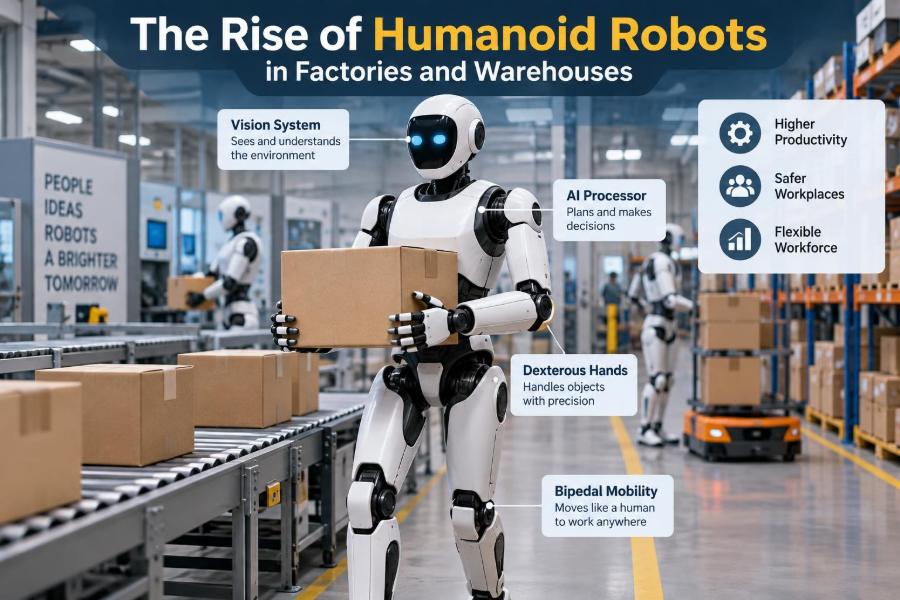
That is where humanoid robots have entered the conversation. They are designed with a human-like body plan—typically a torso, two arms, two legs or a wheeled lower body, cameras, and force-sensitive hands—so they can potentially work in spaces originally built for people.
The idea is compelling, but it deserves careful engineering scrutiny. A humanoid robot is not a general-purpose worker that can simply be switched on. Its real value depends on task design, safety, reliability, integration, and whether its human-shaped form solves a genuine operational problem.
🏭 Why Factories and Warehouses Are Looking Again
Industrial employers face a persistent mismatch between the work that needs doing and the labor available for repetitive, physically demanding shifts. Loading containers, moving totes, replenishing stations, and tending machines can involve awkward reaches, long walking distances, and variable schedules.
At the same time, customer expectations have shortened fulfillment windows. Operations need flexibility when product mixes, package sizes, and order volumes change. Fixed automation is often excellent at one repeatable process, but modifying it can require new fixtures, programming, guarding, and layout work.
Humanoid robots are being explored as a possible bridge between manual work and highly specialized automation. The attraction is not their appearance; it is the possibility of using existing doors, aisles, racks, carts, tools, and workstations with fewer physical changes.
🤖 What Makes a Robot “Humanoid”
A humanoid robot generally has a body arrangement intended to resemble a person’s functional capabilities. That may include two arms for reaching and manipulation, a torso for positioning sensors, and legs for moving through human-scale spaces. Some industrial designs use a wheeled base rather than legs while retaining an upper body with two arms.
This definition matters because “humanoid” does not automatically mean human-level dexterity, understanding, or independence. A robot may look person-like yet be capable of only a narrow set of carefully validated tasks.
For engineering decisions, it is more useful to ask: What objects can it handle, where can it move, what exceptions can it recover from, and how safely can it operate?
🧩 Why Human-Shaped Infrastructure Changes the Design Case
Most industrial buildings were designed around human dimensions. Shelves are reached from standing height, controls are mounted for human hands, stairways fit human feet, and loading areas assume workers can step around irregular obstacles.
A robot with arms and an appropriate reach envelope can interact with that infrastructure without requiring every task to be rebuilt around a fixed machine. For example, a robot might take a tote from a standard cart and place it onto a conventional conveyor.
That advantage disappears when a dedicated machine would do the job more simply. If a task always involves identical cartons arriving in identical positions, a traditional robotic cell may be faster, less complex, and easier to maintain.
📦 The Tasks Being Considered First
The earliest practical applications tend to be repetitive tasks with bounded variation rather than open-ended work. Good candidates have clear pickup and drop-off locations, manageable object weights, predictable cycle times, and a way to safely stop or hand off work when something goes wrong.
- Moving totes, bins, and lightweight cartons between stations
- Picking known items from structured shelves or carts
- Sorting parcels into designated containers
- Replenishing line-side materials in manufacturing
- Simple machine tending, such as loading and unloading parts
- Inspecting spaces with cameras and sensors during routine rounds
These are not trivial tasks. Each requires perception, grasp planning, motion control, and reliable recovery from common failures such as a shifted box or a blocked path.
🦿 Legs, Wheels, and the Mobility Trade-Off
Walking is one of the most visible humanoid capabilities, but it is not always the most useful. Bipedal robots may eventually help in facilities with stairs, uneven floors, narrow passages, or layouts that cannot accommodate mobile platforms easily.
On smooth warehouse floors, wheels usually offer greater energy efficiency, stability, and operational simplicity. A wheeled humanoid upper body can still reach shelves and use tools while avoiding the balance challenges of walking.
The design question is therefore practical rather than aesthetic: does the facility truly need legs? If not, a wheeled base or an autonomous mobile robot paired with a manipulator may deliver a better result.
🖐️ Hands Are Often the Hardest Hardware Problem
Human hands are remarkably adaptable. They can pinch a thin label, stabilize a flexible bag, turn a handle, and feel when an object is slipping. Reproducing even part of that range in an affordable, durable industrial mechanism is difficult.
Many warehouse tasks do not require five-fingered hands. A parallel gripper, suction cup, compliant clamp, or purpose-built end effector can be more reliable for a specific package type. Humanoid hands become more attractive when the robot must operate existing human tools or handle a wide variety of objects.
Compliance is especially valuable. A compliant gripper yields slightly under contact, reducing the chance of crushing an item or damaging itself when placement is imperfect.
👁️ Perception Turns Movement Into Useful Work
Motors can move a robot through a planned trajectory, but perception tells it what is actually happening. Factory and warehouse robots commonly combine cameras, depth sensors, joint encoders, inertial sensors, and sometimes force or tactile sensing.
Computer vision identifies objects, estimates their position and orientation, reads labels when conditions allow, and detects obstacles. Depth sensing helps distinguish a box from the shelf behind it. Force feedback can indicate whether an object is securely grasped or unexpectedly blocked.
Real environments remain difficult: shiny wrap can confuse depth cameras, poor lighting affects images, and loosely packed bins create occlusion. A dependable system must recognize uncertainty rather than confidently making a bad pick.
🧠 From a Task Request to a Completed Action
A useful way to understand a humanoid robot is as a stack of decisions. A warehouse system may send a request such as “move this tote to station three,” but the robot must translate that instruction into many smaller actions.
- Locate the tote and verify its identity.
- Plan a safe route and approach position.
- Choose a grasp point that fits the object and gripper.
- Move while avoiding people, equipment, and shelf edges.
- Confirm the tote is held, transported, and placed correctly.
- Report completion or request help when confidence is low.
This pipeline explains why a seemingly simple task can fail in many places. Reliable automation is as much about detecting and managing exceptions as it is about performing the nominal action.
🎯 The Difference Between Autonomy and Teleoperation
Not every robot action is fully autonomous. In teleoperation, a remote human operator directs some or all movements, often through a control interface, cameras, or motion-tracking equipment. This can help recover from unusual cases and generate examples for improving robot behavior.
Supervised autonomy lies between direct control and independence. The robot carries out validated actions on its own but asks for confirmation or assistance when it encounters an unfamiliar object, a blocked workspace, or a low-confidence perception result.
When evaluating demonstrations, it is worth asking which mode was used. A task completed under close human guidance demonstrates a capability, but it does not necessarily demonstrate unattended shift-long operation.
🧪 Why Demonstrations and Deployments Are Different
A polished demonstration can show that a robot can perform a task under favorable conditions. A deployment must show that it can perform that task repeatedly, recover from routine variation, fit into operations, and be repaired without excessive disruption.
Consider carton handling. A demonstration might use clean, upright boxes placed at known locations. A real dock may include crushed corners, mixed labels, stretch wrap, uneven stacks, changing light, and workers moving through the area.
The meaningful engineering threshold is not “can it do it once?” but “can the operation depend on it safely and predictably?” That requires long-run testing and honest measurement of failures, interventions, and downtime.
⚙️ Cycle Time Is More Than Robot Speed
Factories evaluate automation through throughput: how much useful work passes through a process in a given period. A robot’s arm speed alone says little about throughput if it spends time waiting, rerouting, scanning, or requesting assistance.
Cycle time includes approaching the work area, recognizing the object, grasping it, moving it, placing it, and confirming the result. It also includes the occasional recovery process. A fast motion that causes frequent drops may lower total throughput.
Engineers should compare the complete work cycle, including handoffs and exception handling, rather than comparing a robot’s peak movement speed with a person’s average pace.
🔋 Energy, Heat, and Shift Duration
Mobile humanoids carry substantial electrical and computing loads. Actuators consume energy during movement, sensors and processors run continuously, and walking can demand considerable power because balance must be maintained at every step.
Battery capacity affects useful operating time, but charging strategy matters just as much. A fleet may need scheduled charging windows, battery swapping, or enough robots to maintain production while some units recharge.
Heat is another constraint. Motors, power electronics, and onboard computers generate it, especially under sustained lifting or in warm facilities. Thermal limits can reduce performance or require pauses, so they should be considered during process design rather than discovered during a busy shift.
🛡️ Safety Begins With the Whole Workcell
A humanoid robot is not safe merely because it has sensors or can stop when it detects contact. Safety depends on the full workcell: task speeds, payloads, stopping distances, traffic patterns, visibility, floor conditions, software behavior, and the procedures people follow.
Risk assessment should examine foreseeable interactions. Could the robot swing a load into a person? Could someone step into its path while it is turning? What happens if a camera is blocked, a network connection drops, or a package slips?
Industrial safety requirements vary by jurisdiction and application. Teams should involve qualified safety professionals and use applicable machinery, robot, electrical, and workplace rules rather than assuming a generic feature list is sufficient.
🚧 Designing Safe Human-Robot Collaboration
Many promised applications place robots near people, which makes clear communication essential. Workers need to know where robots operate, how to pause them, what their lights or sounds mean, and whom to contact if behavior seems abnormal.
Common safeguards include reduced-speed zones, virtual boundaries, physical separation for higher-risk motions, emergency stop devices, and rules that prevent a robot from entering a space while a person is performing a conflicting task.
Collaboration should not mean asking people to constantly dodge unpredictable machines. The better goal is a work process in which robot behavior is legible, routes are planned, and human responsibilities are not ambiguous.
📏 Payload, Reach, and Center of Mass
A robot may be able to lift a stated payload under controlled conditions, yet still struggle with the same mass held far from its body. Extending an arm creates torque at the shoulder, torso, base, or ankles. The object’s center of mass matters as much as its weight.
A long, awkward carton can be harder to manipulate than a compact container of equal mass. For a biped, the challenge includes maintaining balance; for a wheeled robot, it includes avoiding tipping and maintaining traction.
Task specifications should describe object dimensions, grip surfaces, weight distribution, pickup height, placement height, and reach distance. “Moves boxes” is too vague to engineer or procure responsibly.
🧱 Facility Variation Is the Real Test
Warehouses vary from one shift to the next. Empty pallets appear in aisles, temporary signage changes sight lines, seasonal items alter shelf contents, and packaging suppliers introduce slightly different cartons.
Robots need a controlled operating envelope: the set of conditions in which they have been tested and approved. Expanding that envelope should be deliberate. A system trained around rigid totes may not safely generalize to soft mailers, reflective bags, or damaged packaging.
Operational discipline helps. Standardized tote locations, clear aisle rules, consistent labels, and well-managed staging areas make robotic work easier—and often improve human workflow too.
🔄 Integration With Existing Automation
A humanoid robot rarely works alone. It may need to receive jobs from a warehouse management system, coordinate with a warehouse execution system, exchange signals with conveyors, and obey traffic rules shared with autonomous mobile robots.
Integration determines whether the robot appears at the right place with the right instruction. If inventory records say a tote is available but it has already been moved, the robot needs a way to reconcile physical reality with digital data.
Interfaces, error codes, job priorities, and fallback procedures should be defined before deployment. Otherwise, a capable robot can become an isolated demonstration that creates manual coordination work around itself.
📊 Choosing Between Robot Types
There is no universal “best” industrial robot. The best architecture is the one that performs a defined task with acceptable safety, reliability, cost, and adaptability.
| System type | Usually strongest when | Common limitation |
|---|---|---|
| Fixed industrial arm | Inputs and outputs are consistent; high repetition is needed | Limited reach beyond its cell; changes may need new tooling |
| Autonomous mobile robot | Materials must travel repeatedly across smooth floors | Typically cannot manipulate complex objects alone |
| Mobile manipulator | Work requires both travel and arm-based handling | May need a structured environment and specialized end effector |
| Humanoid robot | Human-built spaces, varied reaches, and existing tools matter | High mechanical and software complexity |
A pilot should compare alternatives honestly. Humanoid form is a design option, not the default answer.
💰 The Business Case Is Broader Than Labor Cost
It is tempting to evaluate a robot only by comparing its purchase or service cost with an hourly wage. That misses much of the system economics. Integration, facility preparation, maintenance, supervision, training, spare parts, insurance, and downtime all affect the outcome.
Benefits can also be broader than direct labor substitution. A robot may reduce physically stressful handling, support difficult shifts, stabilize a bottleneck, or make output more predictable. Those gains still need to be measured against the operational effort required to achieve them.
A sound business case defines a baseline, states assumptions clearly, and includes a realistic plan for exceptions. The most persuasive projects identify where the robot creates measurable flow improvement rather than relying on novelty.
🔧 Maintenance Is Part of the Product
Humanoid machines contain many joints, sensors, cables, gearboxes, batteries, and computing components. More degrees of freedom can create more versatility, but they also increase inspection and maintenance demands.
Operations teams need practical answers: Which components wear most quickly? How is calibration checked? Can a failed module be replaced on site? What diagnostic data is available? How long does recovery take after a fault?
Designing for maintainability matters. Accessible covers, modular components, clear fault logs, trained technicians, and available spares often influence real uptime more than a dramatic maximum-performance demonstration.
🧑🏭 Work Changes for People, Not Just Machines
Automation can shift work rather than simply remove it. Workers may become exception handlers, robot operators, quality checkers, maintenance trainees, process improvers, or coordinators of mixed human-robot workflows.
That transition is easier when organizations involve employees early. The people who perform a task often understand its hidden variations: the carton that arrives damaged, the shelf that jams, or the workaround used during peak demand.
Training should include both technical skills and practical safety behavior. It should also make clear that reporting a near miss or repeated robot failure is useful operational feedback, not resistance to technology.
🧭 A Practical Way to Select a Pilot Task
A good pilot is narrow enough to measure but meaningful enough to matter. Begin by observing a process across different shifts and conditions, not just during its cleanest hour.
- Choose a task with stable inputs and a clear completion condition.
- Document object variation, weights, locations, and common exceptions.
- Map every human handoff and every system dependency.
- Define safety boundaries and a simple stop-and-recovery procedure.
- Set success measures for quality, throughput, interventions, and uptime.
- Keep a manual fallback process available during the trial.
This approach exposes whether the robot addresses the real bottleneck or merely automates the most visible motion.
🧾 Metrics That Reveal Operational Value
One headline metric can hide serious weaknesses. A robot might complete many successful picks while requiring frequent operator help, or it may run quickly but create enough placement errors to burden downstream quality checks.
Useful measures include completed tasks per operating hour, first-pass success rate, intervention frequency, recovery time, unplanned downtime, damage events, safety-related stops, and the effect on total process throughput.
Metrics should be interpreted in context. Early pilots naturally involve tuning and learning. What matters is whether failure modes are becoming understood and manageable, not whether the first week looks flawless.
⚠️ Common Mistakes in Humanoid Robot Projects
One mistake is selecting a robot before clearly defining the task. Teams then try to reshape operations around a machine whose actual capabilities do not match package types, cycle time, or environmental conditions.
Another is underestimating exceptions. A workflow that works for 90 percent of objects can still be unusable if the remaining cases repeatedly block a critical path and require a person to travel across the facility.
Teams also sometimes neglect change management. Workers need practical involvement, supervisors need escalation rules, and maintenance teams need documentation. A technically capable machine cannot compensate for an undefined operating process.
🌐 Data, Connectivity, and Cybersecurity
Connected robots exchange job data, sensor information, diagnostic logs, and software updates. That connectivity supports fleet management and continuous improvement, but it also creates cybersecurity responsibilities.
Organizations should consider network segmentation, access controls, software update procedures, vendor support access, logging, and what happens if connectivity is interrupted. The robot must fail safely and predictably if a required service is unavailable.
Data governance matters too. Camera systems may capture workers, labels, or facility layouts. Teams should define what is collected, who can access it, how long it is retained, and how policies meet applicable workplace and privacy requirements.
🌱 Ergonomics and Sustainability Questions
Robots can reduce exposure to repetitive lifting, bending, reaching, and long-distance walking, especially when assigned to the most physically taxing portion of a process. But poor process design can simply move strain elsewhere, such as asking people to handle every exception or replenish awkward robot stations.
Environmental impacts also deserve a full-system view. Batteries, electronics, replacement parts, charging infrastructure, and facility energy use all matter. A robot that eliminates unnecessary travel or reduces damage may offer operational gains, but those gains should not be assumed without measurement.
The useful question is whether the new workflow improves both material flow and working conditions over its service life.
🔮 What Progress Is Likely to Look Like
Near-term progress is likely to be uneven and task-specific. Robots will become more capable in controlled workflows before they become dependable in every corner of an unstructured warehouse.
Advances in perception, learning from demonstration, simulation, better actuators, and more capable grippers can expand the range of tasks a machine attempts. Yet physical reliability, safety validation, energy use, and integration will continue to set the pace of real adoption.
Expect hybrid facilities rather than a sudden replacement of people or existing automation. Fixed systems, mobile platforms, robotic arms, and workers will each remain appropriate for different parts of the same operation.
🎓 Skills Robotics Engineers Need for This Field
Humanoid industrial robotics sits at the intersection of mechanical engineering, electrical systems, control theory, perception, software, and operations. Engineers who understand only the robot may miss the process; engineers who understand only the process may underestimate sensing and safety constraints.
Useful skills include kinematics, motion planning, embedded systems, machine vision, sensor fusion, human factors, industrial networking, safety analysis, and data-driven troubleshooting. Equally valuable is the habit of spending time on the floor watching the real task.
Students can build relevant experience by designing manipulation projects, testing perception under imperfect lighting, documenting failure cases, and learning to turn an ambiguous request into measurable requirements.
🧠 The Core Principle: Fit the Robot to the Work
Humanoid robots may become valuable tools where human-oriented infrastructure and variable physical tasks make other automation difficult. Their potential is real, but their form alone does not establish their usefulness.
The strongest projects start with a specific workflow, define the operating conditions, compare alternative automation approaches, and build safety and recovery into the design. They treat people as essential partners in the system, not as an afterthought.
In industrial robotics, the winning question is rarely “Can this robot look like a person?” It is “Can this complete a necessary task safely, reliably, and with a clear operational advantage?”
Humanoid robots will earn their place in factories and warehouses not by imitating people perfectly, but by fitting responsibly into real work. 🦾🏭📦