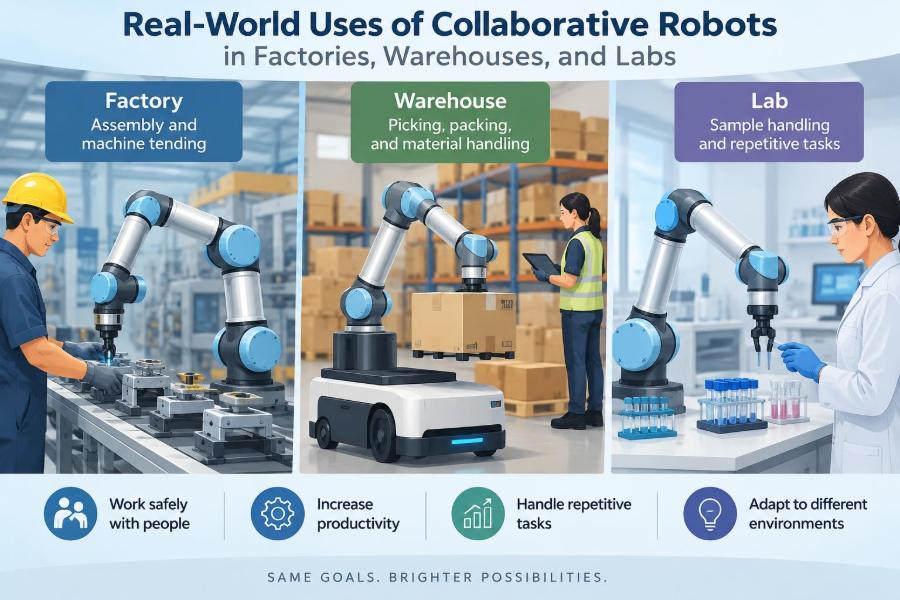

A technician loads a tray of machined parts into a fixture while a compact robotic arm waits beside her. On the next cycle, the arm removes a finished part, presents it for inspection, and places it in a bin. Neither the technician nor the robot could complete the entire job as smoothly alone.
Scenes like this are becoming familiar in manufacturing plants, fulfillment centers, and research laboratories. Collaborative robots, often called cobots, are designed to work in shared or closely adjacent spaces with people rather than being isolated behind large safety fences.
That description can make cobots sound simple: safer robots that work beside humans. In practice, their value comes from careful task design, risk assessment, tooling, and workflow planning. A cobot is not a universal replacement for a worker, nor is it automatically safe in every setup.
Understanding where collaborative robots genuinely fit helps engineers choose better automation projects, helps operators work confidently with new equipment, and helps managers avoid expensive mismatches between a robot and a process.
🤖 What Makes a Robot Collaborative?
A collaborative robot is a robot system intended for applications where people and robots may share a workspace under defined operating conditions. Many cobot arms have rounded surfaces, force sensing, speed monitoring, and controls that limit motion or force.
The key word is system. A robot arm alone is not automatically collaborative. The end effector, workpiece, sharp edges, fixtures, surrounding conveyors, and programmed motion can all introduce hazards that must be evaluated.
Traditional industrial robots are often optimized for high speed, heavy payloads, and repetitive enclosed cells. Cobots generally prioritize adaptable deployment and controlled interaction, though some applications still need barriers or other protective measures.
🧭 Why Shared Workspaces Change Automation
Conventional automation often divides work into two zones: people outside the guarded cell and robots inside it. That arrangement is effective for fast, predictable, high-volume work, but it can be awkward when a person must frequently load parts, inspect results, or make decisions.
A cobot can support a different division of labor. The person handles variation, judgment, and exceptions; the robot handles repeatable motions such as holding, placing, dispensing, or transferring.
This is especially useful in operations with many product variants, smaller batches, or changing schedules. The objective is not merely to put a robot near a person. It is to remove a meaningful bottleneck without making the rest of the process harder.
🛡️ Safety Is Designed, Not Assumed
People sometimes hear “collaborative” and imagine a robot that can never hurt anyone. That is not a realistic safety model. A slow-moving padded arm may be appropriate in one task, while the same arm carrying a hot, sharp, or heavy tool may require separation.
Risk assessment examines foreseeable contact, pinch points, crushing hazards, unexpected starts, dropped objects, and the consequences of a control failure. It also considers workers who are cleaning, teaching, maintaining, or recovering the system after a fault.
- Power and force limiting reduces contact forces through robot design and settings.
- Speed and separation monitoring slows or stops motion when a person approaches.
- Safety-rated monitored stop permits a person to enter an area only after robot motion has stopped.
- Hand guiding allows an operator to physically guide the robot in specified conditions.
These approaches can be combined, but none removes the need for application-specific validation.
🏭 Machine Tending: Loading and Unloading Equipment
Machine tending is one of the most practical factory uses for cobots. A robot can load raw parts into a CNC machine, press, test fixture, or molding station, then remove finished parts while an operator manages several machines or performs quality checks.
Consider a small machining shop making several families of metal brackets. A cobot fitted with a two-finger gripper may pick blanks from a tray, place them in a vice, start the cycle through an approved interface, and unload completed parts. The operator still handles tool changes, first-piece inspection, and unusual part conditions.
The difficult engineering work often lies outside the robot program: consistent part presentation, secure gripping, machine-door coordination, chip management, and recovery when a part is not seated correctly.
🔩 Assembly Tasks with Human Judgment
Assembly lines often mix highly repeatable actions with tasks that require tactile feedback or visual judgment. A cobot can perform the repeatable portion, such as inserting clips, applying adhesive, placing fasteners, or holding a component at a useful angle.
For example, in a hypothetical electronics assembly station, the cobot might present an enclosure and drive a predefined screw sequence. A worker routes a flexible cable, checks connector orientation, and handles variants that cannot be reliably recognized by the current system.
Good collaborative assembly designs give each partner a clear role. If the robot frequently waits for unclear human actions, or the worker waits for a slow robot, the station may gain little throughput.
🪛 Screwdriving and Controlled Fastening
Screwdriving is a common cobot application because the motion is repetitive and the result can be verified. A robotic screwdriver can follow a programmed pattern while recording torque, angle, or completion signals from the tool.
However, a screw is not simply a point in space. Hole location can vary, threads can cross, bits wear, and lightweight parts can shift under force. A robust cell may use compliance devices, vision checks, torque monitoring, and fixtures that locate parts repeatably.
When fastening is safety-critical or quality-critical, engineers should define what evidence counts as an acceptable joint. A “tool cycle complete” signal is not necessarily proof that every assembly condition was correct.
🧴 Dispensing Adhesives, Sealants, and Fluids
Cobots are well suited to dispensing jobs that demand a steady path and consistent speed. Typical examples include gasket beads, adhesives, lubricants, sealants, and small amounts of coating material.
The robot controls the path, but process quality also depends on material viscosity, nozzle condition, temperature, pressure, and cure time. A perfect path cannot compensate for a clogged nozzle or material that has aged beyond its usable window.
For flexible production, operators can use guided teaching to demonstrate a new path and then refine speed, flow, and overlap settings. This is useful for products with frequent design updates, provided the revised program is documented and checked.
📦 Pick-and-Place in Packaging Lines
In packaging, cobots transfer products between conveyors, trays, cartons, and pallets. They can place promotional inserts, orient items, load kits, or move delicate products that would be difficult to handle with rigid mechanical equipment.
A vision system can extend flexibility by identifying an item’s position and orientation. But vision should be treated as one component of a system, not magic. Lighting changes, reflective film, crowded bins, and damaged packaging can reduce detection reliability.
Successful packaging cells plan for ordinary interruptions: empty infeed lanes, misaligned cartons, full outfeed bins, and products that cannot be picked. Clear status signals let operators resolve these events quickly.
📏 Inspection and Metrology Support
Some cobots move cameras, probes, gauges, or scanners around a part for inspection. Their benefit is repeatable positioning, especially when a part needs checks at several locations or angles.
A cobot-mounted camera may inspect labels, connector presence, or surface features. A probe-equipped robot may bring a measuring tool to multiple points. The robot provides movement; the measurement system and its calibration determine whether the data is trustworthy.
Engineers should account for arm deflection, thermal changes, fixture repeatability, and cable forces. A robot that is adequate for moving boxes may not provide the positional stability required for fine measurement without additional controls.
🎨 Surface Finishing and Polishing
Polishing, sanding, deburring, and buffing can be physically tiring because workers repeat controlled contact motions for long periods. A force-controlled cobot can maintain a target contact force while following a surface path.
These jobs reveal why force control matters. A position-only robot might press too hard when a part is slightly higher than expected, or lose contact where the surface dips. Force feedback allows the robot to adapt within limits.
Dust extraction, abrasive wear, workpiece clamping, and tool guarding remain essential. The robot may reduce repetitive strain, but it does not eliminate exposure to dust, noise, or rotating-tool hazards.
🔥 Welding and Thermal Processes
Cobots can assist with welding, soldering, thermal bonding, and other heat-based operations, particularly where workpieces vary or programming time matters. They can hold a torch or position a part while a skilled worker sets parameters and validates results.
Calling the arm collaborative does not make the welding process collaborative. Arcs, hot surfaces, fumes, spatter, shielding gases, and intense light can demand controlled areas, extraction, protective equipment, and interlocks.
The best fit is often a semiautomated station where the robot repeats a qualified motion and the welder remains responsible for setup, joint preparation, parameter selection, and quality interpretation.
📚 Kitting and Order Consolidation
Warehouses use cobots to assemble kits: sets of components packed together for production, service, or customer orders. The robot picks predictable items while a worker handles irregular, fragile, or hard-to-grasp products.
Kitting is more complex than it first appears because errors are expensive. A missing seal, incorrect cable, or wrong fastener can stop downstream assembly. Barcode checks, weight checks, compartmented totes, and confirmation logic can help detect mistakes.
Robot performance depends heavily on inventory presentation. Components that arrive tangled, mixed, or inconsistently oriented may require redesigned bins or a different picking strategy before automation is sensible.
🚚 Mobile Cobots and Intralogistics
A mobile robot base paired with a collaborative arm can move materials between workstations, racks, and staging areas. This combination is often called a mobile manipulator: the base navigates, while the arm loads, unloads, scans, or opens simple interfaces.
It can be valuable in facilities where routes change or fixed conveyors would be too disruptive. For example, a mobile cobot might bring empty trays to a machining area and return finished trays to inspection.
Navigation performance depends on floor condition, traffic rules, charging strategy, wireless reliability, and people’s behavior around the vehicle. A route that works in a quiet demonstration may struggle during a busy shift change.
🧱 Palletizing Small or Variable Loads
Palletizing is traditionally associated with large, fast industrial robots. Cobots can be useful for lighter cases, low-to-medium throughput, frequent pallet-pattern changes, or constrained floor space.
The practical limit is not only payload. Engineers must include the gripper, case weight, reach, acceleration, stack height, and the force created when the arm is extended. An arm may lift a box near its base but be unable to safely place it at the far corner of a tall pallet.
Unstable cartons, damaged pallets, and overhead reach can turn an apparently simple job into a poor collaborative application. Conventional palletizing equipment may be more appropriate for high-speed, heavy-load operations.
🧪 Lab Sample Handling
In laboratories, cobots can transfer sample tubes, plates, vials, racks, and instruments. They are useful where scientists spend time on repetitive transfers that interrupt analytical work.
A robot might move microplates between a liquid handler, incubator, reader, and storage rack. The value is often consistency and traceability: each transfer can be linked to a sample identifier and time stamp through the laboratory workflow system.
Lab automation must protect sample integrity. Sterility, cross-contamination, evaporation, temperature exposure, and accurate identification can matter more than raw cycle speed.
🧬 Life Science Workflows Need Gentle Precision
Biological materials are often sensitive to mixing, temperature, light, and contamination. A cobot can move containers consistently, but it must do so with acceleration limits that prevent spills or cell damage and with tooling suitable for the container geometry.
For a hypothetical cell-culture workflow, a robot could transport sealed vessels between an incubator and imaging station. It would still need carefully validated cleaning practices, access control, and error handling if a vessel is missing or a door fails to open.
Automation can make a workflow more repeatable, but it does not validate the underlying scientific method. Scientists must determine whether robotic handling changes the material or measurement.
⚗️ Chemical and Hazardous Material Handling
Cobots can increase separation between people and undesirable exposures by handling corrosive reagents, repetitive pipetting setups, or contaminated containers. This is valuable only when the entire cell is designed for the hazard.
Compatibility matters: seals, tubing, grippers, cable jackets, and protective covers may degrade when exposed to chemicals. Spill containment, ventilation, decontamination, and emergency procedures are part of the engineering scope.
For high-consequence substances, remote operation or fully enclosed automation may be safer than direct human-robot collaboration. The label “cobot” should never override chemical safety requirements.
👁️ Vision Gives Cobots Context
Machine vision gives a robot information about location, identity, orientation, or condition. It can allow a cobot to pick parts from a tray with variable positions or reject a package with a missing label.
Vision does not equal understanding. A camera can classify an object according to its trained or programmed criteria, yet still fail on unusual reflections, occlusion, new packaging, or poor focus. Engineers need acceptance rules for uncertain results.
Lighting is frequently underestimated. Stable illumination, background contrast, lens selection, and physical shielding from ambient changes often improve results more than adding complex software.
🖐️ End Effectors Determine What the Robot Can Do
The end effector is the device attached to the robot wrist: a gripper, vacuum cup, screwdriver, dispenser, probe, or custom tool. It is the point where the robot meets the real process.
A well-chosen gripper can make a modest robot highly useful. A poor gripper can cause drops, damaged products, slow cycles, and endless operator intervention. Engineers should test real parts, including normal variation, not only perfect samples.
- Vacuum tools work well for many flat, sealed surfaces but can struggle with porous or irregular materials.
- Mechanical grippers provide positive retention but need clearance and controlled grip force.
- Magnetic tools can simplify ferrous-part handling but require attention to residual magnetism and part separation.
- Tool changers enable multiple tasks but add weight, complexity, and failure points.
🧠 Programming by Demonstration and Its Limits
Many cobots allow an operator to physically guide the arm through a motion and save waypoints. This lowers the barrier for simple tasks and can speed early prototyping.
Teaching a path is not the same as engineering a production program. The final application still needs safe speeds, defined tool states, clear startup behavior, fault recovery, access permissions, and checks for missing or mispositioned parts.
Good programs also avoid hidden assumptions. If a task works only because every tray is exactly aligned, that dependency should be controlled by fixtures or sensing rather than left to luck.
🔗 Integrating Machines, Sensors, and Software
A cobot rarely works alone. It exchanges signals with conveyors, machine tools, barcode readers, safety devices, manufacturing systems, and sometimes databases. Integration determines whether the cell behaves like a coordinated process or a collection of disconnected devices.
Teams should define a simple state model: ready, running, waiting for material, faulted, safe stop, and recovery. Each device needs an agreed response in every state.
Traceability may require recording lot numbers, tool results, inspection data, and operator actions. The right amount of data depends on the process; collecting data without a plan can create confusion rather than useful insight.
⏱️ Cycle Time Includes More Than Robot Motion
A short robot path can look impressive, yet the overall station may still be slow. Real cycle time includes loading, scanning, clamping, process time, inspection, handoffs, and recovery from small disruptions.
Before buying equipment, map the current process and identify the actual constraint. If a machine takes several minutes to run, a robot that saves a few seconds during loading may improve operator utilization without changing total output.
This distinction prevents unrealistic expectations. Cobots often deliver strong value through consistency, ergonomics, or staffing flexibility even when they are not the fastest possible automation option.
📈 Choosing the Right Task for a Cobot
The strongest candidates are repetitive tasks with stable inputs, manageable payloads, clear quality criteria, and a meaningful reason to keep people involved nearby. Tasks that are dull, ergonomically awkward, or frequently interrupted by simple handling work can be promising.
| Task characteristic | Often a good cobot fit | May need another approach |
|---|---|---|
| Volume and product mix | Changing products, moderate volumes, frequent changeovers | Very high volume with a stable design |
| Part presentation | Fixtured or reliably sensed parts | Tangled, highly random, or damaged parts |
| Human contribution | Inspection, dexterity, judgment, exception handling | No useful role near the process |
| Hazard level | Risks controlled by the cell design | Heat, speed, mass, or process hazards needing isolation |
A feasibility trial with representative parts and normal operating conditions is more informative than a demonstration with ideal parts.
💰 Looking Beyond Purchase Price
The robot arm is only one portion of a deployed system. Costs may also include tooling, guarding, sensors, integration, fixtures, programming, validation, training, spare parts, and maintenance.
There can also be less obvious operational costs: floor-space changes, extra consumables, cleaning, calibration, and downtime while a team learns the new workflow. These are not arguments against automation; they are reasons to plan it honestly.
A useful business case connects the project to specific outcomes, such as fewer repetitive lifts, steadier machine loading, lower handling damage, improved traceability, or more reliable staffing of an unpopular task.
🧑🏭 Training Operators as System Owners
Operators are often the first people to notice a slipping gripper, a drifting part position, or a confusing recovery sequence. Their practical knowledge should shape cell design before commissioning, not only after problems occur.
Training should cover normal operation, safe stops, fault recognition, approved recovery steps, and when to call engineering or maintenance. Workers should not be pressured to bypass safeguards simply to maintain production.
When operators understand why the robot is there and can contribute improvements, adoption is usually smoother. The goal is a reliable partnership, not a machine imposed on an existing job.
🚧 Common Deployment Mistakes
A common error is choosing a robot before defining the process. The team then tries to force an unsuitable task into the robot’s reach, payload, or speed limits.
Another is automating a broken process. If parts are inconsistent, instructions are unclear, or defects originate upstream, a cobot may reproduce the confusion more consistently rather than solve it.
- Ignoring end-effector testing with realistic part variation.
- Underestimating safety work around tools, fixtures, and workpieces.
- Measuring only robot speed instead of full station throughput.
- Providing no clear fault-recovery procedure.
- Assuming a pilot setup will remain reliable without production-grade fixtures.
🔧 Maintaining Reliability Over Time
Collaborative cells need preventive maintenance just like other automation. Gripper pads wear, vacuum filters clog, fasteners loosen, cable routing changes, and fixtures accumulate debris.
Maintenance plans should include inspections of safety functions and tooling, backups of validated programs, and controlled procedures for software or hardware changes. A small modification can alter reach, collision risk, or process quality.
Tracking frequent faults is especially useful. Repeated “minor” stops often point to an upstream presentation problem, a sensor placement issue, or a recovery design that needs improvement.
🌱 Work Redesign Rather Than Simple Replacement
The most constructive cobot projects redesign work around complementary strengths. Robots repeat motions without fatigue; people adapt to unfamiliar conditions, recognize subtle defects, and make context-dependent decisions.
This can shift jobs toward setup, quality checks, material coordination, troubleshooting, and process improvement. That shift requires training and thoughtful staffing plans, not just new equipment.
Automation outcomes vary by workplace and task. A responsible deployment considers productivity alongside ergonomics, skill development, job quality, and the operational knowledge employees contribute.
🧩 The Core Principle: Automate the Right Portion of the Work
Collaborative robots are most useful when they are assigned a clearly bounded portion of a real workflow. They can tend machines, assemble products, dispense material, inspect parts, move lab samples, kit orders, and transport materials—but only when tooling, safety, and process variation are addressed together.
The deciding question is not “Can a cobot do this motion?” It is “Can this complete system perform this task safely, reliably, and usefully under everyday conditions?” That question leads teams to test real parts, involve operators, plan recovery, and select conventional automation when it is the better technical choice.
The best collaborative robot applications pair repeatable robotic work with human judgment, then engineer the handoff between them with the same care as the robot itself. 🦾🏭🧪