
A warehouse shift rarely runs exactly as planned. A trailer arrives late, a high-demand item needs replenishing, and a worker who normally handles a repetitive task is unavailable. The work still has to move: boxes must be picked, carts supplied, containers loaded, and equipment checked.
For decades, the usual answer was a purpose-built machine. A conveyor moved one product along one route; a robotic arm repeated one motion inside a guarded cell. Those systems remain extremely valuable, but they are less useful when the work changes often or the building was designed around people.
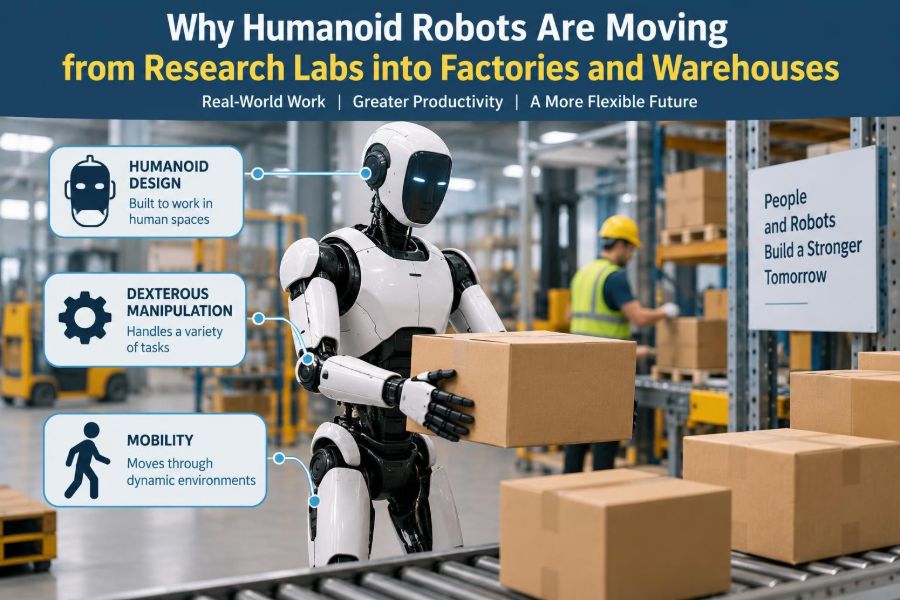
That is where humanoid robots are attracting attention. Their promise is not that they will instantly replace people, nor that a human-shaped machine is automatically the best tool. It is that a robot with a human-like body may operate in workplaces already built for human reach, walking paths, shelves, carts, tools, and safety procedures.
The move from demonstrations to pilots in factories and warehouses reflects a practical question: can a general-purpose machine safely perform enough useful work, reliably enough, to justify the effort of deploying it?
🏭 The shift from impressive demo to useful work
Humanoid robots have long been visible in research labs because they are difficult and scientifically interesting. Walking, balancing, grasping unfamiliar objects, and responding to a changing environment combine several hard robotics problems in one platform.
Industrial interest is growing because the target has become narrower and more practical. A robot does not need to cook dinner or navigate every public sidewalk to be useful. It may only need to move totes, place parts in fixtures, or transport empty containers within a defined facility.
Commercial value begins with repeatable task performance, not human-like appearance.
🧍 Why a human-shaped body can fit existing sites
Factories and warehouses have been built around human dimensions for generations. Their aisles, stairways, racks, worktables, carts, pallet stations, door handles, and hand tools assume a worker can walk, reach, bend, and manipulate objects with two hands.
A humanoid form can potentially use that infrastructure without a complete site redesign. Legs or a mobile base can travel between stations; arms can work at bench height; hands can use handles and containers intended for people.
This does not mean every workplace needs a biped. In many locations, wheels are simpler, faster, and more energy-efficient. The relevant advantage is compatibility with human-designed environments, especially where changing the building would be costly.
📦 Warehouses contain more variation than fixed automation likes
Traditional warehouse automation performs best when product dimensions, routes, and task sequences are stable. A highly tuned system can be remarkably fast at moving the same carton or tote through the same process.
Real operations also contain exceptions: damaged packaging, mixed item sizes, unexpected obstructions, seasonal assortments, and temporary workarounds. People handle these conditions by adjusting posture, grip, route, and sequence almost without thinking.
Humanoid robots are being explored for this middle ground: work that is repetitive but not perfectly uniform. The goal is not to beat specialized automation at its best task, but to cover tasks that are too variable for rigid equipment and too structured to require constant human judgment.
🔧 Factories have a different kind of flexibility problem
Manufacturing plants often use industrial robots behind safeguards for welding, painting, machine tending, and high-speed handling. These machines deliver excellent precision and throughput when their workspace and inputs are controlled.
Yet many factory jobs happen outside those cells. Workers fetch components, load small kits, inspect assemblies, connect simple fixtures, remove dunnage, and keep a line supplied. These activities may be physically modest but are spread across stations and change with product mix.
A mobile humanoid could be useful as an adaptable material-handling worker. Its value depends on whether it can complete the full loop—travel, perceive, pick up, carry, place, and recover from small errors—not merely perform one impressive grasp.
🧠 Embodied AI connects perception to action
A warehouse management system can know that an item should move from location A to location B. A humanoid robot still has to identify the real bin, see whether the path is clear, judge where to grasp the item, and place it without upsetting nearby objects.
This integration is often called embodied AI: intelligence operating through a physical body in a physical environment. It combines perception, planning, motion control, and feedback from sensors.
Language-capable software may help workers specify tasks or describe exceptions. But language alone does not make a robot competent. The machine needs grounded information from cameras, force sensors, joint encoders, and safety systems before it can act safely.
👁️ Seeing a workplace is not the same as understanding it
Modern computer vision can classify many objects and detect people, shelves, containers, and free space. Industrial settings remain challenging because lighting changes, labels are occluded, surfaces reflect light, and many objects look similar from a distance.
For manipulation, the robot must estimate more than an object category. It needs its pose—position and orientation—plus information about shape, accessibility, and likely stability. A partly hidden tote may be visible, yet impossible to grasp from the detected angle.
Robust systems combine visual estimates with task rules and sensor feedback. If the robot feels unexpected resistance, it should slow, stop, or re-evaluate rather than assume its camera model was correct.
✋ Hands remain one of the hardest design choices
Human hands are extraordinarily versatile. They can pinch a label, support a box from below, turn a latch, and adjust grip continuously. Replicating all of that dexterity with motors, gears, sensors, and durable materials is difficult.
Many useful industrial tasks do not require a fully human-equivalent hand. A simpler gripper may handle standardized tote rims, trays, cartons, or fixtures more reliably. Some humanoid platforms therefore use hands with limited fingers, robust fingertips, or task-specific attachments.
The best end effector is a trade-off among dexterity, speed, force control, maintenance, and cost. A robot intended for varied tasks needs broad capability, but it should not sacrifice reliability merely to look anatomically familiar.
⚖️ Balance matters whenever the load moves
Picking up an object changes the robot’s center of mass. Carrying it with one arm extended changes it again. For a biped, every reach is also a balance problem; a poorly planned motion can create a fall risk.
Control software continuously estimates body position, foot contact, joint motion, and load effects. It then adjusts posture and forces to remain stable. This is especially demanding on uneven floors, ramps, or during a shove from a passing cart.
A wheeled humanoid-like platform avoids some legged balance complexity, while still placing arms and sensors at human working heights. This is one reason the term “humanoid” covers a range of designs rather than one fixed body plan.
🦿 Walking is useful, but it is not automatically necessary
Bipedal locomotion can access stairs, narrow walkways, and layouts with floor obstacles that constrain conventional mobile robots. It also allows a machine to occupy similar footprints and reach ranges to a standing worker.
However, walking typically consumes substantial energy, introduces more moving joints, and increases the consequences of a fall. Smooth warehouse floors are often ideal for wheeled mobile bases.
A sensible deployment starts with the mobility the site actually demands. Choosing legs because they look advanced can be an expensive mistake. Choosing wheels where the job requires stairs or step-over access can be equally limiting.
🔋 Energy limits shape the real workday
Battery capacity affects far more than runtime. It determines how frequently a robot must charge, whether it can complete a shift segment, how much payload it can carry, and how much time is lost to charging or battery exchange.
Motion, onboard computing, cameras, cooling, and gripping all draw power. Dynamic walking and repeated lifting can increase energy use sharply compared with slow travel on level ground.
Operations therefore need a charging strategy. It may involve scheduled charging windows, automatic docking, swappable packs, or multiple robots rotating through a task. A useful business case counts these support activities rather than treating the robot as continuously available.
🧭 Autonomy is usually graduated, not absolute
“Autonomous” can describe very different operating modes. A robot might execute a tightly scripted route, select between a few approved task options, request help when uncertain, or operate under remote human supervision.
The right level depends on task risk and environmental variation. Early deployments often use constrained workflows, clear pickup and drop-off locations, and defined recovery procedures. This allows teams to learn where failures occur without exposing the robot to every possible exception.
| Operating approach | Best suited to | Human role |
|---|---|---|
| Scripted automation | Stable, repeated motions | Setup and exception response |
| Supervised autonomy | Variable but bounded tasks | Monitoring and remote assistance |
| Broad autonomy | Highly mature, well-validated operations | Oversight, maintenance, escalation |
Remote assistance is not necessarily a failure. It can be a deliberate bridge while systems gather the operational data needed to improve.
🧑💻 Teleoperation helps robots learn the difficult cases
Teleoperation means a person controls a robot from a distance, often through cameras, controls, and force feedback. In a warehouse, an operator may help the robot recover from an awkward grasp, identify a blocked location, or complete a new task sequence.
These interventions can provide examples for improving future behavior, provided data is collected and reviewed responsibly. They also reveal a central deployment question: how often does the robot need help, and can one person support several machines?
If every minor exception requires continuous human control, the system is not yet delivering the intended autonomy. If assistance is occasional and focused on unusual events, it may be operationally reasonable.
🛡️ Safety changes when robots share space with people
A conventional industrial robot often works behind a fence because it moves with high force and predictable paths. A humanoid intended for a warehouse may operate closer to pedestrians, forklifts, carts, and workers carrying loads.
That requires layered safety measures: speed limits, separation monitoring, obstacle detection, emergency stops, safe stopping behavior, and task-specific limits on force and payload. Physical design matters too; exposed pinch points, sharp edges, and unstable loads create hazards.
No sensor system eliminates risk. Cameras can be blocked, software can misclassify scenes, and people can behave unpredictably. Safety validation must consider realistic failure modes, not only normal operation.
🚦 A safe robot needs a predictable personality
Workers are safer around equipment whose behavior they can anticipate. A robot that signals intended movement, slows before shared intersections, keeps a clear travel zone, and stops consistently is easier to work alongside than one that moves abruptly.
Visual indicators, audible alerts, and clear operating rules can help, but they should not become noise people ignore. The most effective design reduces surprises at the motion-planning level.
Teams should also define who has authority to pause the system and how workers report unsafe behavior. Safety is a workplace process, not a feature that can be purchased once.
📏 Throughput must be measured as a complete task cycle
A video may show a robot picking an object successfully. Operations managers need a broader measure: how long it takes to travel, identify the correct item, handle it, place it, confirm completion, and recover when something goes wrong.
Cycle time also varies across shifts and conditions. A robot that works well with neatly presented totes may slow down when packaging is damaged or staging areas become crowded.
Useful pilots measure task completion, intervention frequency, quality errors, downtime, and safety-related stops. A fast motion is not the same as productive throughput.
🧪 Pilot projects should begin with bounded work
The strongest first applications tend to be repetitive, physically accessible, and easy to verify. Examples include moving empty totes between known stations, feeding standardized containers to a workstation, or transferring parts from a cart to a fixture.
The task should have clear success criteria and a safe fallback. If the robot cannot complete the job, a worker needs to be able to take over without disrupting the broader process.
- Choose items with manageable mass, shape, and grip surfaces.
- Limit early operating areas and document traffic patterns.
- Define what the robot should do when confidence is low.
- Record exceptions, rather than treating each as an isolated nuisance.
Starting small is not timid engineering. It is how an organization separates genuine capability from a polished demonstration.
🧩 Integration often matters more than the robot itself
A robot must fit into the operation’s digital and physical systems. It may need work orders from warehouse software, location data from inventory systems, permissions for doors or elevators, and status signals for conveyors or stations.
Physical interfaces matter just as much. Consistent tote placement, readable labels, suitable charging locations, and clear staging zones can make an application dramatically easier.
Many automation projects fail not because the machine cannot move, but because handoffs are ambiguous. Someone must decide what happens when inventory records disagree with the shelf, a tote is missing, or a station is unavailable.
🗂️ Better process design can simplify the robotics problem
Humanoid robots are often presented as a way to cope with messy workplaces. In practice, modest changes to the workplace can make them much more dependable without eliminating human flexibility.
Standardizing container types, marking pickup zones, improving lighting, reducing loose packaging, and separating pedestrian routes all reduce perception and planning uncertainty. These changes can also improve safety and efficiency for people.
The right question is not “Can the robot handle any mess?” It is “Which process improvements create a reliable human-robot system at reasonable cost?”
🔩 Maintenance is part of the automation workload
Humanoid machines combine many actuators, transmissions, sensors, cables, computers, and protective covers. Frequent starts, stops, impacts, dust, vibration, and heavy lifting can affect component life.
Maintenance teams need diagnostic tools, spare-part plans, calibration procedures, and training. They also need a safe method for moving or securing a disabled robot, particularly if it is large or carrying a load.
Availability—the proportion of scheduled time a system is ready to work—can matter as much as peak capability. A highly capable robot that is difficult to restore after a fault may not suit a high-tempo operation.
📊 The economics depend on the task, not the headline
Evaluating a humanoid robot requires more than comparing its purchase or service cost with a wage. The analysis should include deployment engineering, integration, facility changes, supervision, maintenance, charging, insurance considerations, and expected uptime.
Benefits may include more consistent execution, coverage of undesirable repetitive tasks, operation during difficult staffing periods, and the ability to reassign workers to quality, troubleshooting, or customer-facing work. Those benefits vary widely by site.
A credible calculation asks where the robot creates value over its useful operating life and where specialized automation, ergonomic equipment, or better process design would be a cheaper answer.
👷 Jobs will change before they disappear
When a robot takes over a task, the surrounding work often changes. Workers may stage materials, resolve exceptions, inspect outputs, maintain equipment, train systems, or redesign workflows. New technical roles can emerge, but transition support is not automatic.
Organizations should be careful not to describe all automation as either replacement or liberation. A task may be removed while workload pressure simply shifts elsewhere. The effects depend on staffing decisions, production targets, and whether employees have a voice in implementation.
Involving frontline workers early is practical as well as fair. They understand the awkward cases, unsafe shortcuts, and hidden dependencies that are rarely visible in a process diagram.
🧍♀️ Ergonomics is a strong early-use case
Repetitive lifting, extended reaching, bending, and carrying can contribute to fatigue and injury risk, particularly when shifts are long or work pace is high. Robots may help with portions of jobs that place consistent physical demand on people.
But a robot does not automatically solve ergonomics. If workers must repeatedly rescue failed picks, reposition difficult loads, or work around poorly planned traffic flows, the physical burden may simply move.
Good evaluation looks at the whole task: what motions disappear, what new motions appear, and whether workstations become more or less comfortable for the people who remain involved.
🌐 Labor constraints are a driver, but not a complete explanation
Many operations struggle with recruiting and retaining staff for repetitive, physically demanding, or inconvenient shifts. That pressure makes flexible automation more attractive, especially where demand fluctuates.
Still, labor availability alone does not make a deployment successful. A poorly matched robot creates new work in supervision and recovery. Better pay, training, scheduling, and workplace conditions may also improve retention and should remain part of the conversation.
Humanoids are most plausible where there is both a persistent operational need and a task structure that matches current capability.
🧱 Purpose-built machines still have major advantages
A humanoid is not a universal replacement for conveyors, autonomous mobile robots, robotic arms, palletizers, or specialized grippers. Dedicated equipment can be faster, more reliable, easier to validate, and less expensive when the task is stable.
For example, a fixed palletizing cell may be preferable when box sizes and stacking patterns are known. A small autonomous mobile robot may be better for repeated tote transport across a flat floor.
Humanoids make the most sense where their reach, mobility, and ability to interact with existing human-oriented interfaces reduce the cost of handling variation. The best facility may use several robot types together.
⚠️ Common deployment mistakes to avoid
One mistake is choosing a glamorous task rather than a valuable one. Another is assuming that a successful demonstration proves performance through every shift, season, and exception condition.
Teams also underestimate change management. Workers need training, clear escalation paths, and confidence that safety concerns will be acted on. IT and operations teams need responsibility boundaries for data, access, updates, and cybersecurity.
- Do not measure only successful picks while ignoring recoveries.
- Do not deploy near people before validating stop behavior and routes.
- Do not force a robot into an unstable process that people struggle to run.
- Do not treat vendor capability claims as a substitute for site testing.
🔐 Connected robots introduce cybersecurity concerns
Robots exchange data with scheduling software, fleet-management tools, remote support systems, and sometimes cloud-based services. That connectivity can improve monitoring and updates, but it expands the system’s attack surface.
Access control, network segmentation, software update practices, logging, and incident response matter because a compromised system could affect operations and potentially safety. The required controls depend on the facility and architecture, but cybersecurity should be considered during design rather than after installation.
A useful principle is to give each system only the access it needs to perform its role, then review that access as the deployment grows.
📚 Skills for engineers entering this field
Humanoid robotics sits at the intersection of mechanical engineering, electrical systems, controls, perception, software, human factors, and operations. Few people need to master every specialty, but effective teams understand how decisions in one layer affect the others.
Students can build useful foundations in kinematics, dynamics, feedback control, embedded systems, computer vision, motion planning, and safety engineering. Working professionals can add value by learning process mapping, reliability analysis, and data-driven pilot evaluation.
Equally valuable is the habit of visiting the real work area. A layout drawing rarely shows worn labels, reflective wrap, temporary carts, or the informal practices that determine whether automation survives contact with operations.
🔮 What progress will probably look like
Near-term progress is likely to be incremental: more robust picking, better recovery from routine errors, longer practical operating periods, smoother integration, and deployment across a growing set of bounded tasks.
It is less realistic to expect a single robot to arrive and immediately perform every job a person can do. Human work draws on broad context, social coordination, improvisation, and responsibility that remain difficult to encode and validate.
The important signal is not whether robots look more human in videos. It is whether they become boringly dependable at useful work under normal industrial constraints.
🧭 A practical decision framework for operations teams
Before selecting a humanoid platform, define the problem in operational terms. Describe the objects, routes, workload variation, failure consequences, staffing pattern, and handoffs with other systems.
- Map the current task, including exceptions and physical constraints.
- Compare specialized automation, process redesign, and humanoid options.
- Run a limited pilot with measurable safety, quality, and availability goals.
- Review intervention data and worker feedback before expanding scope.
- Scale only when the total workflow—not just the robot—performs reliably.
This approach protects against both hype and excessive caution. It allows a promising technology to earn a larger role through evidence from the actual workplace.
✅ The core takeaway: fit capability to the work
Humanoid robots are moving toward factories and warehouses because many facilities are designed for human bodies, while operations increasingly need adaptable help with structured physical tasks. Advances in sensing, controls, computing, and remote support have made carefully bounded deployments more plausible.
Yet the central engineering challenge is not to build a machine that resembles a person. It is to create a safe, maintainable, economically sensible system that handles real variability and works well with the people and equipment already on site.
The winning humanoid applications will be the ones where human-compatible form, reliable task performance, and thoughtful workflow design solve a specific operational problem together.
Humanoid robots are becoming industrial tools not because every workplace needs a mechanical person, but because some human-built environments contain tasks where adaptable physical automation finally has a credible place. 🦾🏭📦