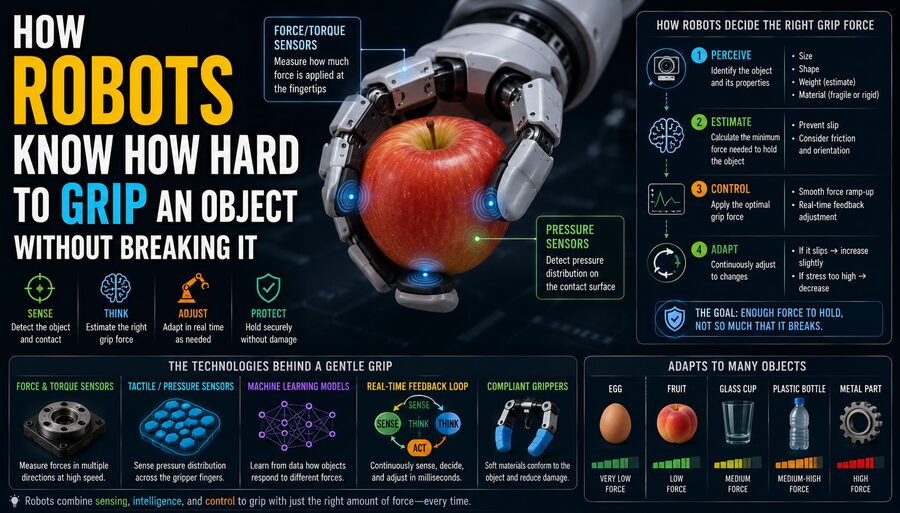

Picking up an object seems effortless for a human. 🖐️ You can hold a paper cup without crushing it, lift a heavy bottle without dropping it, and pick up a fragile egg with just enough pressure to keep it secure.
For a robot, however, this is a surprisingly difficult engineering problem.
A robotic gripper must determine how much force is enough to prevent an object from slipping—but not so much that the object is damaged. The correct force can vary dramatically depending on whether the robot is handling a steel component, a cardboard box, a strawberry, a glass vial, or an electronic component.
Modern robots solve this challenge using a combination of force sensors, tactile sensors, motor feedback, cameras, control algorithms, object models, and increasingly machine learning.
The fundamental idea is a closed feedback loop:
Grip → Measure → Adjust → Measure again
Instead of applying one fixed amount of force and hoping for the best, advanced robotic systems continuously monitor what is happening at the fingertips and adjust their grip in real time. ⚙️🧠
✋ Why Robotic Gripping Is Hard
A simple industrial gripper might consist of two mechanical fingers that move toward each other.
If the robot closes the fingers too weakly, the object may slip.
If it closes them too strongly, the object may:
- Crack
- Bend
- Dent
- Deform
- Burst
- Become scratched
The robot therefore faces two competing requirements:
Grip force must be high enough to resist slipping.
Grip force must remain below the object’s damage limit.
Humans make these adjustments almost unconsciously because our fingers contain highly sensitive nerves.
Robots need sensors and control systems to achieve something similar.
🧠 Humans Provide the Inspiration
Imagine picking up a glass.
Your brain does not calculate an exact force in newtons before your fingers close.
Instead, your nervous system combines information from:
- Touch
- Pressure
- Finger position
- Muscle tension
- Visual appearance
- Past experience
If the glass begins slipping, your fingers automatically tighten.
If the object feels delicate, you instinctively use less force.
Roboticists try to reproduce this behavior through feedback control.
The robot continually senses the interaction between its gripper and the object and changes its motor commands accordingly.
⚖️ The Basic Physics of Gripping
Suppose a robot uses two fingers to lift an object vertically.
Gravity pulls the object downward.
Friction between the robot’s fingertips and the object’s surface prevents it from sliding.
A simplified relationship is:
Available friction ≈ Friction coefficient × Normal grip force
The robot therefore needs enough normal force to create sufficient friction.
If the object becomes heavier, greater friction may be required.
If the surface is slippery, the friction coefficient is lower, so more grip force may be necessary.
This is why a robot may need more force to hold a smooth metal object than a similarly weighted rubber-covered object.
🛡️ Engineers Use a Safety Margin
Robots generally should not operate exactly at the theoretical minimum grip force.
If the calculated force is barely sufficient, a small vibration or unexpected acceleration could make the object slip.
Engineers therefore apply a safety margin.
Conceptually:
Minimum grip needed × Safety factor = Commanded grip
However, the safety factor cannot be excessively large for fragile objects.
A steel block may tolerate a strong grip.
A strawberry may not. 🍓
The control system must balance gripping reliability with object protection.
🔧 Force Sensors Measure Contact Pressure
One common solution is installing force sensors in the robotic gripper.
These sensors can measure how strongly the fingers press against an object.
Technologies may include:
- Strain gauges
- Piezoelectric sensors
- Capacitive force sensors
- Load cells
- Force-torque sensors
Suppose the robot is instructed to grip with 10 newtons of force.
The motors begin closing the fingers.
The force sensor reports:
2 N → 5 N → 8 N → 10 N
When the target force is reached, the controller stops increasing the motor command.
This is called force control.
🧱 What Is a Load Cell?
A load cell is a sensor that measures force.
Many load cells contain small structures that deform extremely slightly when loaded.
Strain gauges attached to the structure detect this deformation.
The deformation changes the electrical resistance of the gauges.
Electronics convert the resistance change into a force measurement.
Because the deformation is tiny, a load cell can measure force accurately without visibly bending.
Load cells are widely used in:
- Robotic grippers
- Industrial scales
- Manufacturing machines
- Material testing systems
🖐️ Tactile Sensors Give Robots a Sense of Touch
Force sensors can tell a robot the overall gripping force, but advanced robots often need more detailed information.
This is where tactile sensors become valuable.
A tactile sensor acts somewhat like electronic skin.
It can measure how pressure is distributed across the surface of the robotic fingertip.
Instead of simply reporting:
Grip force = 8 N
a tactile array might report:
Higher pressure here → Lower pressure there → Contact edge detected
This helps the robot understand exactly how the object is touching the gripper.
🧩 Pressure Distribution Reveals Object Shape
Imagine a robot gripping a round orange. 🍊
A tactile sensor may detect a curved pressure pattern.
Now imagine the same robot gripping a rectangular box.
The contact pattern looks different.
Tactile data can help estimate:
- Shape
- Contact area
- Object orientation
- Grip stability
- Localized pressure
This information is particularly useful when handling irregular or deformable objects.
🚨 Detecting Slip Is Extremely Important
One of the most important abilities of robotic fingers is detecting when an object begins to slip.
A slipping object produces subtle changes in:
- Contact force
- Vibration
- Pressure pattern
- Surface motion
Some tactile sensors can detect tiny vibrations created when an object starts moving relative to the fingertip.
The controller may respond almost immediately:
Slip detected → Increase grip force slightly
This is similar to what human fingers do automatically.
📈 Grip Force Can Increase Gradually
A safe robot often does not immediately clamp an unknown object with maximum force.
Instead, it may use progressive gripping.
For example:
1. Close fingers gently.
2. Detect first contact.
3. Increase force slightly.
4. Lift object slowly.
5. Monitor for slip.
6. Increase force only if necessary.
This approach reduces the risk of damaging fragile objects.
It also allows the robot to learn something about the object’s mechanical behavior during contact.
🥚 Fragile Objects Need Compliance
Handling a metal gear is very different from handling an egg.
An egg has a relatively thin shell and can crack under concentrated pressure.
Robotic grippers designed for delicate objects often use compliant materials.
Compliance means the gripper can deform slightly.
Soft materials such as rubber or silicone spread force over a larger area.
Instead of concentrating pressure at one tiny point:
Small contact area → High pressure
the gripper creates:
Larger contact area → Lower pressure
This helps protect fragile surfaces.
🫧 Soft Robotics Makes Gripping Gentler
Some robots use soft robotic grippers made from flexible materials.
Instead of rigid metal fingers, the gripper may contain:
- Silicone structures
- Inflatable chambers
- Flexible membranes
Air pressure can cause the fingers to bend around an object.
Because the material naturally conforms to the object’s shape, the force becomes distributed over a larger area.
Soft grippers are useful for handling:
- Fruit 🍎
- Baked goods
- Delicate packages
- Biological materials
- Irregular objects
They are especially attractive in food processing and agriculture.
🌱 Robots Picking Fruit Need Exceptional Sensitivity
Agricultural robots face a difficult challenge.
A ripe tomato can be:
- Soft
- Slippery
- Irregular
- Easily bruised
A harvesting robot might first use cameras to identify the fruit.
Then it estimates the fruit’s size and position.
The gripper approaches slowly.
Tactile sensors detect contact.
The controller applies enough force to stabilize the tomato without bruising it.
If the fruit begins slipping, the force may increase only slightly.
This requires close coordination between vision, touch, and motion planning. 🍅🤖
👁️ Cameras Help Estimate What the Object Is
Robots often use cameras before touching an object.
Computer vision can help classify the object.
If the robot recognizes:
Glass bottle
it may use one grip strategy.
If it recognizes:
Foam cup
it may use another.
Vision systems can estimate:
- Object size
- Shape
- Orientation
- Surface appearance
- Possible material
This gives the robot an initial guess for a safe gripping force.
🧠 Object Models Provide Expected Grip Limits
In highly structured industrial environments, engineers may already know the properties of every object.
A database can store information such as:
Part A → 15 N recommended grip
Part B → 40 N recommended grip
Part C → Fragile → 5 N maximum
The robot retrieves the appropriate values when the production system tells it which object is arriving.
This works very well in factories where parts are standardized.
But robots operating in unpredictable environments need more adaptive methods.
⚙️ Motor Current Can Estimate Grip Force
Not every robot requires dedicated fingertip force sensors.
Electric motors produce torque that depends partly on electrical current.
If the gripper motor requires more current while closing, the controller can infer that the fingers are encountering resistance.
With a calibrated mechanical model:
Motor current → Motor torque → Finger force
This provides an approximate measurement of grip force.
It may not be as precise as dedicated force sensing, but it can be useful for many industrial applications.
🔄 Encoders Measure Finger Position
Robotic motors often contain encoders that measure position.
Suppose the robot knows its fingers normally close fully when nothing is between them.
If the fingers stop at a wider position, the robot knows they have contacted something.
Finger position can also help estimate object width.
For example:
Finger separation = 60 mm
may suggest the object is roughly that width at the contact point.
Position feedback combines with force measurements to provide a richer understanding of the grasp.
📐 Force and Position Control Must Work Together
Robotic gripping often requires both:
Position control and force control.
During the approach, position control moves the fingers toward the target.
Once contact occurs, force control regulates pressure.
A simplified transition is:
Move to object → Detect contact → Switch to force regulation
This hybrid approach prevents the gripper from continuing to move rigidly after touching the object.
Without it, a position-controlled gripper might continue trying to reach an impossible commanded position and generate excessive force.
🛋️ Compliance Can Also Be Created in Software
A robot does not always need physically soft fingers to behave gently.
Control algorithms can make a rigid robot act more compliantly.
One technique is impedance control.
Instead of commanding the robot to hold one exact position regardless of external forces, the controller behaves somewhat like a virtual spring.
If the object pushes back, the robot allows some movement.
This creates controlled softness.
Engineers can tune the virtual:
- Stiffness
- Damping
- Response
This is valuable when robots interact directly with uncertain objects or people.
🧽 Deformable Objects Reveal Their Own Stiffness
Some advanced systems can estimate how soft an object is while gripping it.
Imagine the fingers move inward by 2 millimeters and force increases only slightly.
The object is probably soft.
If a tiny displacement creates a large force increase, the object is relatively stiff.
Conceptually:
Force change ÷ Deformation = Approximate stiffness
This information allows the robot to adjust its behavior.
A soft object may require a larger contact area and more careful deformation limits.
📉 Detecting Excessive Deformation
For delicate objects, force alone may not tell the full story.
Imagine a sponge and a hollow plastic cup.
Both might tolerate the same total force differently.
The sponge can deform significantly without damage.
The cup may suddenly buckle.
Some robotic systems therefore monitor:
- Force
- Finger displacement
- Object shape
- Tactile pressure
If the object’s deformation exceeds a safe threshold, the robot can reduce force immediately.
📷 Vision Can Measure Deformation Too
Cameras can sometimes see an object changing shape.
Suppose a robot grips a soft package.
A vision system may compare:
Shape before gripping and shape during gripping
If the package is being compressed excessively, the controller can loosen the grip.
This combination of vision and force sensing is known broadly as sensor fusion.
Multiple sensors compensate for each other’s limitations.
🔗 Sensor Fusion Makes Gripping More Reliable
One sensor rarely provides everything the robot needs.
A sophisticated gripper may combine:
Camera → Where is the object?
Encoder → Where are the fingers?
Force sensor → How hard am I pressing?
Tactile sensor → Where am I touching?
Slip sensor → Is the object moving?
The controller combines these signals to determine the correct action.
This layered perception makes robotic manipulation much more robust.
📦 Boxes Require Different Grip Strategies
Consider a warehouse robot picking cardboard boxes.
A heavily loaded box needs significant grip force to prevent slipping.
But excessive pressure can crush the cardboard.
The robot may estimate package weight from:
- Order data
- Previous lifting force
- Robot joint torque
It may then apply the minimum secure grip with an additional safety margin.
If tactile sensors detect the cardboard beginning to deform, the controller may adjust.
Warehouse robotics therefore requires a balance between speed and careful force control. 📦
💊 Pharmaceutical Handling Requires Precision
Robots in pharmaceutical and laboratory environments may handle:
- Glass vials
- Sample tubes
- Syringes
- Containers
These objects can be fragile and sometimes expensive or hazardous.
Grippers may therefore use:
- Precision force sensors
- Soft fingertip materials
- Carefully limited closing speeds
- Automatic failure detection
If an object is unusually positioned, the robot may reject the grasp rather than applying more force.
In some situations, knowing when not to grip harder is just as important as determining how much force to use.
🔩 Industrial Metal Parts Allow Stronger Grips
At the opposite extreme, manufacturing robots may handle heavy metal components.
These parts usually tolerate much higher force.
The major concern may be preventing the part from slipping while the robot accelerates.
Grip calculations may include:
- Object mass
- Acceleration
- Surface friction
- Gripper orientation
- Safety factor
A robot moving quickly needs more holding force than one lifting the same object slowly.
This is because acceleration creates additional forces.
🏎️ Robot Motion Changes Required Grip Force
Imagine holding a glass of water while standing still.
Now imagine moving your hand suddenly sideways.
You instinctively grip more firmly.
Robots face the same physics.
When the arm accelerates, the gripper must prevent the object from sliding due to inertia.
Therefore, the required gripping force can change during the motion.
Advanced controllers may coordinate:
Robot acceleration ↔ Required gripping force
This allows faster manipulation without unnecessarily crushing the object.
🧲 Some Robots Avoid Gripping Force Entirely
Not every object needs to be squeezed.
Alternative end-effectors include:
- Vacuum suction cups
- Magnetic grippers
- Electrostatic grippers
A vacuum cup can lift a smooth box or sheet by creating a pressure difference.
A magnetic gripper can lift ferromagnetic steel components.
These techniques reduce the need to compress the object between mechanical fingers.
However, each has its own limitations.
Vacuum systems require suitable surfaces, while magnets only work on certain materials.
🫙 Vacuum Grippers Monitor Suction Pressure
A vacuum gripper also needs feedback.
A pressure sensor can determine whether the suction cup has formed a good seal.
Conceptually:
Vacuum established → Safe to lift
If pressure suddenly changes:
Seal lost → Object may be slipping
The robot can stop or lower the object safely.
This is another example of feedback replacing guesswork.
🧠 Machine Learning Can Learn Gripping Strategies
Traditional robot control relies heavily on mathematical models and predetermined parameters.
Increasingly, researchers use machine learning to help robots learn successful grasps.
A robot may be trained on examples containing:
- Images
- Grip locations
- Tactile data
- Applied force
- Whether the object slipped
- Whether it was damaged
Over many trials, the system can learn which grip strategies work best for different objects.
This is particularly useful when object properties are difficult to model explicitly.
🎓 Robots Can Learn From Failed Grasps
Failure provides valuable training information.
Suppose:
Grip = 3 N → Object slips
The system learns that this force was insufficient.
Later:
Grip = 12 N → Object deforms excessively
That force was too high.
After repeated attempts, the robot can learn a safe region such as:
5–8 N
This process resembles how humans gradually learn to handle unfamiliar objects.
🤝 Collaborative Robots Need Even More Force Awareness
Collaborative robots, or cobots, are designed to operate near humans.
Force control becomes particularly important because the robot may accidentally contact:
- A hand
- An arm
- Another worker
Cobots may contain force and torque sensors in their joints.
If unexpected resistance is detected, the robot can slow down or stop.
The same underlying principles that allow gentle object handling also contribute to safer human-robot interaction.
🦾 Force-Torque Sensors Measure More Than Grip
A multi-axis force-torque sensor can measure both forces and twisting moments.
It may detect forces along several directions:
- Left/right
- Forward/backward
- Up/down
and torques around multiple axes.
This allows the robot to determine not only whether an object is heavy but also whether it is tilting or producing an unexpected twisting load.
Such sensors are useful for:
- Precision assembly
- Polishing
- Robotic surgery
- Complex manipulation
🔩 Assembly Robots Need Delicate Contact
Consider inserting one mechanical part into another.
The robot cannot simply push as hard as possible.
If the pieces are slightly misaligned, high force could damage them.
Instead:
Move → Detect contact → Adjust angle → Apply controlled force → Insert
Force feedback allows the robot to feel its way into position.
This is similar to how a person gently wiggles a connector until it fits.
🧬 Robotic Surgery Demands Extremely Fine Control
Medical robotics represents one of the most demanding applications of force control.
Tissues are soft and can be damaged by excessive pressure.
Surgical systems may use carefully controlled motions and specialized sensing to help limit applied forces.
The acceptable force may be far smaller than in industrial manufacturing.
Medical robotics therefore emphasizes:
- Precision
- Smooth movement
- Force limitation
- Extensive validation
The broader lesson is that safe grip force depends strongly on the application.
⚠️ The Robot May Not Know an Object’s Strength
A major difficulty is that visual appearance does not always reveal mechanical strength.
Two identical-looking packages could contain different contents.
A fruit may be firm one day and extremely ripe the next.
A plastic component could have an invisible crack.
Therefore, robots cannot always rely on preprogrammed force values.
Adaptive gripping provides a safer solution:
Begin gently → Measure response → Increase only as required
This strategy minimizes risk when the object is uncertain.
🧪 Engineers Test Grippers With Many Objects
Before deployment, robotic grippers are tested using representative objects.
Engineers may measure:
- Minimum force before slip
- Maximum force before damage
- Friction
- Surface deformation
- Sensor accuracy
- Repeatability
They also test difficult cases:
- Wet surfaces
- Dusty objects
- Unexpected orientation
- Different sizes
- Different temperatures
Robust gripping requires successful operation across natural variation, not just one perfect laboratory object.
🌡️ Temperature Can Affect Gripping
Materials change with temperature.
Rubber fingertips may become softer or harder.
Food products may change firmness.
Lubricants can alter surface friction.
Sensors themselves can also drift slightly as temperature changes.
Industrial robots operating in cold storage, foundries, or outdoor environments may therefore need compensation for environmental conditions.
🧴 Surface Contamination Changes Friction
Oil, water, dust, and grease can dramatically change the friction between a gripper and an object.
A grip that works perfectly on a dry metal component might slip when the component is oily.
Robots may compensate by:
- Detecting slip
- Increasing force within safe limits
- Using textured fingertips
- Selecting a different gripping method
Again, continuous feedback is much safer than relying entirely on a fixed force.
🧮 A Simplified Grip-Control Example
Imagine a robot needs to lift a delicate plastic cup.
Its control process might look like this:
1. Camera identifies the cup. 👁️
2. Robot approaches slowly.
3. Fingers close until tactile sensors detect contact. ✋
4. Grip force rises to a low initial value.
5. Robot begins lifting. ⬆️
6. Slip sensors monitor the cup.
If no slipping occurs:
Maintain force.
If slipping begins:
Increase force slightly.
If excessive deformation is detected:
Reduce force or stop.
The entire process may be repeated many times per second.
🔁 Closed-Loop Control Is the Key
The central engineering concept behind intelligent gripping is closed-loop control.
An open-loop gripper might simply receive:
Close motor for 0.5 seconds
and assume everything worked.
A closed-loop system instead asks:
How much force am I applying?
Is the object moving?
Is it deforming?
Should I increase or decrease pressure?
The controller continuously compares the desired condition with sensor measurements.
Conceptually:
Desired grip → Motor command → Object response → Sensor measurement → Correction
This feedback loop is the foundation of precise robotic manipulation.
🚀 Why Robotic Gripping Is Improving Rapidly
Robotic hands were once relatively simple.
Modern systems benefit from major advances in:
- Smaller sensors
- Better cameras
- Faster processors
- Artificial intelligence
- Soft materials
- Improved control algorithms
Some research robotic hands contain many tactile sensing points and multiple independently controlled fingers.
Their goal is not merely to grab an object.
It is to manipulate objects with increasingly human-like dexterity.
Tasks can include:
- Rotating objects
- Repositioning fingers
- Opening containers
- Using tools
- Handling deformable materials
Accurate grip-force control is essential for all of these abilities. 🤖🖐️
🧠 Robots Still Have a Long Way to Go
Humans remain remarkably good at manipulating unfamiliar objects.
You can pick up a new object and rapidly infer whether it is:
- Heavy
- Fragile
- Slippery
- Soft
- Flexible
Robots still find this general adaptability difficult.
Industrial robots excel when objects and environments are predictable.
Handling arbitrary household objects remains a major robotics research challenge.
Better tactile sensing and AI are gradually narrowing this gap.
✅ Final Thoughts
Robots know how hard to grip an object by combining physics, sensing, feedback, and experience. 🤖✋
They may begin with an estimated force based on an object’s size, weight, material, and expected friction.
Force sensors then measure how strongly the fingers press.
Tactile sensors reveal where pressure is being applied.
Motor-current measurements can estimate mechanical load.
Encoders track finger position.
Slip sensors detect the first signs that an object is moving.
Cameras provide information about shape and deformation.
The controller combines these signals and continuously adjusts the grip.
For fragile objects, soft materials and compliant control spread pressure and prevent crushing. For heavy objects, the robot increases force enough to resist gravity and acceleration. For unfamiliar objects, adaptive strategies allow the system to begin gently and strengthen its grip only when necessary.
The central principle is simple:
Use the smallest force that keeps the object securely under control. 🛡️
That principle applies whether a robot is holding a steel engine component, sorting cardboard packages, harvesting tomatoes, handling laboratory glassware, or assisting with delicate medical procedures.
What looks like a simple robotic hand closing around an object is actually a rapid conversation between sensors, motors, control software, mechanical design, and the laws of friction.
And as tactile sensing and artificial intelligence continue improving, robots are becoming increasingly capable of doing something humans rarely think about at all:
knowing exactly how firmly to hold on—and when to loosen their grip. 🦾✨