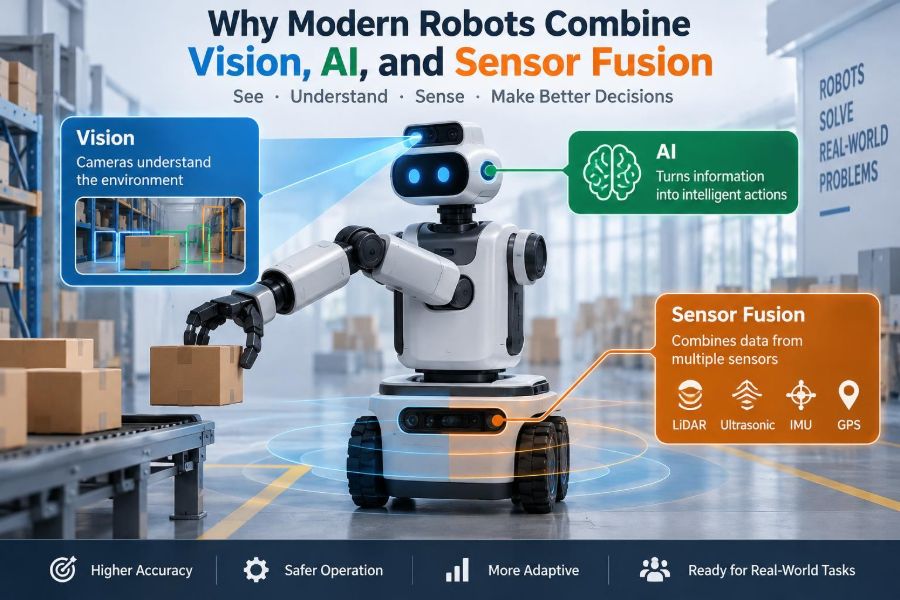

A warehouse robot rolls toward a pallet. Its camera sees a cardboard box, its depth sensor estimates the distance, its wheel encoders report motion, and an onboard model decides whether the box is safe to pick up. None of those signals alone is enough to make the decision reliable.
The same pattern appears in robot vacuums avoiding cables, agricultural machines identifying crops, surgical systems tracking instruments, and mobile robots navigating busy corridors. Real environments are messy: light changes, surfaces reflect, people move unpredictably, and sensors occasionally disagree.
Modern robots therefore combine vision, artificial intelligence, and sensor fusion. Together, these capabilities help a machine turn raw measurements into a useful, continually updated understanding of its surroundings.
This is not simply a matter of adding more sensors. The engineering challenge is deciding what each sensor can contribute, how much to trust it, and what the robot should do when information is uncertain.
🧭 Robots Need a Model of Reality
A robot acts through motors, but it makes decisions from measurements. Before it can grasp an object, steer around a person, or inspect a weld, it needs an estimate of what exists around it and where it is.
Engineers often call this estimate the robot’s state. Depending on the task, state may include position, speed, orientation, nearby obstacles, object identities, and the condition of the robot itself.
Measurements are never a perfect copy of reality. A camera can be blurred, a GPS receiver can be inaccurate indoors, and a wheel can slip. Combining evidence is how robots maintain a workable state estimate despite these imperfections.
👁️ Vision Gives Robots Rich Environmental Detail
Cameras provide dense visual information. A single image can contain labels, colors, edges, textures, hand positions, product barcodes, lane markings, and signs of damage.
For people, recognizing a mug on a cluttered desk feels effortless. For a robot, the visual scene must be transformed into structured information: pixels become candidate objects, object boundaries, poses, or safe grasp points.
Vision is especially valuable because it observes information that many range sensors cannot express. A depth reading may reveal a vertical surface, while an image can help distinguish a glass door from a painted wall.
📷 Cameras Are Powerful but Not Self-Sufficient
A standard camera measures light projected onto a two-dimensional image plane. It does not directly reveal distance. A small nearby object and a large distant object can occupy similar areas in an image.
Cameras also depend strongly on conditions. Low light adds noise, direct sun can create glare, shadows change apparent color, and motion can smear details during exposure.
These limitations do not make cameras unsuitable for robotics. They explain why camera-based systems are usually paired with depth, motion, or proximity measurements rather than asked to solve every perception problem alone.
📐 Depth Turns Images into Spatial Evidence
Robots need geometry: how far away is the shelf, where does the floor end, and how high is the handle? Depth cameras, stereo camera pairs, lidar, radar, and time-of-flight sensors can contribute distance estimates.
A stereo system estimates depth by comparing the apparent location of features in two images. A lidar measures distance using emitted light, while radar uses radio waves and can remain useful in conditions that challenge optical sensors.
Each method has trade-offs. Reflective, transparent, dark, or distant surfaces can confuse particular sensors, so the choice depends on the task and operating environment.
🧠 AI Extracts Meaning from Sensor Data
Raw sensor readings do not automatically tell a robot what matters. Artificial intelligence, particularly machine learning, is often used to recognize patterns in images, point clouds, audio, or combined sensor streams.
A perception model might classify an object as a person, identify a defect on a manufactured part, segment drivable ground from vegetation, or estimate the pose of a tool. These tasks are often difficult to specify using fixed hand-written rules.
AI supplies interpretation, not certainty. A model produces an estimate based on training data and current inputs. Sound robotic design treats that estimate as evidence with limits, not as an unquestionable fact.
🧩 Sensor Fusion Combines Complementary Evidence
Sensor fusion is the process of combining measurements from multiple sensors to form a better estimate than one measurement would provide alone. It can happen at the level of raw signals, extracted features, or final decisions.
Consider a delivery robot approaching a curb. A camera may identify the curb edge, a depth sensor may estimate its height, an inertial measurement unit may report the robot’s tilt, and wheel encoders may measure traveled distance. Fusion connects these partial observations.
The goal is not always to average inputs. Good fusion accounts for what each sensor measures, when it measured it, and how reliable it is likely to be in the current situation.
🔄 Perception Is a Continuous Feedback Loop
Robots do not perceive one frame and then stop. They repeatedly sense, estimate, plan, move, and sense again. Movement changes the viewpoint and may reveal information that was previously hidden.
A mobile robot that is uncertain whether an aisle is blocked can slow down and collect more observations. A robotic arm can move its wrist camera to reduce occlusion before attempting a grasp.
This loop connects perception to control. Better sensing supports safer action, while well-chosen action can create better sensing.
🧭 Localization Answers “Where Am I?”
Localization is the problem of estimating a robot’s position and orientation in a known or partially known environment. It is foundational for navigation, repeatable inspection, and coordinated fleets.
Wheel encoders provide useful short-term motion information, but accumulated wheel slip causes drift. An IMU measures acceleration and rotation, but small biases also accumulate when its readings are integrated over time.
Cameras, lidar, map landmarks, GPS where available, and radio-based positioning can correct that drift. Fusion is what allows these sources to work together across different time scales.
🗺️ Mapping Lets Robots Work in Unfamiliar Places
When a robot must build a map while simultaneously estimating its own position, it faces a problem commonly called SLAM: simultaneous localization and mapping.
In a warehouse, the robot might use walls, racks, and visual features as landmarks. In a field, it may rely on terrain structure, GNSS data, and crop rows. The useful map depends on what the robot needs to do.
Maps are rarely permanent. Furniture moves, aisles are rearranged, and lighting changes. Practical systems must decide which parts of a map are stable enough to trust and which must be updated.
⏱️ Timing Errors Can Break Good Perception
Sensors operate at different rates. An IMU may produce frequent motion readings, a camera may capture images less often, and a lidar may scan over a period rather than all at once.
If a robot is moving and timestamps are misaligned, measurements that describe different moments can be treated as if they occurred together. An obstacle may appear in the wrong place, or a detected object may fail to line up with depth data.
Accurate clocks, timestamp handling, and delay estimation are therefore core perception requirements. A sophisticated model cannot fully repair badly synchronized input.
📏 Calibration Connects the Sensors
Calibration determines how a sensor’s readings relate to physical reality. Camera calibration estimates properties such as focal length and lens distortion. Extrinsic calibration determines where one sensor is mounted relative to another.
For example, if a camera is believed to sit two centimeters from its actual position relative to a lidar, projected lidar points may not match visible object edges. That error can affect object tracking and grasp planning.
Calibration can drift after vibration, impacts, repairs, or thermal changes. Engineers should treat it as a maintained property of the system, not a one-time setup task.
🎯 Confidence Matters as Much as the Estimate
A robot should represent not only its best estimate but also its uncertainty. “The obstacle is about three meters ahead” is different from “the obstacle is probably between two and four meters ahead.”
Uncertainty-aware systems can behave more cautiously when conditions deteriorate. They may slow down, increase following distance, request human review, switch sensors, or stop if the remaining evidence is inadequate.
This principle is particularly relevant near people, expensive equipment, or hazardous processes. The correct response to uncertainty is not always more aggressive AI; it is often a safer operating policy.
🚶 Tracking Helps Robots Understand Motion
Object detection identifies what may be present in a single observation. Tracking connects those detections over time and estimates where objects are likely to move next.
A factory robot sharing space with workers needs more than a box around a person in one camera frame. It needs a stable estimate of the person’s position, walking direction, and possible path.
Fusion improves tracking because motion sensors, depth, visual appearance, and repeated observations can reinforce one another. It also helps prevent a brief camera occlusion from being interpreted as an object vanishing.
🤖 Manipulation Requires Fine-Grained Perception
Navigation can often tolerate approximate geometry. Manipulation is less forgiving. To insert a connector, pick a flexible package, or place a component precisely, a robot needs detailed pose and contact information.
Vision helps locate objects and estimate orientation. Force-torque sensors, tactile arrays, motor current, and joint encoders add evidence once the gripper approaches or touches the object.
A useful rule is that visual perception guides the approach, while contact sensing often verifies the final interaction. Trying to perform delicate contact tasks with vision alone can be fragile.
🏭 Industrial Robots Use Fusion Differently
In structured industrial cells, robots may work with fixed fixtures, controlled lighting, and known part locations. This reduces uncertainty and can make simple sensing strategies highly effective.
Yet modern factories increasingly handle mixed products, variable packaging, mobile platforms, and human collaboration. Vision and AI allow more flexibility, while sensor fusion helps maintain consistency when objects are not perfectly presented.
The appropriate solution is task-specific. A fixed machine tending one repeatable part may not need the sensor stack required by an autonomous mobile manipulator.
🌾 Outdoor Robots Face Changing Conditions
Outdoor machines encounter rain, dust, wind, uneven ground, changing seasons, and sunlight that shifts throughout the day. A perception method that works in a controlled lab may behave very differently outside.
For an agricultural robot, vision may distinguish crop from weeds, GNSS may provide broad position, an IMU may track vehicle attitude, and lidar or radar may help identify obstacles. No individual source remains ideal in every condition.
Redundancy is valuable here, but it adds integration work. More sensors create more data, power draw, mounting constraints, and failure modes.
🚗 Autonomous Vehicles Show the System-Level Challenge
Road vehicles illustrate why the full perception stack matters. They must recognize lanes, traffic lights, vehicles, pedestrians, road boundaries, and changing weather while making decisions at speed.
Cameras provide semantic detail, radar can estimate range and relative velocity, lidar can provide dense geometry, and inertial and positioning sensors support localization. Different vehicle designs choose different combinations, reflecting cost, environment, and safety strategy.
The broader lesson applies beyond cars: reliable autonomy emerges from the interaction of sensing, prediction, planning, control, and fallback behavior—not from one impressive detector.
🧪 Training Data Shapes AI Behavior
Machine-learning models learn from examples, so training data strongly affects what they recognize reliably. If a visual inspection model sees only clean images of one product finish, it may struggle with glare, new packaging, or normal manufacturing variation.
Data collection should represent expected environments, object states, camera viewpoints, and challenging cases. Labels also need clear definitions; inconsistent annotation teaches inconsistent behavior.
Simulation and synthetic data can help cover rare conditions, but they do not eliminate the need to test with real sensors. Differences in optics, materials, lighting, and noise can matter.
⚖️ Fusion Does Not Automatically Remove Bias
Adding sensors does not guarantee neutral or correct perception. If training data systematically underrepresents certain conditions, an AI model may still perform unevenly even when fused with accurate geometry.
Likewise, sensors can share common weaknesses. A camera and a depth camera mounted behind the same dirty protective cover may both be degraded at once.
Engineers should evaluate performance across realistic operating conditions and define what happens outside the validated range. This is more useful than assuming redundancy solves every limitation.
🛡️ Safety Requires Layers Beyond Perception
Perception can fail, so safety should not rely on a single AI output. Physical guards, speed limits, emergency stops, protected zones, independent proximity sensing, and conservative motion planning can create additional safeguards.
For a collaborative robot, a vision system may help anticipate a person’s movement, while separate safety-rated devices may enforce a stop or speed reduction when a boundary is crossed. The exact architecture depends on the application and applicable requirements.
A capable perception system is one layer of risk reduction, not a substitute for a complete safety design.
🔒 Connected Sensors Introduce Security Concerns
Robots increasingly depend on networked cameras, cloud services, fleet management tools, and software updates. These connections can improve monitoring and deployment, but they also broaden the attack surface.
Unauthorized configuration changes, corrupted models, spoofed position signals, and exposed camera feeds can affect performance or privacy. Security needs to cover devices, credentials, update mechanisms, networks, and operational procedures.
Good engineering assumes sensor data can be missing or suspicious. Systems should validate inputs and use safe behavior when trusted information is unavailable.
💻 Compute and Power Set Real Design Limits
High-resolution cameras, lidar, neural networks, and fusion algorithms consume bandwidth, memory, electrical power, and compute time. A robot cannot simply run every possible model at maximum accuracy without consequences.
Latency matters because a decision that arrives too late may be useless. Designers balance model complexity against response time, thermal limits, battery life, and the motion speed of the platform.
Efficient systems may process a lower-resolution stream for broad awareness, then use higher-detail analysis only where needed. Hardware acceleration and careful software design are often as important as model selection.
📊 Choosing Sensors Starts with the Task
A practical sensor suite begins with operational questions, not a shopping list. What must the robot detect? At what range? How precise must the estimate be? What happens if it is wrong?
| Task need | Often useful evidence | Design question |
|---|---|---|
| Identify labels or defects | RGB or specialized cameras, controlled lighting | What visual detail must be resolved? |
| Measure obstacle distance | Lidar, depth camera, radar, ultrasonic sensing | Which surfaces and weather conditions matter? |
| Estimate robot motion | Encoders, IMU, visual odometry | How quickly does drift become unacceptable? |
| Confirm a grasp or insertion | Force, torque, tactile and joint sensing | What contact error can the task tolerate? |
The best combination is usually the smallest set that meets performance and safety needs with reasonable margin. Complexity without a clear purpose makes validation harder.
🧰 A Practical Development Workflow
Teams building a perception system benefit from an iterative process that connects laboratory performance to real operations.
- Define the robot’s decisions, required accuracy, timing, and safe fallback behavior.
- Measure the real environment: lighting, surfaces, clutter, vibration, speed, and expected variation.
- Select sensors whose strengths overlap the most important failure conditions.
- Calibrate, synchronize, and log raw data before optimizing advanced models.
- Test difficult cases deliberately, then revise the sensing, software, or operating constraints.
Logging is essential. When a robot behaves unexpectedly, synchronized sensor records let engineers determine whether the problem began with sensing, fusion, inference, planning, or actuation.
⚠️ Common Design Mistakes
One frequent mistake is optimizing a perception model on curated test images while ignoring the mounting angle, vibration, glare, and latency of the deployed robot. Strong benchmark results do not automatically imply robust field behavior.
Another is treating all sensor outputs as equally trustworthy. A fusion system should account for sensor health and context, such as a camera facing direct sunlight or an encoder reporting movement during obvious wheel slip.
Teams also underestimate maintenance. Dirty lenses, loose mounts, worn wheels, aging batteries, and changed workspaces can gradually weaken a system that initially performed well.
🔍 Testing Must Include Failure Conditions
Normal operation is only part of validation. Testing should include partially blocked views, unusual object orientations, sensor dropouts, delayed messages, degraded lighting, reflective materials, and unexpected motion where relevant.
Engineers should also test transitions: entering a dark area, moving from smooth floor to carpet, starting after a map change, or recovering after a network interruption. Many failures occur at boundaries between operating modes.
For safety-critical uses, testing and assurance require specialized methods and domain-specific expertise. A general prototype should not be assumed ready for high-consequence deployment.
🧑🏫 Skills That Matter for Robotics Engineers
Modern robotics rewards breadth. Useful skills include coordinate transforms, probability, control, embedded systems, computer vision, machine learning, networking, mechanical integration, and debugging with real hardware.
Students can build strong intuition with modest projects: fuse wheel encoder and IMU data on a small rover, compare object detections under different lighting, or use a depth camera to estimate tabletop object positions.
The key habit is to ask what a measurement means physically. A model output is more useful when you understand its coordinate frame, delay, error sources, and connection to a control decision.
🌐 Human Oversight Still Has a Role
Some tasks benefit from human review, especially when edge cases are expensive or difficult to automate. A robot may flag uncertain inspection images, ask an operator to confirm an unusual object, or hand control back during a novel situation.
This is not necessarily a weakness. Well-designed human-robot workflows assign repetitive measurement and motion to the machine while preserving human judgment for ambiguous or high-impact cases.
Interfaces matter: operators need clear information about what the robot detected, how confident it is, and why it chose a cautious mode.
🚀 The Direction of Robotic Perception
Robots are becoming better at combining richer sensors with learned models and faster onboard compute. Multimodal systems can connect visual information with language, maps, touch, and action history in increasingly flexible ways.
However, more capable perception does not erase the fundamentals. Calibration, timing, uncertainty, data quality, safety boundaries, and maintenance remain decisive in real deployments.
The most useful advances will be those that improve not just recognition accuracy, but also transparency, recovery from failure, and dependable behavior under changing conditions.
🦾 The Core Principle: Build Understanding from Evidence
Vision lets robots observe rich visual detail. AI helps interpret that detail. Sensor fusion connects it with distance, motion, position, force, and time to create an actionable estimate of the world.
Each component compensates for limits in the others. Cameras can be ambiguous about depth, inertial sensors drift, learned models can be uncertain outside their experience, and range sensors may lack semantic meaning. A thoughtfully engineered combination is stronger because it is complementary, not because it is complicated.
For students and professionals, the central design question is simple: what evidence does the robot need to make this decision safely and reliably under real conditions? Answering that question leads naturally to the right blend of vision, AI, and sensor fusion.
Modern robots become dependable not by trusting one perfect sensor, but by reasoning carefully from multiple imperfect sources of evidence. That is the foundation of perception systems that can work beyond a controlled demonstration. 🤖👁️🧭