
A warehouse worker says, “Put the fragile blue box on the top shelf.” A home user says, “Clear the breakfast dishes, but leave the mug I’m still using.” A technician says, “Bring me the wrench next to the red toolbox.”
People understand these requests with little effort. We combine words with what we see, infer practical intent, and adapt when the situation changes. Conventional robots, by contrast, have often needed every object, location, and motion specified in advance.
That gap is why robots can look impressive in a tightly controlled demonstration yet struggle with ordinary human instructions. The challenge is not merely hearing language. It is connecting language to the physical world, choosing an appropriate action, and noticing when the result is wrong.
Vision-language-action models, often called VLAs, are an emerging approach to this problem. They aim to give robots a shared way to interpret images, instructions, and motor commands—while still relying on careful engineering, safety systems, and task-specific evaluation.
🧩 The Gap Between Human Requests and Robot Commands
Traditional robot programs commonly use explicit commands such as “move joint 3 by this angle” or “pick object at this coordinate.” These are precise, but they require someone to translate a human goal into machine-ready steps.
A natural instruction contains much more ambiguity. “Put that over there” depends on gesture, context, object identity, social conventions, and a shared understanding of what “there” means. A useful robot must resolve enough of that ambiguity without silently making unsafe assumptions.
VLAs seek to reduce the translation burden. Rather than treating language, perception, and control as separate systems joined by brittle rules, they learn relationships among them from large collections of multimodal examples.
👁️ What “Vision” Means for a Robot
Robot vision is not simply a camera feed. It is the process of extracting actionable information from sensor data: which objects are present, where they are, whether they are reachable, how they are oriented, and whether they are changing.
A VLA may receive images from one or more cameras, depth sensors, wrist-mounted cameras, or other sensors. The model encodes these observations into numerical representations that can be related to words and possible actions.
Visual understanding remains imperfect. A reflective spoon, a partly hidden cable, or two nearly identical containers can confuse a system. Good robot design therefore treats vision as evidence with uncertainty, not as an infallible description of reality.
🗣️ What “Language” Adds Beyond a Label
Object labels alone cannot express many useful goals. A robot needs language to distinguish “place the tray beside the sink” from “put the tray in the sink,” or “move the closest bottle” from “move the bottle closest to the door.”
Language also carries constraints. Words such as “gently,” “upright,” “without spilling,” “after,” and “not the red one” change what counts as a successful action. They can encode priorities that would otherwise require a separate task specification.
Still, language is under-specified by nature. “Tidy the desk” could mean grouping tools, throwing away trash, stacking papers, or all three. When a request has multiple reasonable interpretations, a robot should ask for clarification or use a defined policy—not pretend certainty.
🦿 Why “Action” Is the Hardest Part
Language models can produce plausible text, and vision models can classify or describe scenes. A physical action model faces an additional constraint: a bad prediction can drop an object, damage equipment, or injure someone.
Robot action usually consists of control outputs such as end-effector movement, gripper opening and closing, joint targets, or velocity commands. These commands must be generated repeatedly as the robot observes the consequences of its earlier movements.
This is called closed-loop control. Instead of deciding an entire motion once and hoping the world stays unchanged, the robot observes, acts briefly, observes again, and corrects course.
🔗 The Core Idea of a Vision-Language-Action Model
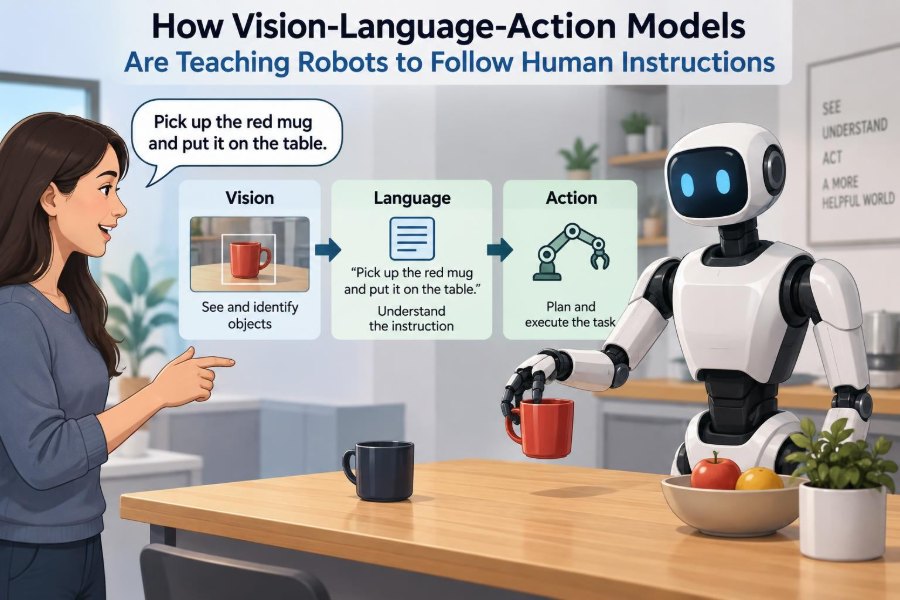
A VLA connects three kinds of information: what the robot sees, what a person asks for, and what the robot should do next. In a simplified loop, a camera image and an instruction enter the model; the model outputs an action or a short action sequence; new observations then update the next decision.
Consider the request: “Pick up the green block and place it in the bowl.” Vision identifies candidate blocks and the bowl. Language indicates the relevant color, the required relationship, and the order of operations. Action converts that interpretation into approach, grasp, lift, transport, and release motions.
The model does not necessarily perform every part alone. Many practical systems combine learned VLA components with conventional motion planning, collision checking, grasp verification, and low-level controllers.
🧠 From Tokens to Motor Commands
Most modern language systems operate on tokens, compact units representing pieces of text. Vision is often converted into visual tokens, while robot state—such as joint positions or gripper status—can be encoded as additional inputs.
The output must ultimately become something a robot controller can use. Depending on the design, the model may predict continuous values, discretized action tokens, target poses, trajectories, or higher-level skills such as “grasp” and “place.”
This design choice matters. High-level outputs can be easier to constrain with established planning tools. Direct low-level actions may offer flexibility, but they make stability, timing, and safety validation more demanding.
📚 Where VLA Training Data Comes From
A VLA needs examples that associate scenes, instructions, and successful behavior. Robot demonstrations are one source: a human teleoperates a robot, guides its arm, or records a scripted task while cameras and sensors capture the interaction.
Training can also draw on image-text data, simulated environments, task descriptions, and data collected across multiple robot platforms. Each source contributes something different, but none perfectly represents the variability of real physical work.
Quality matters as much as quantity. Demonstrations with unclear instructions, poorly calibrated cameras, unsafe motions, or failed grasps can teach unwanted behavior unless they are filtered, labeled, or explicitly modeled as failures.
🎮 Learning from Demonstrations
One common approach is imitation learning. The model observes examples of a person or controller performing a task and learns to predict similar actions when it encounters comparable observations and instructions.
This is intuitive: show the robot many examples of opening drawers, sorting objects, or wiping a surface, then let it generalize to related arrangements. But imitation does not automatically teach recovery. If the robot sees only perfect demonstrations, it may not know what to do after a slightly missed grasp.
Useful data often includes variation: different object positions, lighting, containers, wording, camera angles, and partial failures. Variation helps the model learn the task’s underlying relationships rather than memorizing a single scene.
🧪 Simulation Helps, but Reality Decides
Simulation can generate many virtual scenes without risking hardware. Engineers can vary object layouts, textures, friction estimates, lighting, and instructions, then use the resulting experience to develop policies or test task logic.
However, simulated contact rarely captures every detail of reality. Real grippers flex, objects slip, cameras blur, and materials behave unpredictably. This mismatch is often called the sim-to-real gap.
Simulation is most valuable when paired with real-world testing. It can broaden coverage and identify obvious weaknesses, while physical trials reveal whether the system handles sensor noise, contact forces, and unplanned interference.
🏷️ Grounding Words in the Physical World
Grounding is the process of linking a word or phrase to something the robot can perceive or do. “Red cup” must refer to a particular cup in the current scene; “to the left of the plate” must become a spatial relation; “carefully” must affect motion behavior.
Grounding is especially difficult for relational language. If a user asks for “the box behind the bottle,” the robot needs a viewpoint or coordinate convention. If several bottles exist, it may need to decide which one defines the relation.
Robust systems should expose uncertainty rather than bury it. A simple confirmation—“Do you mean the small box behind the glass bottle?”—can prevent an incorrect action and is often better than a fast but unverified guess.
🧭 Understanding Goals, Not Just Verbs
Two instructions can use the same verb but require different plans. “Put the book on the shelf” may be straightforward. “Put the glass on the shelf” raises questions about stability, clearance, orientation, and whether the shelf edge creates a drop risk.
A robot needs a representation of the goal state: what should be true after acting. For a placement task, that may include object location, orientation, containment, and whether the gripper has released the object safely.
This is why action selection cannot rely only on matching words to motor patterns. The robot must connect a request to the physical conditions that make the request complete.
🧱 Breaking Long Instructions into Manageable Steps
Many useful requests are multi-step: “Collect the parts from the tray, place them in the bin, then close the lid.” A system needs to preserve order, track progress, and recognize when one step has not actually succeeded.
Some architectures use a planner to produce subgoals and an action policy to carry out each subgoal. Others train models to generate actions directly while retaining enough context to handle a sequence.
Decomposition is helpful because individual tasks are easier to observe and verify. “Find the screwdriver” can be checked before “place it in the drawer,” reducing the chance that an early error corrupts the rest of the procedure.
🛠️ A Practical Architecture: Model Plus Tools
It is tempting to imagine one giant model doing everything. In deployed robotics, a more realistic pattern is a layered system where learned and conventional components have different jobs.
| Layer | Typical responsibility | Why it matters |
|---|---|---|
| Language and perception | Interpret instructions and scene context | Connects user intent to visible objects |
| Task planning | Choose subgoals and ordering | Supports multi-step work and checks |
| Motion planning | Find feasible, collision-aware paths | Respects geometry and joint limits |
| Low-level control | Track motion and regulate force | Handles timing and physical contact |
| Safety supervision | Apply boundaries, stops, and permissions | Limits unsafe behavior when uncertainty rises |
These boundaries are not signs that VLAs have failed. They reflect a sound engineering principle: use learned flexibility where perception and language vary, and use deterministic safeguards where physical limits must be enforced.
🤖 Example: Sorting Items at a Workbench
Imagine a robot receiving the instruction, “Put the loose screws in the small parts tray and the washers in the blue cup.” This is a hypothetical example, but it illustrates the interaction of the three modalities.
The robot must visually distinguish screws from washers, find the specified destinations, plan grasps suitable for small objects, and verify that pieces did not fall outside the containers. A fixed script might fail if the cup is moved; a VLA-informed system can use the current image to adapt.
Yet the system still needs constraints. A small part may be difficult to grasp reliably, and loose hardware can create hazards near moving mechanisms. The correct response to repeated failure may be to pause and request human assistance, not to keep probing blindly.
🏠 Why Home Robotics Is a Demanding Test
Homes are highly variable. Furniture shifts, surfaces are cluttered, objects are soft or fragile, and people use casual language. A request such as “put away the groceries” can involve many unknown item types and storage rules.
VLAs are attractive here because they can potentially connect broad human language with visual context. But domestic tasks also make errors more consequential: hot cookware, pets, children, medications, stairs, and personal belongings all require caution.
For this reason, early useful home applications may be narrow and supervised rather than fully autonomous. A robot that reliably carries defined items in a prepared space can be more valuable than one that claims general household competence but behaves unpredictably.
🏭 Industrial Use Requires Predictability
Factories and logistics sites already use robots extensively, often because work cells are designed around repeatable processes. VLAs may help where products, packaging, or instructions change too often for traditional reprogramming to remain efficient.
Examples include mixed-item picking, kitting, inspection support, and handling exceptions that are difficult to enumerate in advance. Natural-language interfaces can also make it easier for trained staff to specify a new task at a high level.
However, industrial deployment demands repeatability, traceability, throughput, and compliance with site-specific safety procedures. A flexible model does not remove the need to validate each workflow, control access, and measure failure modes under realistic operating conditions.
🧍 Human Intent Is More Than the Spoken Sentence
People communicate through pointing, gaze, timing, object arrangement, and prior conversation. “Hand me that” becomes clear when someone points, but it remains ambiguous if several tools lie within reach.
Multimodal robots may combine speech with gesture recognition, visual reference resolution, and task history. Context can help, but it can also create assumptions. If a robot remembers that a user usually wants a particular mug, it should not override a clear current instruction.
Designers should define when the robot may infer intent and when it must confirm. The higher the consequence of being wrong, the stronger the case for explicit confirmation.
❓ Clarification Is a Capability, Not a Failure
A capable assistant does not always act immediately. If a user says “move the container,” and three containers match, asking a short question can be the safest and fastest path overall.
Clarification can be triggered by low confidence, multiple matching objects, conflicting instructions, a missing destination, or an action that violates a safety rule. The question should be concrete: “Should I move the clear container or the red container?”
This interaction design matters. Vague responses such as “I do not understand” place all diagnostic work on the user. A better system explains the specific ambiguity it needs resolved.
🔄 Recovery Separates Demos from Reliable Work
A robot may approach a target correctly and still fail because the object shifts, the gripper misses, or a person moves the destination. Reliable behavior requires detection and recovery.
A recovery loop might include checking whether the object is actually in the gripper, looking again for the target, adjusting the grasp, or returning to a safe pose. In some cases, the appropriate recovery is stopping rather than retrying.
Developers should test disturbances deliberately: move an object slightly, occlude it briefly, alter lighting, or introduce a non-hazardous obstruction. Testing only clean success cases produces a misleading picture of real-world reliability.
⚖️ Safety Cannot Be Learned by Language Alone
Language can express safety intentions—“do not touch the knife”—but words should not be the sole barrier preventing dangerous motion. Physical systems need safeguards that remain effective even when perception or interpretation fails.
Common measures include speed and force limits, collision detection, restricted work zones, emergency-stop hardware, protective separation, tool-specific rules, and human approval for sensitive actions. The appropriate combination depends on the robot, environment, and task.
A model’s confidence is not a safety guarantee. A system can produce a fluent explanation while misidentifying an object or misunderstanding a scene. Safety engineering must assume that such errors can occur.
🔒 Privacy and Data Governance Matter
Robots with cameras and microphones may operate in homes, clinics, warehouses, or offices. Their data can reveal layouts, routines, documents, voices, and people who never directly interacted with the system.
Teams need clear rules for what is collected, where it is processed, how long it is retained, who can access it, and whether recordings are used for later training. These choices should be understandable to operators and affected users.
Data minimization is often a practical starting point: collect what is needed for the task, retain it only as long as justified, and protect it with access controls. Technical capability does not automatically create permission to record.
🧯 Hallucinations Have Physical Consequences
In language systems, a hallucination is an output that sounds plausible but is unsupported or incorrect. For a robot, a related failure might be claiming that it sees an object that is absent, believing a drawer is open when it is closed, or selecting a nonexistent target.
Grounding outputs in current sensor observations can reduce some of these errors, but it does not eliminate them. Sensor blind spots, stale images, ambiguous scenes, and model biases can still lead to false assumptions.
Verification should be tied to action. Before grasping, confirm the target; during movement, monitor progress; after placing, inspect the result. For high-risk tasks, independent sensors or deterministic checks may be necessary.
📏 How to Evaluate a VLA Honestly
A single demonstration video is not an evaluation. Meaningful assessment considers task completion, object damage, collision events, recovery behavior, latency, instruction-following accuracy, and performance across changed conditions.
Tests should include realistic variation rather than only examples resembling training data. Useful categories include new object positions, unfamiliar wording, partial occlusion, different lighting, and tasks requiring clarification.
Failure reporting deserves equal attention. Knowing that a system fails when objects are reflective, phrases are relational, or targets are partly hidden gives engineers actionable information and helps users set appropriate expectations.
🧮 Generalization Is Useful, but It Has Boundaries
Generalization means applying learned patterns to a new situation. A robot trained to place several kinds of cups in a rack may handle an unfamiliar cup shape if the relevant visual and physical relationships are similar.
But “new” can mean many things: a new color, a new object category, a new room, a new tool, or a new safety requirement. Success on one kind of novelty says little about another.
Professionals should ask precise questions: Does the robot generalize across object poses? Across instructions? Across environments? Across contact dynamics? This turns a broad claim into an engineering test plan.
🧑💻 Skills Students Should Build
VLA robotics sits at the intersection of several disciplines. Students do not need to master every area immediately, but they benefit from understanding how the pieces fit together.
- Robot kinematics and control: coordinate frames, motion limits, feedback, and contact behavior.
- Computer vision: cameras, calibration, segmentation, depth, and visual uncertainty.
- Machine learning: datasets, training objectives, overfitting, evaluation, and distribution shift.
- Language and interaction design: ambiguity, grounding, dialogue, and user-centered prompts.
- Safety engineering: hazard analysis, fail-safe behavior, verification, and operational limits.
A strong portfolio project need not be enormous. A small robot that interprets a limited set of visual instructions, asks useful clarifying questions, and safely handles failures can demonstrate more engineering maturity than an overextended “general robot” claim.
🔧 A Sensible Development Workflow
Start with a bounded task and a defined environment. “Sort three known object types into marked bins” is a better initial target than “organize a workshop.” Define what success, failure, and human intervention look like before collecting data.
- Identify hazards, object constraints, and stop conditions.
- Instrument the robot to record synchronized observations, instructions, states, and outcomes.
- Collect varied demonstrations, including recoverable mistakes where appropriate.
- Build baseline methods, such as rules or conventional perception, for comparison.
- Test in simulation and controlled physical trials before widening the environment.
- Measure failures, refine the interface, and add safeguards before adding task complexity.
This workflow prevents a common mistake: treating model training as the project, when the real goal is dependable task performance.
🚫 Common Mistake: Treating Natural Language as a Complete Specification
Natural instructions are convenient, but they rarely include every operational detail. “Clean the spill” does not specify which cleaning agent is allowed, how much force to use, where waste should go, or what to do if the liquid is near electrical equipment.
Systems should combine language with task policies, environmental constraints, and user confirmation. For repeatable work, structured task templates may be preferable to free-form commands for critical parameters.
The lesson is not to avoid natural language. It is to recognize its role: language expresses intent, while engineering supplies the constraints that make action safe and repeatable.
🧷 Common Mistake: Ignoring Coordinate Frames
Robots act in coordinate frames: camera coordinates, robot-base coordinates, tool coordinates, and world coordinates. If these frames are not calibrated and transformed correctly, a robot may identify the right object but reach in the wrong place.
This problem can look like an AI failure even when the model’s semantic understanding is correct. A few centimeters of error may be enough to miss a grasp or collide with a nearby object.
Calibration checks, timestamp synchronization, and repeatable camera mounting are foundational. Advanced models cannot compensate reliably for inconsistent physical geometry.
🌍 Common Mistake: Overlooking the Operating Environment
A model can work well on a clear workbench and fail in a busy room. Changes in lighting, background clutter, network delay, floor vibration, and human traffic all affect robot behavior.
Deployment planning should account for the full system: sensors, compute hardware, communications, maintenance, operator training, and fallback procedures. The robot is not just the model; it is the entire socio-technical setup around it.
When environments cannot be controlled, the safest response may be to narrow the robot’s permitted actions and increase oversight rather than demand unlimited flexibility.
🔮 What Progress Is Likely to Look Like
Progress in VLA robotics is likely to be uneven. Systems may become notably better at interpreting varied instructions and adapting to modest scene changes before they become dependable at long, open-ended tasks in unstructured settings.
Near-term advances may come from better data collection, stronger visual grounding, improved recovery policies, more capable simulators, and tighter integration with established controllers. Hardware improvements in sensing and compliant manipulation will matter too.
The most useful question is not whether a robot is “intelligent” in the abstract. It is whether it can perform a defined task safely, transparently, and reliably under the conditions where people need it.
✨ The Core Principle: Connect Intent to Verified Action
Vision-language-action models offer a compelling direction because they connect the way people naturally communicate with the way robots perceive and manipulate the world. They can make robots less dependent on rigid scripts and more responsive to context.
But the path from instruction to movement contains many opportunities for error: ambiguous language, uncertain perception, poor calibration, unexpected contact, and incomplete recovery. Strong systems address these issues through verification, clarification, layered control, and safety boundaries.
The lasting value of VLAs will not come from a robot that merely responds fluently. It will come from robots that can translate human intent into physical behavior while recognizing what they do not know.
Vision-language-action models are most powerful when flexible AI is paired with disciplined robotics engineering: observe carefully, interpret cautiously, act within limits, and verify the result. That combination is what can turn a spoken request into a trustworthy physical outcome. 🦾👁️⚙️