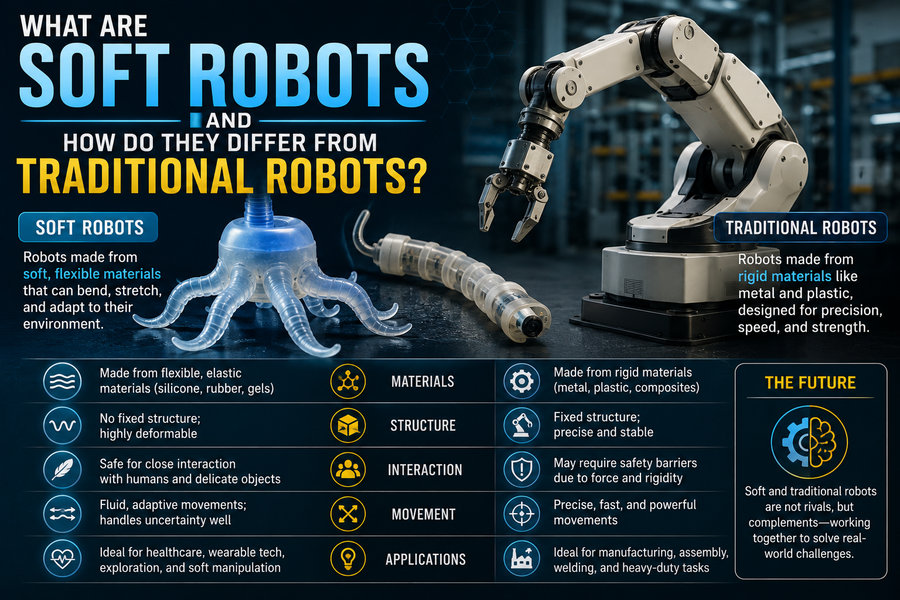

When most people imagine a robot, they picture a machine made from rigid metal parts, electric motors, gears, joints, and hard plastic shells. Industrial robot arms, warehouse robots, humanoid machines, and robotic vehicles all fit this familiar image.
But a rapidly developing field called soft robotics is changing what robots can look like, how they move, and where they can operate. 🧬🤖
Soft robots are built partly or entirely from flexible, elastic, and deformable materials such as silicone rubber, elastomers, fabrics, gels, and other compliant structures. Instead of relying only on rigid joints, they can bend, stretch, twist, inflate, squeeze, and change shape.
This makes soft robots especially useful in environments where traditional rigid machines may be too stiff, too dangerous, or unable to adapt to complex surroundings.
From delicate robotic grippers handling fruit 🍓 to flexible medical devices moving through the human body 🫀, soft robotics is opening new possibilities in engineering, healthcare, agriculture, exploration, and manufacturing.
🫧 What Is a Soft Robot?
A soft robot is a robotic system designed using highly flexible or deformable materials.
Traditional robots typically consist of rigid links connected by mechanical joints. A soft robot may instead use flexible chambers, elastic structures, cables, or smart materials to create motion.
For example, a conventional robotic finger might contain several rigid segments connected by hinges.
A soft robotic finger could be made from silicone with internal air chambers. When air is pumped into those chambers, the finger bends naturally around an object.
This allows the robot to conform to objects instead of forcing objects to conform to the robot.
Soft robots often take inspiration from living organisms such as:
🐙 Octopuses
🐘 Elephant trunks
🪱 Worms
🐍 Snakes
🐛 Caterpillars
🌿 Plants
These biological systems achieve complex movement without depending entirely on rigid skeletons.
🏗️ How Traditional Robots Are Built
Traditional robots are usually based on rigid-body mechanics.
A typical industrial robot arm includes:
- Metal links
- Rotating joints
- Electric motors
- Gearboxes
- Bearings
- Position sensors
- Rigid end effectors
Each joint is carefully controlled.
For example, if a six-axis robot arm needs to move its tool to a certain point, a controller calculates exactly how much each joint must rotate.
This approach provides extremely high:
🎯 Precision
⚡ Speed
🏋️ Strength
🔁 Repeatability
That is why rigid industrial robots dominate automobile factories, electronics manufacturing, welding lines, and other highly controlled environments.
However, rigidity also creates limitations.
A powerful industrial robot can be dangerous if it unexpectedly strikes a human. It may also struggle to manipulate delicate, irregular, or fragile objects.
Soft robotics attempts to solve some of these problems through mechanical compliance.
🧩 What Does “Compliance” Mean?
In robotics, compliance refers to the ability of a structure to deform when force is applied.
Imagine the difference between:
🪨 A steel bar
🧽 A foam sponge
The steel bar resists deformation.
The sponge easily changes shape.
Soft robots are much more compliant than traditional machines.
This compliance allows them to absorb impacts and adapt naturally to surrounding surfaces.
For instance, if a soft robotic gripper closes around a tomato, its flexible fingers can wrap around the tomato’s shape.
A rigid gripper may need highly accurate sensors and force control to avoid crushing it.
The soft gripper can achieve some of that adaptation through its physical structure alone. 🍅
💨 Pneumatic Soft Robots
One of the most common methods for operating soft robots is pneumatic actuation.
Pneumatic systems use compressed air.
Imagine a flexible silicone tube containing specially designed internal chambers.
When air enters the chambers, one side expands more than another.
This unequal expansion causes the structure to bend.
By arranging multiple chambers, engineers can create:
- Bending
- Twisting
- Extension
- Gripping
- Crawling
Soft pneumatic actuators are sometimes called Pneumatic Artificial Muscles or related actuator types, depending on their construction.
Their motion can resemble biological muscles much more closely than a traditional rotary motor.
💧 Hydraulic Soft Robots
Instead of air, some soft robots use liquids.
These are known as hydraulic soft actuators.
Hydraulic systems can generate relatively large forces because liquids are difficult to compress.
Soft hydraulic robots may therefore be useful where stronger motion is required.
However, liquid-based systems introduce challenges such as:
- Leakage
- Pump complexity
- Weight
- Fluid management
Engineers must carefully balance flexibility, power, and reliability.
🧵 Cable-Driven Soft Robots
Some soft robots are controlled using cables or tendons.
This is similar to the way human muscles pull on tendons to move joints.
A motor pulls a flexible cable that runs through the robot.
As the cable shortens, the robot bends.
Cable-driven systems are often used in:
🖐️ Robotic hands
🐙 Tentacle robots
🩺 Medical devices
🤖 Wearable robots
The motors can remain in a rigid base while the moving portion stays lightweight and flexible.
⚡ Smart Materials in Soft Robotics
Some soft robots use materials that change shape when exposed to electrical, thermal, magnetic, or chemical stimulation.
These are often called smart materials.
Examples include:
🧲 Magnetically Responsive Materials
Tiny magnetic particles can be embedded inside soft polymers.
An external magnetic field can then bend or move the robot.
This is particularly interesting for tiny medical robots.
🌡️ Shape Memory Alloys
Shape memory alloys can return to a predefined shape when heated.
Electrical current can heat the material and trigger movement.
These actuators can be compact but may respond more slowly because heating and cooling take time.
⚡ Dielectric Elastomer Actuators
These flexible materials can change shape when exposed to high electric fields.
They are sometimes compared to artificial muscles because of their lightweight and elastic behavior.
🤖 Soft Robots vs. Traditional Robots
The differences can be summarized clearly.
| Feature | Soft Robots 🫧 | Traditional Robots ⚙️ |
|---|---|---|
| Structure | Flexible and deformable | Mostly rigid |
| Common materials | Silicone, rubber, fabrics, gels | Steel, aluminum, rigid plastics |
| Movement | Bending, stretching, twisting | Joint rotation and linear motion |
| Precision | Often lower | Usually very high |
| Safety near humans | Potentially high | Requires careful safety systems |
| Handling delicate objects | Excellent | More difficult |
| Force capacity | Often limited | Can be extremely high |
| Modeling | Complex | Relatively well understood |
| Environmental adaptability | Excellent | Often limited |
| Industrial maturity | Emerging | Highly mature |
Neither approach is universally better.
They are suited to different problems.
🍓 1. Soft Robots Can Handle Fragile Objects
One of the most promising applications of soft robotics is delicate manipulation.
Traditional industrial grippers work extremely well when objects are rigid and uniform.
But consider handling:
🍓 Strawberries
🍅 Tomatoes
🥚 Eggs
🥐 Baked goods
🐟 Seafood
These objects can easily be damaged.
A soft robotic gripper can deform around them while distributing contact pressure across a larger surface.
This reduces the risk of crushing or scratching the product.
For this reason, soft robotics is attracting interest in food processing and agriculture.
👩⚕️ 2. Soft Robots Can Be Safer Around Humans
Traditional industrial robots can move quickly and generate enormous forces.
Historically, they have often been separated from workers using fences and safety barriers.
Soft robots can be physically safer because their bodies deform during contact.
A soft robotic arm may absorb some of the energy of a collision instead of transferring all of it to a person.
This is especially useful in:
🏥 Healthcare
👴 Elder care
🏠 Home robotics
🧑🏭 Collaborative workplaces
However, soft does not automatically mean safe.
Actuators, pressure systems, control errors, or attached tools can still create hazards.
Safety must therefore be engineered into the complete system.
🩺 3. Medical Applications of Soft Robotics
The human body is itself soft, flexible, and constantly moving.
This makes rigid robots challenging to use inside or directly against biological tissue.
Soft robots can potentially interact with the body more gently.
Applications being studied include:
- Flexible surgical tools
- Soft catheters
- Rehabilitation devices
- Wearable exosuits
- Artificial muscles
- Minimally invasive robots
- Assistive gloves
A flexible surgical robot may be able to navigate curved pathways that rigid instruments cannot easily follow.
Soft materials can also reduce concentrated pressure on delicate tissue. 🫀
🧤 4. Wearable Soft Robots
Traditional exoskeletons often use rigid frames and motors.
Soft robotics has led to another concept: the soft exosuit.
Instead of placing a heavy mechanical skeleton around the body, soft exosuits can use textiles, cables, elastic components, and compact actuators.
They may assist:
🚶 Walking
🏃 Running
🦵 Rehabilitation
🏋️ Lifting
Because the structure is flexible, it can often move more naturally with the wearer.
Soft wearable robotics may eventually help people recovering from injury or individuals with reduced mobility.
🐙 5. Inspiration From Nature
Nature is one of the biggest sources of inspiration for soft robotics.
An octopus has no rigid skeleton in its arms, yet it can perform extremely complex movements.
It can:
- Bend
- Twist
- Stretch
- Squeeze
- Grip
- Navigate narrow spaces
Researchers study these biological mechanisms to create robots capable of similar behavior.
An elephant trunk is another example.
It contains thousands of muscles and can perform both powerful and delicate tasks.
Biological inspiration is known as bioinspired engineering or biomimetics. 🌿
🧠 6. Soft Robots Are Harder to Control
Flexibility provides major advantages, but it creates one of the biggest challenges in soft robotics: control.
A rigid robot arm may have a small number of clearly defined joints.
Engineers can calculate the position of each joint mathematically.
A soft robot can deform in an enormous number of possible ways.
This creates what engineers sometimes describe as effectively having many or even theoretically infinite degrees of freedom.
Predicting exactly how every part of the robot will move can therefore be extremely difficult.
Researchers use:
💻 Computer simulations
📐 Finite-element models
🤖 Machine learning
📷 Vision systems
🧠 Adaptive control algorithms
to manage this complexity.
Artificial intelligence could become increasingly important for controlling highly deformable robots.
📡 7. Sensors Are More Difficult to Integrate
Traditional robots can mount sensors inside rigid joints.
Soft robots require sensors that can bend and stretch along with the structure.
Researchers are developing flexible and stretchable sensors capable of measuring:
- Pressure
- Strain
- Bending
- Temperature
- Touch
- Position
Some soft robots use conductive liquids embedded inside flexible channels.
When the robot stretches, the electrical properties of these channels change.
The controller can use this change to estimate the robot’s shape.
This field is often called soft sensing.
🧱 8. Soft Materials Can Wear Out
Soft materials also create durability challenges.
Repeated bending, stretching, and inflation can cause:
- Cracks
- Tears
- Fatigue
- Delamination
- Leakage
A metal robot arm may operate for millions of cycles with proper maintenance.
A highly flexible silicone actuator may degrade faster depending on the stresses it experiences.
Improving material durability is therefore an important area of soft robotics research.
🔧 9. Manufacturing Soft Robots Is Different
Traditional robots are manufactured using machining, casting, welding, and conventional assembly.
Soft robots often require entirely different fabrication methods.
These include:
🧪 Silicone molding
🖨️ 3D printing
🧵 Textile fabrication
🧬 Multi-material printing
🔥 Soft lithography
Advanced 3D printers can even produce structures containing materials with different stiffness levels.
This allows engineers to create complex internal channels and flexible mechanisms that would be difficult to manufacture conventionally.
🧠 10. Embodied Intelligence
One of the most fascinating ideas in soft robotics is embodied intelligence.
Traditional robotics often places most intelligence in software.
The controller determines exactly how the robot should move.
Soft robotics can move part of that intelligence into the physical structure itself.
For example, a flexible gripper automatically conforms to an object’s shape.
The robot may not need to calculate the exact geometry of every contact point.
Its material properties solve part of the problem automatically.
In other words, the robot’s body performs some of the computation through physics.
This concept could lead to simpler and more adaptive machines.
🌊 11. Soft Robots for Exploration
Soft robots could be useful in difficult environments.
A rigid robot may become stuck when encountering narrow openings.
A soft robot may be able to compress or change shape.
Researchers have investigated soft robots for:
🌊 Underwater exploration
🏚️ Disaster response
🕳️ Pipe inspection
🪨 Confined spaces
🌌 Space exploration
A flexible robot inspired by an octopus could potentially move around underwater structures without damaging them.
Similarly, a soft crawling robot could enter spaces too narrow for conventional machines.
🏭 Will Soft Robots Replace Traditional Robots?
Probably not.
Traditional robots remain superior for many applications.
Consider automobile manufacturing.
A welding robot may need to move a heavy welding tool rapidly while maintaining extremely precise positioning thousands of times each day.
Rigid machines are excellent at this.
Soft robots are better where adaptability and gentle interaction matter.
The future is therefore likely to involve hybrid robots combining rigid and soft components.
A robot might have:
🏗️ A rigid structural arm
🫧 A soft gripper
📡 Flexible sensors
🤖 AI-based control
This gives engineers the strength and precision of traditional robotics together with the adaptability of soft systems.
🔬 Major Challenges Facing Soft Robotics
Before soft robots become common in everyday life, researchers must solve several difficult problems.
These include:
🎯 Precision
Soft structures can be difficult to position exactly.
🏋️ Strength
Many soft actuators cannot produce the same forces as industrial motors.
🧠 Control
Modeling deformable structures is computationally complicated.
🔋 Portable Power
Pneumatic systems may require pumps, tanks, or compressors.
📡 Sensors
Flexible robots need flexible sensing technologies.
🧱 Durability
Repeated deformation can damage soft materials.
🏭 Manufacturing
Mass-producing complex soft machines remains challenging.
Solving these problems will determine how quickly soft robotics moves from laboratories into everyday products.
🚀 The Future of Soft Robotics
Soft robotics is still a relatively young field compared with conventional industrial robotics.
However, progress is rapid.
Researchers are developing:
🧬 Self-healing materials
🤖 AI-controlled soft robots
🩺 Miniature medical robots
🖨️ Fully 3D-printed robots
🧤 Advanced wearable devices
🌊 Bioinspired underwater machines
Self-healing materials are particularly interesting.
Imagine a soft robotic actuator that develops a small cut and can partially repair itself, somewhat like biological tissue.
Researchers are also exploring robots whose stiffness can change.
Such a machine could remain soft while interacting with people but become rigid when it needs to carry a heavy load.
This concept is known as variable stiffness.
🏁 Final Thoughts
Soft robots represent a fundamentally different approach to robotics.
Traditional robots are built primarily around rigid components, fixed joints, motors, and precisely controlled movement. They excel when engineers need speed, accuracy, strength, and repeatability.
Soft robots instead use flexible materials and compliant structures that can bend, stretch, twist, and adapt to their surroundings. 🫧🤖
This makes them especially promising for situations involving:
✅ Fragile objects
✅ Human interaction
✅ Medical procedures
✅ Wearable assistance
✅ Irregular environments
✅ Confined spaces
Their greatest advantage—flexibility—is also their biggest engineering challenge.
A robot that can deform in thousands of different ways is much harder to model, sense, and control than a machine made from rigid links.
For that reason, the future of robotics may not be a competition between hard and soft machines.
Instead, the most capable robots may combine both approaches: rigid where strength is required, soft where adaptability matters, and intelligent enough to decide how to use each advantage. 🤖🧠🌍