
A robot vacuum pauses at the edge of a staircase, turns away from a chair leg, and eventually finds its charging dock. On a factory floor, a robot arm repeats a weld within a fraction of a millimeter. In a hospital, a mobile robot carries supplies through corridors shared with people.
These machines look very different, but each depends on the same engineering conversation: what can the robot sense, what can it move, how accurately can it act, and what should happen when conditions change?
Robotics is not simply about building machines that move. It is about connecting the physical world to software decisions through sensors, motors, mechanisms, control systems, and safety rules. A robot succeeds when those parts work together under real conditions—not only in a clean demonstration.
The facts below reveal why robots can be remarkably capable, why they still make surprising mistakes, and what students and working professionals should notice when designing, programming, operating, or evaluating automated systems.
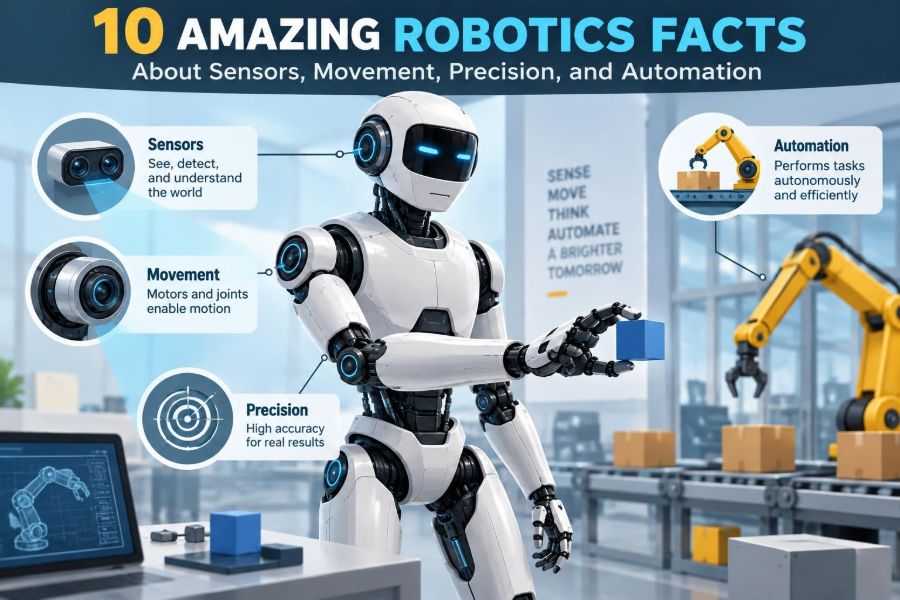
👁️ Fact 1: A Robot’s Sensors Are Its Connection to Reality
A robot controller can execute code perfectly and still make the wrong decision if its sensor data is incomplete, delayed, or misleading. Sensors convert physical conditions—light, distance, force, temperature, rotation, or acceleration—into electrical signals that software can interpret.
This is often compared with human senses, but the comparison has limits. A camera does not “understand” a scene by itself, and a force sensor does not know whether contact is safe. Interpretation comes from algorithms, calibration, context, and programmed rules.
Automation begins with measurement. If a robot cannot reliably observe the variable that affects a task, it must either work in a tightly controlled environment or accept more uncertainty.
📏 Different Sensors Answer Different Questions
No universal sensor can tell a robot everything it needs. An encoder answers, “How far did this motor shaft rotate?” A proximity sensor may answer, “Is an object nearby?” A camera can provide rich visual information but needs more processing and can be sensitive to lighting.
| Sensor type | What it commonly measures | Typical robotics use |
|---|---|---|
| Encoder | Rotation or position | Wheel speed and joint angle feedback |
| Camera | Light and image patterns | Inspection, navigation, object recognition |
| LiDAR or range sensor | Distance to surfaces | Mapping and obstacle detection |
| Force/torque sensor | Contact load and twisting force | Assembly, polishing, collaborative tasks |
| IMU | Acceleration and angular motion | Balance, orientation, motion estimation |
Choosing a sensor is therefore an engineering trade-off among range, accuracy, update rate, cost, robustness, and how easily its data can be used.
🧭 Fact 2: Robots Often Combine Sensors Rather Than Trusting One
Sensor fusion combines measurements from multiple sources to estimate something a single sensor cannot measure reliably. A mobile robot, for example, may blend wheel encoder data, an inertial measurement unit (IMU), and range readings to estimate its location.
Encoders are responsive but accumulate error when wheels slip. An IMU detects rapid changes but can drift over time. A laser scanner can compare the surroundings with a map, yet may struggle with reflective, moving, or featureless surfaces. Together, their weaknesses are less damaging.
Fusion does not make uncertainty disappear. It gives software a better estimate and, in well-designed systems, an indication of how confident that estimate may be.
🌦️ The Environment Can Change What a Sensor Sees
A sensor that works on a lab bench may behave differently in sunlight, dust, steam, vibration, rain, glare, or a crowded warehouse. Cameras may lose contrast in poor lighting. Some optical distance sensors can be affected by very dark, transparent, or shiny materials.
This is why robust robots are tested across expected operating conditions. Engineers ask not only, “Can the sensor detect this object?” but also, “Can it detect it at the required distance, at the required speed, in the least favorable expected environment?”
Environmental testing is especially important for outdoor robots, medical equipment, food processing, and systems near people, where a missed detection can have consequences beyond a failed cycle.
🎯 Fact 3: Precision Is Not the Same as Accuracy
A robot can place a part in almost the same wrong location repeatedly. That machine is precise, because its results are tightly grouped, but not necessarily accurate, because the group is offset from the intended target.
Imagine a robot arm commanded to pick from a fixture. If its coordinate frame is shifted, every pick may be consistently 2 millimeters away from the true part location. Repeatability may look excellent until the gripper misses a small feature.
In production, both properties matter. Repeatability supports consistent cycles; accuracy ensures the cycle occurs where the real-world task requires it.
📐 Calibration Connects Digital Coordinates to Physical Space
Calibration establishes the relationship between a robot’s internal coordinate system and the real equipment around it. It can include finding a camera’s lens characteristics, teaching a tool center point, locating a conveyor, or aligning a robot base with a fixture.
A robot does not automatically know where the tip of a newly installed gripper is. If the software assumes the old tool dimensions, motion commands can be offset even when every motor and encoder is functioning correctly.
Good calibration procedures use stable reference features, documented methods, and periodic verification. A calibration value should never be treated as permanent merely because it was correct on installation day.
🔄 Fact 4: Feedback Makes Motion Correctable
Many useful robots are closed-loop systems. They measure an output, compare it with a target, and adjust the command to reduce the error. A motor encoder feeding position data back to a controller is a familiar example.
Without feedback, a controller may assume a motor turned as commanded even if the load jammed, a belt slipped, or a battery voltage changed. This open-loop approach can be appropriate for simple, low-risk tasks, but it cannot directly correct an unobserved error.
Closed-loop control is one reason modern robots can hold speed, maintain a joint position, or follow a path more reliably than a mechanism driven only by timed motor commands.
⚙️ Motion Is Created by Actuators, Not Code Alone
Software decides what should happen; actuators create the physical change. Electric motors are common because they are controllable and efficient in many applications. Pneumatic cylinders are valuable for fast, simple linear motion, while hydraulic actuators can provide high force in demanding machinery.
Actuator selection affects nearly every downstream decision: power supply, noise, maintenance, control precision, speed, payload, heat management, and safety behavior. A mechanism that needs delicate contact may favor a different drive system from one that lifts heavy loads.
The motor is only one part of the motion chain. Gearboxes, belts, screws, bearings, brakes, and linkages determine how motor torque becomes useful motion.
🦾 Fact 5: Robot Arms Trade Reach, Speed, Payload, and Stiffness
A longer arm can reach farther, but its structure may flex more under load. Moving a heavier payload usually requires more torque, and rapid acceleration increases forces on joints and gearboxes. These constraints mean that a robot’s advertised reach or payload is not the whole performance story.
Consider a robot holding a tool at full extension. Even a small amount of deflection at the joints can create a noticeable error at the tool tip. Fast motion may also create vibration that must settle before a precise operation begins.
Engineers evaluate the complete task envelope: payload, tool weight, center of mass, reach, orientation, cycle time, and required positioning quality.
🧩 End Effectors Determine What a Robot Can Actually Do
The end effector is the tool attached to a robot’s wrist or moving platform. It may be a parallel gripper, vacuum cup, welding torch, screwdriving spindle, dispensing nozzle, scalpel holder, or inspection camera.
Two identical robot arms can have entirely different capabilities because of their end effectors. A vacuum gripper may handle flat cartons quickly but fail on porous packaging. Finger grippers can grasp varied shapes but need enough clearance and carefully chosen contact points.
End-effector design should start with the workpiece and task, not with the assumption that a standard gripper will solve every handling problem.
🤏 Fact 6: Gentle Contact Requires More Than Slowing Down
Reducing speed helps, but delicate operations often require sensing and control of contact force. In force-controlled assembly, the robot can regulate how hard it presses while inserting a component, polishing a surface, or following an edge.
This matters because position commands alone can become unsafe or ineffective when part locations vary slightly. A rigid command to move downward may keep pushing after contact. Force feedback lets the robot detect resistance and respond according to limits.
Force control is not magic. Tool stiffness, sensor placement, surface variability, and controller tuning all affect the result. The safe force range must be defined for the material, product, and task.
🛞 Fact 7: Wheels Do Not Guarantee Reliable Localization
Wheel encoders estimate distance from rotation, a method called odometry. On a clean, high-traction floor, odometry can be useful. But turning, uneven surfaces, wheel wear, small obstacles, and slip introduce errors that accumulate as the robot travels.
A delivery robot that believes it moved exactly one meter after every wheel rotation may gradually become uncertain about its true position. This is why many autonomous mobile robots use landmarks, maps, cameras, LiDAR, or fixed markers in addition to wheel measurements.
The practical lesson is simple: motion estimates are not position truth. The system needs periodic information tied to the outside world.
🗺️ Mapping and Localization Are Related but Different
Mapping creates a representation of the environment. Localization estimates where the robot is within that representation. A robot can use a prebuilt map, construct one as it moves, or combine both approaches depending on the application.
Warehouses are challenging because the environment is partly stable and partly dynamic. Shelving may stay fixed, while people, pallets, carts, and temporary barriers move continually. A useful navigation system distinguishes durable landmarks from temporary obstacles.
A map is therefore not a guarantee of safe travel. It is a planning resource that must be updated by live perception.
🧠 Fact 8: Perception Is an Interpretation Problem
Perception turns raw sensor readings into useful concepts such as “person,” “open aisle,” “defective label,” or “graspable object.” This step is much harder than collecting pixels or distance values because real objects appear in different poses, lighting, backgrounds, and states.
Machine-learning models can recognize patterns effectively in suitable conditions, but their output depends on training data, camera placement, thresholds, and the differences between test environments and real deployment. A system may detect a familiar package well while struggling with an unusual reflective wrapper.
For this reason, engineers define what the robot needs to know. A task may require only reliable detection of a barcode location, not a broad claim of visual understanding.
🔍 Quality Inspection Needs a Clear Definition of “Defect”
Automated inspection can be fast and consistent, but only if acceptance criteria are translated into observable features. “Looks wrong” is not enough for a vision system. The requirement might instead be a missing cap, an unreadable code, a seal outside a specified region, or a surface feature above a defined limit.
Lighting is often as important as the camera. Backlighting can reveal a silhouette, angled light can reveal texture, and diffuse light can reduce glare. A poor optical setup cannot always be repaired by more sophisticated software.
Inspection systems also need a review path for ambiguous cases. Rejecting every uncertain item may waste good product; accepting all uncertainty can allow defects through.
⏱️ Fact 9: Fast Robots Need Predictable Timing
Timing matters when a robot coordinates with conveyors, sensors, cameras, safety devices, and other machines. Latency is the delay between an event and a system response. Jitter is variation in that delay from one cycle to another.
For example, a camera may identify a part on a moving conveyor, but the robot must receive the result, calculate the intercept point, and move there before the part passes. An average response time is not enough if occasional late responses cause missed picks.
Real-time control does not always mean “as fast as possible.” It means that the system can meet timing requirements predictably enough for its specific task.
📡 Communication Delays Can Become Motion Errors
Robots increasingly exchange data with programmable logic controllers, cameras, fleet managers, databases, and remote monitoring systems. Networked information is useful, but a motion-critical decision should not depend on an unpredictable connection unless the architecture explicitly manages that risk.
A remote dashboard can tolerate a delay. A safety stop signal cannot. Engineers separate functions by their required responsiveness and use appropriate industrial communication methods, local control, and fail-safe behavior.
When troubleshooting an intermittent robot fault, communication logs can be as valuable as mechanical inspection. A command arriving late may look like a mechanical timing problem from the outside.
🏭 Fact 10: Automation Works Best When the Whole Process Is Designed for It
A robot is rarely a drop-in replacement for a person. Successful automation often involves changing fixtures, part presentation, labeling, material flow, inspection points, and exception handling. The process must make the desired action repeatable.
A simple example is bin picking. If randomly piled parts overlap, vary in orientation, and reflect light unpredictably, the vision and grasping problem becomes difficult. Presenting parts in trays or using a feeder can simplify the task dramatically.
This does not mean every process should be made rigid. It means complexity should be placed where it is most manageable: in mechanical design, sensing, software, or human decision-making.
🧱 Fixtures Are Often an Invisible Source of Precision
A fixture holds a workpiece in a known, stable position. It may seem less exciting than a robot arm, but it can reduce sensing demands, shorten cycle time, and improve quality. In many industrial cells, the fixture defines the real accuracy of the operation.
Good fixtures locate a part repeatably without damaging it or trapping debris. They also consider loading ergonomics, quick changeover, access for tools, and how the robot will verify that the part is present.
A common design mistake is asking software to compensate for variability that a modest mechanical improvement could eliminate more reliably.
🛑 Safety Is a System Property, Not a Single Sensor
Emergency stops, safety-rated scanners, guards, interlocks, reduced-speed modes, and risk assessments each address different hazards. No one device makes every robot application safe.
Safety design begins by identifying hazards: crushing, impact, sharp tools, unexpected starts, dropped loads, electrical energy, hot surfaces, and access to moving machinery. The next question is what could fail, including sensor faults, software faults, human error, and foreseeable misuse.
A collaborative robot is not automatically safe in every use. Tool shape, payload, speed, pinch points, workspace layout, and the specific contact scenario all matter. Qualified safety professionals and applicable local requirements should guide implementation.
🤝 Collaborative Robots Change the Workspace, Not the Need for Planning
Collaborative robots, often called cobots, are designed for applications where people may work nearby under defined conditions. They can support flexible tasks such as tending machines, assisting assembly, or moving between stations.
They may operate more slowly than traditional industrial robots in some shared-space scenarios because speed and force limits affect productivity. A guarded high-speed robot can be more appropriate when human access during operation is unnecessary.
The best choice depends on the workflow. “Collaborative” describes a possible operating approach, not a universal substitute for guarding, training, or process design.
🔋 Power Management Shapes Mobile Robot Uptime
Battery capacity alone does not determine how long a mobile robot can work. Travel distance, acceleration, payload, terrain, computing load, sensor suite, temperature, and charging strategy all affect energy use.
Frequent rapid starts and stops can consume more energy than steady travel. A robot that plans efficient routes, avoids unnecessary detours, and charges during natural pauses may achieve better availability than one with a larger battery but poor task scheduling.
Battery systems also require monitoring and protective design. Safe charging, thermal management, and end-of-life replacement procedures belong in the operational plan, not as afterthoughts.
🧰 Maintenance Preserves Performance That Software Cannot Restore
Robots experience wear in cables, bearings, gearboxes, belts, grippers, vacuum lines, connectors, and moving fixtures. Dust and contamination can affect optical sensors; loose fasteners can change alignment; worn gripper pads can change grasp reliability.
Preventive maintenance uses inspections, lubrication or replacement schedules where appropriate, trend monitoring, and verification of key motions. Predictive approaches may use data such as motor current, temperature, vibration, or cycle counts to flag changes worth investigating.
Maintenance records help distinguish a programming issue from a gradual physical change. A robot that begins missing picks after months of operation may need mechanical attention before it needs a new algorithm.
🧪 Simulation Is Valuable, but It Is Not the Factory Floor
Simulation helps engineers check reach, detect likely collisions, estimate cycle time, test sequences, and train operators without immediately stopping production equipment. Digital models can reveal obvious design conflicts early.
However, a simulation may not capture cable behavior, part variation, sensor noise, friction, lighting, network delays, or an operator’s actual workflow. Its result is only as useful as its assumptions.
Use simulation to reduce uncertainty, then validate on real equipment with controlled tests. Treat a virtual success as evidence that a concept is worth testing—not proof that every deployment risk has been removed.
📊 Good Robot Metrics Include Failures and Recoveries
Cycle time and throughput are useful, but they do not tell the full story. A robotic cell can look fast during uninterrupted operation while losing time to jams, bad picks, manual resets, or lengthy recovery procedures.
Useful performance questions include:
- How often does the robot complete the task correctly without intervention?
- What conditions cause faults or uncertain decisions?
- How long does a trained operator need to diagnose and recover from each fault?
- Does quality remain stable across shifts, materials, and environmental changes?
Designing for recovery is practical engineering. Clear fault messages, safe restart states, accessible components, and well-defined manual procedures can protect uptime as much as a faster motion profile.
🧑💻 Robot Programming Is Also Process Programming
Robot code defines trajectories and I/O signals, but it also encodes assumptions about materials, sequence, error handling, and human interaction. A robust program checks whether expected conditions are true before taking consequential actions.
For example, before placing a part, the system may verify that the gripper still holds it and that the destination fixture is available. If a check fails, the program should enter a known safe state rather than continue with a chain of incorrect actions.
Readable names, documented coordinates, version control, and structured fault handling make automation easier to improve over time. These habits matter as much as clever motion logic.
🧭 Clear Coordinate Frames Prevent Confusing Errors
Robots move relative to coordinate frames: a base frame, tool frame, workpiece frame, camera frame, or conveyor frame. Confusion between frames can create errors that look mysterious until the geometry is inspected.
If a tool rotates, a command that was “move 10 millimeters forward” must be interpreted relative to the intended frame. Forward from the robot base is not necessarily forward from the tool tip.
A disciplined coordinate strategy makes programs more reusable. Instead of hard-coding many individual points, engineers can define a fixture frame and express task locations relative to it.
🧠 Human Judgment Remains Part of Many Automated Systems
Automation is strongest when it assigns work according to capability. Robots excel at repeatable motion, sustained attention, data logging, and operating in environments that may be dull, hazardous, or physically demanding. People remain especially valuable when goals are ambiguous, situations are novel, or trade-offs require broad context.
In practice, many systems are semi-automated. A person loads varied materials, resolves exceptions, approves uncertain inspections, maintains equipment, and improves the process while the robot handles a repeatable portion of the work.
Thinking in terms of human-robot system design leads to better interfaces, clearer handoffs, and more realistic expectations than asking whether a task is simply “automatable.”
📚 Skills That Transfer Across Robotics Roles
Robotics careers span mechanical design, electrical engineering, embedded systems, controls, software, manufacturing, integration, field service, and research. The tools differ, but several foundations transfer widely.
- Basic mechanics: forces, motion, stiffness, and tolerances.
- Electrical fundamentals: power, signals, sensors, and safe wiring practices.
- Programming: data handling, state machines, debugging, and readable code.
- Controls: feedback, stability, tuning, and measurement limits.
- Systems thinking: understanding interactions across hardware, software, and workflow.
Build small projects that require integration, not only isolated code or mechanisms. A simple mobile robot that senses, moves, logs failures, and recovers from a lost target teaches valuable engineering habits.
⚠️ Common Mistake: Designing for the Demonstration Only
A polished demonstration often uses ideal parts, bright lighting, a clean floor, fully charged batteries, and a person ready to intervene. Real operation includes shifted parts, dirty sensors, worn tools, unusual inputs, and changes between shifts.
Design reviews should include “what if” questions: What happens if the object is absent? What if the camera cannot classify it? What if the gripper fails to seal? What happens after a power interruption?
The goal is not to imagine every conceivable failure. It is to identify credible failure modes, detect them early, limit their effects, and provide a safe recovery path.
🧩 Core Takeaway: Reliable Robotics Is Managed Uncertainty
The most impressive robot is not necessarily the one with the most sensors, the fastest arm, or the most advanced software. It is the one whose measurements, mechanics, control logic, safety measures, and recovery behavior suit the real task.
Sensors provide estimates rather than perfect truth. Movement creates forces and error sources. Precision depends on calibration and structure. Automation succeeds when the process is designed so that expected variation can be detected, controlled, or handled safely.
For anyone learning robotics, this is the central principle: ask what the machine knows, what it can physically do, what can go wrong, and how the system responds when reality differs from the plan.
Great robotics engineering turns uncertain physical situations into dependable, understandable actions through thoughtful system design. 🦾📏🤖