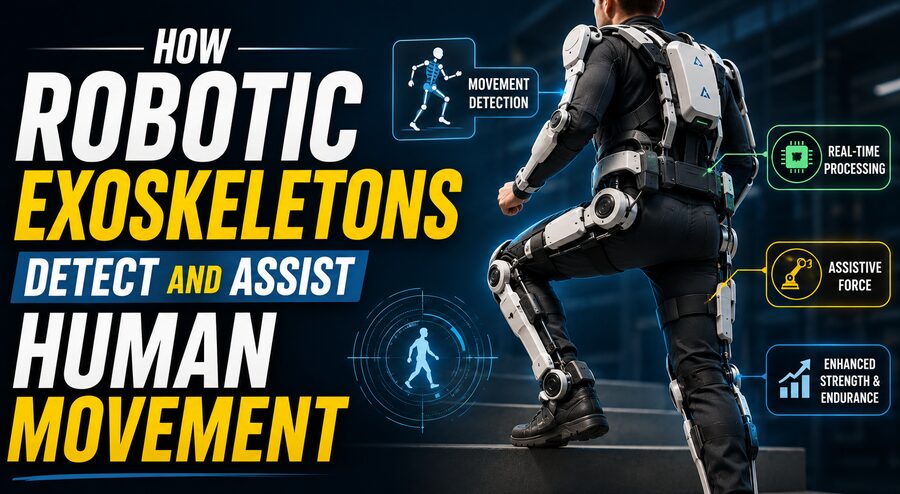

Robotic exoskeletons are wearable machines designed to work alongside the human body. Instead of replacing a person’s limbs, they attach to the outside of the body and provide mechanical assistance to movements such as standing, walking, lifting, or rehabilitation exercises. 🦿⚙️
These systems are used in areas such as:
- Medical rehabilitation 🏥
- Mobility assistance
- Industrial work 🏭
- Military research
- Physical therapy
- Injury prevention
- Human-performance augmentation
What makes a robotic exoskeleton especially impressive is that it must understand what the wearer is trying to do and then assist that movement without fighting against the person.
To accomplish this, exoskeletons combine sensors, control algorithms, electric or hydraulic actuators, biomechanics, and real-time feedback.
In simple terms, the system continuously follows a loop:
Detect movement ➡️ estimate human intention ➡️ calculate assistance ➡️ move actuators ➡️ measure the result ➡️ adjust again
This loop may repeat hundreds or even thousands of times per second. 🔄
🦿 What Is a Robotic Exoskeleton?
A robotic exoskeleton is a powered mechanical structure worn around part or all of the body.
Depending on its purpose, it may assist:
- Hips
- Knees
- Ankles
- Shoulders
- Elbows
- Back
- Hands
A lower-body rehabilitation exoskeleton, for example, may contain rigid frames alongside the user’s legs, motors at the hip and knee joints, foot sensors, batteries, and an onboard computer.
An industrial exoskeleton may support only the shoulders or lower back.
Not all exoskeletons are fully powered. Some are passive, using springs, elastic elements, or mechanical linkages rather than motors.
Powered robotic exoskeletons, however, actively generate force or torque to assist movement. ⚡
🧠 The Main Challenge: Understanding Human Intent
A powered exoskeleton cannot simply move according to a fixed program.
Humans constantly change their movements.
A person may:
- Start walking
- Stop
- Turn
- Climb stairs
- Sit down
- Stand up
- Change walking speed
- Shift weight
- Avoid an obstacle
The exoskeleton must recognize these intentions quickly.
If the user begins stepping forward but the machine continues holding the leg back, the device becomes uncomfortable or potentially unsafe.
Therefore, one of the central engineering challenges is intent detection.
The machine must infer:
What is the wearer trying to do right now? 🧠➡️🤖
📡 Sensors Are the Exoskeleton’s Eyes and Ears
Exoskeletons use several types of sensors to understand what is happening.
Common sensors include:
- Joint-angle sensors
- Force sensors
- Pressure sensors
- Inertial measurement units
- Electromyography sensors
- Torque sensors
- Foot-contact sensors
No single sensor tells the entire story.
Advanced systems combine several measurements to build a more reliable picture of human movement.
📐 Joint-Angle Sensors
Joint-angle sensors measure how much a limb or exoskeleton joint has rotated.
For example, a sensor at the knee may report that the joint is bent by:
35°
As the user walks, the controller tracks how the angle changes over time.
From this, the system can estimate:
- Joint position
- Joint speed
- Movement direction
These measurements help synchronize the exoskeleton with the user’s natural motion.
Rotary encoders are commonly used for this purpose.
⚖️ Force and Torque Sensors
Force sensors measure how strongly the user is pushing or pulling against the machine.
Suppose a person begins trying to extend their knee.
The leg presses against the exoskeleton frame.
A force or torque sensor detects this effort.
The controller may interpret it as:
The user wants to straighten the leg.
The motor can then provide assistance in the same direction.
This is similar to power steering in a vehicle.
The human provides an initial command force, and the machine amplifies it. 💪⚙️
👣 Foot-Pressure Sensors
Walking depends heavily on which foot is in contact with the ground.
Exoskeletons may place pressure sensors beneath the feet.
These can detect whether:
- Heel contact has occurred
- The entire foot is loaded
- Weight is shifting forward
- The toes are leaving the ground
This helps the system determine the current walking phase.
Human walking is often divided into two broad stages:
Stance phase — the foot is on the ground.
Swing phase — the foot is moving through the air.
Knowing which phase is occurring allows the exoskeleton to provide appropriate assistance. 👣
🧭 Inertial Measurement Units
Many wearable robots contain an Inertial Measurement Unit, commonly called an IMU.
An IMU may combine:
- Accelerometers
- Gyroscopes
- Sometimes magnetometers
These sensors measure motion and orientation.
For example, an IMU attached to the torso can help determine whether the user is:
- Leaning forward
- Turning
- Accelerating
- Standing upright
A forward lean may indicate that the wearer intends to begin walking.
The controller can combine this information with foot pressure and joint angles before triggering a step. 📡
⚡ Electromyography Reads Muscle Activity
One of the most fascinating methods of detecting intent is electromyography, or EMG.
When muscles contract, they produce small electrical signals.
Electrodes placed on the skin can detect these signals.
Suppose electrodes are positioned over the thigh muscles.
When the person tries to extend the knee, electrical activity increases before the limb has moved significantly.
The exoskeleton can detect this activity and begin providing assistance.
This offers an important advantage:
The machine may detect movement intention before visible movement occurs. 🧠⚡
💪 How EMG-Based Assistance Works
Imagine a patient recovering from a neurological injury.
They attempt to lift their leg, but their muscles are too weak to complete the movement.
EMG sensors still detect that the muscles are trying to activate.
The controller interprets the signal.
It then commands a motor to provide additional torque.
The sequence becomes:
Muscle activation
⬇️
EMG sensor detects signal
⬇️
Controller estimates intended movement
⬇️
Motor assists joint
⬇️
Leg moves
This allows the patient’s own effort to initiate the movement instead of the robot moving completely independently.
🔌 Why EMG Is Difficult
EMG signals are useful but noisy.
Measurements can be influenced by:
- Sweat
- Electrode placement
- Skin movement
- Nearby muscles
- Electrical interference
- Fatigue
The same muscle contraction may also produce different signal strengths from one day to another.
Therefore, EMG-based exoskeletons often require calibration.
Algorithms must filter and interpret the raw electrical data before making movement decisions.
🧠 Sensor Fusion
Because every sensor has limitations, advanced exoskeletons often use sensor fusion.
Sensor fusion means combining multiple sources of information.
For example:
EMG says: the user is activating the thigh.
Foot sensor says: weight has shifted to the opposite leg.
IMU says: the torso is leaning forward.
Joint sensor says: the knee is beginning to bend.
Together, these signals provide strong evidence that the wearer is starting a step.
Sensor fusion makes intent detection more reliable than relying on one measurement alone. 🔍
⚙️ How the Exoskeleton Produces Movement
Once the controller decides what assistance is needed, it sends commands to actuators.
Actuators are components that produce mechanical movement.
Powered exoskeletons may use:
- Electric motors
- Hydraulic actuators
- Pneumatic actuators
- Series-elastic actuators
Electric motors are especially common because they can be compact, controllable, and battery powered.
⚡ Electric Motor Actuation
An electric motor may be mounted near the knee or hip.
The motor turns through a gearbox that increases torque.
The generated torque then helps rotate the joint.
For example:
Human knee torque = 20 N·m
Suppose the task requires:
50 N·m
The exoskeleton might contribute an additional:
30 N·m
The person still participates in the motion, but the robotic system reduces the muscular effort required.
🔩 Why Gearboxes Are Often Needed
Small electric motors can rotate very quickly but may not generate enough torque directly.
Human joints often require substantial torque.
A gearbox converts:
High motor speed + low torque
into:
Lower joint speed + higher torque
This allows a relatively compact motor to assist heavy movements.
However, gearboxes add:
- Weight
- Friction
- Mechanical complexity
Designers must carefully balance power against comfort and portability.
🌀 Series-Elastic Actuators
Some exoskeletons use series-elastic actuators.
In these systems, a spring is deliberately placed between the motor and the human joint.
The spring provides several advantages:
- Smoother force delivery
- Shock absorption
- More accurate force measurement
- Improved safety
By measuring how much the spring stretches, the controller can estimate the force being applied.
This can make the interaction between human and robot feel less rigid. 🌱⚙️
🔄 Real-Time Feedback Control
The exoskeleton does not simply apply one motor command and hope for the best.
It uses feedback control.
Suppose the desired knee angle is:
45°
The sensor reports:
38°
The controller detects a 7° error.
It increases motor assistance.
A moment later, the sensor reads:
43°
The controller reduces the correction.
This process continues rapidly.
The general feedback loop is:
Desired movement
⬇️
Actual movement measured
⬇️
Difference calculated
⬇️
Motor command adjusted
⬇️
Movement measured again
This allows smooth and precise assistance. 🔄
🎛️ Assist-as-Needed Control
Rehabilitation systems often use a strategy called assist-as-needed.
The robot does not provide maximum help all the time.
Instead, it measures how much the patient can do independently.
If the patient is performing most of the movement, the machine provides little assistance.
If the patient struggles, assistance increases.
Conceptually:
More human effort → less robotic help
Less human ability → more robotic help
This can encourage patients to actively participate rather than becoming passive passengers. 🏥
🚶 Detecting the Walking Cycle
Human walking follows a repeating pattern.
A simplified gait cycle includes:
- Heel strike
- Foot loading
- Mid-stance
- Heel rise
- Toe-off
- Swing
- Next heel strike
Sensors help the exoskeleton estimate which stage is happening.
At toe-off, for example, the system may assist hip flexion to bring the leg forward.
During stance, it may support the knee to prevent collapse.
Correct timing is critical.
Assistance applied too early or too late can interfere with natural walking.
🧠 Gait Pattern Recognition
Some exoskeletons use machine-learning algorithms to recognize movement patterns.
The system may learn patterns corresponding to:
- Level walking
- Stair climbing
- Sitting
- Standing
- Walking uphill
- Walking downhill
Sensor data is continuously classified.
If the algorithm recognizes a transition from walking to stair climbing, it can change its control strategy.
For example, climbing stairs generally requires more hip and knee torque than walking on level ground.
The machine can automatically increase support. 🪜
🪑 Detecting Sitting and Standing
Sitting and standing require different movement patterns from walking.
To detect a sit-to-stand motion, the system may observe:
- Forward trunk lean
- Foot placement
- Knee angle
- Hip angle
- Increased force beneath the feet
Once the movement is detected, the exoskeleton may provide coordinated hip and knee extension.
This can help people with reduced leg strength rise from a chair more safely.
🏥 Rehabilitation Exoskeletons
One major application of robotic exoskeletons is rehabilitation.
Patients recovering from:
- Stroke
- Spinal cord injury
- Traumatic brain injury
- Multiple sclerosis
- Neuromuscular conditions
may have difficulty walking independently.
A rehabilitation exoskeleton can guide the legs through repeated walking motions.
Repetition is important in rehabilitation because it helps train muscles and the nervous system.
Therapists can adjust assistance according to the patient’s ability.
🧠 Neuroplasticity and Repeated Movement
The nervous system can adapt through a process known as neuroplasticity.
Repeated practice may help the brain and spinal cord strengthen useful movement patterns.
An exoskeleton can allow a patient to perform hundreds of controlled steps during a therapy session.
Without robotic assistance, the patient may fatigue after only a small number of repetitions.
The exoskeleton therefore acts as both a mobility device and a training tool. 🧠🚶
🦽 Mobility Exoskeletons
Some systems are intended for daily mobility rather than therapy.
A person with severe lower-body weakness may use crutches or another support device while the exoskeleton moves the legs.
The user may trigger actions through:
- Buttons
- Weight shifts
- Body lean
- Hand controllers
The system then performs controlled stepping patterns.
These devices are highly engineered because balance and fall prevention are major concerns.
🏭 Industrial Exoskeletons
Exoskeletons are also being developed for factories, warehouses, construction, and logistics.
Workers may repeatedly:
- Lift boxes
- Hold tools overhead
- Bend forward
- Carry loads
These activities can fatigue muscles and contribute to injuries.
An industrial exoskeleton can redistribute part of the load.
For example, a shoulder-support exoskeleton may use springs or powered actuators to help hold the arms overhead while a worker installs components. 🛠️
📦 Back-Support Exoskeletons
Warehouse workers often bend forward to lift objects.
A back-support exoskeleton can detect this posture and provide extension assistance as the worker stands up.
The objective is not necessarily to allow people to lift much heavier objects.
Instead, it may reduce muscular strain during repetitive tasks.
Good industrial design focuses on ergonomics, not simply raw strength augmentation.
⚠️ Why More Power Is Not Always Better
It might seem that the ideal exoskeleton should provide as much force as possible.
In reality, excessive assistance can be dangerous.
If the robot moves too strongly:
- It may force joints into uncomfortable positions.
- It may disturb balance.
- It may reduce natural muscle activity.
- It may cause injury.
The system must therefore limit:
- Torque
- Speed
- Joint angle
- Acceleration
Safe interaction is more important than maximum mechanical output. 🛡️
🧍 Alignment With Human Joints
One of the biggest mechanical challenges is aligning the exoskeleton’s joints with the user’s joints.
A robotic knee hinge that is poorly aligned with the human knee can create unwanted forces.
Human joints also do not always rotate around one perfectly fixed axis.
Designers use:
- Adjustable frames
- Sliding joints
- Compliant mechanisms
- Carefully positioned straps
to accommodate anatomical differences.
Proper fitting is essential for comfort and safety.
🪶 Weight Is a Major Design Challenge
Every motor, battery, frame, sensor, and gearbox adds weight.
If an exoskeleton becomes too heavy, the user must expend extra energy simply carrying the device.
Engineers therefore use materials such as:
- Aluminum alloys
- Carbon-fiber composites
- Lightweight polymers
- Titanium in specialized applications
The challenge is to create a structure strong enough to transmit forces while remaining wearable.
🔋 Battery Life
Powered exoskeletons require energy.
Batteries must supply motors, computers, sensors, and communication electronics.
High-torque movements can consume significant power.
Designers must balance:
Battery capacity vs. weight
A larger battery provides longer operating time but makes the exoskeleton heavier.
Improving actuator efficiency and recovering energy during certain movements are active areas of research. 🔋
♻️ Energy Recovery
When a human walks, some joints absorb mechanical energy during certain phases.
Advanced exoskeletons may attempt to recover part of this energy.
For example, when the knee decelerates the leg, a motor could temporarily operate as a generator.
Recovered energy can be returned to the battery.
This idea is similar to regenerative braking in electric vehicles.
Although recovery is limited by the biomechanics of walking, it may help improve overall efficiency.
🧠 Adaptive Control
Human movement changes over time.
A rehabilitation patient may become stronger.
A worker may become fatigued.
Walking speed may vary.
Advanced exoskeletons can adapt their assistance automatically.
The controller may learn:
- Preferred walking speed
- Typical stride length
- Joint torque patterns
- Muscle activation
- Fatigue indicators
It can then adjust assistance to the individual user.
This personalization can make movement feel more natural. 🤖🧠
🤖 Machine Learning in Exoskeleton Control
Machine learning is increasingly used to interpret complex sensor data.
Algorithms may be trained to predict:
- Next movement
- Walking phase
- Terrain type
- User fatigue
- Required assistance
For example, a neural network might analyze several IMUs and pressure sensors and predict that the user is about to climb stairs.
The controller can prepare before the first step onto the staircase.
Prediction can reduce delay and improve responsiveness. ⚡
👁️ Environmental Sensing
Some experimental exoskeletons can also observe the environment.
Cameras or depth sensors might identify:
- Stairs
- Slopes
- Obstacles
- Uneven ground
The device can combine environmental data with human intention.
Imagine a user approaching stairs.
The camera detects the staircase.
Body sensors indicate that the user intends to continue forward.
The exoskeleton can automatically transition into a stair-climbing mode. 📷🪜
🛡️ Safety Systems
Robotic exoskeletons must include multiple safety layers.
These may include:
- Emergency-stop buttons
- Mechanical joint limits
- Torque limits
- Fall detection
- Battery monitoring
- Sensor redundancy
- Software fault detection
If a critical sensor fails, the system may stop rather than continue moving based on uncertain data.
Medical systems often undergo extensive testing because users may have limited ability to recover from unexpected movement.
📉 Fall Detection
IMUs can detect sudden changes in body orientation and acceleration.
If a fall appears to be occurring, the exoskeleton may:
- Lock certain joints
- Reduce actuator movement
- Trigger an alarm
- Enter a safe control mode
Preventing falls entirely is difficult, so many systems are also used with crutches, walkers, harnesses, or trained supervision.
🧪 Calibration Before Use
Because every human body is different, exoskeletons often need calibration.
The system may measure:
- Leg length
- Joint locations
- Range of motion
- Muscle signals
- Walking pattern
Calibration helps ensure that the machine’s movements correspond to the user’s biomechanics.
An EMG-based system may also need to learn what the user’s muscle activation looks like when they attempt specific movements.
⚙️ Passive vs. Powered Exoskeletons
Not every useful exoskeleton requires motors.
🟢 Passive Exoskeleton
Uses:
- Springs
- Elastic bands
- Mechanical linkages
Advantages:
- Lightweight
- No battery
- Simpler maintenance
⚡ Powered Exoskeleton
Uses:
- Motors
- Hydraulics
- Electronic control
Advantages:
- Greater assistance
- Programmable behavior
- Active movement support
Passive systems are particularly attractive in industrial applications where small amounts of support can reduce fatigue.
🧠 Human-in-the-Loop Optimization
A promising design approach is human-in-the-loop optimization.
The exoskeleton tries different assistance patterns while measuring how the user’s body responds.
For example, researchers may monitor metabolic effort or muscle activity.
The controller gradually adjusts assistance to minimize fatigue.
Instead of assuming one control pattern works for everyone, the machine discovers what works best for a specific person.
This can produce highly personalized movement assistance. 🎯
🌍 Challenges Outside the Laboratory
Walking on a laboratory treadmill is relatively predictable.
Real-world movement is much harder.
Users encounter:
- Uneven sidewalks
- Crowds
- Doors
- Curbs
- Slippery surfaces
- Sudden turns
- Different chair heights
For exoskeletons to become more common in daily life, they must safely handle this unpredictable environment.
That requires better sensing, faster control, lighter hardware, and improved balance assistance.
🚀 The Future of Robotic Exoskeletons
Future systems may become:
- Lighter
- Quieter
- More energy-efficient
- More personalized
- Easier to wear
- Better at predicting intent
Developments in:
- Artificial intelligence
- Lightweight batteries
- Soft robotics
- Advanced sensors
- Compact motors
- Biomechanical modeling
could make exoskeletons feel less like rigid machines and more like natural extensions of the body. 🦿✨
Soft exosuits are one promising direction.
Instead of heavy rigid frames, they use textiles, cables, and flexible actuators to assist movement with less weight.
🧠 The Deeper Engineering Principle
The most important challenge in exoskeleton design is not simply producing mechanical force.
It is producing the right amount of force, in the right direction, at the right moment.
Too early, and the machine fights the wearer.
Too late, and the assistance is useless.
Too strong, and movement feels unnatural or unsafe.
Too weak, and the user receives little benefit.
This is why sensing and control are just as important as motors.
🏁 Final Thoughts
Robotic exoskeletons assist human movement by continuously detecting what the body is doing, estimating what the user intends to do next, and generating carefully controlled mechanical assistance.
They may use:
Joint sensors to measure limb position 📐
Force sensors to detect user effort 💪
Foot-pressure sensors to identify walking phases 👣
IMUs to measure body motion and orientation 🧭
EMG sensors to detect muscle activation ⚡
These signals are processed by a controller, which sends commands to motors, hydraulic systems, or other actuators.
The machine then measures the resulting movement and adjusts its assistance through a continuous feedback loop.
In rehabilitation, this technology can help patients practice movements they cannot yet perform independently. In mobility applications, it can help support standing and walking. In industry, it can reduce muscular strain during repetitive work.
The goal is not simply to make humans stronger.
The real achievement is coordination between biological movement and robotic power.
A successful exoskeleton must behave less like an external machine and more like a responsive partner—detecting intent, following natural biomechanics, and providing assistance only when and where it is needed. 🤖🤝🧍
As sensors, AI, actuators, and wearable materials continue to improve, robotic exoskeletons may become increasingly capable of blending into everyday movement, helping people regain mobility, reduce fatigue, and perform demanding physical tasks with greater support and safety. 🦿⚙️✨