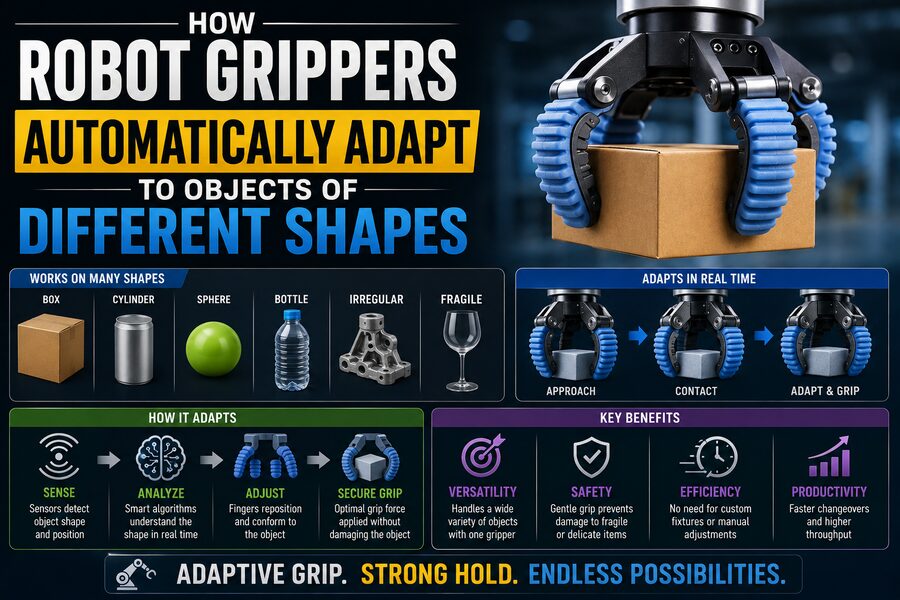

Industrial robots once worked best in highly controlled environments where every object had the same size, orientation, and shape. A robot on an assembly line might repeatedly pick up the exact same metal component thousands of times using a rigid gripper designed specifically for that part.
Modern automation is much more demanding. 📦⚙️
Warehouse robots may need to pick boxes, bottles, bags, tools, fruit, electronic components, and irregular packages from the same bin. Food-processing robots must handle delicate products that vary naturally in shape. Collaborative robots may need to manipulate objects they have never encountered before.
To do this reliably, robots need adaptive grippers.
An adaptive gripper can conform to an object’s geometry instead of requiring the object to match a perfectly predetermined shape. Some grippers accomplish this mechanically through flexible fingers and underactuated joints, while others use sensors, cameras, artificial intelligence, pneumatic structures, or soft materials.
The central goal is simple:
Detect the object → make contact → conform to its shape → apply enough force to hold it securely without damaging it. 🤏✨
🦾 What Is a Robot Gripper?
A robot gripper is the end-of-arm tool that physically interacts with objects.
It is essentially the robot’s “hand.”
Grippers can use many different methods to hold objects, including:
- Mechanical fingers
- Vacuum suction
- Magnetic attraction
- Soft pneumatic fingers
- Adhesive surfaces
- Electrostatic forces
The best method depends on what the robot must handle.
A steel plate in a factory might be lifted magnetically, while a cardboard box may be picked up using suction cups. A delicate strawberry may require a soft gripper capable of distributing force gently across its surface. 🍓
Adaptive grippers are particularly useful when objects vary.
🔧 Why Traditional Rigid Grippers Have Limitations
A simple two-finger parallel gripper works well when the dimensions of the object are known.
The fingers open.
The robot positions them around the object.
The fingers close.
The part is secured.
This works extremely well in repetitive manufacturing.
But imagine asking the same gripper to pick:
- A cylinder
- A triangular component
- A soft pouch
- A spherical fruit
- An irregular tool
A rigid jaw shape optimized for one object may contact another object at only one or two small points.
That can make the grasp unstable.
Adaptive grippers solve this problem by allowing the contact surfaces or finger positions to change automatically. 🔄
🖐️ The Human Hand Is the Inspiration
Human hands are remarkably adaptive.
When you pick up a coffee cup, your fingers wrap around its cylindrical wall.
When you hold a tennis ball, your fingers spread around a sphere.
When you carry a shopping bag, your fingers hook under its handle.
You do not need a completely different hand for every object.
Instead, the joints, muscles, tendons, skin, and sensory nerves continuously adjust.
Roboticists attempt to reproduce some of this adaptability using mechanical and electronic systems. 🧠🖐️
A robot gripper does not necessarily need five human-like fingers. Sometimes a two- or three-finger mechanism can achieve substantial adaptability using clever mechanical design.
⚙️ Underactuation: One Motor, Several Moving Joints
One of the most important concepts in adaptive robot grippers is underactuation.
A fully actuated robotic finger might have one motor for every joint.
If a hand had 12 joints, it might need 12 independent actuators.
That becomes expensive, heavy, and difficult to control.
An underactuated gripper uses fewer actuators than movable joints.
For example, one motor may control several finger segments through:
- Tendons
- Linkages
- Springs
- Differential mechanisms
When one section of the finger touches an object, the remaining joints can continue moving.
This allows the finger to wrap naturally around the object’s shape. 🔩
🧩 How an Underactuated Finger Conforms to an Object
Imagine a robotic finger with three segments.
The motor begins pulling a tendon.
All segments start closing.
The first segment touches the object.
Instead of stopping the entire finger, the mechanism allows the remaining segments to continue rotating.
The second segment then contacts another part of the object.
Finally, the fingertip settles against the surface.
The result is multiple contact points.
Instead of requiring the robot controller to calculate every joint angle perfectly, the mechanical structure itself performs part of the adaptation.
This is sometimes called mechanical intelligence because useful behavior emerges from the design of the mechanism. ⚙️🧠
🔗 Tendon-Driven Grippers
Tendons are common in adaptive robotic hands.
A flexible cable runs through the finger and connects its joints to a motor.
When the motor pulls the cable, the finger bends.
Springs or elastic elements may reopen the finger when tension is released.
This arrangement resembles the way biological tendons transfer muscle forces to finger joints.
Tendon-driven systems can be:
- Lightweight
- Compact
- Mechanically compliant
- Capable of wrapping around irregular objects
They are especially useful when designers want several finger joints to move together naturally.
🪀 Differential Mechanisms Share Force Between Fingers
Some adaptive grippers use mechanical differentials.
A differential distributes motion or force between multiple fingers.
Suppose two fingers are driven by one motor.
One finger touches the object first.
Instead of preventing the second finger from moving, the differential allows the second finger to continue closing until it also makes contact.
This helps center and secure objects even when their geometry is uneven.
A similar principle is used in vehicle drivetrains, where a differential allows wheels to rotate at different speeds.
In a gripper, the same broad mechanical idea allows fingers to move by different amounts while sharing one actuator. 🔄
🧸 Compliance Makes Grippers More Forgiving
Compliance refers to the ability of a structure to flex or yield under force.
Rigid mechanisms resist deformation.
Compliant mechanisms intentionally allow controlled movement.
In a gripper, compliance can be useful because it allows the fingers to adjust when the object’s location or shape is slightly different from expected.
For example, if a robot’s positioning is off by a few millimeters, a rigid gripper might strike the object.
A compliant gripper can deform slightly and still establish a successful grasp.
Compliance also reduces peak contact forces, which is important for fragile products. 🥚
🌬️ Soft Robotic Grippers
Some of the most adaptable grippers are made from soft elastomers rather than rigid metal links.
These soft robotic grippers may use pneumatic chambers inside flexible fingers.
When air pressure increases, the chambers expand asymmetrically, causing the finger to bend.
Several soft fingers can wrap around an object.
Because the fingers naturally deform around surfaces, they can handle irregular shapes without requiring extremely precise geometric models.
Soft grippers are useful for objects such as:
- Fruit 🍎
- Baked goods
- Medical products
- Fragile electronics
- Irregular consumer goods
🍅 Why Soft Grippers Are Good for Delicate Objects
Consider a ripe tomato.
A traditional rigid gripper could easily bruise it if excessive force is concentrated at small contact points.
A soft finger spreads force across a larger area.
Because the material itself deforms, the gripper can conform to the tomato’s surface.
This reduces local pressure.
The same principle helps robots handle products such as:
- Peaches
- Pastries
- Eggs
- Seafood
- Soft packaging
Food automation has therefore become an important application of adaptive soft gripping. 🍑
🧲 Granular Jamming Grippers
A particularly unusual adaptive gripper uses a flexible membrane filled with granular material.
The gripper presses the membrane against an object.
The loose particles shift and conform around the object’s surface.
Then air is removed from the membrane.
The pressure difference compresses the particles together, causing them to jam and become rigid.
The gripper now holds the object.
To release it, the vacuum is removed and the particles become loose again.
This is known as granular jamming.
It is valuable because one flexible surface can conform to a wide range of geometries. 🎈➡️🪨
💨 Vacuum Grippers Adapt in a Different Way
Vacuum gripping does not necessarily involve fingers.
A suction cup creates a pressure difference between the cup and the object surface.
Atmospheric pressure then pushes the cup against the object.
Flexible suction cups can adapt to slight surface curvature and unevenness.
Industrial systems may use arrays of many suction cups.
If some cups do not contact the object, others may still create enough holding force.
This makes multi-cup vacuum grippers useful for handling:
- Boxes
- Sheets
- Bags
- Glass panels
- Packages
📦
However, suction works best when the surface can form a reasonably good seal.
🔲 Adaptive Suction Arrays
Some warehouse robots use large arrays of individually compliant suction elements.
Imagine a gripper containing dozens of small suction cups.
When the gripper approaches an irregular package, some cups contact higher surfaces while others compress farther.
The array conforms to the package’s shape.
Valves can isolate cups that fail to seal, preventing excessive vacuum loss.
This provides a degree of adaptability without requiring articulated robotic fingers.
Such systems are especially useful in parcel and logistics automation. 🚚
👁️ Vision Helps the Robot Choose a Grasp
Mechanical adaptability alone is not enough.
The robot still needs to know:
- Where the object is
- How it is oriented
- Where it can be safely grasped
Machine vision systems provide this information.
Cameras may capture:
- RGB images
- Depth information
- 3D point clouds
Software then estimates object geometry.
A grasp-planning algorithm identifies promising contact locations.
The robot moves the gripper toward one of these positions.
Once contact begins, mechanical compliance or sensor feedback handles the remaining uncertainty. 👁️🤖
🧠 AI-Based Grasp Planning
Traditional robot programming relies on explicitly defined rules.
For example:
If object type = bottle → grasp at center
Modern systems can use machine learning to evaluate many possible grasps.
A model may analyze an image or 3D representation and predict:
- Grasp position
- Gripper orientation
- Expected stability
- Collision risk
The system can rank possible grasps and choose one with a high predicted success rate.
This is particularly useful in bin picking, where many randomly oriented objects are piled together.
📦 The Bin-Picking Challenge
Imagine a warehouse bin containing dozens of different objects.
Some are partially hidden.
Others overlap.
Several may have shiny or transparent surfaces that are difficult for cameras to measure.
The robot must:
- Detect reachable objects.
- Select one.
- Find a safe grasp.
- Avoid collisions with nearby items.
- Close the gripper.
- Verify that the object was successfully picked.
Adaptive grippers improve this process because the grasp does not need to be geometrically perfect.
The fingers can compensate for small positioning errors. 🎯
🫳 Force Sensors Detect Contact
A robot also needs to know when it has touched the object.
Some grippers include force or torque sensors.
As the fingers close, the controller monitors contact force.
Once sufficient force is reached, the gripper stops tightening.
This prevents unnecessary squeezing.
Force sensing can also detect whether:
- The object slipped
- The grasp is asymmetric
- Something unexpected is blocking the fingers
Feedback makes the gripper much more intelligent than a simple open-or-close mechanism. 📡
✋ Tactile Sensors Give Robots a Sense of Touch
More advanced robotic hands include tactile sensors.
These sensors mimic aspects of human touch.
They may measure:
- Pressure
- Contact location
- Shear force
- Texture
- Slip
Some tactile sensors contain arrays of tiny sensing elements across the fingertip.
Others use cameras inside transparent elastic pads to observe how the contact surface deforms.
This gives the robot detailed information about how the object is interacting with the gripper. 🖐️
🧼 Detecting Slip
A grasp can initially appear successful but later begin to slip.
Tactile sensors can detect small movements between the object and fingertip.
The controller can then increase grip force slightly.
This creates a feedback loop:
Grip → detect slip → increase force → stabilize object
The goal is to use only as much force as necessary.
Too little force allows slipping.
Too much can damage the object or waste energy.
⚖️ Grip Force Must Match the Object
Different objects require dramatically different forces.
A metal tool may tolerate a strong grip.
A paper cup may collapse.
A glass container could break.
A soft fruit may bruise.
Adaptive systems therefore regulate force using information from:
- Object classification
- Force sensors
- Tactile feedback
- Motor current
- Prior learned experience
The controller can continuously adjust grip pressure during manipulation. 🍷⚙️
🔌 Motor Current Can Estimate Force
Some grippers estimate gripping force without dedicated fingertip force sensors.
Electric motors draw more current when they encounter greater resistance.
By monitoring motor current, the controller can estimate how much force the fingers are applying.
This method is less precise than specialized force sensing in some situations, but it can provide useful feedback at relatively low cost.
🌀 Shape Adaptation Through Flexible Materials
Not every adaptive gripper requires multiple joints.
Some designs use a continuous flexible surface.
When pressed against an object, the material bends around the shape.
Examples include:
- Silicone fingers
- Foam pads
- Flexible suction cups
- Inflatable structures
This approach reduces mechanical complexity.
Instead of actively controlling every contact point, the material itself naturally conforms to the object.
That can make the gripper robust when handling uncertain geometry.
🧱 Rigid and Soft Hybrid Grippers
Purely soft grippers are highly compliant but may struggle with heavy loads.
Rigid grippers provide strength but may lack adaptability.
Hybrid designs combine both.
For example, a gripper might use:
- Rigid structural links
- Flexible joints
- Soft fingertip pads
The rigid structure carries large loads.
The compliant surfaces conform to the object.
This can provide a good balance between strength, precision, and adaptability. 💪
🏭 Adaptive Grippers in Manufacturing
Manufacturers traditionally use dedicated tooling for each component.
Changing products can require changing the robot’s gripper.
Adaptive grippers can reduce this need.
One gripper may handle several part variants.
This can be especially valuable in:
- Flexible manufacturing
- Low-volume production
- High-mix assembly
- Machine tending
If a factory produces many different components, reducing tooling changes can save substantial time and cost.
🚚 Warehouse Automation
Warehouses are one of the most demanding environments for adaptive gripping.
An e-commerce fulfillment center may contain millions of products with different:
- Shapes
- Sizes
- Materials
- Packaging
A general-purpose picking robot might encounter a toothpaste box followed by a toy, bottle, cable, and soft package.
Adaptive fingers or suction arrays allow the same robotic system to handle a much broader product range.
This reduces the need for dedicated automation for every SKU. 📦
🌾 Agriculture and Food Handling
Natural products are rarely identical.
Two apples may differ in:
- Diameter
- Shape
- Orientation
- Firmness
Agricultural robots therefore benefit greatly from adaptive gripping.
Soft or compliant grippers can pick:
- Apples
- Strawberries
- Tomatoes
- Mushrooms
- Lettuce
without requiring every item to match a precise industrial specification.
This is one reason soft robotics has received significant attention in agricultural automation. 🌱🤖
🧑🤝🧑 Collaborative Robots
Collaborative robots, or cobots, are designed to work closer to people than traditional fenced industrial robots.
Adaptive grippers can support these applications because compliant fingers reduce the severity of some accidental contacts.
However, a soft gripper alone does not automatically make an entire robot system safe.
Safety still depends on:
- Robot speed
- Force limits
- Risk assessment
- Sensors
- Control software
- Application design
Adaptive gripping can contribute to safer interaction, but it is only one part of the complete safety system. 🛡️
🔄 Self-Centering Grippers
Some adaptive grippers automatically center objects.
Imagine three fingers arranged around a circular opening.
As they close together, a cylindrical object is naturally pushed toward the center.
Mechanical linkages can synchronize the finger movement.
This reduces the need for perfectly accurate robot positioning.
Self-centering behavior is especially useful for:
- Cylindrical components
- Pipes
- Bottles
- Round machine parts
🧠 Passive Adaptation vs. Active Adaptation
Adaptive grippers can be divided conceptually into two categories.
⚙️ Passive Adaptation
The mechanism automatically conforms through:
- Springs
- Flexible materials
- Linkages
- Underactuation
The robot controller does not need to command every adjustment.
🤖 Active Adaptation
Sensors detect the object and motors deliberately change:
- Finger position
- Grip force
- Joint angle
- Contact strategy
Many advanced grippers combine both.
Mechanical compliance handles small uncertainties, while active control handles larger decisions.
🎯 Why Passive Adaptation Is Valuable
Robotic perception is never perfectly accurate.
A camera might estimate an object’s location with a few millimeters of error.
Instead of demanding perfect sensing, mechanical compliance can absorb that uncertainty.
This is often more efficient than trying to solve everything through software.
Good robotic design frequently combines:
Perception intelligence + control intelligence + mechanical intelligence
Rather than depending entirely on one of them. 🧠⚙️
📊 Grasp Stability Depends on Contact Geometry
A good grasp must resist forces that would otherwise make the object move.
Important factors include:
- Number of contact points
- Friction
- Contact location
- Grip force
- Object center of mass
Wrapping several fingers around an object can create a form closure or strong force closure that prevents movement in multiple directions.
Adaptive fingers increase the likelihood of achieving useful contact over irregular shapes.
🧽 Finger Surface Materials Matter
The material covering a robotic fingertip has a major effect on grip.
A high-friction rubber pad may hold a smooth object with less squeezing force.
Soft pads also conform to microscopic surface irregularities.
Possible fingertip materials include:
- Rubber
- Silicone
- Polyurethane
- Specialized polymers
Selecting the right surface can improve gripping performance without changing the mechanical design.
⚠️ Too Much Compliance Can Be a Problem
Adaptability comes with tradeoffs.
A very flexible gripper may have difficulty:
- Positioning objects precisely
- Holding heavy loads
- Resisting high acceleration
- Performing insertion tasks
For example, inserting a tight-fitting metal peg into a hole may require much greater stiffness than lifting a piece of fruit.
Engineers therefore choose the appropriate level of compliance for the application.
The best gripper is not always the softest or most complex one.
🔩 Tool Changers Provide Another Form of Adaptability
Sometimes one universal gripper is not practical.
A robot can instead use an automatic tool changer.
The robot may switch between:
- Parallel jaw gripper
- Vacuum tool
- Magnetic gripper
- Soft gripper
The robot chooses the tool best suited to each object.
This adds mechanical complexity but can greatly expand the range of tasks one robot can perform.
🤖 Learning From Failed Grasps
AI-based robotic systems can improve through data.
Suppose the robot attempts to grasp a bottle and drops it.
The system can record:
- Camera image
- Chosen grasp point
- Gripper angle
- Applied force
- Success or failure
Across thousands or millions of attempts, machine-learning models can discover which grasp strategies work best.
This can improve performance on objects the robot has never seen before. 📈
🔮 The Future of Adaptive Robotic Hands
Research is moving toward grippers with increasingly human-like capabilities.
Future systems may combine:
- Highly sensitive artificial skin
- Variable stiffness
- Soft actuators
- Vision
- Force sensing
- Machine learning
- Dexterous multi-finger control
One goal is general-purpose manipulation: a robot capable of handling everyday objects without requiring a custom tool for each one.
Achieving human-level dexterity remains extremely difficult, but adaptive grippers are an important step toward that goal. 🚀
🧩 A Simple Analogy
Imagine picking up three objects:
A tennis ball, a coffee mug, and a banana.
You do not calculate the exact coordinates of every finger joint before touching them.
Instead, you move your hand into position, make contact, let your fingers conform to the object’s shape, feel the pressure, and adjust.
Adaptive robot grippers follow the same broad strategy:
Approach → contact → conform → sense → adjust → hold
🖐️➡️🤖
The combination of mechanical flexibility and sensor feedback makes reliable grasping possible even when every object is different.
✅ Conclusion
Robot grippers automatically adapt to objects of different shapes by combining mechanical compliance, underactuated mechanisms, flexible materials, sensing, and intelligent control. 🤖🦾
Underactuated fingers can use one motor to drive several joints, allowing some finger segments to stop when they touch an object while others continue wrapping around it. Differential linkages distribute motion between fingers, while tendons and springs create naturally conforming movement.
Soft robotic grippers go even further by using flexible materials that physically mold themselves around irregular objects. Vacuum arrays, granular-jamming devices, and compliant fingertip surfaces provide other ways of adapting without requiring perfectly matched geometry.
Sensors add another layer of intelligence. Cameras estimate object position and shape, force sensors measure contact pressure, and tactile sensors can detect slipping. The controller can then adjust finger position or gripping force in real time.
The result is a system that does not need every product to be identical.
Instead of forcing the object to fit the gripper, the gripper changes itself to fit the object. 🔄
This capability is transforming warehouse automation, flexible manufacturing, agriculture, food handling, collaborative robotics, and many other fields where objects are unpredictable.
The long-term goal is ambitious: robotic hands that can handle the physical world with the same effortless adaptability humans demonstrate every day. 🧠🖐️⚙️