
Robots are becoming increasingly capable of working around people. Collaborative robotic arms share factory workspaces with technicians. Humanoid robots walk through buildings. Powered exoskeletons assist human movement, while rehabilitation robots physically interact with patients.
These machines often need something traditional industrial robots were not designed for: controlled physical compliance.
A conventional motor-driven joint can be extremely stiff. If its controller commands a position, the actuator may resist anything trying to move it away from that position. That rigidity can be useful when machining metal or moving parts with high precision, but it becomes dangerous when a robot unexpectedly collides with a person. ⚠️
One important solution is the Series Elastic Actuator, commonly abbreviated SEA.
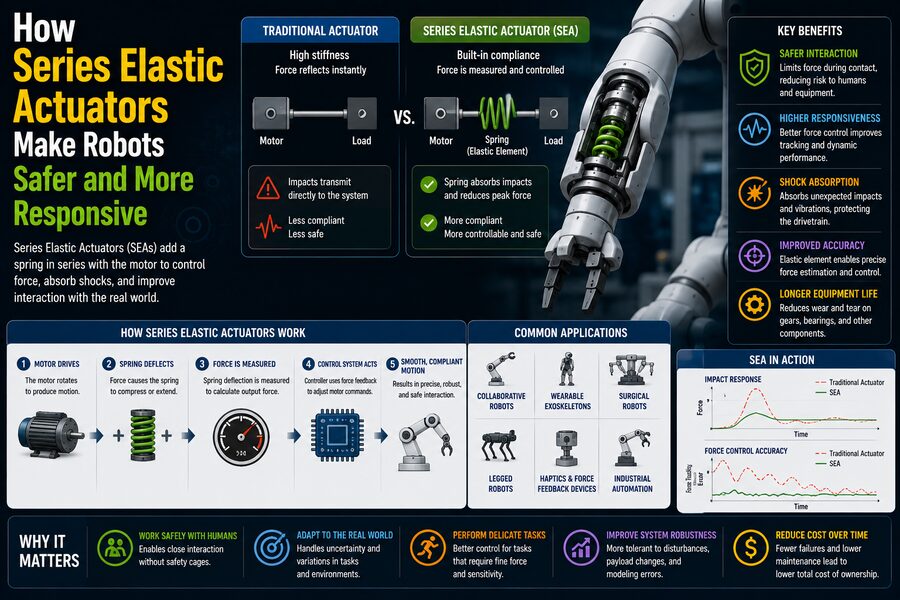
A series elastic actuator deliberately places a spring or other elastic element between the motor-transmission system and the load. Instead of transmitting motor force rigidly to the robot joint, the spring can compress or stretch.
That controlled elasticity allows engineers to measure force more accurately, absorb impacts, store energy, and create robots that interact with people and uncertain environments more naturally.
The basic principle is surprisingly simple:
Put a carefully designed spring in the force path, measure how much it deforms, and use that deformation to control how strongly the robot pushes. 🌀⚙️
🧠 What Is a Series Elastic Actuator?
A typical robotic actuator contains:
Electric motor → gearbox → robot joint
The motor produces rotation, while the gearbox increases torque and reduces speed.
In a series elastic actuator, an elastic element is inserted in series with the mechanical output:
Motor → gearbox → spring → robot joint
Because the spring lies directly in the load path, almost every force transmitted between the motor and robot joint passes through it.
When the robot pushes against an object, the spring deforms.
Engineers measure that deformation and calculate the corresponding force or torque.
This turns the elastic element into both:
🛡️ A mechanical shock absorber
and:
📏 A force-sensing device.
🌀 Why Put a Spring in a Robot Joint?
At first, deliberately making a robot joint flexible may seem like a bad engineering decision.
Traditional machine design often tries to eliminate compliance because flexibility can reduce positional precision.
But robots that interact physically with the real world face a different problem.
The world is unpredictable.
A robot may encounter:
👤 A person
📦 An object in the wrong position
🪜 An unexpected obstacle
🌍 Uneven ground
⚙️ A mechanical impact
If the actuator is perfectly rigid, the resulting collision forces can rise extremely quickly.
A spring slows that force buildup.
Instead of every millimeter of unexpected motion immediately becoming a large impact force, some displacement is absorbed through elastic deformation.
That gives the control system valuable time to detect what happened and respond.
⚖️ Hooke’s Law Turns Spring Deflection Into Force
The key measurement principle behind many SEAs comes from Hooke’s law:
F = kx
where:
F= spring forcek= spring stiffnessx= spring deformation
For a rotational spring, the equivalent relationship is:
τ = kθ
where:
τ= torquek= torsional stiffnessθ= angular deflection
Suppose an actuator contains a linear spring with stiffness:
10,000 N/m
and the measured compression is:
0.005 m
Then:
F = 10,000 × 0.005 = 50 N
By measuring only a few millimeters of spring movement, the controller can estimate the force being transmitted to the robot joint.
This is one of the most valuable features of the architecture. 📏
🛡️ 1. Series Elastic Actuators Reduce Collision Forces
Imagine a robotic arm moving toward a table.
The controller expects the table surface to be 2 centimeters lower than it actually is.
A highly rigid actuator continues trying to reach its commanded position even after the arm contacts the table.
Force can rise extremely rapidly.
With an SEA, the output spring begins compressing when contact occurs.
The joint can temporarily stop moving while the motor side continues moving slightly.
The spring absorbs some of the mechanical energy.
Meanwhile, sensors detect increasing deformation.
The controller recognizes that contact has occurred and reduces the motor command.
This process can significantly soften impacts. 🤖🛡️
⏱️ Mechanical Compliance Works Before Software Reacts
One of the most important safety advantages of physical elasticity is that it works immediately.
Electronic control systems have delays caused by:
📡 Sensor sampling
🧠 Computation
⚙️ Motor-driver response
🔄 Communication networks
These delays may be small, but impact forces can grow extremely quickly.
A mechanical spring does not wait for software.
The instant an impact occurs, it begins deforming.
That passive response can reduce peak force even before the controller has fully recognized the collision.
This is sometimes described as a form of mechanical intelligence built directly into the actuator.
📏 2. SEAs Make Force Measurement Easier
Measuring motor current can provide an estimate of actuator torque because electric motor torque is related to current.
However, current-based force estimation can be inaccurate because of:
⚙️ Gear friction
🔩 Gearbox losses
🌀 Backlash
🌡️ Temperature changes
🛢️ Lubrication conditions
A force measured from spring deformation can often represent output load more directly.
If the spring stiffness is known accurately, the actuator can estimate joint force using position sensors placed on both sides of the elastic element.
For example:
Motor-side angle − output-side angle = spring deflection
That deformation corresponds to torque.
This enables highly effective closed-loop force control.
🎯 3. Force Control Becomes More Precise
Many robotic tasks are not really position-control problems.
Consider a robot polishing a surface.
The important question may not be:
“Is the tool exactly 412.3 mm from the robot base?”
Instead, it may be:
“Is the tool pressing against the surface with 20 newtons of force?”
A series elastic actuator can regulate this force directly.
The controller measures spring deformation and adjusts the motor until the desired force is achieved.
This makes SEAs useful for:
🪚 Grinding and polishing
🧽 Surface cleaning
🤝 Human-robot interaction
🦿 Prosthetics
🩺 Rehabilitation robotics
📦 Delicate manipulation
The robot can maintain controlled contact even if the exact surface position changes slightly.
🤝 Robots Can Interact With Humans More Naturally
People are not rigid structures.
Human arms, legs, muscles, and tendons are naturally compliant.
When two people shake hands, neither person controls hand position with machine-like stiffness.
Instead, both continually adjust force.
Series elastic actuators allow robots to behave more similarly.
A robotic arm can yield slightly when pushed.
An exoskeleton can support a person’s movement without rigidly forcing the limb along an exact trajectory.
A rehabilitation robot can apply assistance while still allowing the patient to contribute effort.
This compliance makes physical interaction feel less mechanical and potentially safer. 🤝🤖
🦿 SEAs in Prosthetic and Rehabilitation Devices
Series elastic actuators are particularly attractive in wearable robotics.
Imagine a powered ankle prosthesis.
During walking, the ankle experiences changing forces throughout every step.
The actuator needs to:
- Support body weight
- Absorb impact
- Store energy
- Return energy during push-off
- Adapt to changing terrain
A rigid motor and gearbox can perform these tasks, but elastic elements can make the behavior more natural.
The spring can temporarily store energy when loaded and release it later.
This resembles the behavior of biological tendons.
🧬 Biological Muscles Are Naturally Elastic
Human movement depends heavily on elastic tissues.
Tendons stretch under load and store mechanical energy.
During running, for example, the Achilles tendon stores energy as the foot contacts the ground and releases it during push-off.
Roboticists often borrow this principle.
A series elastic actuator does not copy human biology exactly, but the analogy is useful:
Motor ≈ muscle
Series spring ≈ tendon
The motor provides controlled energy while the spring provides compliance and energy storage.
This combination can improve dynamic movement.
⚡ 4. Springs Can Store and Return Energy
When an SEA spring compresses, it stores potential energy.
For a linear spring:
E = ½kx²
That stored energy can later be returned to the system.
This is especially valuable in cyclic movements such as:
🏃 Running
🚶 Walking
🦿 Jumping
🔄 Repetitive robotic motion
Instead of forcing the motor to generate every moment of peak power directly, the spring can contribute energy during part of the motion.
This may reduce instantaneous motor demands.
🏃 Series Elastic Actuation in Legged Robots
Walking and running robots experience repeated impacts with the ground.
Every foot strike creates rapidly changing forces.
Rigid joints transfer much of that shock into gearboxes and structures.
Series elastic elements can absorb part of the impact.
They can also help robots adapt when the terrain is slightly higher or lower than expected.
Suppose a robot expects the floor at one height but encounters a small rock.
A compliant leg can absorb the unexpected displacement instead of immediately producing a severe impact.
This helps protect:
⚙️ Gearboxes
🔩 Bearings
🧱 Structural components
📡 Sensors
as well as the surrounding environment.
🌍 Compliance Helps Robots Handle Uncertain Environments
Industrial robots traditionally operate in highly controlled spaces.
Every fixture, part, and motion path is carefully defined.
Mobile and service robots cannot rely on such predictable conditions.
They encounter:
🪑 Furniture
🪨 Uneven terrain
🚪 Doors
👥 Moving people
📦 Unknown object positions
Mechanical compliance gives the robot a margin for error.
Instead of demanding perfect environmental knowledge, the robot can tolerate small differences between its internal model and reality.
That can make the entire system more robust.
📉 5. Elasticity Protects Gearboxes From Shock Loads
Robot gearboxes can be expensive and mechanically sensitive.
Sudden impacts create large peak torques.
If those peaks are transmitted directly through rigid gears, teeth and bearings may experience high stress.
An SEA spring reduces how rapidly torque rises.
The energy that would have produced a sharp mechanical shock is temporarily stored elastically.
This can reduce stress on:
🔩 Gear teeth
⚙️ Bearings
🧱 Mounting structures
🔗 Couplings
The result may be improved actuator durability.
🎛️ How a Series Elastic Actuator Is Controlled
An SEA usually has multiple sensors.
The system may measure:
- Motor position
- Output position
- Spring deflection
- Motor current
- Joint velocity
A force-control loop might work like this:
Desired force
⬇️
Measure spring deformation
⬇️
Calculate actual force
⬇️
Compare desired vs. actual
⬇️
Adjust motor torque
⬇️
Repeat continuously
This can happen hundreds or thousands of times per second.
The motor constantly changes its behavior so the spring deformation corresponds to the desired joint force.
🔄 Position Control Is Still Possible
Adding elasticity does not mean the robot loses position control completely.
A higher-level controller can still command a target joint position.
The actuator may use an inner force-control loop and an outer position-control loop.
For example:
Outer loop: Determine how much force is needed to reach a desired position.
Inner loop: Make the actuator produce that force accurately.
This layered architecture can provide smooth motion while preserving compliance.
🧠 Impedance Control Works Naturally With SEAs
One important robotic control strategy is impedance control.
Instead of commanding only position or force, the controller specifies how the robot should respond when displaced.
Conceptually, the robot can behave like a programmable:
🌀 Spring
💧 Damper
⚖️ Mass
For example, a robotic arm can be commanded to behave as if its endpoint were connected to a soft virtual spring.
Push the arm slightly, and it yields.
Push harder, and resistance increases.
Series elastic actuators are well suited to this kind of behavior because force is measurable and mechanical compliance already exists.
🫳 A Robot Can Feel Softer Without Becoming Weak
Compliance does not mean an actuator cannot generate large forces.
A well-designed SEA may still produce significant torque.
The difference is how the force is transmitted.
A robot joint could generate:
100 Nm of controlled torque
while still allowing a few degrees of spring deflection during unexpected contact.
This is very different from a weak actuator.
The robot remains powerful, but its interaction with the environment becomes more controllable.
🧱 Spring Stiffness Is a Critical Design Choice
The series spring cannot be chosen arbitrarily.
If it is too stiff:
❌ Collision forces rise rapidly
❌ Force sensing becomes less sensitive
❌ Compliance benefits decrease
If it is too soft:
❌ Position accuracy may decrease
❌ The actuator may feel sluggish
❌ Large deflections may occur
❌ Control bandwidth may be limited
Engineers therefore choose spring stiffness based on the robot’s required:
- Force range
- Position accuracy
- Speed
- Impact tolerance
- Control bandwidth
This creates a fundamental design tradeoff.
📡 Sensor Resolution Matters
Suppose a very stiff spring deflects only:
0.01 mm
under a typical load.
The sensor must measure extremely tiny displacements accurately.
A softer spring might deflect:
1 mm
under the same load.
That larger movement is easier to measure.
Therefore, spring stiffness affects force-sensing resolution.
This is one reason moderate compliance can improve practical force control.
📉 Elasticity Reduces Control Bandwidth
Series elasticity has disadvantages.
A spring introduces another mechanical dynamic into the system.
The actuator can oscillate.
Motor motion does not immediately translate into load motion.
As a result, extremely fast position changes become harder.
The achievable control bandwidth may be lower than that of a highly rigid direct-drive system.
Engineers must therefore balance:
Responsiveness ⚡
against:
Compliance 🌀
The ideal balance depends on the application.
📳 Resonance Must Be Controlled
A motor, spring, and load form a dynamic mechanical system.
Like a mass attached to a spring, it has natural frequencies.
If control commands excite those frequencies, oscillation can develop.
Engineers use techniques such as:
💧 Damping control
🎛️ Feedback tuning
📊 Model-based control
🔍 Resonance filtering
to ensure stable behavior.
Poorly tuned SEAs can feel bouncy or unstable.
Well-designed ones can feel smooth and highly responsive.
⚙️ Different Types of Elastic Elements
The compliant element does not have to be a simple coil spring.
Engineers may use:
🌀 Compression springs
🔄 Torsion springs
🍃 Leaf springs
🧱 Flexure mechanisms
⭕ Elastomeric elements
⚙️ Custom-machined elastic structures
The design depends on packaging, torque range, fatigue life, weight, and desired stiffness.
Flexures are especially attractive because they can provide predictable elasticity with very little backlash.
🔩 Rotary Series Elastic Actuators
Many robot joints rotate.
In a rotary SEA, the elastic element twists under torque.
Sensors measure the relative angle between:
motor/transmission side
and:
joint/output side.
If the torsional stiffness is known, torque can be calculated directly.
This configuration is common in robotic arms, humanoid joints, and legged robots.
↔️ Linear Series Elastic Actuators
Some robots require straight-line motion.
A linear SEA may contain:
Motor → ball screw or transmission → compression spring → load
The spring length changes as force develops.
This can be useful in:
🦿 Exoskeletons
🏥 Rehabilitation machines
🤖 Linear robotic mechanisms
🛠️ Force-controlled industrial tools
The same fundamental principle applies regardless of whether the motion is rotary or linear.
🆚 SEA vs. Traditional Rigid Actuator
A rigid actuator prioritizes:
🎯 Position accuracy
⚡ High bandwidth
📐 Structural stiffness
An SEA prioritizes:
🛡️ Impact tolerance
📏 Force sensing
🤝 Safe interaction
🌀 Compliance
Neither architecture is universally better.
A CNC machine may benefit from extremely rigid servo drives.
A robot assisting a patient may benefit far more from controlled elasticity.
Engineering design depends on the task.
🆚 SEA vs. Direct-Drive Actuator
A direct-drive actuator connects a motor to the load with little or no gearing.
Direct-drive systems can have low friction and excellent torque sensing through motor current.
They can also provide natural backdrivability.
However, producing high torque directly may require a large and heavy motor.
SEAs allow engineers to combine a smaller high-speed motor with a gearbox while still recovering useful compliance and force sensitivity.
This can be attractive when weight and packaging matter.
🔄 What Is Backdrivability?
A robot joint is backdrivable when external forces can move it backward through the transmission.
Imagine grabbing a robot arm and pushing it gently.
A highly backdrivable joint moves easily.
A high-ratio gearbox may resist strongly because friction and gear reduction make reverse motion difficult.
Series elasticity does not completely eliminate gearbox resistance, but the spring allows the output side to move somewhat even before the motor transmission backdrives.
This can make interaction feel more compliant.
🫂 Collaborative Robots Benefit From Compliance
Collaborative robots, or cobots, are designed to operate near humans.
Safety relies on many strategies, including:
📡 Proximity sensing
⚡ Motor current monitoring
🧠 Collision detection
🛑 Emergency stopping
🌀 Mechanical compliance
Series elasticity can be one of these protective layers.
If a worker unexpectedly contacts the robot, compliance can limit how rapidly contact force rises while the control system stops or changes motion.
However, a spring alone does not make a robot automatically safe.
Complete safety requires system-level risk assessment and appropriate standards.
🏥 Rehabilitation Robots Need Controlled Force
A rehabilitation robot may repeatedly guide a patient’s arm or leg through therapeutic motion.
The device must provide enough force to assist movement without overpowering the patient.
An SEA can measure interaction force directly.
The controller can then respond differently depending on patient behavior.
For example:
Patient moves actively → robot assists less
Patient struggles → robot assists more
This creates more adaptive therapy.
🦾 Exoskeletons Benefit From Human-Compatible Compliance
Powered exoskeletons physically attach to the human body.
Small alignment errors between robotic joints and biological joints are almost unavoidable.
A completely rigid actuator could convert these errors into uncomfortable forces.
Series elasticity helps absorb some of these differences.
It can also provide precise measurements of how much assistive torque the device applies.
This is critical when augmenting walking, lifting, or rehabilitation exercises.
🧑🚀 Humanoid Robots Use Elasticity for Dynamic Motion
Humanoid robots experience many of the same mechanical challenges as humans:
🚶 Walking impacts
🏃 Running loads
🪜 Stair contact
🤝 Physical interaction
⚖️ Balance disturbances
Elastic actuators can help manage these forces.
During a foot strike, the actuator can absorb energy.
During push-off, stored energy can be returned.
During a disturbance, compliant joints can yield rather than immediately transmitting a shock through the entire body.
This can support more robust locomotion.
🦿 Series Elasticity Can Improve Balance Control
Balancing requires controlling forces against the ground.
A walking robot does not only need to know where its foot is.
It needs to understand:
How hard is the foot pushing against the ground?
Joint torque measurements from SEAs can help estimate these interaction forces.
The controller can then modify ankle, knee, and hip torques to maintain balance.
This is especially useful when terrain is uneven or unpredictable.
🏭 Industrial Robots Can Use SEAs for Contact Tasks
Not every industrial operation requires extreme rigidity.
Some processes depend on consistent contact force.
Examples include:
🧽 Polishing
🔧 Assembly
🔩 Press fitting
🪵 Sanding
🧪 Material testing
A force-controlled elastic actuator can adapt to small variations in part geometry.
Instead of requiring perfect fixtures and exact positions, the robot can maintain a specified contact force.
This may simplify automation.
🔌 Connector Insertion Is Easier With Compliance
Imagine a robot inserting an electrical connector.
If the plug is misaligned by even a small amount, a rigid position-controlled robot may jam it or damage the pins.
A compliant actuator can allow slight movement while contact forces guide the connector into alignment.
This principle is sometimes called compliant insertion.
Humans do this naturally.
When inserting a plug, we feel resistance and adjust.
SEAs help robots achieve similar behavior.
📦 Handling Fragile Objects Becomes Safer
A robotic gripper handling:
🥚 Eggs
🍓 Fruit
🧪 Laboratory glassware
📱 Electronics
must avoid excessive force.
If the actuator can measure force accurately through spring deformation, the gripper can stop increasing force once sufficient grip is achieved.
This reduces the likelihood of crushing or damaging delicate objects.
🔋 Energy Efficiency Can Improve in Cyclic Tasks
In repetitive movements, elastic energy storage can reduce motor workload.
Consider a jumping robot.
When it lands:
Kinetic energy → spring energy
During takeoff:
Spring energy → kinetic energy
The motor still needs to supply energy because losses exist, but it may not need to provide the full instantaneous peak.
This can reduce electrical peak power and potentially improve efficiency.
⚡ Springs Can Increase Peak Mechanical Power
A motor has limited maximum power.
A spring can store energy slowly and release it quickly.
Imagine compressing a spring over:
0.5 seconds
and releasing its energy over:
0.05 seconds.
The instantaneous mechanical power during release can be much larger than the motor’s continuous power.
This principle can help robots perform explosive movements such as jumping.
The actuator temporarily stores motor energy and then releases it rapidly.
🧠 Variable-Stiffness Actuators Go One Step Further
A conventional SEA has approximately fixed spring stiffness.
More advanced robotic actuators may allow stiffness itself to change.
These are called variable-stiffness actuators.
A robot might use:
🌀 Soft behavior around people
and:
⚙️ Stiffer behavior during precision tasks.
Variable-stiffness systems can offer greater versatility but are mechanically and computationally more complex.
SEAs remain popular because they provide many benefits with a relatively understandable architecture.
🧪 Engineers Must Calibrate the Spring
Accurate force estimation requires knowing the spring’s real stiffness.
Manufacturing tolerances mean the actual relationship may differ slightly from the theoretical design.
Engineers therefore calibrate the actuator.
They apply known forces or torques and measure deformation.
The resulting calibration curve may reveal:
📏 Actual stiffness
🔄 Hysteresis
🌡️ Temperature sensitivity
⚠️ Nonlinear behavior
The control software can then compensate for these effects.
🔁 Hysteresis Can Affect Accuracy
Some elastic materials do not follow exactly the same force-deformation path during loading and unloading.
This behavior is called hysteresis.
Elastomers can exhibit significant hysteresis.
Metal springs and flexures may have much less.
If precise force sensing is required, engineers prefer elastic components with predictable and repeatable behavior.
Material choice therefore influences sensing quality.
🌡️ Temperature Can Change Spring Properties
Robots operate under changing thermal conditions.
Motors and gearboxes generate heat.
Environmental temperature may also vary.
Some spring materials change stiffness slightly with temperature.
If the actuator relies on spring deformation to calculate force, these changes can affect measurement accuracy.
High-performance systems may compensate using:
🌡️ Temperature sensors
📊 Calibration tables
🧠 Model-based corrections
🔧 Fatigue Life Matters
A series spring may flex millions of times during a robot’s lifetime.
That makes fatigue a critical design consideration.
A spring that works perfectly for 1,000 cycles may fail after 10 million cycles if stress is too high.
Engineers analyze:
- Maximum stress
- Stress concentration
- Material endurance
- Surface finish
- Load cycles
Elastic elements must be designed for repeated deformation without cracking.
🛡️ Mechanical Stops Protect the Spring
Many SEAs include mechanical stops.
These prevent the spring from deforming beyond a safe limit.
Suppose an unusually severe impact occurs.
The spring initially absorbs the load.
If deformation reaches its maximum allowable value, a hard stop engages.
This protects the elastic component from permanent deformation or fracture.
The rest of the drivetrain must then safely handle the remaining load.
📊 SEA Performance Is a Multi-Objective Tradeoff
An ideal actuator would have:
⚡ Unlimited speed
💪 Unlimited torque
🎯 Perfect position accuracy
📏 Perfect force sensing
🌀 Unlimited compliance
🪶 Zero weight
No real actuator can achieve all of these simultaneously.
SEA design involves compromises among:
- Motor size
- Gear ratio
- Spring stiffness
- Sensor resolution
- actuator mass
- force bandwidth
- position bandwidth
- mechanical strength
Successful design means selecting the best balance for the robot’s intended job.
💻 Advanced Control Improves SEA Performance
Modern controllers can compensate for many disadvantages of elastic actuation.
Techniques may include:
🧠 Model predictive control
📊 State estimation
🎛️ Disturbance observers
🔄 Feedforward compensation
🤖 Learned control policies
These methods use mathematical models and sensor data to predict how the spring, motor, and load will behave.
The controller can then respond more accurately and quickly.
This makes modern SEAs far more capable than simple passive spring systems.
📡 High-Speed Sensors Make SEAs More Responsive
Better sensing technology improves actuator performance.
Modern robots may use:
🔄 High-resolution encoders
📏 Optical displacement sensors
🧲 Magnetic encoders
🧠 Fast motor-current measurement
By measuring spring deflection with extremely low latency, the controller can update force commands rapidly.
This helps reduce the traditional tradeoff between compliance and responsiveness.
🚀 Why Series Elastic Actuators Matter for Future Robotics
Future robots are expected to leave isolated factory cages and operate more directly in human environments.
They may:
🏠 Help inside homes
🏥 Assist patients
🏭 Work beside technicians
📦 Handle unpredictable objects
🚶 Walk through public spaces
🦾 Augment human strength
These tasks require a different kind of actuator from traditional rigid industrial machinery.
Robots must be strong enough to perform useful work but compliant enough to tolerate uncertainty.
Series elastic actuators provide one practical way to achieve that balance.
✅ Conclusion
Series elastic actuators make robots safer and more responsive by deliberately placing an elastic element between the motor and the robot’s load.
That spring changes the behavior of the entire actuator. 🌀🤖
During a collision, it can absorb some of the impact before software has time to react. During normal operation, its deformation provides a direct measurement of output force or torque. This allows precise force control, smoother human interaction, better adaptation to uncertain environments, and reduced shock loading on gearboxes and bearings.
The spring can also store and return mechanical energy, which is especially useful in walking, running, jumping, prosthetic, and exoskeleton applications.
However, elasticity introduces engineering challenges. Springs reduce stiffness, create resonances, limit control bandwidth, and require careful selection of stiffness, sensor resolution, fatigue strength, and control strategy.
That means a successful SEA is not simply:
“Motor + random spring.”
It is an integrated system involving:
⚙️ Motor design
🌀 Elastic mechanics
📏 Force sensing
🧠 Feedback control
🛡️ Safety engineering
When these elements are designed together, the actuator can combine strength with compliance in a way that rigid drives often cannot.
The core idea is powerful:
Instead of forcing robots to resist every unexpected movement, give them controlled elasticity so they can feel, absorb, and respond to the forces around them. 🤝⚡
That capability is one of the reasons series elastic actuators have become so important in collaborative robots, humanoids, rehabilitation machines, prosthetics, exoskeletons, and advanced legged robots.
As robots move closer to people, safer physical interaction will become increasingly important—and sometimes the smartest thing engineers can put between a powerful motor and the outside world is a carefully designed spring. 🌀🤖🛡️