
Modern surgery has changed dramatically over the past few decades. Procedures that once required large incisions and long hospital stays can now sometimes be performed through a few small openings using cameras, specialized instruments, and robotic systems. 🏥🔬
These machines are often called surgical robots, but the name can be misleading.
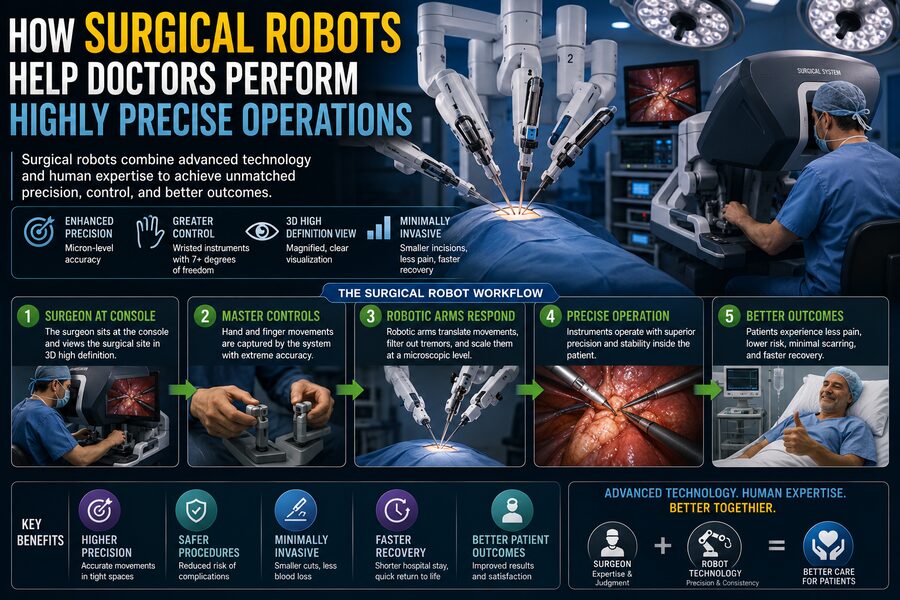
In most robotic-assisted operations, the robot does not independently decide how to perform the surgery. Instead, a trained surgeon controls the system. The robotic platform translates the surgeon’s hand movements into extremely precise movements of tiny surgical instruments inside the patient’s body.
The basic idea is:
Surgeon’s hands → robotic control system → precise instrument movement → surgical procedure
Robotic surgery combines mechanical engineering, computer control, medical imaging, optics, software, ergonomics, and surgical expertise to help doctors operate in places where ordinary human hands may have limited access.
So how do these systems actually make surgery more precise? 🤔
🦾 What Is a Surgical Robot?
A surgical robot is a computer-controlled mechanical system designed to assist surgeons during an operation.
A typical robotic surgical system may include several major components:
- A surgeon console
- Robotic arms
- Surgical instruments
- High-resolution cameras
- Computer control systems
- Safety monitoring equipment
The surgeon usually sits at a console and looks through a magnified display showing the surgical area.
Controls detect the surgeon’s hand and finger movements.
The computer then converts those movements into commands sent to robotic arms positioned beside the patient.
Those arms manipulate instruments such as:
- Scissors ✂️
- Graspers
- Needle drivers
- Cautery tools
- Tissue dissectors
The robot therefore acts as a highly sophisticated mechanical extension of the surgeon.
👨⚕️ The Surgeon Remains in Control
One of the most important misconceptions about robotic surgery is that a machine performs the operation on its own.
In most commonly used robotic-assisted surgery systems, that is not what happens.
The surgeon makes the decisions.
The surgeon determines:
- Where to cut
- What tissue to move
- Where to place stitches
- When to stop
- How to respond to unexpected anatomy
The robotic system executes the surgeon’s movements.
If the surgeon stops moving the controls, the instruments generally stop as well.
This makes robotic surgery fundamentally different from a fully autonomous industrial robot working through a preprogrammed sequence.
🔬 Why Small Movements Matter So Much in Surgery
Human hands are extremely capable, but surgery can require movements on a tiny scale.
A surgeon may need to:
- Separate delicate tissue
- Avoid important nerves
- Seal small blood vessels
- Place tiny sutures
- Operate in narrow spaces
Even a movement of a few millimeters can matter.
Robotic systems can translate a larger movement of the surgeon’s hands into a smaller movement of the instrument.
This is known as motion scaling.
For example, the surgeon might move a control by:
10 millimeters
while the instrument moves only:
2 millimeters
This allows very fine manipulation.
✋ How Tremor Filtering Improves Precision
Human hands naturally produce tiny involuntary movements.
This physiological tremor is usually insignificant in everyday life.
But during microscale surgery, even small hand movements can become important.
Robotic systems can use software to distinguish intended movements from very small high-frequency tremors.
The system can then filter some of that unwanted motion.
Conceptually:
Surgeon’s movement + tiny tremor → computer processing → smoother robotic movement
This does not make the surgeon’s skill unnecessary.
It helps translate that skill more steadily into instrument motion. 🎯
🌀 Robotic Instruments Can Move Like Tiny Wrists
Traditional laparoscopic surgery uses long instruments inserted through small openings called ports.
These tools are extremely useful, but many behave somewhat like rigid sticks.
Their movement is constrained by the point where they enter the body.
Robotic instruments can often include small articulated joints near their tips.
These joints may imitate some movements of the human wrist.
That allows the instrument to:
- Rotate
- Bend
- Approach tissue from different angles
This additional freedom of movement can be especially useful in confined anatomical spaces.
Imagine trying to tie a knot using long straight chopsticks.
Now imagine the tips of those chopsticks could bend like tiny wrists.
That extra movement can make complex manipulation significantly easier. 🦾
👁️ High-Definition 3D Vision Helps Surgeons See Detail
Precision surgery is not only about controlling instruments.
The surgeon also needs excellent vision.
Many robotic systems use high-definition cameras capable of providing a magnified stereoscopic view.
This gives the surgeon three-dimensional depth perception.
Instead of looking directly into an open surgical site, the doctor sees a detailed digital image.
The system may allow the surgeon to inspect:
- Blood vessels
- Tissue planes
- Nerves
- Sutures
- Anatomical boundaries
Magnification can make small structures easier to recognize.
Better visibility can support more controlled movements.
📷 Why 3D Vision Is Different From Ordinary Video
A standard two-dimensional image provides height and width but limited direct depth information.
A stereoscopic imaging system captures slightly different views corresponding to the surgeon’s left and right eyes.
The brain combines these images to perceive depth.
This is similar to natural human binocular vision. 👀
Depth perception can help a surgeon judge:
- How far an instrument is from tissue
- How deep a needle should move
- Whether structures are in front of or behind one another
This is particularly valuable when operating through small incisions where direct visual access is limited.
🩹 Smaller Incisions Can Reduce Surgical Trauma
Many robotic procedures are forms of minimally invasive surgery.
Instead of creating one large opening, surgeons may insert instruments through several small incisions.
Smaller incisions can potentially lead to benefits such as:
- Less tissue disruption
- Reduced postoperative pain
- Smaller scars
- Shorter hospital stays
- Faster recovery
However, these outcomes depend strongly on the specific procedure, patient, surgical team, and clinical circumstances.
Robotic surgery is not automatically superior for every operation.
In some cases, conventional laparoscopic or open surgery may remain the better choice.
🧵 Robotic Systems Can Help With Suturing
Suturing inside a confined body cavity can be technically demanding.
The surgeon must manipulate a curved needle, pass it through tissue at the correct angle, and tie secure knots.
Articulated robotic instruments can provide additional degrees of freedom that make these movements more natural.
The surgeon can control the needle using motions more similar to open surgery while still operating through small ports.
This can be useful in procedures requiring extensive internal reconstruction or stitching. 🪡
🫀 Where Are Surgical Robots Used?
Robotic-assisted systems have been used across several surgical specialties.
Applications can include certain procedures in:
- Urology
- Gynecology
- General surgery
- Colorectal surgery
- Thoracic surgery
- Cardiac surgery
- Head and neck surgery
Other robotic technologies assist with:
- Orthopedic procedures
- Neurosurgery
- Spinal surgery
- Interventional procedures
Not all surgical robots work the same way.
Some directly manipulate soft-tissue instruments.
Others help guide drills, implants, needles, or surgical tools relative to preoperative imaging.
🦴 Robotic Assistance in Orthopedic Surgery
Orthopedic robots can operate differently from soft-tissue surgical systems.
Consider a joint-replacement procedure.
Before surgery, imaging may help create a three-dimensional model of the patient’s anatomy.
The surgical team can plan:
- Implant position
- Bone removal
- Alignment
During the procedure, the robotic system may help keep instruments within a predefined region.
The robot may not independently perform the entire operation.
Instead, it can provide guidance and physical constraints that help the surgeon execute the plan accurately.
This can be especially useful when placement depends on millimeter-level alignment.
🧠 Robotic Guidance in Neurosurgery
The brain contains extremely delicate structures.
Neurosurgical procedures may require instruments to follow precise paths while avoiding critical tissue.
Robotic guidance systems can work with medical imaging to help position instruments accurately.
A planned trajectory might be mapped using:
- CT scans
- MRI scans
- Other navigation data
The robotic system can then help maintain instrument orientation relative to the patient’s anatomy.
This combines robotics with image-guided surgery. 🧠📡
🗺️ Surgical Navigation Works Like GPS for the Operating Room
Some modern surgical systems use navigation technology similar in concept to GPS.
Before or during surgery, imaging creates a map of the patient’s anatomy.
The system tracks the position of surgical instruments relative to that map.
The surgeon can see information such as:
Instrument location → anatomical model → planned target
This can help with tasks where direct visibility is limited.
Navigation systems are used in areas including:
- Neurosurgery
- Spine surgery
- Orthopedics
- Ear, nose, and throat surgery
Robotics can add controlled mechanical positioning to this digital navigation layer.
🧠 How Computers Translate the Surgeon’s Movements
The controls at the surgeon’s console contain sensors.
These sensors continuously measure variables such as:
- Position
- Rotation
- Direction
- Control activation
Computer software transforms those inputs into commands for electric motors inside the robotic arms.
A simplified control loop looks like:
Surgeon moves control
⬇️
Sensors measure movement
⬇️
Computer calculates desired instrument motion
⬇️
Motors move robotic joints
⬇️
Camera shows result to surgeon
⬇️
Surgeon adjusts next movement
This process repeats rapidly.
The human and machine therefore operate in a continuous feedback loop. 🔄
⚙️ Encoders Tell the Robot Where Its Joints Are
Robotic arms need to know their exact positions.
They often use sensors called encoders.
Encoders measure the angle or position of joints.
The control system can compare:
Desired position
with:
Measured position
If the two differ, the controller adjusts the motor.
This is an example of closed-loop control.
Closed-loop control is used throughout engineering, from industrial machines to aircraft systems.
In surgery, it helps ensure robotic joints follow commanded movements accurately.
🛡️ Safety Systems Are Built Into the Robot
Because surgical robots interact directly with patients, safety engineering is critical.
Systems may monitor:
- Joint position
- Motor current
- Instrument status
- Communication signals
- Mechanical limits
Software can prevent certain movements beyond designed ranges.
The system may stop or enter a safe state if it detects serious faults.
Some designs also use mechanical limits and redundancy so safety does not depend entirely on one software function.
The exact safety architecture differs among systems, but the general goal is:
Detect abnormal behavior before it creates patient harm.
🚨 What Happens If the Robot Loses Power?
Operating rooms have procedures for equipment failures.
If a robotic system loses power or experiences a fault, the surgical team must be able to respond safely.
This may involve:
- Securing instruments
- Removing robotic equipment
- Continuing laparoscopically
- Converting to open surgery if clinically necessary
This is one reason robotic surgery requires an entire trained team rather than only a surgeon who knows how to operate the console.
Nurses, anesthesiologists, technicians, and assisting surgeons all play important roles.
🧑⚕️ Training Is Essential
Robotic systems can provide sophisticated capabilities, but they also introduce a learning curve.
Surgeons need training in:
- Console operation
- Instrument control
- Camera positioning
- Robotic docking
- Emergency procedures
Training may involve:
- Simulators
- Laboratory practice
- Supervised operations
- Procedure-specific instruction
Experience matters because knowing how to move the robot is only one part of surgery.
The surgeon must still understand anatomy, pathology, complications, and operative strategy.
Robotics enhances surgical tools; it does not replace medical expertise.
🎮 Why Surgical Consoles Can Feel Similar to Simulators
The surgeon often sits at an ergonomic console and manipulates hand controls while looking through a display.
This can resemble a sophisticated simulator.
But underneath the interface is a precise real-time control system connected to instruments inside a patient.
The console can provide several engineering advantages:
- Comfortable seated posture
- Stable hand positioning
- Magnified vision
- Motion scaling
Reducing physical strain may be valuable during operations lasting several hours.
🧍 Ergonomics Matter More Than It Seems
Traditional minimally invasive surgery can require surgeons to hold awkward postures while manipulating long instruments.
Over many years, this can contribute to occupational strain.
Robotic consoles can potentially improve ergonomics by allowing surgeons to operate while seated and supported.
Better ergonomics does not directly operate on the patient, but it can help the surgical team maintain fine control during lengthy procedures.
Human factors engineering therefore plays an important role in surgical robotics.
🧪 Fluorescence Imaging Can Reveal Hidden Structures
Some robotic systems can integrate specialized imaging technologies.
For example, fluorescence imaging may allow surgeons to visualize blood flow or specific anatomical structures after an appropriate fluorescent agent is administered.
The camera detects wavelengths of light that ordinary human vision cannot see directly.
Software then displays that information to the surgeon.
This may help evaluate:
- Tissue perfusion
- Blood vessels
- Certain anatomical structures
Robotics can therefore combine mechanical precision with enhanced digital vision. 🌈
🖥️ Digital Surgery Creates New Possibilities
Traditional surgical instruments are mostly mechanical.
Robotic systems place a computer between the surgeon’s hands and the instruments.
That digital layer creates opportunities for additional technology.
Future and emerging systems can potentially integrate:
- Imaging overlays
- Automated measurements
- Anatomy recognition
- Surgical navigation
- AI assistance
- Performance analytics
For example, software might highlight a planned boundary or measure distance from a critical structure.
The robot can become not only a mechanical tool but a digital surgical platform.
🤖 Where Could AI Assist Surgical Robots?
Artificial intelligence could support robotic surgery without necessarily taking full control.
Potential assistance includes:
- Recognizing anatomical landmarks
- Tracking instruments
- Identifying phases of an operation
- Warning about unusual conditions
- Analyzing surgical video
- Helping plan procedures
For example, an AI system might analyze video and indicate that an instrument is approaching a region requiring extra caution.
However, integrating AI into surgery requires extremely rigorous validation because errors can have serious consequences.
🦾 Could Surgical Robots Ever Operate Autonomously?
Some research systems have demonstrated limited autonomous capabilities under controlled conditions.
A robot might automate a narrowly defined task such as:
- Following a planned trajectory
- Positioning an instrument
- Performing a repetitive motion
But fully autonomous general surgery is far more difficult.
Human anatomy varies.
Tissues move and deform.
Unexpected bleeding can occur.
Scar tissue may alter normal anatomy.
Surgery requires continual judgment.
Therefore, increasing autonomy is likely to develop gradually and may first appear in highly constrained tasks rather than entire operations.
📏 Precision Does Not Automatically Mean Better Outcomes
It is tempting to assume that a more precise machine must always produce a better medical result.
But surgery is more complicated.
Clinical outcomes depend on:
- Appropriate procedure selection
- Surgeon experience
- Patient health
- Disease severity
- Team performance
- Postoperative care
Robotic assistance can offer technical advantages, but those benefits must be demonstrated for specific procedures.
A robot that enables more precise movement does not automatically make every operation safer or more effective.
Evidence and clinical judgment remain essential. 📊
💰 Robotic Surgery Can Be Expensive
Surgical robots can involve substantial costs.
Expenses may include:
- Initial system purchase
- Maintenance
- Disposable instruments
- Training
- Operating-room time
- Specialized staffing
Hospitals therefore need to evaluate whether the clinical and operational benefits justify these costs.
The economic calculation can differ dramatically between procedures and healthcare systems.
A robotic platform used frequently across multiple specialties may have different economics from one used only occasionally.
🏥 Operating Rooms Must Be Designed Around the System
Large robotic systems require space.
The operating room must accommodate:
- The patient
- Surgical staff
- Anesthesia equipment
- Robotic arms
- Instrument carts
- Imaging equipment
The robot must also be positioned so its arms can reach the surgical site without interfering with each other or the clinical team.
This setup process is often called docking.
Efficient docking is an important part of robotic surgical workflow.
⏱️ Robotics Can Change Operation Times
Robotic surgery can sometimes make certain complex manipulations easier, but setting up the system can add time.
Early in a team’s experience, procedures may take longer because of:
- Docking
- Instrument changes
- Learning curve
As teams become more experienced, workflow can become faster.
Whether robotic surgery reduces or increases total procedure time depends on the type of operation and the team’s experience.
🧼 Sterility Is a Major Engineering Challenge
Anything that enters or approaches the sterile surgical field must be carefully controlled.
Robotic instruments may need to be sterilized or designed for sterile use.
Parts of the robotic arms may be covered with sterile drapes.
Instrument tracking is important because some devices have defined usage limits.
Medical robotics therefore has to satisfy not only mechanical requirements but also:
- Sterilization
- Biocompatibility
- Infection-control requirements
This adds another layer of engineering complexity.
🫁 Minimally Invasive Surgery Changes How Surgeons Access Organs
In open surgery, the surgeon may directly touch and manipulate tissue.
Robotic surgery often uses instruments inserted through narrow ports.
The abdomen or other body cavity may sometimes be expanded with gas to create working space.
The surgeon then performs the operation using camera guidance.
This reduces the size of the external opening but changes the way surgeons interact with anatomy.
Robotic articulation and 3D vision help compensate for those access limitations.
✋ What About the Sense of Touch?
Human surgeons normally use tactile feedback to feel tissue.
Some robotic systems provide limited or no direct haptic feedback, depending on the platform.
This means the surgeon may rely more strongly on visual cues to judge force.
Experienced surgeons can infer tension by observing how tissue deforms.
Researchers are also developing improved force-sensing and haptic technologies that could communicate mechanical resistance back to the surgeon.
If widely implemented, such systems could make robotic interaction feel more natural.
📡 Could Surgeons Operate From Far Away?
Because the surgeon’s controls are electronically connected to robotic actuators, remote surgery is technically conceivable.
This is known as telesurgery.
However, long-distance surgery introduces difficult challenges:
- Network latency
- Connection reliability
- Cybersecurity
- Local emergency backup
- Legal responsibility
Even a short communication interruption could be unacceptable during a critical maneuver.
Therefore, widespread long-distance robotic surgery requires far more than simply connecting the robot to the internet.
🔐 Cybersecurity Becomes a Patient-Safety Issue
A conventional scalpel does not need cybersecurity.
A networked robotic surgical system does.
Modern medical robots contain computers, software, and communication interfaces.
Security measures are therefore important to prevent:
- Unauthorized access
- Malicious software
- Configuration changes
- Data breaches
As surgery becomes increasingly digital, cybersecurity becomes part of medical-device safety. 🔐
🧩 Surgical Robots Are Systems, Not Just Robotic Arms
The visible robotic arms receive most of the attention, but the complete surgical system includes much more.
A successful operation depends on:
Mechanical engineering → precise movement
Electrical engineering → motors, sensors, power
Software engineering → control algorithms
Optics → high-quality imaging
Human factors → usable controls
Medical science → clinical decisions
Safety engineering → fault protection
The robot works because all these disciplines operate together.
📊 Traditional vs. Robotic-Assisted Surgery at a Glance
👐 Traditional Open Surgery
Can provide:
- Direct access
- Direct tactile interaction
- Large operating field
But may require larger incisions.
🔬 Conventional Laparoscopic Surgery
Can provide:
- Small incisions
- Reduced tissue disruption
- Efficient minimally invasive access
But instruments may have limited articulation.
🤖 Robotic-Assisted Surgery
Can provide:
- Small-incision access
- Articulated instruments
- Motion scaling
- Tremor filtering
- Magnified 3D visualization
- Improved surgeon ergonomics
But it adds:
- Equipment cost
- Technical complexity
- Training requirements
- Setup requirements
There is no single approach that is best for every patient or operation.
🌟 Final Thoughts
Surgical robots help doctors perform highly precise operations by acting as sophisticated extensions of the surgeon’s hands and eyes. 🤖👨⚕️
The surgeon moves controls at a console.
Sensors measure those movements.
Computer algorithms filter, scale, and translate them.
Electric motors move articulated instruments inside the patient.
High-resolution cameras provide magnified three-dimensional views of the surgical field.
The result can give surgeons extraordinary control in small and difficult-to-reach spaces. 🔬
The central concept is:
Human judgment + robotic precision + digital visualization
rather than:
Robot replaces surgeon.
That distinction is essential.
Modern surgical robots are powerful tools, but the surgeon still supplies anatomical knowledge, clinical judgment, strategy, and responsibility.
As robotics, imaging, AI, force sensing, and computer vision continue to advance, surgical systems may become increasingly capable of assisting with planning, navigation, monitoring, and narrowly defined automated tasks.
Yet their greatest strength may remain the partnership between machine precision and human expertise.
A surgical robot can make a movement incredibly small.
It can filter tremor.
It can provide a magnified view.
It can position an instrument with remarkable repeatability.
But deciding what should be done, why it should be done, and how to respond when reality differs from the plan remains at the heart of surgery. 🧠🏥
That is what makes robotic surgery such an interesting engineering achievement: it does not simply automate medicine.
It combines the strengths of advanced machines with the judgment of trained physicians to make delicate operations more controllable and, in appropriate cases, less invasive. 🦾🔬✨