
Robots are extremely good at moving to precise positions, but simply knowing where a robot is does not always tell it what it is touching.
Imagine a robotic arm inserting a fragile connector into a socket, polishing a curved metal surface, tightening a component, assisting a surgeon, or holding a delicate object. In each case, position alone is not enough. The robot must also understand how much force it is applying and in which direction that force is acting. 🦾⚙️
This is where force-torque sensors become essential.
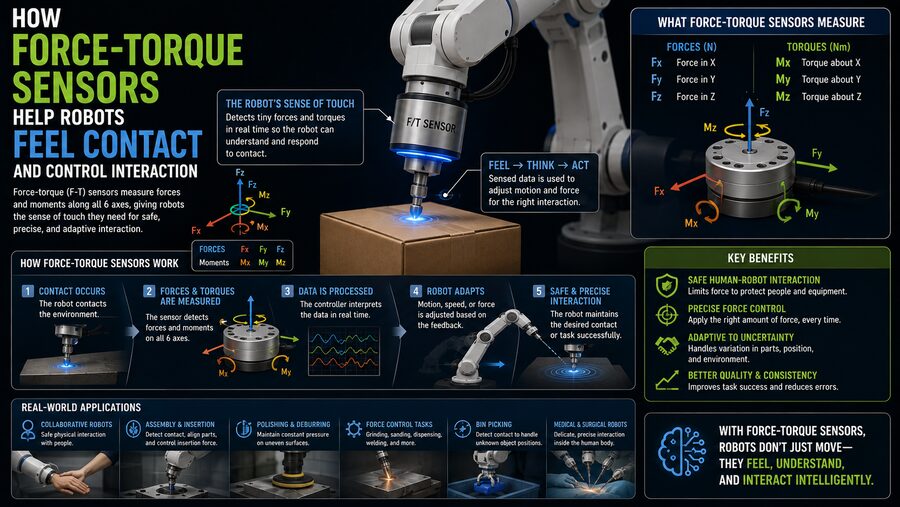
A force-torque sensor measures the forces and twisting moments acting on a robot. By continuously monitoring contact, the robot can detect when it touches an object, estimate how strongly it is pushing or pulling, recognize unexpected collisions, and adjust its motion in real time.
These sensors are a major reason modern robots can perform tasks that require sensitivity, compliance, precision, and safe physical interaction rather than simply following rigid programmed paths.
🧩 What Is a Force-Torque Sensor?
A force-torque sensor is a device that measures mechanical loads.
In robotics, it commonly measures forces along three axes:
- Fx — force along the x-axis,
- Fy — force along the y-axis,
- Fz — force along the z-axis.
It also measures rotational moments, or torques, around those same axes:
- Tx — torque around the x-axis,
- Ty — torque around the y-axis,
- Tz — torque around the z-axis.
Because it measures three forces and three torques, this type of device is often called a six-axis force-torque sensor or 6-axis F/T sensor.
In simplified form:
3 forces + 3 torques = 6 degrees of load measurement
This gives the robot a much richer picture of physical contact than a single force measurement could provide. 📊
📍 Where Is the Sensor Installed?
A common location is between the robot wrist and the end-of-arm tool.
For example:
Robot Arm → Force-Torque Sensor → Gripper or Tool
If the robot pushes a tool against a surface, the reaction force passes through the sensor.
The sensor can therefore measure what the robot experiences at the point of interaction.
Other systems may place force sensors in:
- robot joints,
- grippers,
- robotic feet,
- surgical instruments,
- assembly fixtures.
The best location depends on what kind of interaction needs to be measured.
🧠 Why Position Control Alone Is Not Enough
Traditional industrial robots are often programmed to follow exact positions.
For example:
Move the tool to X = 500 mm, Y = 200 mm, Z = 150 mm.
This works well when the environment is precisely known.
But real manufacturing environments contain variation.
A workpiece might be:
- slightly misaligned,
- a little thicker,
- positioned a few millimeters differently,
- warped,
- flexible.
If the robot blindly follows its programmed coordinates, it may push too hard against the object.
That can cause:
- tool damage,
- product damage,
- assembly failure,
- excessive wear,
- safety problems.
A force-torque sensor allows the robot to detect what is actually happening physically and adapt. 🔄
✋ Force Feedback Gives the Robot a Sense of Touch
Humans naturally use force feedback.
When you insert a key into a lock, you do not rely only on vision.
You feel resistance.
If the key does not enter properly, your fingers detect the force and you adjust its angle.
Robots can use a similar principle.
The force-torque sensor acts as a form of mechanical touch sensing.
If the robot expects gentle contact but measures a large force, it can slow down, stop, or move away.
If it measures no contact when contact is expected, it may continue moving until the required force is reached.
This creates a feedback loop:
Move → Measure Force → Compare With Target → Correct Motion
That loop can run many times per second. ⚡
🔄 What Is Force Control?
Force control means the robot adjusts its movement to achieve a desired contact force.
Suppose a polishing robot should press a tool against a surface with 20 newtons of force.
If the sensor measures:
15 N
the robot may move slightly closer.
If it measures:
25 N
the robot may move slightly away.
The objective is to maintain approximately:
20 N
even if the surface is not perfectly flat.
This differs from pure position control, where the robot would remain at a fixed coordinate regardless of how hard it was pressing.
Force control is extremely useful for tasks where consistent physical contact matters. 🎯
🪶 What Is Compliance?
A compliant robot can yield slightly when it encounters contact rather than behaving as if it were perfectly rigid.
This behavior is important when robots interact with uncertain environments.
For example, if a robotic gripper holding a component encounters the edge of a hole, a rigid controller might keep pushing.
A compliant controller can detect the sideways force and allow the robot to shift slightly.
This can help the part align itself.
Compliance may be created mechanically through flexible structures or electronically through control algorithms using force-torque feedback.
🔧 Peg-in-Hole Assembly
One of the classic robotics examples is peg-in-hole insertion.
Imagine a cylindrical pin that must be inserted into a tightly fitting hole.
Even tiny alignment errors can cause the peg to catch on the edge.
A position-only robot might force the peg downward and jam it.
A robot with force-torque sensing can detect lateral forces.
Suppose it experiences force toward the left.
That may indicate the peg is contacting the left edge of the hole.
The controller can shift the tool slightly to the right until forces become balanced.
Then insertion can continue. 🔩
This makes force sensing extremely valuable for precision assembly.
🏭 Force-Torque Sensors in Manufacturing
Many industrial processes require controlled contact.
Examples include:
- assembly,
- grinding,
- polishing,
- sanding,
- deburring,
- machining assistance,
- testing.
Consider robotic grinding.
If the robot presses too lightly, it may not remove enough material.
If it presses too hard, it can damage the workpiece or wear the grinding tool quickly.
Force feedback helps maintain the correct pressure while the robot follows the surface.
This produces more consistent results even when individual parts vary slightly.
🪚 Surface Finishing and Polishing
Polishing is an especially good example of why force control matters.
A surface may contain small curves, dimensional errors, or irregularities.
A fixed robot path cannot perfectly match every variation.
With force sensing, the robot can keep the polishing wheel pressed against the surface with a relatively constant force.
As the surface rises or falls, the robot adjusts automatically.
This can improve:
- finish consistency,
- tool life,
- quality,
- productivity.
✨ Force control makes the robot behave less like a rigid machine and more like a skilled operator maintaining steady hand pressure.
🛡️ Collision Detection
Force-torque sensors also improve robot safety.
Suppose a robot is moving toward a workpiece but unexpectedly hits an obstacle.
The sensor may detect a sudden increase in force.
The controller can then:
- stop immediately,
- reduce speed,
- reverse direction,
- trigger an alarm.
This is useful for protecting:
- tools,
- fixtures,
- products,
- the robot itself.
In collaborative robotics, detecting unexpected contact can also contribute to safer interaction, though overall safety depends on the complete robot design and applicable safety standards. ⚠️
🤝 Collaborative Robots and Human Interaction
Collaborative robots, often called cobots, are designed to work closer to people than conventional industrial robots.
Force sensing can help these robots recognize physical interaction.
For example, if a person gently pushes the robot arm, the control system may interpret the force as a command to move.
This enables hand-guiding or freedrive operation.
An operator can physically move the robot into desired positions and teach it a path without entering every coordinate manually. 🧑🏭🤖
Force sensing can also help monitor accidental contact during operation.
🩺 Medical and Surgical Robotics
Medical robotics demands extremely sensitive force control.
In surgery, excessive force can damage tissue.
Force-torque sensing can help a surgical robot detect how strongly an instrument is interacting with tissue or bone.
Potential applications include:
- minimally invasive surgery,
- rehabilitation robotics,
- prosthetics,
- robotic catheter systems,
- orthopedic procedures.
In rehabilitation robots, force sensing can help determine how much effort a patient is contributing during movement.
The robot can then adjust assistance accordingly. 🏥
🦿 Force Sensing in Walking Robots
Legged robots also depend on force sensing.
A robot walking on uneven terrain must know when its foot contacts the ground and how much load each leg is carrying.
Sensors in the feet or joints can measure forces during contact.
This information helps the robot:
- detect touchdown,
- maintain balance,
- redistribute weight,
- adapt to uneven surfaces,
- avoid slipping.
For humanoid robots, force sensing can be especially important when controlling balance.
If too much load shifts toward one foot, the controller can adjust posture. 🦿⚖️
🖐️ Robotic Gripping
Force sensing can also improve manipulation.
A gripper must apply enough force to hold an object securely without crushing it.
Imagine gripping:
- a glass bottle,
- fruit,
- electronic components,
- thin plastic parts.
Too little force may cause the object to slip.
Too much force may damage it.
Force sensors can help the gripper regulate its grasp.
When combined with tactile sensors, vision, and position sensing, robots can manipulate delicate objects much more reliably.
⚙️ How Force-Torque Sensors Actually Measure Loads
Many force-torque sensors use strain gauges.
A strain gauge is a tiny electrical element whose resistance changes when it is stretched or compressed.
Inside the sensor is a carefully designed metal structure that deforms by an extremely small amount when force is applied.
The deformation may be microscopic, but strain gauges can detect it.
The process is:
Applied force → Tiny structural deformation → Strain gauge resistance changes → Electrical signal → Force calculation
Several strain gauges are arranged in different orientations so the system can separate forces and torques along different axes.
🌉 The Wheatstone Bridge Circuit
Strain gauges are frequently connected using a circuit known as a Wheatstone bridge.
This circuit is extremely sensitive to small changes in electrical resistance.
When the sensor structure bends slightly, some gauges stretch while others compress.
This changes the balance of the circuit and produces a small voltage signal.
Electronics then amplify and digitize that signal.
Calibration converts the electrical output into engineering units such as:
- newtons,
- newton-meters.
This allows the robot controller to receive meaningful physical measurements. 📐
📊 Why Calibration Is Necessary
No real sensor is perfectly identical to another.
Manufacturing differences, temperature, mounting conditions, and electronics can slightly change sensor response.
Force-torque sensors are therefore calibrated.
Calibration determines the relationship between measured electrical signals and actual forces.
A calibration process applies known loads in different directions.
The sensor output is recorded and used to calculate a calibration matrix.
This matrix helps convert raw signals into estimates of:
Fx, Fy, Fz, Tx, Ty, Tz
Accurate calibration is essential for precise force control. 🎯
🔀 What Is Cross-Axis Sensitivity?
Ideally, a force in the x-direction should affect only the Fx measurement.
In reality, sensor deformation can slightly influence several channels.
This is called cross-axis coupling or cross-talk.
For example, a strong Fz load may create a small apparent Fx reading.
High-quality calibration can compensate for much of this interaction.
Mechanical sensor design also aims to minimize cross-axis effects.
⚖️ Torque Is Different From Force
Force pushes or pulls.
Torque creates rotation.
Imagine using a wrench.
The force applied to the handle creates a torque around the bolt.
In robotics, torque measurement can reveal whether a tool is twisting against an object.
For example, during connector insertion, a robot might detect unexpected torque if the part is entering at an angle.
During fastening, torque can help determine whether a screw or component has reached the correct tightness.
Force and torque together therefore provide a complete picture of contact mechanics. 🔧
🔩 Fastening and Tightening Applications
Automated screwdriving and fastening often require controlled torque.
A robot may move a tool into position and begin tightening.
Torque measurements can help detect:
- thread engagement,
- cross-threading,
- final tightening level,
- abnormal resistance.
This can improve assembly quality.
Fastening systems may use dedicated torque sensors inside the tool as well as wrist-mounted force-torque sensors.
🧱 Detecting Surface Contact
A force sensor can help a robot determine exactly when contact begins.
Suppose the robot slowly approaches a table.
Before contact:
Fz ≈ 0
At the instant the tool touches:
Fz begins increasing
The controller detects this threshold and stops the approach.
This provides more reliable contact detection than relying only on a preprogrammed position.
It is especially useful when surface position varies from part to part.
🔄 Hybrid Position-Force Control
Many robotic tasks require position control in some directions and force control in others.
This is known as hybrid position-force control.
Imagine polishing a flat panel.
The robot may need to:
- move precisely along X,
- move precisely along Y,
- regulate contact force along Z.
So:
X and Y → Position controlled
Z → Force controlled
This combination is extremely useful because the robot can follow a planned path while maintaining controlled pressure against the surface.
🧠 Impedance Control
Another important strategy is impedance control.
Instead of commanding only force or position, impedance control defines a relationship between them.
The robot behaves somewhat like a virtual spring and damper.
For example:
If the environment pushes the robot, the robot yields according to its programmed stiffness.
A low stiffness setting makes the robot feel soft and compliant.
A high stiffness setting makes it resist displacement strongly.
This can create smooth interaction with uncertain environments and people.
🌀 Admittance Control
Admittance control is closely related.
In an admittance-controlled system, measured force is used to calculate how the robot should move.
Conceptually:
Measured Force → Desired Motion
If someone pushes the robot with greater force, the robot may move faster in that direction.
This approach is often used for hand-guided robots.
The difference between impedance and admittance control is technical, but both aim to make robot interaction more controlled and responsive.
⚡ Why High Sampling Rates Matter
Force can change very quickly during contact.
If the control system measures force too slowly, it may react late.
For example, a robot could collide with a rigid object and build dangerous force before the next measurement arrives.
Force-control systems therefore often use high update rates.
Fast measurement helps the controller:
- detect contact quickly,
- react to impacts,
- maintain stable force,
- reduce oscillation.
Low latency between sensing and motion correction is especially important for delicate tasks.
📉 Filtering Sensor Noise
Force-torque sensor signals are not perfectly clean.
Measurements may contain noise from:
- electrical electronics,
- robot vibration,
- motor motion,
- structural resonance,
- tool vibration.
A controller can use digital filters to smooth the signal.
However, excessive filtering creates delay.
This introduces another engineering tradeoff:
More filtering → smoother data but slower response
Less filtering → faster response but more noise
Control engineers choose filters carefully depending on the task.
🌡️ Temperature Can Affect Measurements
Temperature changes can cause sensor materials and electronics to drift.
If a robot operates near furnaces, welding equipment, or other heat sources, this may become important.
Modern force-torque sensors may include:
- temperature compensation,
- calibration corrections,
- internal monitoring.
For high-precision applications, engineers may allow sensors to reach stable operating temperatures before critical measurements.
🧮 Payload Weight Must Be Compensated
A wrist-mounted force-torque sensor measures not only contact with the environment.
It also senses the weight of the attached tool.
Suppose a robot holds a 5 kg gripper.
Gravity continuously creates a downward force.
When the robot rotates its wrist, that gravitational load appears in different sensor directions.
The controller must compensate for:
- tool mass,
- center of gravity,
- robot orientation.
Otherwise, the system might mistake the tool’s own weight for contact force.
This is known as payload compensation or gravity compensation. ⚖️
🎯 Sensor Resolution and Range Must Be Balanced
Force-torque sensors are available in different measurement ranges.
A sensor designed to measure thousands of newtons may not detect tiny forces as precisely as a sensor designed for delicate laboratory work.
Engineers therefore balance:
- maximum load,
- sensitivity,
- resolution,
- overload capacity.
A polishing robot may need relatively large force capacity.
A micro-assembly robot may need extremely fine sensitivity.
Choosing the correct sensor range is important for both accuracy and durability.
⚠️ Overload Protection
Robots can generate substantial forces.
If a collision exceeds the sensor’s rated capacity, the sensor may be damaged.
Manufacturers therefore specify:
- normal measurement range,
- overload limits,
- maximum allowable moment.
Mechanical stops or protective structures may also be used in high-risk applications.
Software collision limits can provide another layer of protection.
🧪 Force-Torque Sensors in Research
Robotics researchers use force-torque sensors to study:
- manipulation,
- human-robot interaction,
- locomotion,
- control algorithms,
- contact mechanics.
Because the sensors provide precise measurements of interaction forces, they are useful for validating models and testing new control strategies.
Research robots may combine F/T sensors with:
- cameras,
- tactile skins,
- joint encoders,
- inertial sensors.
This allows the robot to build a richer understanding of its environment.
👁️ Force Sensing and Vision Work Better Together
Vision and force sensing provide complementary information.
A camera can tell the robot:
“The part appears to be here.”
Force sensing can tell it:
“The part is actually touching the tool here.”
Vision is excellent for locating objects before contact.
Force sensing becomes valuable once physical interaction begins.
A modern robotic assembly system may therefore use:
Camera → Coarse alignment
Force sensor → Final contact adjustment
This combination can dramatically improve reliability. 👁️+✋
🤖 Learning From Force Data
Machine learning can also use force-torque data.
A robot may learn patterns associated with:
- successful insertion,
- failed insertion,
- slipping,
- impact,
- correct fastening.
For example, the force profile during a successful connector insertion may have a recognizable pattern.
If future force measurements differ significantly, the robot can identify a problem.
This turns force-torque sensing into both a control tool and a quality-monitoring system. 📈
🏭 Force Data Can Improve Quality Control
Manufacturers can record force curves during production.
Suppose every correctly assembled part produces a specific force pattern.
An abnormal pattern may indicate:
- misalignment,
- missing component,
- damaged part,
- incorrect fit.
The robot can flag the assembly before it moves further down the production line.
This allows force sensing to support in-process quality inspection without requiring a completely separate inspection station.
⚠️ Force Sensing Does Not Automatically Make a Robot Safe
A force-torque sensor can improve collision detection and physical interaction, but it is not a complete safety system by itself.
Safe robotics may also require:
- speed limits,
- power limits,
- safe mechanical design,
- emergency stops,
- protective guarding,
- safety-rated controllers.
Industrial safety standards specify how collaborative and conventional robots should be evaluated.
Force sensing is therefore one component within a broader safety architecture.
🌍 Why Force-Torque Sensors Matter for the Future of Robotics
As robots move beyond repetitive factory tasks, they increasingly need to work in environments that are uncertain and physically interactive.
Future robots may need to:
- assist people,
- handle delicate products,
- perform maintenance,
- work in hospitals,
- manipulate household objects,
- navigate uneven terrain.
These tasks require more than accurate positioning.
They require an understanding of contact.
Force-torque sensing gives robots critical information about how their actions affect the physical world.
🧠 Giving Robots a Mechanical Sense of Touch
A robot can use cameras to see where objects are, encoders to know where its joints are, and force-torque sensors to understand what happens when it physically touches something.
The sensor measures forces and twisting moments in several directions.
Those measurements enter a feedback controller that can adjust the robot’s movement.
If contact is too strong, the robot can back away.
If contact is too weak, it can apply more pressure.
If unexpected sideways force appears, it can realign.
If a collision occurs, it can stop. 🛑
This capability transforms the robot from a machine that simply follows coordinates into one that can respond dynamically to its environment.
The central principle is:
Force-torque sensors help robots control physical interaction by measuring the forces and moments created during contact and feeding that information back into the robot’s motion controller. 🤖✋⚙️
That feedback is what allows modern robots to assemble parts gently, polish surfaces consistently, grip delicate objects, walk more stably, and work more safely around people.
In other words, if cameras give robots something like vision, force-torque sensors give them one of the most important pieces of a robotic sense of touch. 🦾✨