
A robot in a warehouse may need to lift a rigid box, place a glossy phone into a tray, and pick a bruisable peach before its next battery charge. To a person, these are ordinary hand movements. To a robot, each object poses a different mechanical problem.
The arm receives most of the attention because it makes a robot look active. Yet the end-effector—the device attached to the wrist—is where the robot finally meets the physical world. A poor gripper can turn an accurate, expensive robot into a machine that drops parts, damages products, or stops for human intervention.
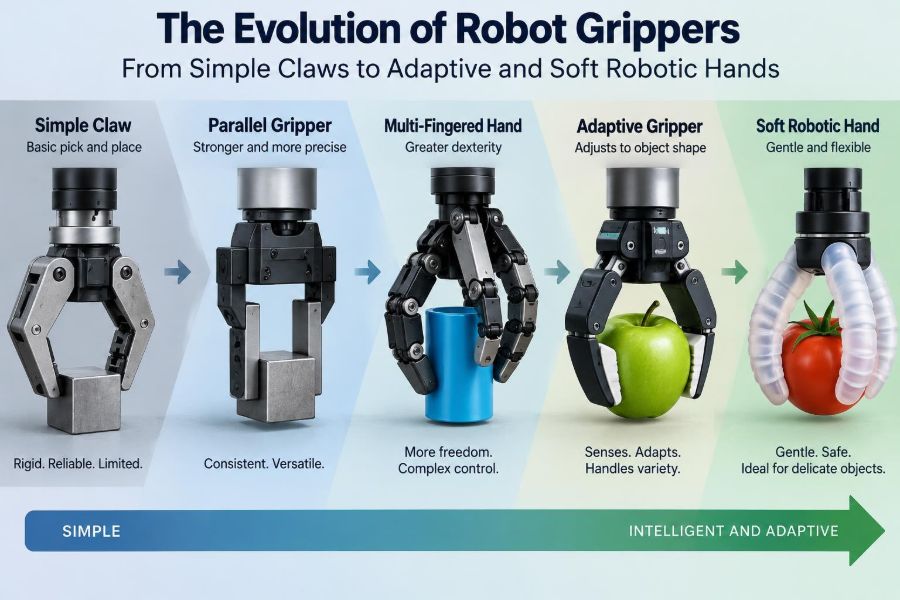
Robot grippers have therefore evolved from simple two-jaw claws into specialized tools, sensor-rich adaptive devices, and soft hands that deform around delicate objects. This shift reflects a broader goal in robotics: not merely moving through space, but interacting reliably with an unpredictable environment.
Understanding that evolution helps engineers choose the right tool, diagnose handling failures, and see why a gripper that looks less “hand-like” can sometimes be the better engineering solution.
🧩 What a Robot Gripper Actually Does
A gripper is an end-effector designed to grasp, hold, release, or manipulate an object. It converts energy from an actuator—electric, pneumatic, hydraulic, or another source—into controlled contact forces.
Its task is broader than closing around an object. A successful grasp must locate the part, tolerate variation, apply enough force, resist gravity and acceleration, avoid damage, and release at the correct time.
🧱 The Earliest Industrial Claws
Early industrial robots commonly used rigid mechanical claws with two opposing fingers. Their environments were structured: parts arrived in known orientations, fixtures constrained their positions, and the same motion repeated for long production runs.
This simplicity was a strength. A two-finger parallel gripper is compact, fast, repeatable, and relatively easy to control. For a metal component with flat, predictable surfaces, it remains one of the most practical designs available.
⚙️ Why Parallel-Jaw Grippers Became a Standard
In a parallel-jaw gripper, both fingers move inward or outward along straight paths. The design can grip an object externally by squeezing its outside, or internally by expanding against a hole or cavity.
Parallel motion makes it easier to center a roughly symmetrical part. Engineers can also replace finger pads or machine custom fingertips to match a workpiece, improving contact area and reducing the chance of rotation.
- Strengths: high repeatability, compact design, straightforward integration.
- Limitations: limited tolerance for unknown shapes, poses, and sizes.
- Best fit: organized industrial cells with stable part geometry.
🔩 Angular Grippers and Their Useful Geometry
Angular grippers swing their fingers around pivots instead of translating them along rails. They can open wide while keeping the mechanism relatively short, which helps when a gripper must clear a part or approach from above.
The trade-off is that contact geometry changes as the fingers rotate. This is often acceptable for simple pick-and-place tasks, but it can make centering and force prediction less direct than with parallel jaws.
🧲 Vacuum Cups Changed Picking Strategies
Not every gripping problem needs fingers. A vacuum gripper creates a pressure difference between a suction cup and an object surface, producing a holding force. It can pick flat cartons, sheet metal, glass, and many sealed packages without wrapping around them.
Vacuum is especially useful when objects are closely packed, because a cup can approach from above without needing room for fingers on both sides. However, porous, dusty, heavily textured, or leaking surfaces can reduce suction reliability.
🪝 Magnetic and Adhesive End-Effectors
Magnetic grippers provide another contact-light approach for ferromagnetic materials such as many steel parts. Permanent magnets can hold without continuous power, while electromagnets can be switched, although loss of power and residual magnetism must be considered in the design.
Adhesive-inspired grippers, including dry adhesive surfaces, seek to handle selected materials with low normal force. Their usefulness depends strongly on surface cleanliness, texture, orientation, and the particular adhesive mechanism. They are specialized tools rather than universal replacements for jaws.
📐 Grasping Is a Problem of Forces and Moments
Holding an object is not only about squeezing hard. The gripper must prevent translation and rotation. Friction resists sliding, while the locations of contact points determine whether the object can twist out of the grasp.
An object held far from the wrist creates a larger moment, or turning effect. That is why a gripper that securely holds a part while stationary may fail when the robot accelerates, changes direction, or makes a fast stop.
🧠 Force Closure and Form Closure
Form closure occurs when geometry alone constrains an object, such as a part nested in a shaped pocket or hooked beneath a feature. It can be very secure but usually requires a compatible object shape.
Force closure relies on controlled contact forces and friction to resist motion in multiple directions. A person holding a bottle by squeezing it is using force closure. Many robotic grasps depend on it, making surface condition and force control central concerns.
📏 The Importance of Contact Area
A small hard fingertip concentrates pressure. That can be useful for locating a rigid component precisely, but it can dent soft materials, scratch coatings, or create unstable point contacts on curved objects.
Wider compliant pads spread load and adapt to small shape errors. The ideal contact area depends on the task: gripping a machined pin is different from handling a bakery item or a painted automotive panel.
🔌 Actuators Define Much of a Gripper’s Character
Pneumatic grippers are common in factories because compressed air can provide fast, robust motion with simple hardware. Their force may be less directly controlled than an electric system, especially when pressure, friction, and speed vary.
Electric grippers use motors, screws, belts, or gears to move fingers. They often offer programmable position, speed, and force settings. Hydraulic systems can deliver very high force, but their complexity and potential for fluid leakage make them less suitable for many clean handling tasks.
🧭 The Move from Repeatability to Flexibility
Traditional automation succeeds by making the environment predictable. Fixtures, conveyors, and dedicated tooling reduce uncertainty before the robot ever attempts a grasp.
Modern applications increasingly ask robots to work with mixed inventory, variable packaging, or items presented in less controlled ways. The gripper must then absorb more uncertainty instead of relying entirely on upstream organization.
🖐️ Underactuated Hands Use Mechanics Intelligently
An underactuated gripper has fewer independent actuators than movable joints. Rather than controlling every finger joint separately, it uses tendons, linkages, springs, or differential mechanisms so fingers naturally wrap around an object.
For example, one motor can close several finger segments. If one segment touches an object first, the remaining motion can continue at other joints. This passive adaptation is often more reliable than trying to calculate every contact point in advance.
🌿 Compliance Makes Contact More Forgiving
Compliance is the ability of a mechanism to yield under force. It may come from soft materials, springs, flexible joints, controlled motor behavior, or the structure of the fingers themselves.
A compliant gripper can tolerate a few millimeters of position error, accommodate small dimensional variation, and reduce impact at first contact. Too much compliance, however, can lower positional accuracy or make an object feel unstable during transport.
🧤 Soft Robotics Changes the Meaning of a Finger
Soft robotic grippers use elastomers, textiles, flexible chambers, or other deformable structures rather than relying solely on rigid links. When actuated, a soft finger may bend, curl, inflate, or conform around an object.
The result is a gentler interface with uncertain geometry. A soft hand is not automatically better: its deformation can make precise placement, high-temperature work, sharp-object handling, and exact force prediction more difficult.
🎈 Pneumatic Soft Fingers and Inflatable Structures
Many soft grippers use internal air chambers. Pressurizing asymmetrical chambers causes a finger to bend; inflating a membrane can create a surface that envelops an object; vacuum can also stiffen or contract selected structures.
These designs can handle irregular produce, fragile laboratory vessels, and mixed consumer goods. Their practical requirements include a clean air supply, tubing management, pressure regulation, and attention to puncture or fatigue risks.
☕ Granular Jamming and Shape Conformation
Granular jamming uses a flexible membrane filled with particles. Pressed onto an object, the particles flow and conform around it. Removing air from the membrane makes the particles jam together, increasing stiffness and helping retain the shape.
This is an elegant example of a gripper changing its mechanical state during a task. It can be effective for some irregular objects, but it may be slower or bulkier than a conventional gripper and is not ideal for every geometry.
👁️ Tactile Sensing Lets Grippers Feel Contact
Vision can estimate where an object is, but it cannot always tell whether a finger has made secure contact. Tactile sensors measure information such as force, pressure distribution, deformation, vibration, or slip.
With tactile feedback, a robot can close until it detects contact, increase force only as needed, and react when an object begins to slide. The challenge is making sensors durable, affordable, easy to calibrate, and robust against contamination.
📡 Vision, Perception, and the Grasp Plan
A camera system can estimate object pose, identify candidate grasp regions, and avoid obstacles. For randomly piled objects—a common bin-picking problem—the robot must reason about occlusion, uncertain boundaries, and collisions with neighboring items.
Perception does not eliminate mechanical uncertainty. A grasp planner may choose a promising location, but compliance and sensing still help when the estimated pose differs from the object’s actual position.
🛑 Force Control Prevents Crushing and Dropping
Position control commands a gripper to move to a specified opening. Force control instead regulates the contact force, either directly through sensors or indirectly through motor current and mechanical models.
Neither approach is sufficient alone for all tasks. Position control is useful for repeatable geometry; force-limited closing is safer for delicate or variable objects. Many systems combine both: close by position, detect contact, then maintain a controlled grip.
🍓 Food and Agriculture Demand Gentle Adaptation
Fruit, vegetables, meat, baked goods, and other food products vary in size, ripeness, moisture, and surface texture. A gripper must avoid bruising or tearing while still working fast enough for a production process.
Soft fingers, vacuum systems, and hybrid tools are all used in this space. Hygiene also matters: materials, crevices, cleaning procedures, and resistance to washdown conditions can be as decisive as grasp performance.
💊 Medical and Laboratory Handling Has Different Constraints
In laboratories, grippers may move vials, pipette tips, plates, or small instruments where accurate placement and contamination control are critical. In medical settings, safety, sterilization, biocompatibility, and human factors impose additional requirements.
A compliant design can reduce damage to delicate items, but it must still be validated for its intended use. Robotics hardware alone does not establish suitability for clinical or safety-critical applications.
📦 Warehouses Favor Throughput and Recovery
Fulfillment systems often handle a wide range of packaging: boxes, polybags, bottles, blister packs, and loose retail products. A gripper that succeeds on one item type may struggle on another, so hybrid end-effectors are common.
A practical warehouse design also plans for failure. It needs a way to detect a missed pick, recover from a dropped item, avoid collisions, and route difficult objects for another attempt or human assistance.
🔄 Hybrid Grippers Combine Complementary Methods
Some end-effectors pair suction with fingers. Vacuum can quickly lift a flat top surface, while fingers provide backup restraint or handle items with poor seals. Other designs combine a rigid palm with soft fingertips.
Hybrid tools add capability, but they add valves, sensors, control logic, maintenance points, and mass at the robot wrist. The best design is not the one with the most mechanisms; it is the one that resolves the actual handling uncertainty.
⚖️ Comparing Major Gripper Families
| Gripper family | Typical advantage | Typical limitation | Common use |
|---|---|---|---|
| Parallel jaw | Accurate and repeatable | Needs accessible opposing surfaces | Machined parts and fixtures |
| Vacuum | Fast top-down picking | Depends on seal and surface condition | Cartons, panels, packaging |
| Soft pneumatic | Conforms gently to variation | Lower precision and added air hardware | Food and irregular goods |
| Underactuated hand | Wraps around diverse shapes | Less independent finger control | Research and flexible handling |
| Magnetic | Simple contact with steel | Material-specific | Metal handling |
🧮 Selecting a Gripper Starts with the Object
Engineers sometimes begin by choosing a robot model or an attractive hand design. A better starting point is a clear object and task description: mass, dimensions, fragility, material, surface finish, temperature, orientation, and expected variation.
Then examine the motion. A part lifted vertically at low speed is different from one carried through sharp accelerations or inserted into a tight assembly. The required grip force must include a sensible allowance for real-world uncertainty, not just nominal weight.
🧪 Test the Worst Plausible Conditions
Prototype tests should include variation, not only the ideal part in an ideal pose. Test dusty surfaces, worn cups, slightly shifted boxes, full and empty containers, uneven loads, and realistic cycle speeds where applicable.
For delicate items, define acceptable damage criteria before testing. “It did not visibly break” is not a sufficient quality metric for products where scratches, bruising, seal damage, or contamination matter.
🔧 Custom Fingertips Often Beat a New Gripper
A standard gripper can become highly capable with carefully designed fingertips. Features such as V-grooves, locating shoulders, compliant pads, and shaped nests can prevent rotation and guide a part into a repeatable position.
Custom fingers should not be so tightly matched that minor part variation causes jamming. Good tooling includes clearance where needed and uses contact surfaces deliberately rather than copying the entire object shape.
⚠️ Common Gripper Design Mistakes
- Choosing grip force from object weight alone and ignoring robot acceleration.
- Assuming a clean, high-friction surface will remain clean in production.
- Using soft materials without considering wear, tearing, cleaning, or temperature.
- Adding sensors without a control strategy that acts on their information.
- Optimizing for a successful pickup while neglecting release and placement.
- Ignoring cable, hose, and wrist-load limits during integration.
These failures are rarely solved by a stronger actuator alone. They usually require better contact geometry, sensing, process control, or a more realistic understanding of variation.
🧰 Maintenance Is Part of Grasp Reliability
Suction cups wear and accumulate debris. Finger pads lose friction. Pneumatic lines leak, joints develop play, and force sensors can drift. A gripper that worked during commissioning may slowly become unreliable without obvious software changes.
Maintenance plans should include inspection points and measurable checks, such as vacuum level, opening repeatability, pad condition, or the force needed to retain a representative part. Reliability is a system property, not a one-time design achievement.
🤝 Human Safety and Collaborative Contact
Soft surfaces and compliant mechanisms can reduce injury risk in accidental contact, but they do not make a robot inherently safe. Arm speed, payload, pinch points, sharp edges, unexpected motion, and the surrounding cell all matter.
Collaborative applications need a task-specific risk assessment and appropriate safeguards. A gripper designed to handle fragile objects may still exert hazardous force in a trapped-body scenario.
🚀 What the Next Generation of Grippers May Emphasize
Future grippers will likely combine better tactile sensing, more capable perception, adaptable mechanics, and control systems that learn from repeated handling attempts. The aim is not necessarily to imitate every feature of a human hand.
Instead, progress often comes from matching morphology—the physical form of the tool—to the task. A simple vacuum cup with reliable sensing may outperform a complex multi-finger hand when the workpiece and workflow favor suction.
🎯 The Core Principle: Match the Hand to the Uncertainty
The evolution from claws to adaptive and soft robotic hands is not a straight replacement story. Rigid grippers remain excellent when parts and processes are controlled. Adaptive and soft designs become valuable when object shape, pose, surface, or fragility introduces uncertainty that rigid tooling cannot economically absorb.
The most effective gripper balances mechanics, sensing, control, maintainability, and safety. It grips with enough force, at the right locations, while allowing just enough adaptability for the real environment—not an idealized one.
Robot grippers succeed when their physical design is chosen for the object, motion, and uncertainty of the task—not when they merely resemble a human hand. That principle connects the simplest industrial claw to the most advanced soft robotic hand. 🦾🤖📦