
A warehouse robot rolls toward a pallet, but a loose strip of shrink wrap hangs across its path. A home robot sees a dark patch on the floor and must decide whether it is a shadow, a rug, or a spill. A delivery robot reaches a curb where rain has blurred the painted edge.
None of these situations is difficult for most people. We combine sight, sound, touch, memory, and context almost automatically. For a robot, each requires turning noisy sensor signals into a reliable understanding of what is nearby and what can be done safely.
That challenge is called machine perception. It is the set of methods that lets a robot estimate the state of the world from camera images, laser scans, force readings, sounds, and other sensor data.
Recent progress is not about giving robots a single magical sense. It comes from better ways to combine imperfect evidence, represent uncertainty, learn useful patterns, and connect perception to action. Those discoveries are changing what robots can do outside carefully controlled demonstrations.
👁️ Perception Is More Than Seeing
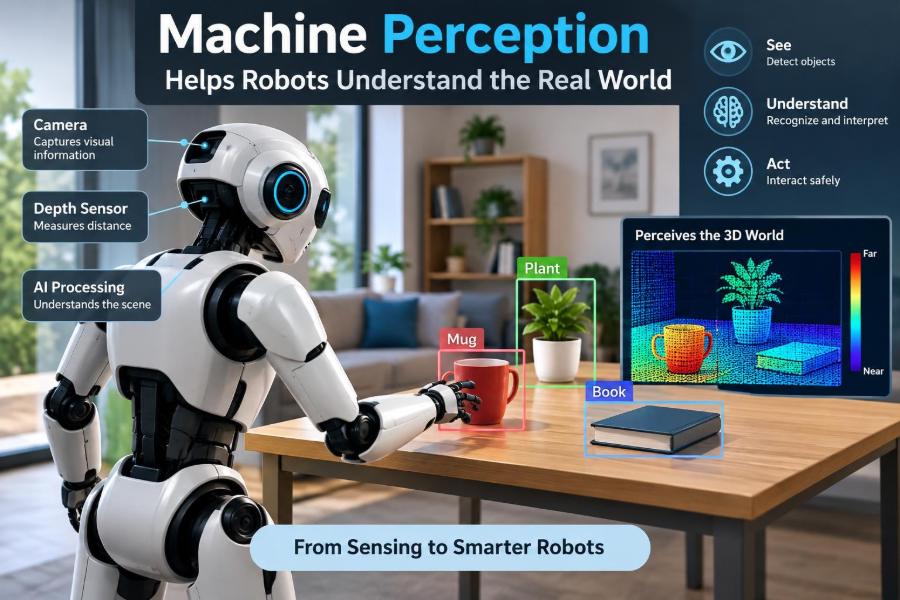
A camera records pixels, not objects. A depth sensor returns distance measurements, not a map of safe places to drive. Perception is the interpretation layer that converts measurements into concepts useful for a task: a graspable cup, an open doorway, a moving person, or an uncertain obstacle.
This distinction matters because correct labels alone are not enough. A robot may identify a box correctly yet still fail if it does not know the box’s pose, size, surface friction, or whether another object blocks its path.
🧠 The World Is Partly Hidden
Robots must reason from incomplete observations. One side of an object may be occluded, lighting can conceal edges, and sensor views change as the robot moves. This is sometimes called the partial observability problem.
A useful system therefore maintains estimates rather than treating every observation as complete truth. If a robot loses sight of a person behind a shelf, it should account for the possibility that the person may reappear rather than assuming the aisle is empty.
📷 Cameras Provide Rich but Ambiguous Clues
RGB cameras are inexpensive and capture texture, color, text, and visual context. They help distinguish a banana from a yellow tool handle, read a label, or recognize that a clear glass sits on a table.
But an image loses depth when a three-dimensional scene is projected onto a flat sensor. A small nearby object can resemble a large distant one. Reflections, darkness, motion blur, and exposure changes can also produce misleading appearances.
📏 Depth Sensing Adds Geometry
Depth cameras, stereo camera pairs, and lidar systems estimate distance to surfaces. Their measurements help robots build local maps, segment objects from backgrounds, and plan collision-free motion.
Each technology has failure modes. Stereo methods need visible texture; structured-light devices can struggle outdoors in strong sunlight; lidar may have difficulty with certain shiny, transparent, or very dark materials. Geometry is powerful, but it is not automatically complete.
🛰️ Lidar Made Mapping More Practical
Lidar sends out laser pulses and measures returns, creating a cloud of points in space. For mobile robots, its main contribution is often dependable geometric structure over a useful range, particularly where lighting changes would trouble a camera.
Point clouds are sparse compared with images, however. A lidar may outline a chair’s legs without revealing its color, material, or whether a thin hanging cable lies between scans. Strong systems use lidar as one source of evidence rather than a universal answer.
🎛️ Sensor Fusion Reduces Blind Spots
Sensor fusion combines multiple sensor streams to produce an estimate that is more useful than any single stream. A camera can recognize a pedestrian, lidar can estimate the person’s position, and wheel encoders can estimate the robot’s own motion between observations.
Fusion is not merely stacking data together. Measurements must be time-aligned, calibrated to a common coordinate frame, and assigned appropriate confidence. A delayed camera frame can be actively dangerous when a robot is moving quickly.
| Sensor source | Strongest contribution | Common limitation |
|---|---|---|
| Camera | Appearance, texture, semantics | Lighting and depth ambiguity |
| Lidar or depth sensor | Shape and distance | Reflective or transparent surfaces |
| IMU | Rapid rotation and acceleration cues | Drift over time |
| Tactile sensor | Contact, pressure, slip | Only senses what is touched |
| Microphone | Events such as speech or impacts | Noise and source ambiguity |
🧭 Localization Answers “Where Am I?”
Before a robot can place observations on a map, it must estimate its own position and orientation. This process is called localization. Orientation matters just as much as location: a map is not useful if the robot does not know which way it faces.
Wheel odometry provides a running estimate from wheel turns, but small errors accumulate. Cameras and lidar can compare current features with a known map or previous observations to correct that drift.
🗺️ SLAM Builds a Map While Using It
Simultaneous localization and mapping, usually shortened to SLAM, tackles a circular problem: the robot needs a map to locate itself, yet needs a location estimate to build a map. SLAM resolves this by continuously updating both estimates together.
A robot vacuum mapping rooms is a familiar example. More demanding versions support inspection robots in industrial sites, robots in unfamiliar buildings, and machines operating where satellite positioning is unavailable or unreliable.
🔁 Loop Closure Corrects Accumulated Error
Imagine walking around a large building while estimating every step from memory. By the time you return to the entrance, small errors may place it several meters away from where you started. Robots have the same problem.
Loop closure occurs when the system recognizes a previously visited place. It can then reconcile old and new estimates, reducing drift across the map. False loop closures are risky, so systems need strong geometric and contextual checks before making a correction.
🏷️ Object Detection Finds Things Worth Acting On
Object detection identifies categories and locations, often as boxes in an image or clusters in 3D space. It lets a robot ask practical questions: where is the tote, which shelf contains the target, and is a person near the work area?
Detection is task-dependent. A recycling robot may need to separate material classes. A hospital courier robot may care less about object names than about people, doorways, carts, and reachable controls.
🧩 Segmentation Gives Objects Their Boundaries
Detection says that a mug is in a region. Segmentation assigns pixels or points to specific objects or surface categories. This finer representation is valuable when a robot must choose an exact grasp point or stay within a drivable corridor.
Semantic segmentation groups by class, such as floor, wall, person, and table. Instance segmentation distinguishes individual members of a class, such as two separate cups touching on a counter.
🧱 Scene Understanding Connects Objects to Structure
Robots need relationships as well as labels. A scene model can encode that the cup is on the tray, the tray is on a table, and the table blocks a particular route. This structure supports more sensible behavior than a collection of isolated detections.
Context also helps resolve ambiguity. A flat rectangle near a doorway may be a mat, while the same shape high on a wall may be a sign. Context should guide inference, not override direct evidence when the evidence disagrees.
📐 Pose Estimation Makes Manipulation Possible
For manipulation, knowing an object is present is only the first step. The robot needs its pose: position and orientation in three dimensions. A wrench angled toward a bin and a wrench lying flat may require entirely different grasps.
Pose estimation can use object models, depth observations, key visual features, or learned methods. It becomes hard with symmetrical objects, clutter, occlusion, and deformable items such as clothing or cables.
✋ Touch Closes the Gap Between Guessing and Knowing
Vision can predict that a gripper is aligned with a handle, but contact reveals whether the grasp actually succeeded. Force-torque sensors, pressure arrays, joint torque estimates, and tactile skins provide this feedback.
Touch is especially helpful for transparent, reflective, and occluded objects. A robot can gently probe a surface, detect contact, and adjust instead of continuing a motion based on a mistaken visual estimate.
🧤 Active Perception Changes the Viewpoint
A passive system waits for information. An active perception system moves to obtain better evidence: it turns a wrist camera, circles a pallet, illuminates a dark shelf, or nudges an object carefully to see whether it is loose.
This is a major insight in robotics. Perception and action form a loop. When uncertainty is high, the best next action may be one that improves observation rather than one that immediately pursues the final task.
🧪 Self-Supervised Learning Finds Structure in Unlabelled Data
Hand-labeling images and point clouds is expensive, and labels rarely cover every workplace, room, weather condition, or object variation. Self-supervised learning uses naturally available structure in data—such as adjacent video frames or matching views—to learn representations without a human label for every sample.
These representations can make later task training more data-efficient. They do not remove the need for evaluation: a model can learn visual regularities that are useful in one environment and misleading in another.
🧠 Foundation Models Bring Broad Visual Knowledge
Large pretrained vision and language models can recognize broad concepts and associate language with visual patterns. For robots, this opens possibilities such as finding an object described in ordinary language or grouping unfamiliar items by function.
Broad knowledge does not equal operational reliability. A robot still needs calibrated geometry, task constraints, and safeguards. A fluent language description cannot establish that an object is reachable, safe to grasp, or appropriate to manipulate.
🗣️ Language Can Guide, Not Replace, Perception
Language is useful for setting goals: “bring the red container from the lower shelf” carries information about color, object type, and spatial relation. It can also help a system ask for clarification when multiple objects match.
Grounding language means connecting words to sensor observations and actions. The phrase “the one beside the printer” must be resolved against the robot’s current map, not guessed from generic knowledge.
🏃 Motion Reveals What Still Images Miss
Motion creates clues about depth, object boundaries, and intent. As a robot moves, nearby surfaces shift faster across its image than distant surfaces, an effect known as motion parallax. Tracking also helps distinguish a person walking from a poster of a person.
Predicting motion matters in shared spaces. A robot should not simply react to the current location of a forklift or pedestrian; it should consider plausible short-term paths and preserve a safety margin.
🌦️ Domain Shift Is the Real-World Test
A model trained in a bright, tidy facility may perform poorly in a dim warehouse with dust, seasonal clothing, new packaging, or different camera placement. This mismatch between training conditions and deployment conditions is called domain shift.
The practical lesson is to test across variation, not just average conditions. Useful test sets include glare, shadows, partially blocked sensors, crowded layouts, rare object poses, and ordinary changes such as a moved cart.
🪞 Transparent and Reflective Objects Remain Difficult
Glass, polished metal, mirrors, and clear plastic challenge common sensors because light may pass through, scatter, or reflect from unexpected directions. A depth sensor can report a background surface instead of the glass door in front of it.
Robots can reduce this risk through multi-view observation, tactile confirmation, conservative motion, and sensor combinations. There is no single correction that works for every material and viewing angle.
🌑 Lighting Changes Can Break Familiar Cues
Shadows may resemble holes; glare may erase boundaries; automatic exposure can change the apparent color of an object. These are not edge cases for robots operating near windows, loading bays, or shifting indoor lights.
Robust systems use exposure-aware imaging, depth and geometry where appropriate, training data with realistic lighting variation, and policies that slow down or request help when visual confidence falls below an acceptable level.
❓ Uncertainty Must Be Represented Explicitly
A perception system should distinguish “I see an obstacle” from “I may see an obstacle.” Confidence scores alone can be misleading if they are poorly calibrated, meaning a reported confidence does not match actual reliability.
For safety-relevant behavior, uncertainty should influence planning. A robot might take a wider route around an ambiguous region, pause for another observation, or hand control to an operator rather than treating a fragile prediction as fact.
🛑 Perception Is a Safety Function
When people share space with robots, perception supports collision avoidance, speed control, protective stopping, and sensible interaction. The right response depends on the task and environment; a slow indoor service robot and a high-payload industrial machine face different hazards.
Safety cannot rest on perception alone. It also depends on physical design, limits on force and speed, supervisory controls, independent protective measures, testing, and clearly defined operating conditions.
🧰 Simulation Helps, but Reality Gets the Final Vote
Simulators can generate varied layouts, object poses, and sensor conditions quickly. They are useful for early algorithm development, regression testing, and testing scenarios that would be costly or unsafe to stage repeatedly.
Yet simulated texture, contact, lighting, and sensor artifacts may not match reality closely enough. Simulation-to-real transfer works best when teams validate on real hardware early and deliberately model the variations that matter to the task.
📊 Evaluate the Whole Robot Loop
A perception benchmark may report classification or localization accuracy, but deployment needs broader questions. Does the robot complete the task? Does it recover gracefully when an object is hidden? Does it become cautious at the right time rather than stopping needlessly?
- Measure performance across normal and difficult conditions.
- Track failures by cause: sensing, calibration, model behavior, planning, or mechanics.
- Test temporal stability, not just individual frames.
- Include recovery behavior after uncertain or incorrect observations.
- Review near misses, because they often reveal weak assumptions before a serious failure occurs.
🔧 Calibration Is an Engineering Discipline
Even an excellent perception model suffers if a camera is mounted slightly differently than expected or if the transformation between lidar and robot arm coordinates is wrong. Calibration defines the geometric relationships among sensors, joints, and tools.
Calibration can drift through vibration, temperature changes, maintenance, or accidental bumps. Teams should treat it as a monitored operational condition, with checks that reveal when sensor alignment no longer supports required precision.
🧹 Data Quality Often Beats Model Novelty
Many practical perception failures originate in mislabeled data, narrow examples, inconsistent sensor settings, or unobserved edge cases. A more elaborate model cannot reliably infer distinctions absent from the information it receives.
Good data practice includes recording representative failures, documenting collection conditions, preserving difficult examples, and separating training, tuning, and final evaluation data in a way that avoids accidental overlap.
🧑🔧 Human Oversight Has a Defined Role
Human operators are valuable when a system encounters ambiguity, unusual objects, or conditions outside its approved operating envelope. The goal is not to use people as a hidden patch for predictable design weaknesses.
Interfaces should show what the robot detected, where it believes objects are, and why it paused when possible. Clear feedback helps an operator correct a situation and gives engineers evidence for improving the next version.
⚖️ Perception Choices Depend on the Task
There is no best sensor suite or model in the abstract. A robotic arm sorting known parts in a fixture needs different perception than an agricultural machine navigating uneven rows or a domestic robot handling varied household clutter.
Start with decisions the robot must make, the tolerated error, the speed of change, and the consequences of being wrong. Then select sensing, computation, and fallback behavior that match those requirements.
🧭 A Practical Design Workflow
- Define the task in observable terms, including objects, surfaces, motions, and success conditions.
- List uncertainty sources: lighting, occlusion, changing inventory, dynamic people, sensor noise, and calibration drift.
- Choose complementary sensors based on those risks rather than on novelty.
- Build a simple end-to-end baseline before adding complexity.
- Test failures in representative environments, then improve the weakest link.
- Specify safe fallback actions for missing, conflicting, or low-confidence observations.
This workflow keeps perception connected to operations. It also prevents a common mistake: optimizing an isolated recognition score while overlooking whether the robot can act safely and repeatably.
🔮 The Next Advance Is Better Closed-Loop Understanding
Future systems will likely become more capable by combining richer learned representations with geometry, memory, contact feedback, and deliberate information-gathering actions. A robot that can remember a room, recognize uncertainty, and change its viewpoint has a more useful form of intelligence than one that merely labels images.
Progress will also depend on reliability engineering. The most valuable perception systems are not those that appear confident in every situation, but those that identify their limits and respond appropriately.
🦾 The Core Takeaway: Perception Must Support Action
Machine perception helps robots understand the real world by turning diverse, imperfect sensor signals into estimates that support navigation, manipulation, and safe interaction. Cameras, lidar, tactile sensing, mapping, learned visual models, and language each contribute different evidence.
The central principle is simple: a robot does not need a perfect internal copy of the world. It needs a sufficiently accurate, timely, and uncertainty-aware understanding for the action it is about to take—and a safe way to respond when that understanding is incomplete.
The strongest robots treat perception as an ongoing conversation between sensing, reasoning, and action, not as a one-time act of recognition. That is what helps them move from controlled demos toward useful work in the changing, cluttered world people actually inhabit. 🤖👁️🦾